
Lower body pull exercises are movements that train the posterior chain, especially the glutes, hamstrings, calves, and spinal erectors, through hip-dominant patterns like hinging, curling, and hip extension. They matter because most people do plenty of lower body pushing with squats, lunges, and step-ups, but often undertrain the muscles that drive sprinting, jumping, lifting, and deceleration.
Guidance from the American College of Sports Medicine, the World Health Organization, and the National Strength and Conditioning Association supports regular muscle-strengthening work and highlights the importance of posterior-chain training for overall performance.
In simple terms, lower body pull exercises usually involve driving the hips back, loading the hamstrings and glutes, and then extending the hips to stand, swing, or pull. That makes them different from lower body push exercises, which are usually more knee-dominant and quad-focused. Research indexed in PubMed suggests that movements like the Romanian deadlift and glute-ham raise are especially effective choices when your goal is to strengthen the back side of the lower body.
What Are Lower Body Pull Exercises?
Lower body pull exercises are exercises where the main effort comes from the back side of the lower body rather than the front. That usually means the glutes and hamstrings are doing most of the work while the hips move through flexion and extension.
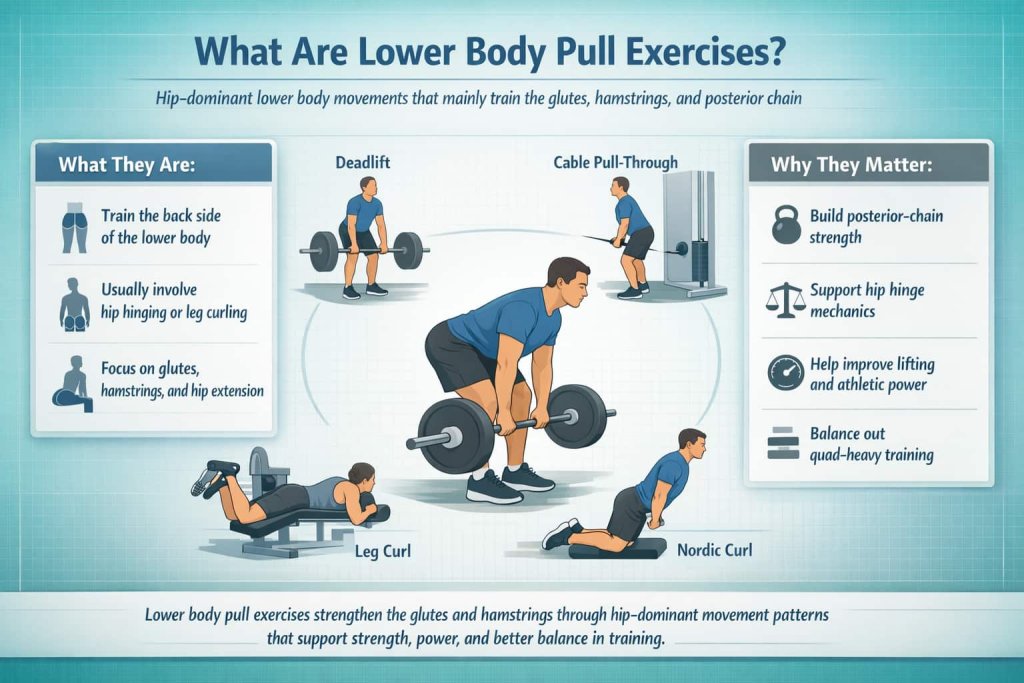
Deadlift variations, pull-throughs, leg curls, and Nordic-style hamstring work all fit this category. Coaching material from the National Strength and Conditioning Association describes the deadlift as a key pattern for training hip extension and posterior-chain performance.
Lower Body Pull vs. Lower Body Push
Understanding this difference makes exercise selection much easier.
Lower body pull exercises are usually:
- Hip-dominant
- Posterior-chain focused
- Centered on hamstrings, glutes, calves, and back extensors
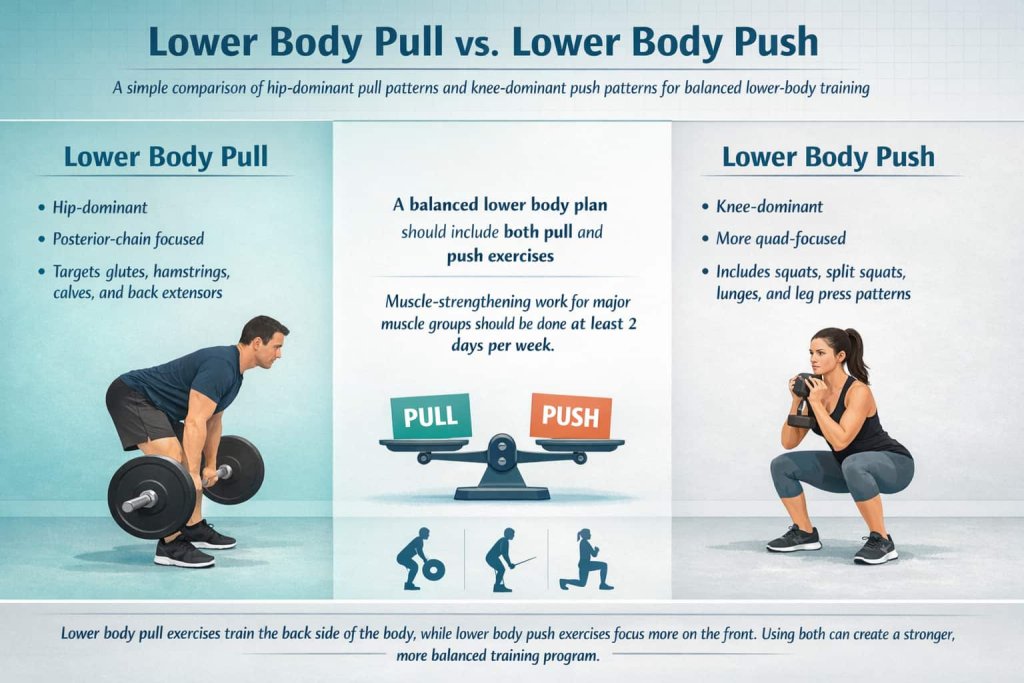
Lower body push exercises are usually:
- Knee-dominant
- More quad-focused
- Centered on squats, split squats, lunges, and leg press patterns
A balanced lower body program should include both. The World Health Organization recommends muscle-strengthening activities involving major muscle groups on 2 or more days per week, which is a useful minimum target for structuring your weekly training.
10 Best Lower Body Pull Exercises
Lower body pull exercises help strengthen the muscles on the back side of your body, especially the glutes, hamstrings, and calves. These 10 exercises can improve strength, power, balance, and overall lower-body performance.
1. Romanian Deadlift
How to do it:
- Stand tall with a barbell or dumbbells in front of your thighs.
- Keep a soft bend in your knees.
- Push your hips back while keeping the weights close to your legs.
- Lower until you feel a strong stretch in your hamstrings without losing a neutral spine.
- Drive your hips forward to return to standing.
Why it works:
The Romanian deadlift is one of the best pure hip-hinge exercises for building hamstring and glute strength. It keeps tension on the posterior chain through a long range of motion and teaches the exact movement pattern many people need for better lifting mechanics.
Muscles worked:
Hamstrings, glutes, spinal erectors, adductors, forearms, and core stabilizers.
Trainer Tip:
Think “hips back, ribs down, weights close.” Do not turn it into a squat by letting the knees drift too far forward.
2. Conventional Deadlift
How to do it:
- Stand with your feet about hip-width apart and the bar over midfoot.
- Hinge down and grip the bar just outside your legs.
- Set your back, brace your trunk, and pull the slack out of the bar.
- Push through the floor and stand up while keeping the bar close.
- Lock out by extending the hips, then lower with control.
Why it works:
The conventional deadlift trains the entire lower-body pull pattern under heavier loading than most other exercises. It builds full-body strength, but its lower-body contribution is centered on hip extension and posterior-chain force production.
Muscles worked:
Glutes, hamstrings, spinal erectors, lats, adductors, traps, forearms, and core.
Trainer Tip:
Keep the bar close from start to finish. If the bar drifts forward, the lift usually gets harder on the back and less efficient overall.
3. Single-Leg Romanian Deadlift
How to do it:
- Stand on one leg with a dumbbell in the opposite hand or one in each hand.
- Keep a soft bend in the standing knee.
- Hinge at the hip while the free leg extends behind you.
- Lower until your torso and back leg form a long line.
- Return to standing by driving through the planted foot.
Why it works:
This variation adds balance, hip-stability demand, and side-to-side control to the classic hinge pattern. It is excellent for exposing asymmetries and teaching the glute-hamstring connection on each leg independently.
Muscles worked:
Glutes, hamstrings, adductors, foot and ankle stabilizers, and core.
Trainer Tip:
Keep your hips square to the floor. A slight reach back with the non-working leg helps you stay stable and controlled.
4. Glute-Ham Raise
How to do it:
- Set up on a glute-ham developer with your feet secured.
- Start tall with your hips extended and torso upright.
- Lower your body under control by extending at the knees and hips.
- Pull yourself back up using the hamstrings and glutes.
- Finish in a straight, braced position.
Why it works:
The glute-ham raise is a high-value hamstring and glute exercise because it combines knee flexion with hip extension demands. Research indexed in PubMed comparing hamstring exercises found the glute-ham raise among the strongest options for hamstring activity.
Muscles worked:
Hamstrings, glutes, calves, and spinal stabilizers.
Trainer Tip:
If the full version is too hard, shorten the range or use light assistance. Quality reps matter more than forcing full depth.
5. Nordic Hamstring Curl
How to do it:
- Kneel on padding and secure your ankles under a stable anchor.
- Keep your body tall from knees to shoulders.
- Lower yourself forward slowly under control.
- Catch yourself with your hands near the bottom if needed.
- Push lightly off the floor and return to the start.
Why it works:
The Nordic hamstring curl is one of the best eccentric hamstring exercises available. The latest PubMed-indexed umbrella review found benefits for sprint performance, eccentric strength, muscle architecture, and hamstring injury prevention, making it a standout option for athletes and active adults who can tolerate the difficulty.
Muscles worked:
Hamstrings primarily, with support from glutes and trunk stabilizers.
Trainer Tip:
Start with low volume. This exercise creates a strong training stimulus and often causes soreness when introduced too aggressively.
6. Good Morning
How to do it:
- Place a barbell across your upper back as you would for a back squat.
- Stand tall with feet about hip- to shoulder-width apart.
- Slightly bend your knees and hinge your hips back.
- Lower your torso while keeping your spine neutral.
- Drive the hips forward to stand back up.
Why it works:
The good morning trains the hip hinge with the load on the back rather than in the hands. It is useful for lifters who want more posterior-chain volume and better control through trunk position and hip loading.
Muscles worked:
Hamstrings, glutes, spinal erectors, adductors, and core.
Trainer Tip:
Use modest loads until your hinge pattern is very solid. This is a technique-sensitive exercise, not one to rush.
7. Cable Pull-Through
How to do it:
- Attach a rope handle to a low cable pulley.
- Face away from the machine and step forward so the cable passes between your legs.
- Hold the rope, brace your core, and hinge your hips back.
- Drive your hips forward until you stand tall.
- Squeeze your glutes at the top without overextending your low back.
Why it works:
The cable pull-through is a beginner-friendly lower body pull exercise that teaches hip extension without heavy spinal loading. It is especially useful for people learning the hinge pattern before moving to deadlifts and Romanian deadlifts.
Muscles worked:
Glutes, hamstrings, adductors, and core.
Trainer Tip:
Let the hips do the work. Do not turn the movement into a squat by sitting too low.
8. Kettlebell Swing
How to do it:
- Stand with feet slightly wider than hip width and a kettlebell in front of you.
- Hinge and hike the kettlebell back between your legs.
- Snap the hips forward to drive the kettlebell to chest height.
- Let it swing back naturally while maintaining a strong hinge.
- Repeat with crisp, controlled reps.
Why it works:
The kettlebell swing is a fast hip-hinge exercise that builds power, conditioning, and posterior-chain coordination. A study indexed in PubMed on kettlebell swing loading found increasing mass raised hip and trunk demands while avoiding excessive knee moments, which helps explain why swings are such a useful lower body pull pattern.
Muscles worked:
Glutes, hamstrings, spinal erectors, lats, forearms, and core.
Trainer Tip:
Think “hinge, not squat.” The kettlebell should float because of hip speed, not because you lift it with your arms.
9. Stability Ball Leg Curl
How to do it:
- Lie on your back with your heels on a stability ball.
- Lift your hips into a bridge.
- Pull the ball toward you by bending your knees.
- Pause briefly, then extend your legs back out slowly.
- Keep your hips lifted the whole time if possible.
Why it works:
This combines hamstring knee flexion with glute bridge stability. It is a strong bodyweight option for home workouts and teaches the hamstrings to work while the hips stay active.
Muscles worked:
Hamstrings, glutes, calves, and core stabilizers.
Trainer Tip:
If keeping the hips high is too hard, do partial reps first or lower the hips slightly until you build strength.
10. Seated or Lying Leg Curl
How to do it:
- Adjust the machine so the pad sits comfortably above your ankles.
- Set your body firmly against the bench or back support.
- Curl the weight through a smooth, controlled range.
- Pause briefly at the contracted position.
- Lower slowly without letting the stack slam down.
Why it works:
Machine leg curls directly train knee flexion, which complements hinge-based exercises well. They are useful for adding targeted hamstring volume without the technical demands of a deadlift pattern.
Muscles worked:
Hamstrings primarily, with some calf involvement depending on ankle position.
Trainer Tip:
Control the lowering phase. The eccentric portion is where a lot of the training value happens.
Benefits of Lower Body Pull Exercises
Lower body pull exercises can help you:
- Build stronger glutes and hamstrings
- Improve hip hinge mechanics
- Support sprinting, jumping, and change of direction
- Balance out quad-heavy training
- Improve lifting strength for deadlift-based patterns
- Add eccentric hamstring work that may help reduce hamstring injury risk in sports settings
The injury-prevention angle is especially relevant for Nordic hamstring work. A 2024 umbrella review indexed in PubMed found positive effects on sprint performance, eccentric strength, muscle activation, and muscle architecture, while also reporting hamstring injury-prevention benefits in the included literature.
Which Lower Body Pull Exercises Are Best for Beginners?
For most beginners, the best starting options are:
- Cable pull-through
- Romanian deadlift with light dumbbells
- Stability ball leg curl
- Machine leg curl
- Single-leg Romanian deadlift with bodyweight support if needed
These options are easier to learn than conventional deadlifts, Nordic hamstring curls, or heavy good mornings. They let you build hinge awareness and hamstring strength without needing advanced technique right away.
Sample Lower Body Pull Workout
Option 1: Strength-Focused
- Romanian deadlift: 3 sets of 6 to 8 reps
- Cable pull-through: 3 sets of 10 to 12 reps
- Leg curl: 3 sets of 10 to 15 reps
- Single-leg Romanian deadlift: 2 to 3 sets of 8 reps per side
Option 2: Athletic Posterior-Chain Session
- Conventional deadlift: 3 to 5 sets of 3 to 5 reps
- Kettlebell swing: 3 sets of 10 to 15 reps
- Nordic hamstring curl: 2 to 3 sets of 4 to 6 reps
- Glute-ham raise or leg curl: 2 to 3 sets of 8 to 12 reps
For general health, public guidance from the American College of Sports Medicine and the World Health Organization supports including major-muscle-group strengthening at least 2 days per week.
Form Tips to Keep Lower Body Pull Exercises Safe
A few basics matter more than fancy cues:
- Keep a neutral spine rather than rounding aggressively under load
- Let the hips move back in hinge exercises
- Keep the load close to your body when possible
- Progress gradually instead of jumping to heavy weights too soon
- Stop if you feel sharp pain, dizziness, or loss of control
These exercises can be very effective, but technique and load selection matter. If you have a history of back pain, recent hamstring injury, balance problems, or recent surgery, it is smart to get individual guidance before starting a hard pulling program.
Common Mistakes
Turning Every Hinge Into a Squat
When the knees move too far forward, the exercise becomes more quad-dominant and less of a true pull pattern.
Chasing Heavy Weight Before Technique
This often shows up as rounding, rushing, and losing tension. Build the pattern first.
Ignoring Eccentric Control
Exercises like Romanian deadlifts, Nordic hamstring curls, and leg curls work best when you control the lowering phase.
Skipping Unilateral Work
Single-leg patterns can reveal gaps in balance, hip control, and side-to-side strength.
Doing Only Deadlifts
Deadlifts are excellent, but knee-flexion hamstring work like curls and Nordics adds something different and valuable.
Frequently Asked Questions
What Muscles Do Lower Body Pull Exercises Work?
They mainly work the glutes, hamstrings, calves, adductors, and spinal erectors. Some exercises also involve the lats, traps, forearms, and core for support.
Are Deadlifts Lower Body Pull Exercises?
Yes. Deadlifts are one of the main lower body pull patterns because they are hip-dominant and heavily involve the posterior chain.
Are Hamstring Curls Considered Lower Body Pull Exercises?
Yes. They are a lower body pull exercise because the hamstrings actively flex the knee to pull the load.
How Often Should I Train Lower Body Pull Exercises?
Most people do well with 1 to 3 lower body pull sessions per week depending on overall volume, recovery, and training experience. Public-health guidance supports resistance training at least 2 days per week for major muscle groups.
What Is the Best Lower Body Pull Exercise for Glutes and Hamstrings?
The Romanian deadlift is one of the best all-around options. For direct hamstring work, the Nordic hamstring curl, glute-ham raise, and leg curl are also excellent choices.
Can Beginners Do Nordic Hamstring Curls?
Yes, but they should usually start with regressions, low volume, and plenty of control. It is an advanced exercise for most people.
Do I Need Both Push and Pull Exercises for Legs?
Yes. Push and pull exercises train different movement patterns and muscle emphasis. A balanced leg program should include both.
Conclusion
Lower body pull exercises deserve a clear place in almost every strength program. They help build stronger glutes, hamstrings, and hips, improve hinge mechanics, and support better performance in lifting, sprinting, and everyday movement. Start with a few solid basics, focus on control, and progress gradually. That approach usually works far better than trying to force advanced exercises too early.
References
- PubMed – The Effects of Nordic Hamstring Exercise on Performance and Injury in the Lower Extremities
- PubMed – Effects of Kettlebell Mass on Lower-Body Joint Kinetics During a Kettlebell Swing Exercise
- NSCA Coach – Exercise Progressions for Resuming Strength Training Following Posterior Chain Muscle Injury
- WHO Guidelines on Physical Activity and Sedentary Behavior