
A medium orange has about 62 calories. That makes oranges a relatively low-calorie fruit that also gives you fiber, vitamin C, water, and several helpful micronutrients in one easy snack. According to the USDA and USDA SNAP-Ed, raw orange contains about 47 calories per 100 grams, and one medium orange weighing about 131 grams provides about 62 calories.

Understanding orange calories is useful because many people want a fruit that feels fresh and satisfying without adding too many calories. Oranges often fit that goal well, especially when eaten whole instead of as juice, because the whole fruit keeps its fiber. The American Diabetes Association notes that whole fruit is generally a better choice than juice when you want the benefits of the fruit itself, including fiber.
How many calories are in an orange by size?
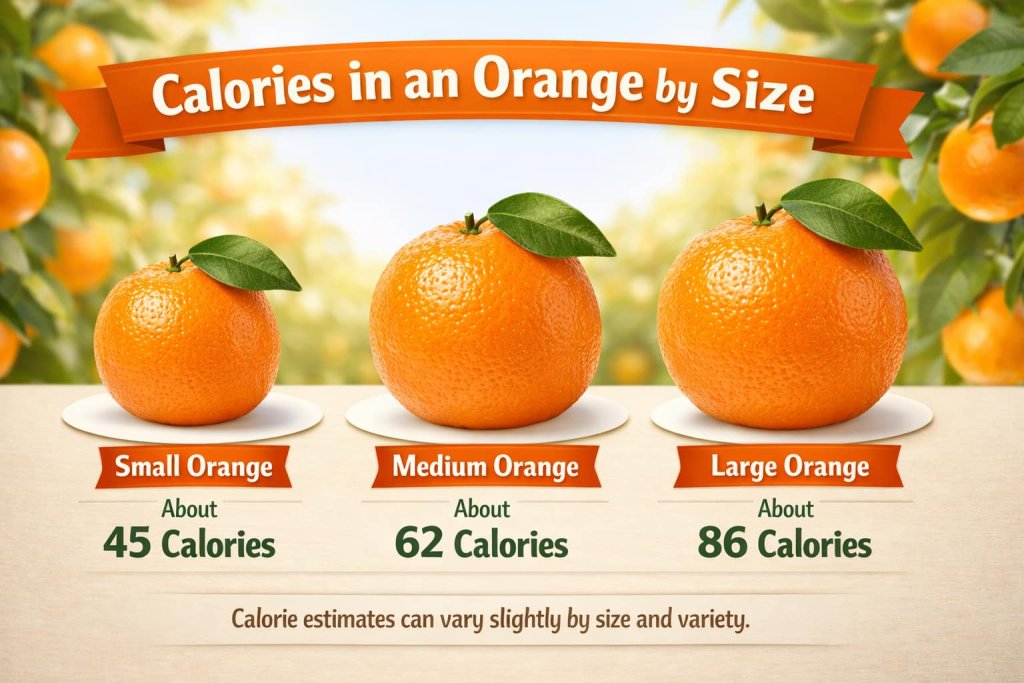
Orange calories vary mostly by size.
- Small orange: about 45 calories
- Medium orange: about 62 calories
- Large orange: about 86 calories
These values are useful estimates for everyday tracking. The exact number can vary slightly depending on the orange’s size, variety, and edible portion.
Nutrition profile of a medium orange
| Nutrient | Amount in 1 medium orange |
|---|---|
| Calories | 62 |
| Carbohydrates | 15.4 g |
| Fiber | 3.1 g |
| Sugars | 12.2 g |
| Protein | 1.2 g |
| Fat | 0.2 g |
| Vitamin C | about 70 mg |
| Potassium | about 237 mg |
Here is a practical nutrition snapshot for one medium orange, based on USDA food data. Minor differences can happen depending on variety and exact size, but this gives a reliable everyday estimate.
Orange nutrition profile per 100 grams
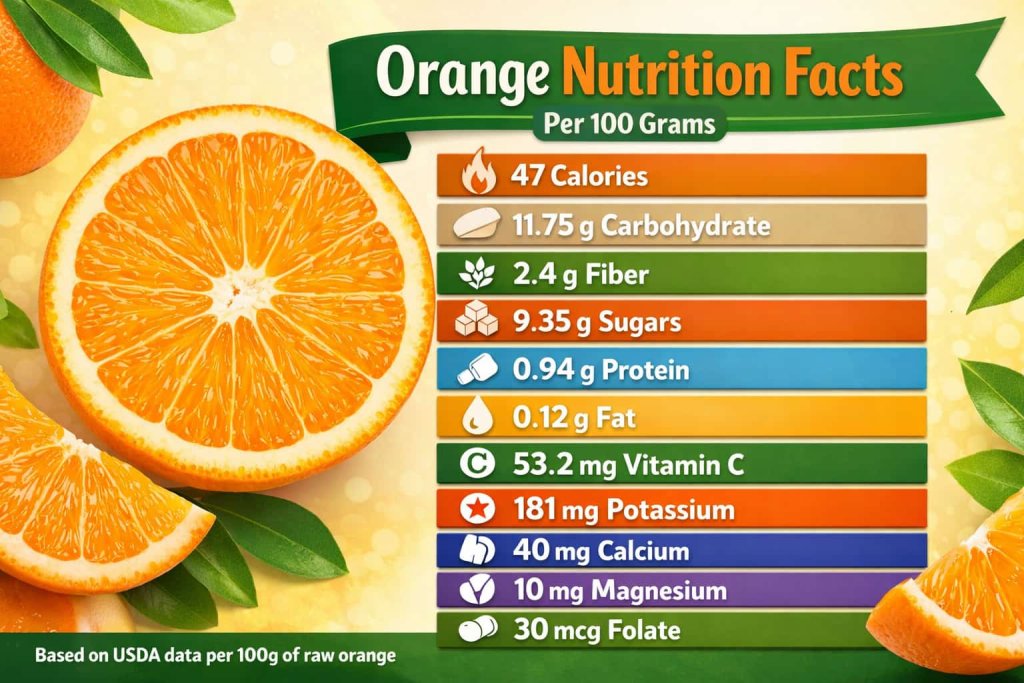
Using USDA food composition data, 100 grams of raw orange provides about:
- 47 calories
- 11.75 g carbohydrate
- 2.4 g fiber
- 9.35 g sugars
- 0.94 g protein
- 0.12 g fat
- 53.2 mg vitamin C
- 181 mg potassium
- 40 mg calcium
- 10 mg magnesium
- 30 mcg folate
This is a helpful reference when you want to compare oranges with other fruits by weight.
Is an orange good for weight management?
Yes, for many people, oranges are a smart fruit for weight management. They are naturally portioned, relatively low in calories, and high in water. A medium orange gives you sweetness and volume for about 62 calories, which can make it easier to choose over higher-calorie snacks.
Why an orange can be a smart snack choice
A medium orange gives you sweetness, water, and fiber for about 62 calories. That often makes it a more filling choice than many processed snacks with a similar or higher calorie cost. For example, swapping a pastry, candy bar, or sugary drink for a whole orange can help lower overall calorie intake while still giving you something sweet and refreshing. The orange is not a special weight-loss food, but it can be a practical lower-calorie choice that supports a balanced eating pattern.
Whole orange vs orange juice for calorie control
A whole orange is usually the better choice when fullness is the goal. Juice is easier to drink quickly and contains much less fiber than the intact fruit. Even when the calories seem similar, juice is usually less filling than eating the orange itself. The American Diabetes Association recommends whole fruit over juice for this reason.
Key nutrients in orange
Vitamin C
Vitamin C is the standout nutrient in oranges. The NIH Office of Dietary Supplements identifies citrus fruits as major dietary sources of vitamin C. A medium orange can provide a large share of the daily vitamin C adults need.
Fiber
A medium orange gives about 3 grams of fiber. That is one reason whole oranges are more filling than juice and often fit well into everyday healthy eating and weight-management plans.
Potassium
Oranges also contribute potassium. Potassium supports normal muscle and nerve function, but some people with kidney disease may need to monitor how much they get. The National Institute of Diabetes and Digestive and Kidney Diseases advises adults with chronic kidney disease to keep potassium in their target range and to limit serving sizes of foods high in potassium when needed.
Folate and other micronutrients
Oranges provide smaller but useful amounts of folate, calcium, and magnesium. These do not usually get as much attention as vitamin C, but they add to the fruit’s overall nutrition value.
What affects the calorie count in an orange?
Several things can change the number slightly.
Size
A small orange has fewer calories than a large one. This is the main reason calorie counts vary from one orange to another.
Variety
Different orange varieties can vary a little in water content, sweetness, and edible portion size. In practice, the difference is usually modest unless the fruit is much larger or smaller than average.
Whether you eat it whole or as juice
A whole orange and a glass of orange juice are not the same nutritionally. The whole fruit keeps fiber, while juice is less filling and easier to consume in larger amounts.
Orange type can change the calories
Not all oranges are the same size. A small mandarin or clementine usually has fewer calories than a medium orange, while a large navel orange may have more. In everyday use, the biggest reason calorie counts differ is usually the edible size of the fruit, not that one type of orange is dramatically different from another.
Are oranges high in sugar?
Oranges do contain natural sugar, but they also contain fiber and water. A medium orange has about 12 grams of natural sugar, which comes packaged with nutrients and fiber. That is very different from foods with lots of added sugar and little nutrition. Whole fruit can still fit into a balanced eating pattern for most people.
For people watching blood sugar, portion size still matters. One whole orange is often an easier choice to manage than juice because it is naturally portioned and contains fiber. Eating the fruit with a meal or pairing it with protein or healthy fat, such as yogurt or nuts, may also help make the snack feel more balanced.
Who should be a little more careful with oranges?
Most people can enjoy oranges without any problem, but a few groups may need extra caution.
People with acid reflux or GERD
The National Institute of Diabetes and Digestive and Kidney Diseases says acidic foods, including citrus fruits, can worsen symptoms in some people with GERD. If oranges seem to trigger burning, chest discomfort, or reflux, it may help to reduce the portion or avoid them when symptoms are active.
People with chronic kidney disease who need to limit potassium
Not everyone with kidney disease has to avoid oranges, but some people do need to watch potassium intake. NIDDK advises people with chronic kidney disease to follow their individual potassium goal and limit portions of potassium-containing foods when advised by their care team. Oranges and orange juice may need closer attention in a potassium-restricted eating plan.
People with oral allergy symptoms or fruit allergy
Fruit allergy is uncommon, but it can happen. The NHS notes that some people develop oral allergy syndrome, which can cause itching or irritation in the mouth and throat after eating raw fruits or vegetables. Severe food allergy symptoms need prompt medical attention.
Easy ways to enjoy oranges in a healthy diet
Oranges are simple to use in everyday meals and snacks:
- Eat one as a stand-alone snack
- Add orange segments to a yogurt bowl
- Pair an orange with nuts for a more filling snack
- Slice into a salad for extra freshness
- Use orange segments in a fruit bowl instead of drinking juice
For most people, the simplest approach is also the best: eat the orange whole. That keeps the fiber and usually helps with fullness more than juice does.
Fresh oranges vs packaged orange products
A fresh orange is usually the best reference point when you are thinking about calories and nutrition. Orange-flavored snacks, sweetened dried fruit, canned oranges in syrup, and many bottled orange drinks can have more added sugar and more calories than a plain whole orange. If you want nutrition closest to the fresh fruit, choose whole oranges or orange segments packed without added sugar.
FAQ
How many calories are in one orange?
A medium orange has about 62 calories. Smaller oranges have fewer, and larger oranges have more.
Is an orange low in calories?
Yes. Oranges are generally considered a low-calorie fruit, especially compared with many packaged snacks and desserts. Raw orange has about 47 calories per 100 grams.
Is orange good for weight loss?
Oranges can support a weight-loss plan because they are relatively low in calories and contain fiber and water. They are not a special fat-burning food, but they can be a smart snack choice in a balanced calorie-controlled diet.
Is orange juice the same as eating an orange?
No. A whole orange keeps its fiber, while juice usually contains much less fiber and is easier to consume quickly. Whole fruit is usually the better choice when you want more fullness.
Conclusion
A medium orange has about 62 calories, along with fiber, vitamin C, potassium, and other useful nutrients. For many people, oranges are a practical, refreshing fruit that fits well into weight-management and everyday healthy eating plans. The best choice is usually the whole fruit, not the juice, because it is more filling and keeps the fiber.
If you are building a healthier snack routine, a whole orange is one of the easiest places to start.
Sources/References
- USDA — FoodData Central
- USDA SNAP-Ed — Oranges
- American Diabetes Association — Best Fruit Choices for Diabetes
- NIH Office of Dietary Supplements — Vitamin C – Health Professional Fact Sheet
- National Institute of Diabetes and Digestive and Kidney Diseases — Healthy Eating for Adults with Chronic Kidney Disease
- National Institute of Diabetes and Digestive and Kidney Diseases — Eating, Diet, and Nutrition for GER and GERD
- NHS — Food allergy