
Trap exercises with dumbbells can absolutely help you build stronger, bigger traps when you train the muscle through more than one pattern, especially shrugs, rows, carries, reverse-fly variations, and lower-trap raises. That matters because the trapezius is not just the “upper traps” near your neck. It is a large upper-back muscle that helps move and stabilize your shoulder blades, supports neck and upper-back movement, and contributes to posture and shoulder control. Cleveland Clinic and StatPearls both describe the trapezius as a major muscle for shoulder-blade movement and upper-back function.
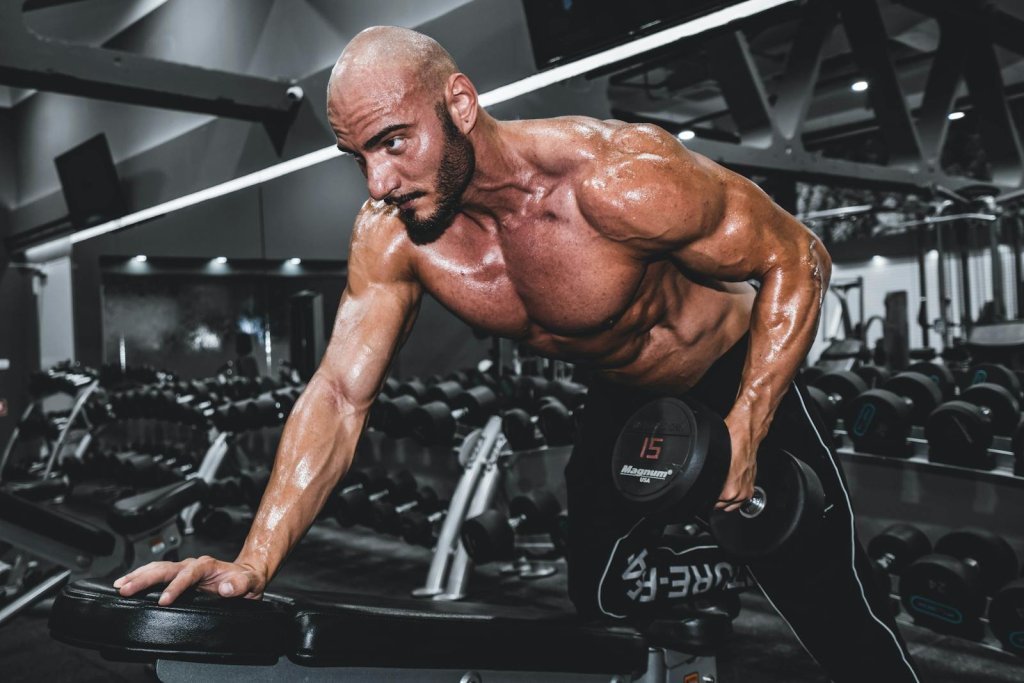
If your goal is better trap development, dumbbells are a smart tool because they are accessible, easy to scale, and useful for training the upper, middle, and lower portions of the traps from different angles. Research on scapular and periscapular exercise selection also suggests that body position and exercise choice affect how the trapezius works, which is one reason a good trap program should include more than shrugs alone, as noted in a PubMed-indexed systematic review.
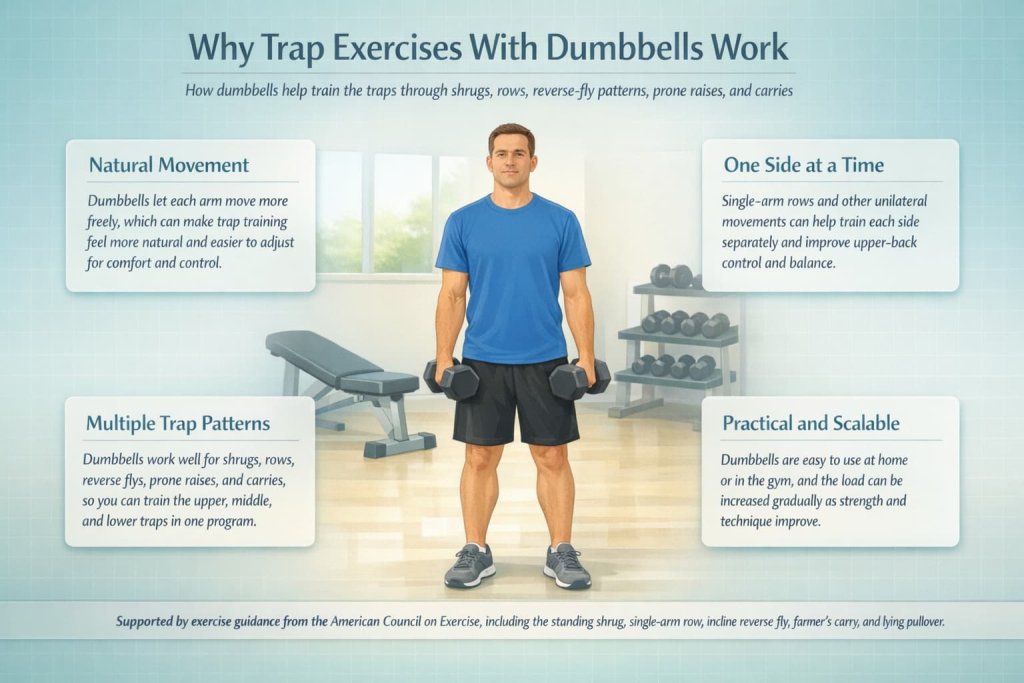
Why Trap Exercises With Dumbbells Work
Dumbbells work well for trap training because they let you move naturally, train one side at a time, and use several useful patterns in one program. That includes:
- Shrugging for upper-trap loading
- Rowing for mid-trap and upper-back strength
- Reverse-fly and prone raise patterns for mid- and lower-trap work
- Carries for trap tension, grip, and postural control
The American Council on Exercise directly supports several strong dumbbell options for this goal, including the standing shrug, single-arm row, incline reverse fly, farmer’s carry, and lying pullover.
13 Best Trap Exercises With Dumbbells
Build stronger, bigger traps with these 13 effective dumbbell exercises that train the upper, middle, and lower traps.
You will also learn proper form, muscles worked, and simple tips to train safely and get better results.
1. Dumbbell Shrug
Why it works: This is the most direct dumbbell move for loading the upper traps. The ACE standing shrug is one of the clearest official exercise-library options for trap-focused dumbbell training.
Muscles worked: Upper trapezius, levator scapulae, forearms, grip.
How to do it:
- Stand tall with a dumbbell in each hand at your sides
- Keep your arms straight and your chest tall
- Shrug your shoulders straight up with control
- Pause briefly at the top
- Lower slowly without rolling the shoulders
Trainer Tip: Think “up and controlled,” not “up and circle.” Rolling the shoulders usually adds motion without making the exercise better.
2. Seated Dumbbell Shrug
Why it works: Sitting reduces lower-body assistance and makes it easier to focus on the upper traps without swaying.
Muscles worked: Upper trapezius, forearms, grip.
How to do it:
- Sit upright on a bench with a dumbbell in each hand
- Let the weights hang by your sides
- Keep your torso still and your chin neutral
- Shrug both shoulders straight up
- Pause, then lower under control
Trainer Tip: This variation is useful when standing shrugs turn into a body-rocking exercise.
3. Single-Arm Dumbbell Row
Why it works: The ACE single-arm row is a strong dumbbell back exercise that trains the upper back through scapular retraction and shoulder extension, which can contribute to middle-trap development alongside the lats and rear delts.
Muscles worked: Middle trapezius, rhomboids, lats, rear delts, biceps, core stabilizers.
How to do it:
- Place one knee and one hand on a bench for support
- Hold a dumbbell in the other hand
- Keep your back flat and your neck neutral
- Pull the dumbbell toward your lower ribs or hip
- Squeeze your shoulder blade back gently
- Lower with control and repeat
Trainer Tip: Do not yank the weight toward your shoulder. Pulling slightly lower usually keeps the movement cleaner.
4. Chest-Supported Dumbbell Row
Why it works: The bench support helps reduce cheating and lets you focus on the upper back. It is a useful choice when you want trap and upper-back work without extra low-back fatigue.
Muscles worked: Middle trapezius, rhomboids, rear delts, lats, biceps.
How to do it:
- Set an incline bench and lie chest-down on it
- Hold a dumbbell in each hand with arms hanging down
- Keep your chest connected to the bench
- Row the dumbbells up with elbows moving back
- Squeeze the upper back briefly
- Lower under control
Trainer Tip: Pull with your elbows, but keep your shoulders away from your ears.
5. 45-Degree Incline Dumbbell Row
Why it works: This angle can be excellent for upper-back training and fits well with dumbbell trap work because it emphasizes controlled scapular retraction.
Muscles worked: Middle trapezius, rhomboids, rear delts, lats, biceps.
How to do it:
- Set a bench to roughly 45 degrees
- Lie face-down with dumbbells hanging below you
- Keep your neck neutral and chest supported
- Row the weights toward the sides of your torso
- Pause briefly at the top
- Lower slowly
Trainer Tip: This is often easier to feel in the mid-back than a freer, unsupported bent-over row.
6. Incline Reverse Fly
Why it works: The ACE incline reverse fly is a strong option for the mid traps, rear delts, and upper-back control muscles.
Muscles worked: Middle trapezius, lower trapezius, rear delts, rhomboids.
How to do it:
- Lie chest-down on an incline bench
- Hold light dumbbells with palms facing each other
- Keep a soft bend in your elbows
- Raise your arms out to the sides in a wide arc
- Stop when your arms reach about shoulder height
- Lower slowly
Trainer Tip: Use lighter weights than you think you need. This exercise usually works better with precision than with load.
7. Bent-Over Dumbbell Reverse Fly
Why it works: This gives you a similar pattern without needing an incline bench. It can help train shoulder-blade control and upper-back balance.
Muscles worked: Middle trapezius, lower trapezius, rear delts, rhomboids.
How to do it:
- Hinge at the hips with a flat back
- Hold a dumbbell in each hand under your shoulders
- Keep a slight bend in the elbows
- Lift the weights out to the sides
- Pause briefly at the top
- Lower with control
Trainer Tip: Do not turn it into a shrug. Keep the neck relaxed and let the upper back do the work.
8. Farmer’s Carry With Dumbbells
Why it works: The ACE farmer’s carry is a practical loaded-carry option that challenges the traps, grip, and trunk while teaching you to stay tall under load.
Muscles worked: Upper trapezius, forearms, grip, core, shoulders, legs.
How to do it:
- Hold a heavy dumbbell in each hand
- Stand tall with shoulders set down and back
- Walk slowly and steadily for distance or time
- Keep your ribs stacked and avoid leaning
- Set the weights down with control
Trainer Tip: Think “tall and quiet.” The goal is to carry with minimal sway, not to rush.
9. Dumbbell High Pull
Why it works: This variation can load the upper traps and upper back dynamically, but it should be done with control and reasonable weight.
Muscles worked: Upper trapezius, deltoids, upper back, forearms.
How to do it:
- Stand with dumbbells in front of your thighs
- Hinge slightly and brace your trunk
- Pull the dumbbells upward with elbows leading
- Bring them to about chest height
- Lower with control
Trainer Tip: Keep this smooth, not explosive and sloppy. If it irritates your shoulders, skip it and use shrugs or carries instead.
10. Dumbbell Upright Row
Why it works: This can train the upper traps and shoulders, but it is not for everyone. Some people find upright rows uncomfortable at the shoulder.
Muscles worked: Upper trapezius, deltoids, forearms.
How to do it:
- Stand tall with dumbbells in front of your thighs
- Pull the weights upward close to your body
- Let your elbows rise out and up
- Stop around lower-chest to upper-ab level
- Lower slowly
Trainer Tip: A smaller range of motion is often smarter here. You do not need to pull high to get value from the movement.
11. Prone Y Raise With Dumbbells
Why it works: Prone raise patterns are often used in shoulder-blade training, and lower-trap-focused work is supported by AAOS scapular training ideas and research on trapezius function.
Muscles worked: Lower trapezius, rear delts, rotator cuff, upper back stabilizers.
How to do it:
- Lie face-down on a bench or stability setup
- Hold very light dumbbells
- Raise your arms overhead in a Y shape
- Keep your thumbs pointed up
- Pause briefly, then lower slowly
Trainer Tip: This is a light-load precision exercise. Chasing heavy weight usually ruins it.
12. Prone T Raise With Dumbbells
Why it works: The T raise is a simple way to train the mid traps and upper-back stabilizers through shoulder-blade retraction.
Muscles worked: Middle trapezius, rear delts, rhomboids, lower trapezius.
How to do it:
- Lie face-down on an incline bench
- Hold light dumbbells below you
- Raise the arms out to the sides to form a T
- Keep your neck neutral and shoulders controlled
- Pause briefly, then lower slowly
Trainer Tip: Focus on smooth shoulder-blade motion instead of trying to “muscle” the weights up.
13. Dumbbell Pullover
Why it works: The ACE lying pullover is not a pure trap isolation move, but it can contribute to upper-back and shoulder-girdle training when used as part of a broader dumbbell program.
Muscles worked: Lats, chest, serratus anterior, long head of triceps, upper back support muscles.
How to do it:
- Lie across a bench or flat on a bench
- Hold one dumbbell with both hands above your chest
- Lower the weight behind your head with control
- Keep your ribs from flaring too much
- Pull the dumbbell back to the start
Trainer Tip: Use this as a supportive upper-body movement, not your main trap builder.
Before You Start Trap Exercises With Dumbbells
Warm up for 5 to 10 minutes, then do a few easy reps of rows, light reverse flys, or shoulder-blade control drills before your working sets. AAOS shoulder-conditioning guidance supports gradual strengthening and includes shoulder-blade-focused work such as scapula setting and scapular retraction.
Use these basics before you begin:
- Start with lighter dumbbells than you think you need
- Keep your neck long instead of jamming your shoulders toward your ears
- Brace your trunk so your ribs do not flare
- Move with control instead of jerking the weight
- Stop if you feel sharp pain, worsening pain, numbness, or unusual joint discomfort
Best Trap Exercises With Dumbbells by Goal
For Upper-Trap Size
These usually make the most sense first:
- Dumbbell shrug
- Seated dumbbell shrug
- Farmer’s carry
- Dumbbell high pull
For Middle-Trap and Upper-Back Balance
These are strong choices:
- Single-arm dumbbell row
- Chest-supported dumbbell row
- 45-degree incline dumbbell row
- Incline reverse fly
- Prone T raise
For Lower-Trap Support and Shoulder-Blade Control
These are often the better fits:
- Prone Y raise
- Incline reverse fly
- Bent-over reverse fly
Common Mistakes in Trap Exercises With Dumbbells
Only Doing Shrugs
Shrugs can help build the upper traps, but they do not cover the full job of the trapezius. A more complete plan should include rows, carries, and lower-trap-friendly raise patterns. Research on scapular muscle ratios supports the idea that exercise selection matters.
Going Too Heavy Too Early
Reverse flys, Y raises, and T raises usually need lighter loads. Heavy dumbbells often cause neck tension, torso swinging, or poor shoulder motion.
Turning Every Move Into a Shrug
Rows and reverse flys should not become neck-dominant. Keep your neck relaxed and avoid constantly hiking the shoulders upward.
Ignoring Shoulder Discomfort
Both AAOS and Cleveland Clinic emphasize gradual training and paying attention to pain. Sharp pain, worsening pain, or loss of control is a sign to stop and modify.
Simple Dumbbell Trap Workout
Here is a practical beginner-friendly routine:
Workout A
- Dumbbell shrug: 3 sets of 10 to 15
- Chest-supported dumbbell row: 3 sets of 8 to 12
- Incline reverse fly: 2 to 3 sets of 10 to 15
- Farmer’s carry: 3 rounds of 20 to 40 seconds
Workout B
- Single-arm dumbbell row: 3 sets of 8 to 12 per side
- Seated dumbbell shrug: 3 sets of 10 to 15
- Prone T raise: 2 to 3 sets of 10 to 15
- Prone Y raise: 2 sets of 8 to 12
CDC guidance says adults should do muscle-strengthening activities for all major muscle groups on 2 or more days each week, which supports training traps as part of a broader back-and-shoulder plan rather than in isolation every day.
Can Trap Exercises With Dumbbells Help Posture?
They may help support better posture when they are part of a balanced strength program, especially one that includes rows and scapular-control work. Cleveland Clinic notes that the trapezius helps maintain and adjust posture, and AAOS emphasizes balanced upper-body exercise. But trap work alone does not magically fix posture, especially if daily movement habits, workstation setup, and overall strength are ignored.
FAQs About Trap Exercises With Dumbbells
Are Dumbbell Shrugs Enough to Build Traps?
No. They are useful for upper traps, but a fuller trap plan should also include rows, carries, and reverse-fly or prone-raise patterns to train the middle and lower traps.
What Is the Best Dumbbell Trap Exercise for Beginners?
The dumbbell shrug, chest-supported row, and farmer’s carry are usually among the easiest places to start because they are simple to learn and easy to scale. ACE directly supports shrug, row, and carry patterns in its exercise library.
How Often Should I Train Traps With Dumbbells?
Most people do well with 1 to 2 focused trap sessions per week inside a broader upper-body plan. General muscle-strengthening guidance supports training major muscle groups at least twice weekly.
Are Trap Exercises With Dumbbells Good for Home Workouts?
Yes. Dumbbells are one of the best home tools for trap work because you can use them for shrugs, rows, reverse flys, raises, and carries with minimal setup.
Which Dumbbell Trap Exercises Hit the Lower Traps Best?
Prone Y raises, incline reverse flys, and some controlled T-raise variations are usually better lower-trap choices than shrugs.
Should Trap Exercises Make My Neck Hurt?
No. It is normal to feel muscular effort around the upper back and shoulders, but sharp neck pain or persistent discomfort is a sign to stop, reduce load, or choose a different movement.
Are Upright Rows Necessary for Trap Growth?
No. They can work for some people, but they are optional. You can build strong traps with shrugs, rows, carries, reverse flys, and prone raises.
Conclusion
Trap exercises with dumbbells are one of the easiest and most practical ways to build stronger, bigger traps at home or in the gym. The key is to train the traps as a full upper-back muscle group, not just as something you shrug. Start with the basics, use clean form, and build your program around a mix of shrugs, rows, carries, and lighter trap-support moves for the middle and lower fibers.
A simple, effective plan is to pair one shrug, one row, one reverse-fly or raise variation, and one carry in each workout. Stay patient, progress gradually, and your traps will usually respond better than they will from endless heavy shrugs alone.