
Cable machine exercises for abs can help you build a stronger core by adding adjustable resistance to crunch, anti-rotation, and rotational movements. They are useful because the cable machine lets you train more than just “six-pack” muscles. It also helps challenge the obliques, deep core stabilizers, and the muscles that keep your trunk steady during daily movement and lifting. As Mayo Clinic explains, the core includes the muscles around the pelvis, lower back, hips, and abdomen, and better core strength supports balance and stability.
A good cable abs workout is not about using the heaviest stack. It is about controlled reps, stable posture, and training the core through different jobs like flexion, resisting rotation, and rotating with control. That fits current guidance from the CDC and the new 2026 guidance highlighted by ACSM, which continue to support strength training at least two days per week and emphasize that consistent training matters more than overly complicated programming.
Why cable machine exercises for abs work so well
Cable machines are useful for ab training because they provide smooth, adjustable resistance across many movement patterns. Instead of doing only floor crunches, you can train trunk flexion, anti-rotation, and chopping patterns in a more progressive way.
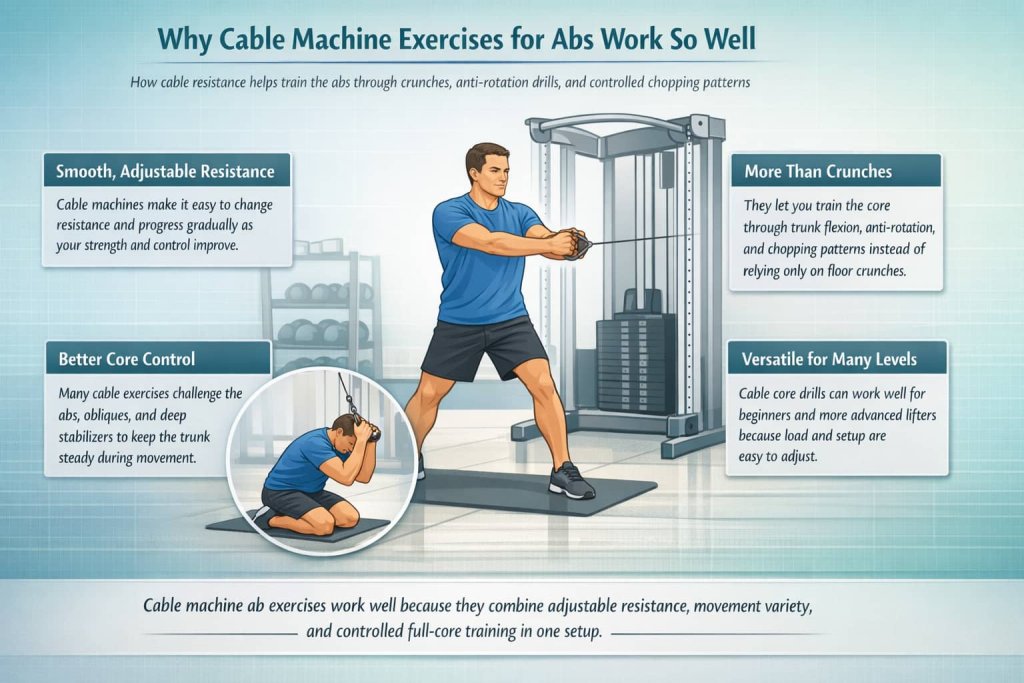
The ACE Exercise Library includes cable and resistance-based core drills such as the standing crunch, standing anti-rotation press, and kneeling wood chop, which shows how well cables fit full-core training.
13 best cable machine exercises for abs
Build a stronger core with these 13 best cable machine exercises for abs, from crunches and wood chops to anti-rotation moves that challenge your entire midsection. These exercises can help improve core strength, stability, and control while giving you an easy way to adjust resistance as you progress.
1. Kneeling Cable Crunch
Why it works: This is one of the most direct cable machine exercises for abs because it loads trunk flexion and lets you progress resistance easily.
How to do it:
- Attach a rope to a high pulley
- Kneel facing the machine
- Hold the rope by the sides of your head
- Brace your abs and keep your hips mostly still
- Curl your rib cage down toward your pelvis
- Pause briefly, then return slowly
Muscles worked: Rectus abdominis, obliques, deep core stabilizers.
Trainer Tip: Think about pulling your ribs down, not just pulling with your arms.
2. Standing Cable Crunch
Why it works: This variation trains the abs in a more upright position and can feel easier to set up in a busy gym. The ACE standing crunch uses a high pulley with the belly button drawn in and the rib cage rolling down under control.
How to do it:
- Set the pulley high with a rope attachment
- Face away from the machine
- Hold the rope near your head with elbows slightly tucked
- Keep knees soft and torso tall
- Curl your rib cage down
- Return slowly without leaning back hard
Muscles worked: Rectus abdominis, obliques, deep trunk stabilizers.
Trainer Tip: Avoid turning it into a hip hinge. Let the abs drive the motion.
3. Cable Pallof Press
Why it works: This is one of the best anti-rotation cable machine exercises for abs. Your core works to resist the cable pulling you sideways. The ACE standing anti-rotation press places the pulley at about chest height and has you press the handle away while keeping the torso tall and steady.
How to do it:
- Set the pulley at chest height
- Stand sideways to the machine
- Hold the handle with both hands at your chest
- Press the handle straight forward
- Pause without letting your torso twist
- Bring the handle back slowly
Muscles worked: Obliques, transverse abdominis, rectus abdominis, glutes.
Trainer Tip: Widen your stance slightly if balance is the limiting factor.
4. Half-Kneeling Pallof Press
Why it works: The half-kneeling position reduces momentum and helps you focus on bracing and pelvic control.
How to do it:
- Set the pulley at chest height
- Get into a half-kneeling stance with the outside knee down
- Hold the handle at your chest
- Press straight forward
- Hold for a second or two
- Return with control
Muscles worked: Obliques, transverse abdominis, glutes, hip stabilizers.
Trainer Tip: Squeeze the glute on the kneeling side to stay stable.
5. High-to-Low Cable Wood Chop
Why it works: This trains rotation with control and gives extra emphasis to the obliques and total core coordination.
How to do it:
- Set the pulley high
- Stand sideways to the machine
- Grab the handle with both hands
- Pull the cable diagonally across your body toward the opposite hip
- Rotate through the trunk under control
- Return slowly
Muscles worked: Obliques, rectus abdominis, shoulders, hips.
Trainer Tip: Rotate smoothly. Do not jerk the handle down.
6. Low-to-High Cable Wood Chop
Why it works: This upward chopping pattern changes the angle and can feel especially good for training the obliques and upper trunk control.
How to do it:
- Set the pulley low
- Stand sideways to the machine
- Hold the handle with both hands
- Pull diagonally upward across your body
- Finish high near shoulder level
- Return slowly to the start
Muscles worked: Obliques, abs, shoulders, hips.
Trainer Tip: Let the torso rotate naturally, but stay controlled from start to finish.
7. Kneeling Wood Chop
Why it works: The kneeling setup limits lower-body momentum and increases the demand on the trunk. The ACE kneeling wood chop uses a high pulley and a rope attachment to create a strong diagonal core pattern.
How to do it:
- Set a rope on a high pulley
- Kneel sideways to the machine
- Grip both ends of the rope
- Pull down and across the body
- Keep the movement smooth
- Return with control
Muscles worked: Obliques, rectus abdominis, deep core stabilizers, shoulders.
Trainer Tip: Do not rush the lowering phase. That is where a lot of the training effect happens.
8. Cable Reverse Crunch Pull-In
Why it works: This cable abs variation can help emphasize the lower portion of the anterior core by combining pelvic tuck control with resistance.
How to do it:
- Attach ankle straps or use a low cable setup
- Lie on your back with your feet attached or positioned for the variation you use
- Brace your core
- Pull your knees in while gently curling your pelvis up
- Lower slowly
- Reset without arching your back hard
Muscles worked: Lower abs emphasis, hip flexors, deep core stabilizers.
Trainer Tip: Keep the movement small and controlled. Do not swing.
9. Cable Seated Twist
Why it works: This exercise can target the obliques while giving you a stable base to focus on controlled trunk rotation.
How to do it:
- Sit sideways to a chest-height cable
- Hold the handle with both hands
- Sit tall with knees bent and feet planted
- Rotate away from the machine
- Pause briefly
- Return slowly
Muscles worked: Obliques, rectus abdominis, deep trunk stabilizers.
Trainer Tip: Turn through the rib cage, not by yanking with the arms.
10. Single-Arm Cable Anti-Rotation Hold
Why it works: Holding one handle with one arm increases the challenge to the trunk because the body has to resist rotation and side-bending.
How to do it:
- Set the pulley around chest height
- Stand sideways to the machine
- Hold one handle in the outside hand
- Press or hold the arm slightly forward
- Resist twisting or leaning
- Hold, then switch sides
Muscles worked: Obliques, transverse abdominis, shoulders, glutes.
Trainer Tip: Start with short holds of 10 to 20 seconds per side.
11. Cable Side Bend
Why it works: This move directly trains the lateral trunk muscles, though it is best used as part of a balanced core routine rather than your only oblique exercise.
How to do it:
- Set the pulley low
- Stand sideways to the machine
- Hold the handle in the outside hand
- Let the cable pull you slightly toward the stack
- Bend away from the stack using your side waist
- Return slowly
Muscles worked: Obliques, quadratus lumborum, deep core stabilizers.
Trainer Tip: Use a lighter weight than you think you need. Control matters more than load here.
12. Cable Mountain Climber Drive
Why it works: This standing variation challenges the abs to brace while the hips move, which can make it feel more athletic and integrated.
How to do it:
- Set the pulley low with ankle straps or handles depending on the variation
- Lean into a supported position
- Drive one knee toward your chest against resistance
- Return slowly
- Alternate sides or finish one side first
- Keep your trunk steady
Muscles worked: Abs, hip flexors, obliques, shoulder stabilizers.
Trainer Tip: Do not let the lower back arch as the knee comes forward.
13. Cable Dead Bug Pulldown
Why it works: This variation combines a dead bug pattern with cable tension, which can be excellent for learning rib control and full-core bracing.
How to do it:
- Lie on your back under or near a cable setup
- Hold the handle or rope with arms stable
- Bring hips and knees to a tabletop position
- Lower one leg slowly while keeping your low back controlled
- Return and switch sides
- Keep your ribs down throughout
Muscles worked: Deep core stabilizers, rectus abdominis, obliques, shoulders.
Trainer Tip: Reduce the cable weight if you cannot keep your spine controlled.
Best cable machine exercises for abs by goal
Best for upper abs
The kneeling cable crunch and standing cable crunch are usually the most direct choices when your goal is a stronger, more noticeable abdominal flexion pattern.
Best for obliques
High-to-low wood chops, low-to-high wood chops, cable side bends, and seated cable twists all do a strong job of training the muscles that rotate and side-bend the trunk.
Best for stability
The Pallof press, half-kneeling Pallof press, and single-arm anti-rotation hold are excellent for teaching the core to resist movement, not just create movement.
Best for total core control
The cable dead bug pulldown and cable mountain climber drive are useful because they combine bracing with limb motion.
How to add cable machine exercises for abs to your workout
For most people, 2 to 4 cable ab exercises per workout is enough. You do not need 10 core moves in one session. Current CDC guidance still supports muscle-strengthening work at least two days per week, and Mayo Clinic notes that stronger core muscles help many physical activities feel easier and more stable.
A simple weekly approach could look like this:
- Day 1: kneeling cable crunch, Pallof press, high-to-low wood chop
- Day 2: standing cable crunch, half-kneeling Pallof press, low-to-high wood chop
- Day 3: cable dead bug pulldown, anti-rotation hold, seated cable twist
Sets and reps for cable machine exercises for abs
A practical starting range for most cable machine exercises for abs is:
- 2 to 4 sets per exercise
- 8 to 15 reps for dynamic moves
- 10 to 30 seconds for holds
- 45 to 75 seconds rest between sets
This style of programming fits the broader message from the ACSM update: simple, repeatable strength work done consistently is more important than chasing a perfect program. The 2026 ACSM update reviewed data from more than 30,000 participants across 137 systematic reviews.
Common mistakes to avoid
Using too much weight
If the cable stack is pulling you out of position, the weight is too heavy.
Turning core work into an arm exercise
Your hands hold the attachment, but your trunk should control the movement.
Moving too fast
Momentum reduces tension on the abs and usually makes form worse.
Forgetting anti-rotation work
A strong core is not built on crunches alone. Anti-rotation drills matter too, as ACE makes clear.
Overarching the lower back
AAOS guidance on trunk stability supports keeping the abdominals active and the spine controlled rather than exaggerated into extension.
Who should be careful with cable abs training
Use extra caution or get professional guidance first if you have a recent abdominal, hip, back, or shoulder injury, recent surgery, or pain that gets sharper as you train. Exercise should feel challenging, but it should not feel unstable or painful in a way that keeps building during the set.
FAQs
Are cable machine exercises for abs better than bodyweight abs exercises?
Not always better, but often easier to progress. Cable machines let you increase or reduce resistance more precisely than many bodyweight exercises.
Can cable machine exercises for abs help build visible abs?
They may help strengthen and develop the abdominal muscles, but visible abs also depend heavily on overall body composition, nutrition, and genetics.
How often should I train abs with a cable machine?
For many people, 2 to 3 times per week works well, especially when those sessions fit into a full-body or upper-lower program. That also aligns with CDC guidance for muscle-strengthening work at least two days weekly.
Should I do cable abs at the start or end of a workout?
Usually near the end works best, especially if heavy compound lifts come first. But anti-rotation drills can also work well early in a session as part of a warm-up or activation block.
What cable ab exercise is best for beginners?
The standing cable crunch and Pallof press are usually beginner-friendly because they are easy to set up and easy to control.
Are cable wood chops safe?
They can be safe when done with controlled resistance and smooth rotation. Problems usually happen when the weight is too heavy or the movement is rushed.
Can I train abs every day with cables?
Most people do better with recovery between harder ab sessions. Two to four focused core sessions per week is usually more practical than hard daily cable work.
Conclusion
Cable machine exercises for abs are one of the best ways to train your core with adjustable resistance, variety, and progression. The smartest plan is to combine crunch-based moves, anti-rotation drills, and controlled rotational exercises instead of relying on one pattern alone. Start lighter than you think, move with control, and build consistency first.