
Cable machine glute exercises can help you build stronger, rounder glutes by training hip extension, hip abduction, and single-leg control with smooth, adjustable resistance. That matters because the glutes do more than shape the hips. They help with lifting, stair climbing, running, pelvic control, and lower-body stability.
A smart cable glute routine usually includes kickback, abduction, squat or hinge patterns, and unilateral work instead of repeating only one movement. Official guidance from the CDC also supports doing muscle-strengthening activity at least 2 days per week.
What are cable machine glute exercises?
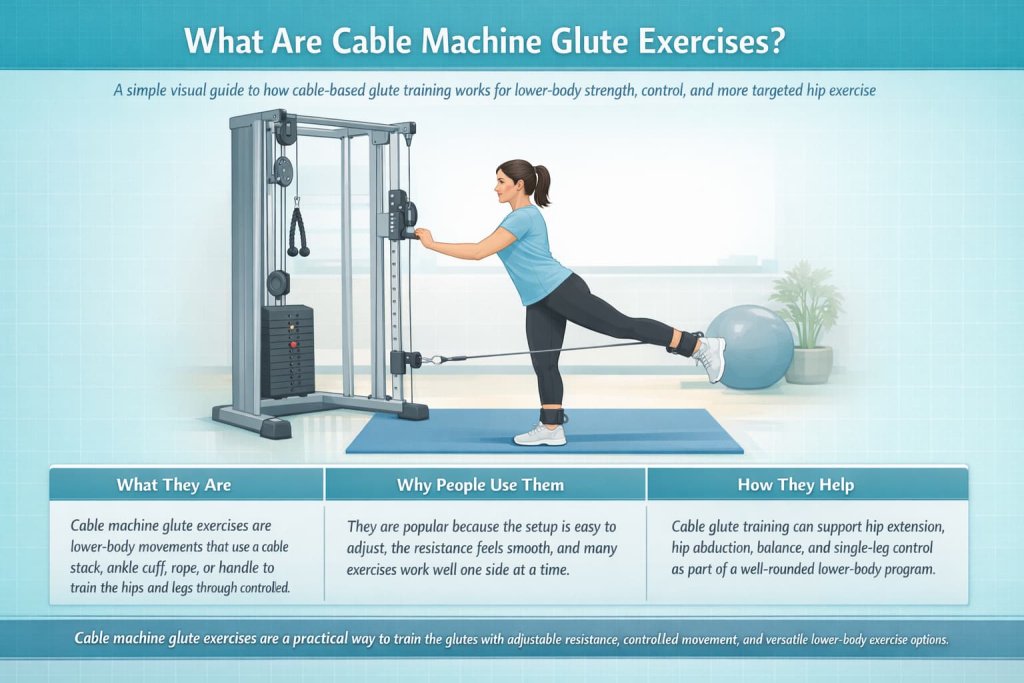
Cable machine glute exercises are lower-body exercises performed with a cable stack, ankle cuff, rope, or handle to load the hips and legs through a controlled range of motion. They are useful because the setup is easy to adjust, the resistance stays consistent, and many movements work well one side at a time.
ACE includes cable-friendly butt-and-hip exercises in its exercise library, while the NSCA recommends using a mix of compound and isolation patterns when the goal is stronger or more developed glutes.
Why cable machine glute exercises work
Cable training works well for glutes because it lets you load the hip from different angles without needing heavy barbells. That makes cables practical for kickbacks, abduction work, pull-throughs, lunges, and hinge patterns. The NSCA notes that the glutes act as hip extensors, abductors, and external rotators, which is one reason exercise variety matters.
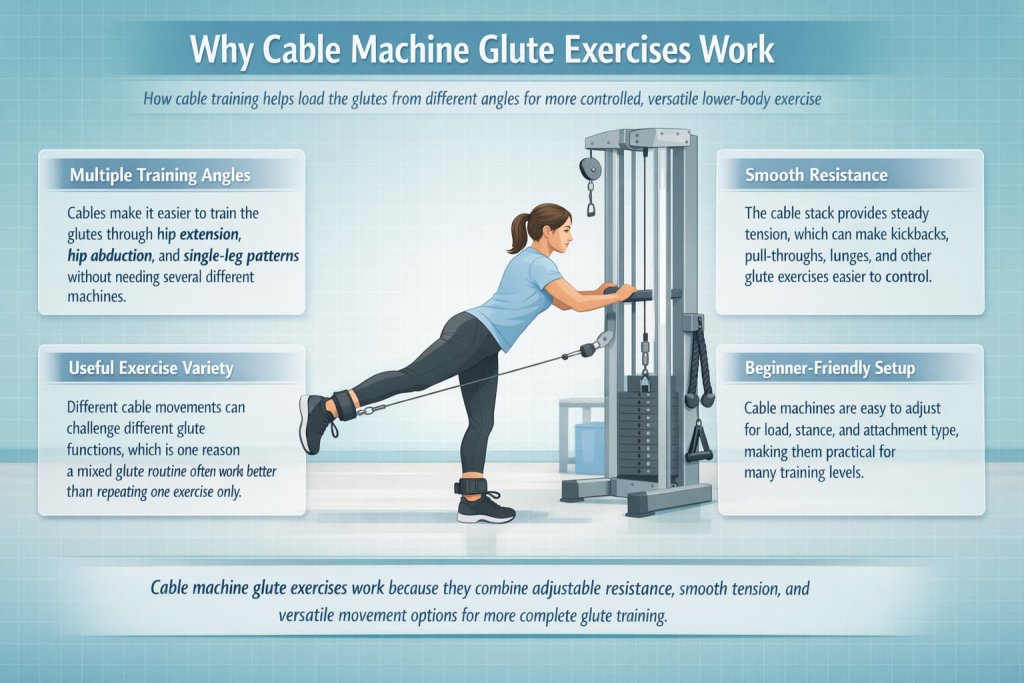
Research on gluteus medius and minimus exercise selection also supports using different movement patterns because different exercises challenge different glute segments and functions.
10 best cable machine glute exercises
Build stronger, rounder glutes with these 10 best cable machine glute exercises that target hip extension, abduction, and single-leg control. This mix helps improve glute strength, shape, stability, and overall lower-body function.
1. Cable Glute Kickback
How to do it
- Attach an ankle cuff to a low pulley.
- Stand tall and hold the machine lightly for balance.
- Brace your core and keep a soft bend in the standing leg.
- Drive the working leg back in a controlled arc without swinging.
- Squeeze the glute at the end range.
- Return slowly and repeat before switching sides.
Why it works: The cable glute kickback is one of the clearest ways to train hip extension directly. It keeps tension on the glute through the full rep and is easy to scale for beginners or more advanced lifters.
Muscles worked: Gluteus maximus, gluteus medius, hamstrings, core stabilizers.
Trainer Tip: Do not arch your lower back to move the weight farther. Keep the motion coming from the hip.
2. Standing Cable Hip Abduction
How to do it
- Attach an ankle cuff to a low cable.
- Stand sideways to the machine with the outside leg attached.
- Hold the machine lightly and stand tall.
- Move the working leg out to the side with control.
- Pause briefly, then return slowly.
- Keep your torso upright and avoid leaning away.
Why it works: This move targets the outer glutes, especially the gluteus medius and minimus, which support pelvic control and single-leg stability. ACE lists standing hip abduction as a butt-and-hip exercise and notes it can be performed with bands, cables, or selectorized machines.
Muscles worked: Gluteus medius, gluteus minimus, gluteus maximus, core stabilizers.
Trainer Tip: Use a small, clean range instead of throwing the leg out with momentum.
3. Cable Pull-Through
How to do it
- Attach a rope to a low pulley.
- Face away from the machine and hold the rope between your legs.
- Step forward until there is tension on the cable.
- Hinge at the hips with a neutral spine.
- Drive the hips forward to stand tall.
- Squeeze the glutes at the top, then repeat.
Why it works: The cable pull-through trains the glutes in a hip-hinge pattern similar to other posterior-chain lifts, but often with a more approachable setup. It is a strong option for people who want glute work without loading the spine heavily.
Muscles worked: Gluteus maximus, hamstrings, adductors, core stabilizers.
Trainer Tip: Think hips back, then hips through. Do not turn it into a squat.
4. Cable Romanian Deadlift
How to do it
- Attach a straight bar or dual handles to a low cable.
- Stand facing the machine and step back to create tension.
- Hold the handle close to your thighs.
- Push your hips back while keeping your spine neutral.
- Lower until you feel a stretch through the hamstrings.
- Drive through the feet and return to standing.
Why it works: This exercise loads the glutes and hamstrings through a controlled hinge pattern. It is useful for people who want steady tension and a clear line of pull.
Muscles worked: Gluteus maximus, hamstrings, adductors, erector spinae, core.
Trainer Tip: Keep the cable close to your body and avoid rounding your back.
5. Cable Reverse Lunge
How to do it
- Hold one or two cable handles, depending on your setup.
- Stand tall with the cable providing light resistance.
- Step one leg back into a reverse lunge.
- Lower with control until both knees bend comfortably.
- Push through the front foot to return to standing.
- Repeat on one side or alternate sides.
Why it works: Reverse lunges train the glutes through hip extension while also challenging balance and lower-body control. ACE includes reverse lunge variations in its library, and unilateral training fits well with the NSCA advice to use a range of compound patterns for glute development.
Muscles worked: Gluteus maximus, gluteus medius, quadriceps, hamstrings, calves.
Trainer Tip: Keep most of your pressure through the front foot instead of pushing off the back leg.
6. Cable Curtsy Lunge
How to do it
- Hold a cable handle at chest level or use a low setup depending on your machine.
- Step one leg back and slightly across behind the body.
- Lower with control while keeping your chest tall.
- Drive through the front foot to return to standing.
- Repeat before switching sides.
Why it works: This variation adds a lateral and rotational control challenge, which can increase demand on the glute medius and glute maximus. It is best used as an accessory move, not as your only glute exercise.
Muscles worked: Gluteus medius, gluteus maximus, quadriceps, adductors, core.
Trainer Tip: Keep the movement smooth and stay within a range you can control well.
7. Cable Squat
How to do it
- Hold a cable handle or rope at chest height.
- Step back to create tension.
- Sit back into a squat with your feet about shoulder-width apart.
- Lower as far as you can with control.
- Push through the floor to stand.
- Repeat with a steady tempo.
Why it works: A cable squat is useful for beginners because the front-loaded cable can help with balance and posture while still training the glutes and thighs. Squat patterns are one of the staple exercise categories the NSCA highlights in glute-focused programming.
Muscles worked: Gluteus maximus, quadriceps, adductors, hamstrings, core.
Trainer Tip: Sit back and down. Do not let the cable pull you forward.
8. Cable Step-Back Kickback
How to do it
- Attach an ankle cuff to a low cable.
- Stand facing the machine and hold it lightly.
- Step the working leg slightly back, then continue into a kickback.
- Pause briefly at the end.
- Return under control and repeat.
Why it works: This combines a small hip-extension setup move with a kickback, which can help some people find the glute more clearly than a strict standing kickback.
Muscles worked: Gluteus maximus, gluteus medius, hamstrings, core stabilizers.
Trainer Tip: Keep the movement slow enough that you can feel the glute doing the work.
9. Cable Fire Hydrant
How to do it
- Attach an ankle cuff to a low pulley.
- Stand facing the machine and hold on for support.
- Bend the working knee about 90 degrees.
- Lift the knee slightly out to the side.
- Pause, then return slowly.
- Repeat without twisting the torso.
Why it works: The fire hydrant pattern emphasizes the outer glutes and hip control. It can be especially useful as a lighter accessory after heavier glute work.
Muscles worked: Gluteus medius, gluteus minimus, gluteus maximus, deep hip stabilizers.
Trainer Tip: Keep the pelvis level. Do not rotate your body to raise the leg higher.
10. Cable Diagonal Kickback
How to do it
- Attach an ankle cuff to a low cable.
- Stand at a slight angle to the machine.
- Move the working leg back and slightly outward on a diagonal.
- Pause at the top without swinging.
- Return slowly and repeat.
- Switch sides after your set.
Why it works: The diagonal path can challenge both hip extension and hip abduction, making it a practical hybrid glute accessory.
Muscles worked: Gluteus maximus, gluteus medius, hamstrings, core stabilizers.
Trainer Tip: This should feel controlled, not explosive. Keep the range clean and repeatable.
Best cable machine glute exercises for different goals
For glute growth
Start with cable pull-throughs, cable Romanian deadlifts, cable squats, and cable glute kickbacks. These usually let you use more load or more total tension.
For glute medius and outer glute focus
Use standing cable hip abduction, cable fire hydrants, and cable diagonal kickbacks. These are especially useful for hip abductor work. Research reviews on PubMed support the idea that abduction-focused exercises have an important place in hip training.
For beginners
Cable squats, cable pull-throughs, and light kickbacks are usually the easiest to learn.
For single-leg control and balance
Cable reverse lunges, cable curtsy lunges, and standing cable hip abduction are strong options.
How to build a cable machine glute workout
A simple cable glute workout can look like this:
Option 1: Beginner cable glute workout
- Cable squat: 2 to 3 sets of 8 to 12 reps
- Cable glute kickback: 2 to 3 sets of 10 to 15 reps per side
- Standing cable hip abduction: 2 to 3 sets of 10 to 15 reps per side
- Cable pull-through: 2 sets of 10 to 12 reps
Option 2: Glute growth cable workout
- Cable Romanian deadlift: 3 to 4 sets of 8 to 10 reps
- Cable pull-through: 3 sets of 10 to 12 reps
- Cable glute kickback: 3 sets of 12 to 15 reps per side
- Cable diagonal kickback: 2 to 3 sets of 12 to 15 reps per side
Option 3: Glute stability and shape workout
- Standing cable hip abduction: 3 sets of 12 to 15 reps per side
- Cable reverse lunge: 3 sets of 8 to 10 reps per side
- Cable fire hydrant: 2 to 3 sets of 12 to 15 reps per side
- Cable curtsy lunge: 2 sets of 8 to 10 reps per side
How often should you do cable machine glute exercises?
For most adults, training the glutes 2 to 3 times per week works well when volume and recovery are managed properly. The CDC recommends muscle-strengthening activity at least 2 days per week, and that is a good baseline for a glute-focused plan too. Exact weekly volume depends on the rest of your lower-body training, effort level, and recovery.
Common mistakes with cable machine glute exercises
Using too much weight
If the weight makes you swing, twist, or arch your back, it is too heavy.
Turning every move into a lower-back exercise
Kickbacks and pull-throughs should come from the hips, not from throwing the spine into extension.
Skipping abduction work
Many people focus only on glute max exercises and ignore the glute medius and minimus. That can leave the program less complete, which is one reason hip-abductor work is often included in exercise reviews on PubMed.
Rushing the reps
Slower, cleaner reps usually make cable glute work more effective.
Holding on too hard
A light support grip is fine, but avoid turning the handle into a way to yank through the rep.
Are cable machine glute exercises better than free weights?
Not automatically. Cable glute exercises are best seen as a practical option, not a magic shortcut. Free weights are excellent for heavy squats, hinges, lunges, and hip thrusts. Cables are excellent for constant tension, easier setup changes, and controlled isolation work. The strongest overall glute programs often use both. That balanced view matches the NSCA emphasis on exercise selection and variety instead of treating one movement style as the only answer.
FAQ about cable machine glute exercises
Are cable machine glute exercises effective?
Yes. They can be effective for glute strength and muscle-building when you choose the right exercises, use enough effort, and progress over time. They are especially useful for kickbacks, abduction work, lunges, and pull-throughs. The NSCA supports using varied glute training patterns rather than relying on only one movement.
Which cable glute exercise is best for glute growth?
There is no single best exercise for everyone. In most programs, cable pull-throughs, cable Romanian deadlifts, cable squats, and cable glute kickbacks are some of the most useful options because they cover both heavier hip work and direct glute isolation.
Do cable kickbacks grow the glutes?
They can help, especially for the gluteus maximus, when they are done with enough control, effort, and progressive overload. They work best as part of a bigger glute plan, not as your only exercise.
How many reps should I do for cable machine glute exercises?
A practical starting range is about 8 to 12 reps for bigger compound lifts and 10 to 15 reps for lighter isolation exercises. The best rep range depends on your goal, load, and form quality.
Can beginners do cable machine glute exercises?
Yes. Beginners often do well with cable squats, cable pull-throughs, and light kickbacks first because they are easier to control than some more advanced variations.
Are cable machine glute exercises good for the glute medius?
Yes. Standing cable hip abduction, cable fire hydrants, and diagonal kickbacks are all useful options for the glute medius and minimus. Research reviews on PubMed support the value of abduction-focused exercise in hip strengthening.
Can I train glutes with cables only?
Yes, you can build a solid glute routine using only cables. Still, many people get the best long-term results from combining cables with other tools such as dumbbells, barbells, benches, or bodyweight work.
Conclusion
Cable machine glute exercises are a practical way to train the glutes for strength, shape, and lower-body control. The best results usually come from combining hip-extension moves like kickbacks and pull-throughs with hip-abduction work and single-leg exercises. Keep your form controlled, progress gradually, and use a mix of patterns instead of relying on just one movement.