
Yes, arm exercises without weights can help you build stronger, more toned arms when the movements are challenging enough and you do them consistently. The key is choosing bodyweight exercises that train your chest, shoulders, triceps, biceps, and upper-back support muscles through enough range and control to create a real training effect, which aligns with guidance from the CDC.
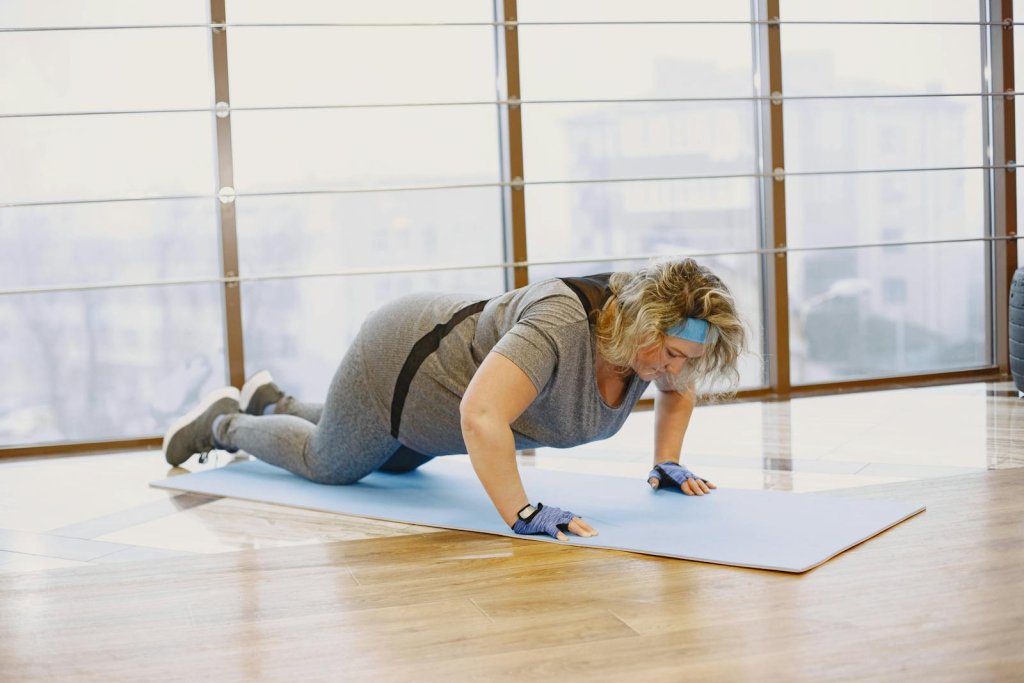
This matters because you do not need dumbbells to start strengthening your arms at home. A well-planned no-weights routine can count toward weekly muscle-strengthening guidelines, improve upper-body endurance, and help you build the base for harder exercises later. Public-health guidance from the NHS and exercise guidance from Mayo Clinic support regular strength work for the major muscle groups at least two days per week.
One important note: “toned” arms usually mean a mix of stronger muscles plus enough overall leanness for that muscle shape to show. Arm workouts help build strength and muscle definition, but they do not “spot reduce” fat from only one area. That is why the best results come from regular strength training, overall physical activity, and realistic expectations. This is an evidence-based training inference drawn from official strength-training guidance, not a claim that one move alone changes body fat in one place.
Why arm exercises with no weights still work
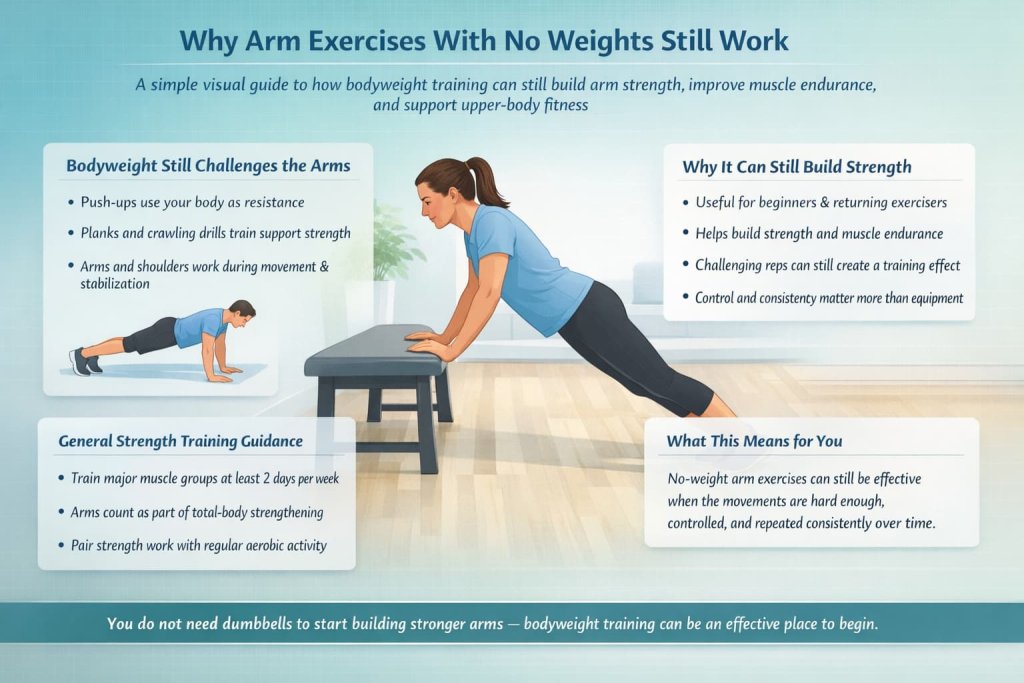
Bodyweight training still creates resistance. In push-up variations, planks, crawling drills, and support holds, your arms and shoulders have to move or stabilize part of your body mass. That can be enough to strengthen muscles, especially for beginners or anyone returning to exercise. Mayo Clinic notes that strength training does not require machines or dumbbells only, and that a level of resistance that tires the muscles after about 12 to 15 reps can be effective.
For general health, adults should do muscle-strengthening work for all major muscle groups at least two days per week, alongside aerobic activity targets. Arms are specifically included in those major muscle groups in CDC and NHS guidance.
Before you start arm exercises without weights
Start with a version you can control. Good form matters more than doing the hardest variation right away. Mayo Clinic and Cleveland Clinic both emphasize controlled movement, proper alignment, and building up gradually instead of rushing into difficult reps.
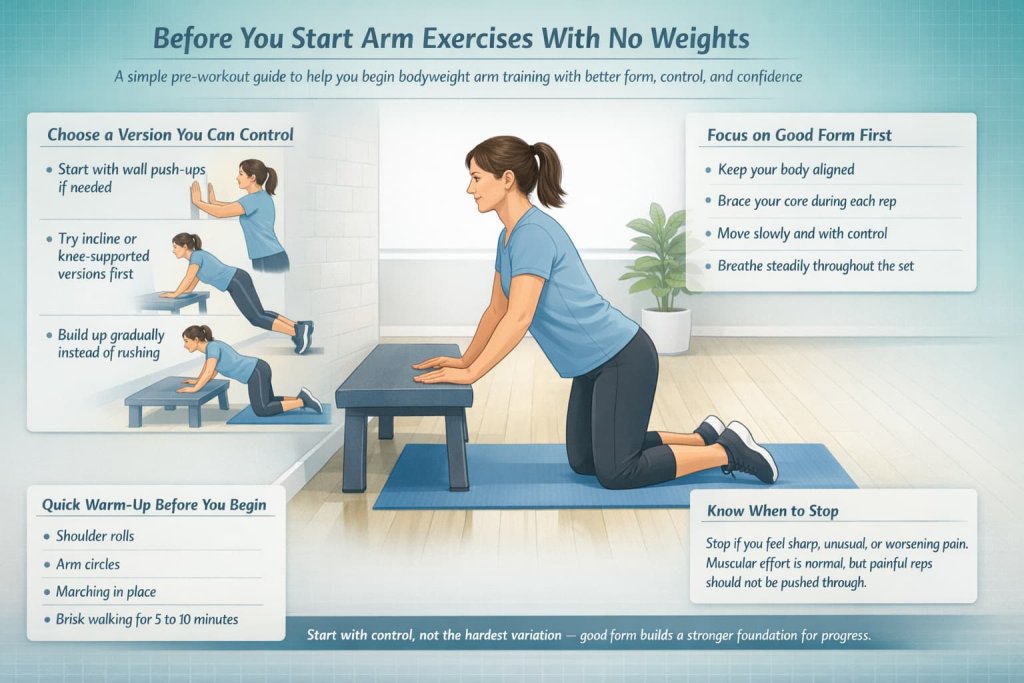
Use these quick rules before your first set:
- Warm up for 5 to 10 minutes with shoulder rolls, arm circles, marching, or brisk walking
- Begin with wall, incline, or knee-supported versions if standard push-ups are too hard
- Keep your core braced so your body stays aligned
- Breathe steadily and avoid holding your breath
- Stop if you feel sharp, unusual, or worsening pain
12 Best Arm Exercises With No Weights
Build stronger, more toned arms at home with these simple no-weight exercises that train your shoulders, triceps, chest, and upper-body support muscles. These beginner-friendly bodyweight moves need no equipment and can help improve strength, control, and muscle endurance.
1. Wall Push-Up
Why it works: This is one of the easiest and most useful starting points for people who cannot yet do floor push-ups. Raising your hands reduces the amount of bodyweight you press, which makes it easier to learn alignment and arm control. This matches the general principle of progressive strength training supported by Mayo Clinic.
Muscles worked: Chest, shoulders, triceps, and core stabilizers.
How to do it:
- Stand facing a wall with your hands slightly wider than shoulder width
- Place your palms on the wall at chest height
- Step your feet back until your body forms a straight line
- Bend your elbows and lower your chest toward the wall
- Press through your palms to return to the start
- Repeat with smooth, controlled reps
Trainer Tip: Keep your body in one line from head to heels. Do not let your hips sag or your neck jut forward.
2. Incline Push-Up
Why it works: Incline push-ups are harder than wall push-ups but easier than floor push-ups. They are a practical bridge movement because the higher surface reduces the pressing load while still training full-body tension. Cleveland Clinic’s push-up guidance supports this kind of progression.
Muscles worked: Chest, shoulders, triceps, and core.
How to do it:
- Place your hands on a sturdy bench, countertop, or box
- Walk your feet back until your body is straight
- Lower your chest toward the edge with control
- Keep your elbows bending back and slightly out naturally
- Press back up to the start position
- Repeat for steady reps
Trainer Tip: Use a surface height that lets you complete all reps with good form. Lower the surface over time as you get stronger.
3. Knee Push-Up
Why it works: Knee push-ups help you train a true floor pressing pattern without taking on the full load of a standard push-up. Mayo Clinic’s modified push-up demonstration supports beginner-friendly push-up variations with controlled form.
Muscles worked: Chest, shoulders, triceps, and core.
How to do it:
- Start on the floor with your hands slightly wider than shoulder width
- Bend your knees and keep your body straight from head to knees
- Brace your midsection
- Lower your chest toward the floor
- Press through your hands to return to the start
- Repeat without rushing
Trainer Tip: Do not think of this as an “easy” move. Treat it like a real strength exercise and keep every rep strict.
4. Standard Push-Up
Why it works: The standard push-up is one of the best no-equipment upper-body exercises because it trains the chest, shoulders, triceps, and core at the same time. Cleveland Clinic notes the importance of hand placement, plank alignment, and controlled reps for a good basic push-up.
Muscles worked: Chest, shoulders, triceps, core, and serratus anterior.
How to do it:
- Begin in a high plank with hands under or slightly wider than shoulder width
- Keep your legs straight and your body aligned
- Lower your chest toward the floor while keeping control
- Pause briefly near the bottom if needed
- Push the floor away to return to the start
- Repeat while keeping your core tight
Trainer Tip: Your whole body should rise and lower together. Avoid dropping the hips first or lifting them too high.
5. Close-Grip Push-Up
Why it works: Bringing the hands in slightly closer usually increases triceps demand compared with a regular push-up. It is a smart bodyweight choice when your goal is more back-of-the-arm work without equipment. This is a practical training inference based on the mechanics of narrower pressing and the role of the triceps in elbow extension.
Muscles worked: Triceps, chest, shoulders, and core.
How to do it:
- Set up in a plank with your hands a little narrower than your normal push-up position
- Keep your elbows closer to your sides as you lower
- Lower your chest with control
- Press back up without letting your hips sag
- Repeat for controlled reps
Trainer Tip: Do not place your hands so close that your wrists or shoulders feel jammed. Slightly narrow is usually enough.
6. Pike Push-Up
Why it works: Pike push-ups shift more emphasis toward the shoulders while still training the triceps. This makes them useful when you want bodyweight arm work that feels different from regular push-ups and starts to mimic an overhead pressing pattern.
Muscles worked: Shoulders, triceps, upper chest, and core.
How to do it:
- Start in a push-up position
- Lift your hips up so your body forms an upside-down V shape
- Place your hands firmly on the floor
- Bend your elbows and lower your head toward the floor between your hands
- Press back up to straighten your arms
- Repeat while keeping the movement controlled
Trainer Tip: If your hamstrings feel too tight, bend your knees slightly so you can focus on the pressing motion.
7. Bench or Chair Triceps Dip
Why it works: Dips place a strong demand on the triceps and can be done almost anywhere with a sturdy surface. They are popular for bodyweight arm training, but they should be done carefully because the shoulder position may bother some people.
Muscles worked: Triceps, shoulders, and chest.
How to do it:
- Sit on the edge of a sturdy chair or bench
- Place your hands beside your hips on the edge
- Slide your hips slightly forward off the seat
- Bend your elbows to lower your body
- Press through your palms to straighten your arms
- Repeat without dropping too deep
Trainer Tip: Keep the range comfortable. If your shoulders feel pinchy, reduce depth or choose close-grip push-ups instead.
8. Plank Shoulder Tap
Why it works: This exercise makes the arms support your body while the shoulders and core resist side-to-side shifting. That combination improves upper-body stability and time under tension even though there is no external weight.
Muscles worked: Shoulders, triceps, chest stabilizers, and core.
How to do it:
- Start in a high plank
- Spread your feet a little wider for balance
- Lift one hand and tap the opposite shoulder
- Place that hand back on the floor
- Repeat with the other side
- Continue alternating while keeping your hips as still as possible
Trainer Tip: Move slowly enough that your torso does not rock side to side.
9. Up-Down Plank
Why it works: Moving between forearm plank and high plank increases arm and shoulder work while also challenging trunk stability. It is useful for muscular endurance and controlled pushing strength.
Muscles worked: Triceps, shoulders, chest, and core.
How to do it:
- Begin in a forearm plank
- Press one hand into the floor, then the other, to rise into a high plank
- Lower one forearm back down, then the other, to return to the start
- Alternate which arm leads each rep
- Keep your hips steady throughout
- Repeat for the desired number of reps
Trainer Tip: Think “quiet hips.” The less twisting you show, the better the rep.
10. Bear Crawl Hold
Why it works: The bear position places your shoulders and arms under constant tension while your core works to hold posture. Even without moving, this can become a serious upper-body endurance drill.
Muscles worked: Shoulders, arms, chest stabilizers, and core.
How to do it:
- Start on your hands and knees
- Lift your knees a few inches off the floor
- Keep your back flat and your core braced
- Hold the position while breathing steadily
- Maintain even pressure through both hands
- Rest and repeat
Trainer Tip: A shorter hold with perfect position is better than a long hold with a rounded back and shaky shoulders.
11. Crab Walk
Why it works: Crab walks train the arms in a support position while also involving the shoulders and upper back. The movement pattern is different from push-ups, which adds variety to a no-weights arm routine.
Muscles worked: Triceps, shoulders, upper back, glutes, and core.
How to do it:
- Sit on the floor with your hands behind you and feet flat
- Lift your hips off the floor
- Move one hand and the opposite foot forward
- Alternate sides to travel a short distance
- Stay controlled and keep your chest open
- Return and repeat
Trainer Tip: Begin with small steps. Fast crab walks often turn messy and reduce the benefit.
12. Arm Circles
Why it works: Arm circles are low-load, but they can still help build local muscular endurance in the shoulders and upper arms, especially for beginners or as a finisher. They also work well on days when harder push-up-based training is not practical.
Muscles worked: Shoulders, upper arms, and postural stabilizers.
How to do it:
- Stand tall with your arms extended out to your sides
- Make small forward circles for a set time
- Reverse the direction after the set
- Keep your shoulders down and away from your ears
- Continue for the planned duration
- Rest and repeat if needed
Trainer Tip: Keep the circles controlled. Swinging wildly turns this into momentum instead of muscle work.
How to build a simple arm workout with no weights
A practical beginner workout could look like this:
- Wall or incline push-ups: 2 to 3 sets of 8 to 15 reps
- Knee or standard push-ups: 2 to 3 sets of 5 to 12 reps
- Plank shoulder taps: 2 to 3 sets of 10 to 20 taps total
- Chair dips or up-down planks: 2 sets of 8 to 12 reps
- Arm circles: 2 rounds of 20 to 40 seconds each direction
For many people, one challenging set can still be useful, and 12 to 15 reps is a reasonable target range when the variation is difficult enough. That aligns with Mayo Clinic guidance on strength training effort.
Quick overview of the 12 best no-weight arm exercises
| Exercise | Main focus | Best for |
|---|---|---|
| Wall Push-Up | Chest, shoulders, triceps | Beginners |
| Incline Push-Up | Chest, shoulders, triceps | Building toward floor push-ups |
| Knee Push-Up | Chest, shoulders, triceps, core | Early strength gains |
| Standard Push-Up | Chest, shoulders, triceps, core | Full bodyweight pressing |
| Close-Grip Push-Up | Triceps, chest, shoulders | More triceps emphasis |
| Pike Push-Up | Shoulders, triceps | Vertical pressing pattern |
| Bench or Chair Triceps Dip | Triceps, shoulders, chest | Triceps-focused bodyweight work |
| Plank Shoulder Tap | Shoulders, triceps, core | Stability and control |
| Up-Down Plank | Triceps, shoulders, chest, core | Dynamic arm endurance |
| Bear Crawl Hold | Shoulders, arms, core | Time-under-tension control |
| Crab Walk | Triceps, shoulders, upper back | Arm endurance with coordination |
| Arm Circles | Shoulders, upper arms | Low-load finisher or beginner work |
How often should you train your arms without weights?
Most people do well with arm training two to three times per week, especially when they are using bodyweight exercises that also involve the chest, shoulders, and core. Official guidance from the CDC and NHS recommends muscle-strengthening work on at least two days per week for all major muscle groups.
A simple weekly setup could be Monday and Thursday, or Tuesday, Thursday, and Saturday. Leave enough recovery time if your pushing muscles are still very sore.
Common mistakes that make no-weight arm workouts less effective
Going too hard too soon
People often jump straight to standard push-ups before they can control incline or knee versions. That usually leads to short reps, sagging hips, and stalled progress. A better approach is to start at a level where your last few reps feel difficult but still look clean.
Using speed instead of control
Fast reps often reduce tension on the target muscles. Slowing down the lowering phase usually makes bodyweight arm exercises more effective because your muscles have to control the load longer. This is a coaching inference consistent with the general strength-training principle of controlled movement.
Forgetting progression
If wall push-ups feel easy forever, your body has no reason to adapt much more. Progress by lowering the incline, adding reps, adding pauses, or moving to a harder variation.
Expecting spot reduction
Arm workouts can strengthen and shape the arms, but visible definition depends on broader factors too. For many readers, that includes total activity, recovery, and overall nutrition habits, not endless arm reps alone.
Who should be careful with these exercises?
Use extra caution or get guidance first if you have a recent shoulder, elbow, wrist, or neck injury, difficulty getting on and off the floor, or pain that worsens during or after exercise. NHS guidance also advises speaking to a GP first if you have not exercised for some time or if you have medical conditions or concerns.
A simple rule is this: muscular effort is normal, but sharp, unstable, or worsening pain is not.
FAQs about arm exercises no weights
Can you really build arm muscle without weights?
Yes. You can build some arm muscle with bodyweight training if the exercises are challenging enough and you progress them over time. Push-up variations, dips, holds, and plank drills can all create useful resistance.
What is the best no-weight arm exercise for beginners?
Wall push-ups are often the best place to start because they teach pressing mechanics with less bodyweight load. Incline push-ups are another strong beginner option.
How long does it take to tone your arms?
That varies. Strength and endurance may improve within a few weeks of consistent training, but visible definition depends on several factors, including your starting point and overall habits. There is no single guaranteed timeline supported by official guidance.
Are push-ups enough for arms?
Push-ups are excellent, but they mainly emphasize the chest, shoulders, and triceps. A better plan is to combine push-ups with triceps-focused moves, support holds, and stability drills for more complete arm training.
How many reps should I do?
A common starting point is 8 to 15 controlled reps per set, using a variation that makes the last few reps feel hard. Mayo Clinic notes that one set of about 12 to 15 reps can be effective when the resistance is challenging enough.
Can I do these exercises every day?
You can do light movement daily, but hard arm strength sessions usually work better with recovery between them. Two to three sessions per week is a practical starting point for most people.
Conclusion
Arm exercises with no weights can absolutely help you build stronger, more toned arms. The smartest approach is to start with a level you can control, use steady progressions like wall to incline to floor push-ups, and train consistently each week.
For the best results, pick four to six movements from this list, stay patient, and focus on clean reps instead of chasing fatigue too early.