
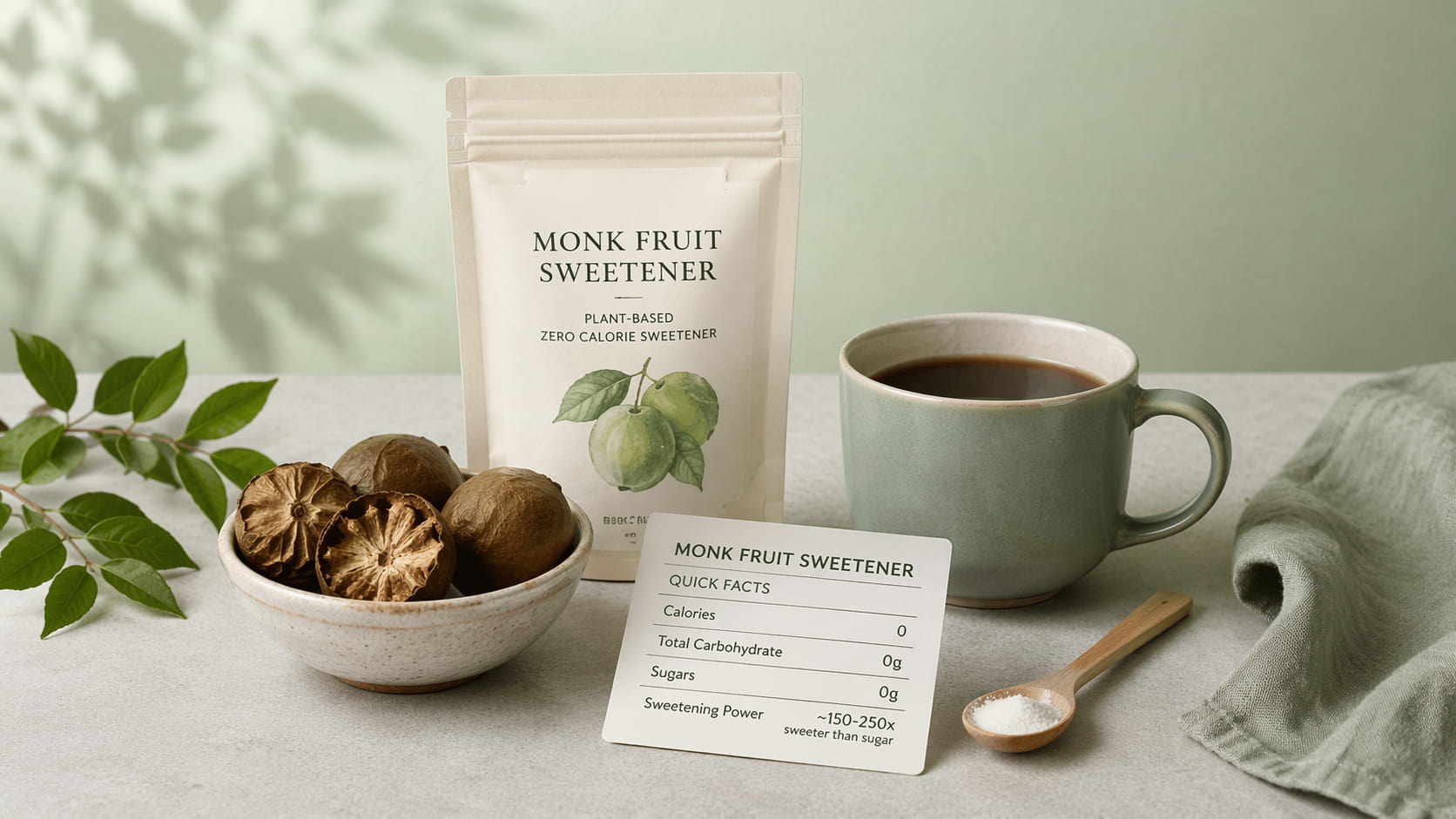
Monk fruit sweetener is a very sweet, low- or no-calorie sugar substitute that can help you cut back on added sugar, and current U.S. guidance considers purified monk fruit extracts used in food to be safe under their intended conditions of use. That said, not every product sold as monk fruit is the same. Some are mostly monk fruit extract, while others are blends with erythritol or other ingredients, so understanding the label matters.
If you want a sweetener for coffee, tea, baking, or everyday sugar reduction, monk fruit can be a practical option. The key is knowing what it is, how it compares with sugar and stevia, and how to choose a product that actually fits your goals.
What Is Monk Fruit Sweetener?
Monk fruit sweetener comes from Siraitia grosvenorii, also called luo han guo or monk fruit. According to the U.S. Food and Drug Administration, the sweetness comes mainly from compounds called mogrosides, and monk fruit extract is reported to be about 100 to 250 times sweeter than sugar depending on its composition.
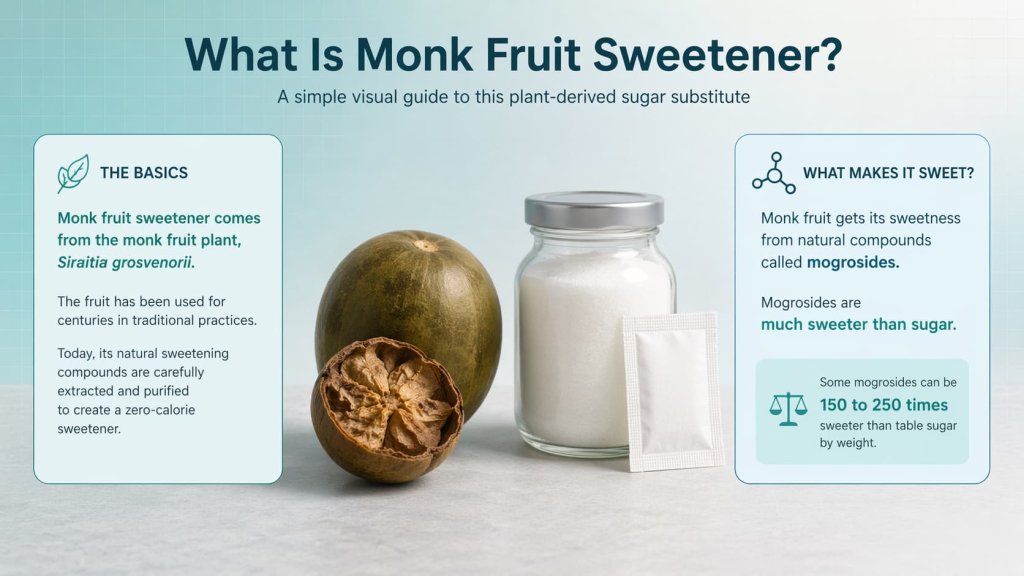
In practical terms, monk fruit sweetener is made by processing the fruit into juice or extract and concentrating the sweet compounds. FDA GRAS notices for monk fruit describe extraction and purification steps that separate the sweet mogrosides from other fruit components, which is why the sweetener sold in packets, liquids, and baking blends is much more concentrated than the whole fruit itself.
Monk Fruit Sweetener vs Sugar
Regular table sugar adds calories and counts toward your daily added sugar intake. Pure monk fruit extract is a non-nutritive sweetener, so it can provide sweetness with little or no calories in the final product, depending on what else is added to the formula. The American Diabetes Association notes that many nonnutritive sweeteners pass through the body without providing calories, which is one reason people use them to lower calorie and carbohydrate intake.
That can be useful because added sugar still matters for overall diet quality. The American Heart Association recommends limiting added sugars to no more than 6% of daily calories. Replacing some added sugar with monk fruit sweetener may help with that goal, but it does not automatically make the whole food healthy. A sweetened coffee drink, protein bar, or dessert can still be high in calories, carbs, or saturated fat even if it uses monk fruit.
Can Monk Fruit Sweetener Help With Weight Loss?
Monk fruit sweetener may help with weight loss indirectly, but it is not a fat-loss ingredient by itself. If you use it to replace added sugar in foods or drinks you regularly consume, it may help lower your overall calorie intake. The American Heart Association says replacing sugary foods and drinks with sugar-free options containing low-calorie sweeteners is one way to limit calories and help achieve or maintain a healthy weight.
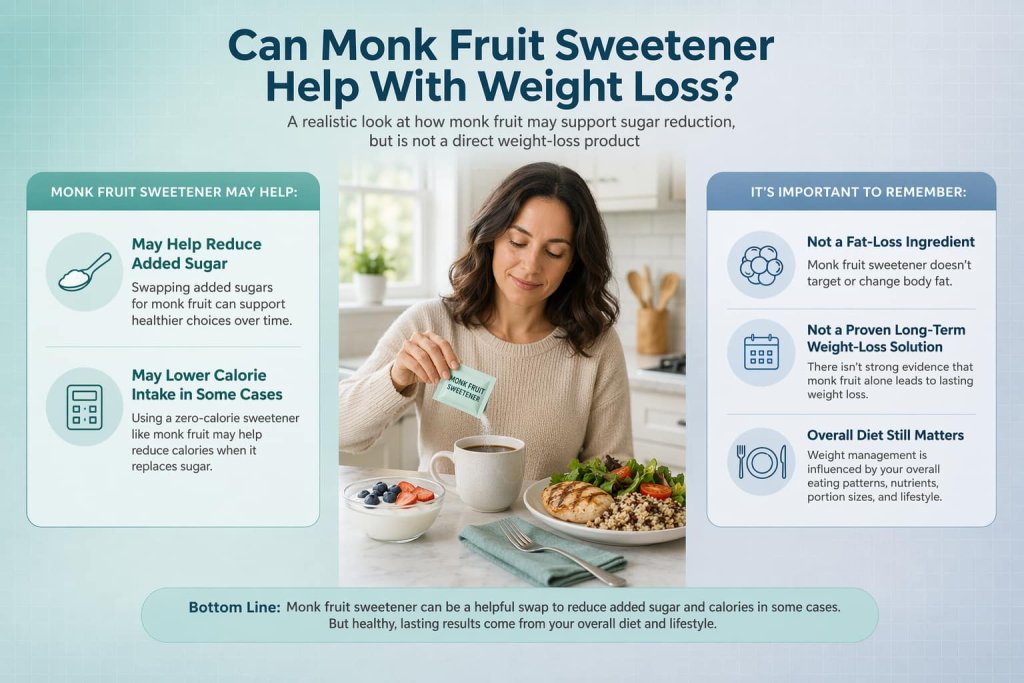
That said, monk fruit sweetener should not be presented as a proven long-term weight-loss solution on its own. The World Health Organization recommends against using non-sugar sweeteners as a means of weight control because the overall evidence does not show a clear long-term benefit. A more accurate way to think about monk fruit is as a sugar-reduction tool that may support a lower-calorie eating pattern, not as a direct weight-loss product.
This is also why the rest of your diet still matters. Swapping sugar in coffee, tea, or yogurt may help reduce excess calories, but using monk fruit in highly processed foods does not automatically make them weight-loss-friendly. As Cleveland Clinic notes, replacing sugar with monk fruit may help cut empty calories, but meaningful weight change still depends on your overall eating pattern, activity level, and consistency.
Monk Fruit Sweetener vs Stevia
Monk fruit and stevia are both plant-derived high-intensity sweeteners, but they are not identical. FDA says monk fruit extract is reported to be about 100 to 250 times sweeter than sugar, while certain steviol glycosides are reported to be about 200 to 400 times sweeter than sugar. In the U.S., both are commonly used under GRAS pathways for purified forms rather than being treated like ordinary sugar.
For most shoppers, the more important difference is the finished product, not the plant source alone. Some people prefer one taste over the other, but from a nutrition standpoint both are mainly tools for reducing sugar. The better choice is usually the one with the simplest ingredient list and the one you can use consistently without adding more sweetener than you intended.
Does Monk Fruit Sweetener Affect Blood Sugar?
FDA says high-intensity sweeteners generally do not raise blood sugar levels, and the American Diabetes Association includes monk fruit among sweeteners recognized as safe for the public, including people with diabetes. That makes monk fruit sweetener appealing for people trying to reduce sugar intake or manage carbohydrate intake more carefully.
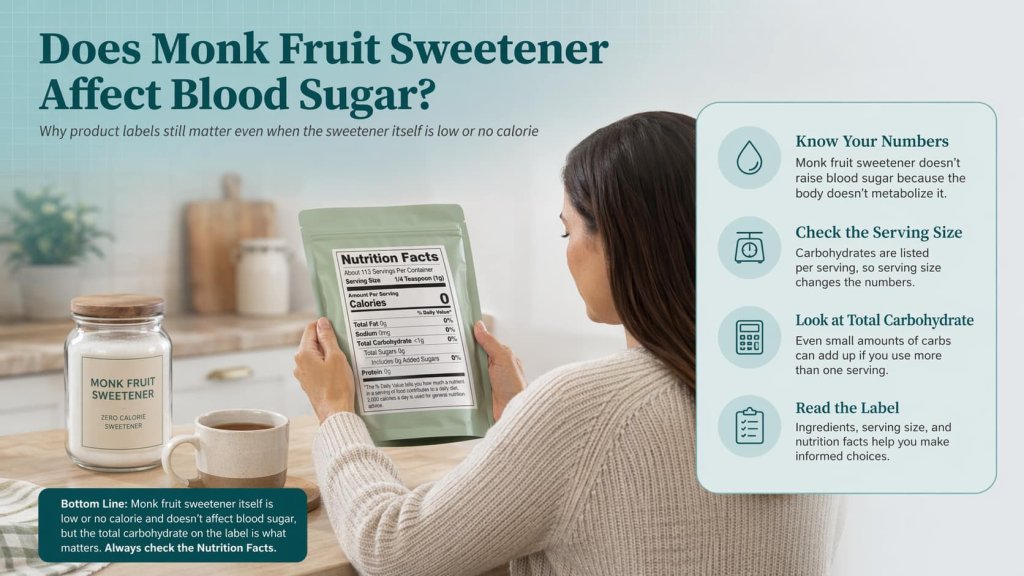
But there is an important catch: a monk fruit product is not automatically carb-free. The American Diabetes Association warns that claims such as sugar-free, reduced sugar, or no sugar added are not necessarily lower in total carbohydrate than the original product. You still need to check the serving size, total carbohydrate, and the full ingredient list on the package. The FDA Nutrition Facts label guide is a useful refresher if you want to review what those numbers mean.
Is Monk Fruit Sweetener Safe?
Yes, current U.S. guidance supports the safety of purified monk fruit extracts used in foods under intended conditions of use. On the FDA high-intensity sweeteners page, FDA explains that for certain monk fruit extracts, the agency has not questioned the notifier’s GRAS conclusion. That is different from saying monk fruit is one of the FDA-approved food additive sweeteners, but it still reflects a U.S. safety framework used for food ingredients.
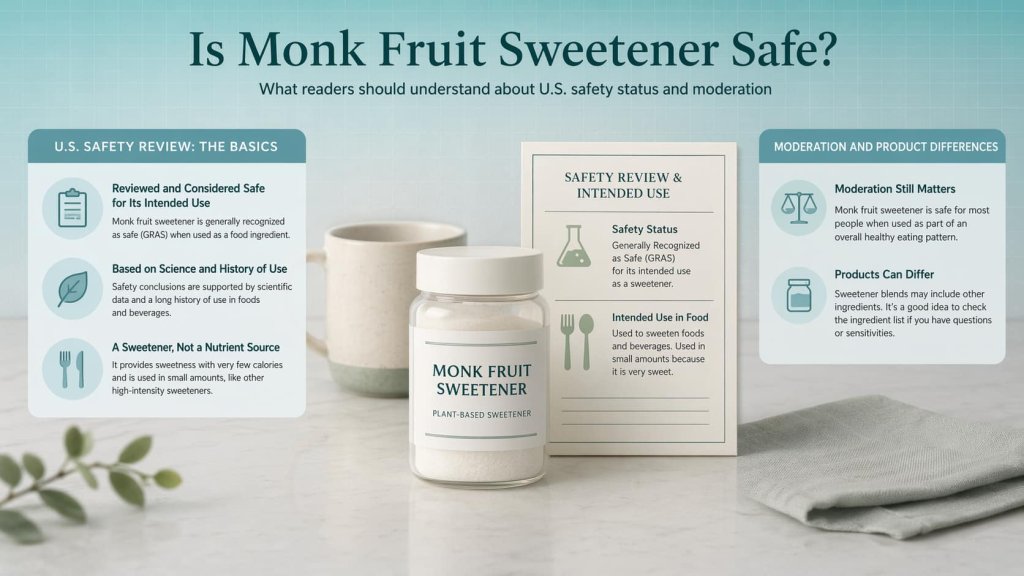
In plain language, GRAS means qualified experts concluded that a specific monk fruit extract is reasonably safe for its intended use in food. It does not mean every monk fruit product on the shelf is identical, and it does not replace the need to check the ingredient list. The safety conclusion applies to the ingredient as used, which is one reason product formulation still matters.
FDA’s current sweeteners page also does not list a formal acceptable daily intake for monk fruit, unlike some other sweeteners. That does not mean unlimited intake is a good idea. It means FDA does not provide a specific ADI number for monk fruit on that page. Moderation is still a sensible approach, especially if you use sweeteners in many foods and drinks across the day.
The MedlinePlus sugar substitutes reference also describes monk fruit as a non-nutritive sweetener that is generally recognized as safe by FDA and notes that it is heat stable, which helps explain why it appears in beverages, packets, and some baking products.
Possible Downsides of Monk Fruit Sweetener
The biggest practical downside is product formulation. Many products marketed as monk fruit sweetener are blends rather than pure monk fruit extract. According to Cleveland Clinic, manufacturers often combine monk fruit with erythritol or other ingredients to make the product measure more like sugar and taste less intensely sweet.
That matters because side effects may come from the blend, not from monk fruit itself. Cleveland Clinic notes that erythritol-containing products can cause bloating, gas, nausea, or stomach upset in some people, especially in larger amounts. FDA has also said that after reviewing a 2023 paper about possible cardiovascular effects of erythritol, the observational studies in that paper did not establish a causal link, and the agency is continuing to monitor new evidence.
This distinction is important because monk fruit itself is not a sugar alcohol. If a product labeled monk fruit sweetener causes gas, bloating, or stomach upset, the more likely reason may be a blended ingredient such as erythritol rather than the monk fruit extract alone. For people with sensitive digestion, that makes the full ingredient list especially important.
Another limitation is that monk fruit should not be sold as a proven health booster. Cleveland Clinic notes that mogrosides have antioxidant properties, but there is not solid human evidence showing that monk fruit extract itself delivers major health benefits beyond helping some people reduce sugar intake. That is the most evidence-based way to think about it right now.
How to Choose a Monk Fruit Sweetener
If you want the simplest product, focus on the ingredient list first, not the marketing on the front of the package. FDA labeling guidance explains that ingredients are listed in descending order by weight, so the first few ingredients tell you what the product mostly contains. You can also use the Nutrition Facts panel to compare serving sizes, carbs, and sweetener blends.
Here is what to check before you buy:
- Look for monk fruit extract or luo han guo extract on the ingredient list.
- See whether erythritol or another bulking ingredient appears before monk fruit extract. If it does, the product is mostly that ingredient.
- Check the Nutrition Facts label for total carbohydrate, serving size, and added sugars.
- Pick a format that matches how you actually cook: packets for drinks, liquid drops for small-volume use, or a baking blend for recipes that need more bulk.
When comparing two products, do not judge by the front label alone. Check whether the product is meant to replace sugar one-for-one, how much you need per teaspoon or cup of sugar, and whether the first ingredient is monk fruit extract or a bulking agent such as erythritol. That small step can tell you a lot about taste, digestion, baking performance, and overall value.
Using Monk Fruit Sweetener in Coffee, Tea, and Baking
Monk fruit sweetener works well in drinks and many simple foods because only a very small amount is needed. MedlinePlus says monk fruit is heat stable and gives a practical example: about 1/4 teaspoon of monk fruit sweetener can provide sweetness similar to 1 teaspoon of sugar, depending on the product.
For baking, the main point is concentration. Since monk fruit is much sweeter than sugar, straight swaps do not always work unless the recipe is designed for monk fruit or you are using a blend made for baking. Products labeled for baking often include other ingredients to add bulk and make measuring easier.
Sugar does more in baking than add sweetness. It also helps with bulk, moisture retention, spread, and browning, so a straight swap with pure monk fruit extract may leave some recipes drier, paler, or smaller in volume even when the sweetness tastes right. That is why monk fruit baking blends usually work better than pure extract in cookies, cakes, and other recipes that rely on sugar for structure.
In everyday use, monk fruit sweetener is usually easiest in:
- coffee or tea
- yogurt or oatmeal
- smoothies
- sauces and dressings
- recipes written specifically for monk fruit or monk fruit blends
Who May Want to Be Careful With Monk Fruit Sweetener?
If you have diabetes, monk fruit can be a helpful sugar-reduction tool, but it is still important to look at the full food, not just the sweetener. The American Diabetes Association emphasizes reading the total carbohydrate on the label because sugar-free does not automatically mean low-carb.
If you are sensitive to sugar alcohols or often get bloating from sugar-free products, a monk fruit blend with erythritol may not feel the same as a product that relies more heavily on pure monk fruit extract. In that case, checking the ingredient list is especially important.
During pregnancy, MedlinePlus says there is limited evidence to support either use or avoidance of sugar substitutes in general and advises moderation. For people who are pregnant, have digestive conditions, or use sweeteners heavily every day, it is reasonable to discuss the best option with a clinician or registered dietitian.
FAQ About Monk Fruit Sweetener
Is monk fruit sweetener safe for people with diabetes?
It can be a reasonable option because FDA says high-intensity sweeteners generally do not raise blood sugar levels, and the American Diabetes Association recognizes monk fruit among sweeteners considered safe for the public, including people with diabetes. The important step is still checking total carbs and serving size on the product you buy.
Is monk fruit sweetener better than sugar?
For reducing added sugar, it often can be. Monk fruit sweetener may help lower sugar intake and calorie intake compared with regular sugar, but better depends on how you use it. Replacing sugar in a drink is different from eating a heavily processed dessert that still has lots of calories from other ingredients.
Is monk fruit sweetener better than stevia?
Neither is universally better. Both are plant-derived high-intensity sweeteners used to reduce sugar. FDA says stevia-derived sweeteners are generally sweeter by weight than monk fruit, but the better pick for you is usually the one with the ingredient profile, taste, and intended use that fits your routine.
Does monk fruit sweetener contain erythritol?
Sometimes yes, sometimes no. Many retail products are blends, which is why the ingredient list matters. A product can say monk fruit sweetener on the front and still contain erythritol as a major ingredient.
Can you bake with monk fruit sweetener?
Yes. MedlinePlus says monk fruit is heat stable, so it can be used in cooking and baking. The main issue is measurement and texture, since monk fruit is much sweeter than sugar and many recipes work better with a monk fruit blend made for baking.
The Bottom Line on Monk Fruit Sweetener
Monk fruit sweetener is a useful option if your goal is to cut added sugar without giving up sweetness. It is best understood as a sugar-reduction tool, not a miracle ingredient. Choose products with clear labels, check whether they are blended with erythritol or other fillers, and match the format to how you actually eat and cook.
If you are deciding between sugar, stevia, and monk fruit, start with your real goal: better blood sugar awareness, fewer added sugars, easier baking, or fewer stomach issues from blends. Once you know that, the label usually tells you the answer.
References
- U.S. Food and Drug Administration — Aspartame and Other Sweeteners in Food
- U.S. Food and Drug Administration — High-Intensity Sweeteners
- MedlinePlus — Sweeteners – sugar substitutes
- American Diabetes Association — Get to Know Carbs
- U.S. Food and Drug Administration — The Nutrition Facts Label
- American Heart Association — Added Sugars