

Most people burn about 380 to 500 calories in 10,000 steps if they weigh around 154 pounds and cover roughly 4.8 miles. The exact number can be lower or higher depending on your body weight, walking speed, stride length, and whether you are walking on flat ground or hills. If you are searching for how many calories burned in 10000 steps, the best answer is a realistic range, not one fixed number. According to the Centers for Disease Control and Prevention, a 154-pound person burns about 280 calories per hour walking at 3.5 mph and about 460 calories per hour walking at 4.5 mph. In a 2024 update, the National Heart, Lung, and Blood Institute noted that about 5,000 daily steps equaled 2.4 miles in an adult sample, which puts 10,000 steps at about 4.8 miles as a practical working estimate.
That matters because a flat “10,000 steps burns X calories” claim can be misleading. Your actual calorie burn depends on how far those steps take you, how quickly you move, and how much body mass you are carrying while you walk. For health planning or weight goals, the National Institute of Diabetes and Digestive and Kidney Diseases recommends using its Body Weight Planner rather than relying on a one-size-fits-all guess.
How many calories does 10,000 steps burn for most people?
Using the CDC’s walking calorie rates for a 154-pound adult and the NHLBI distance example, 10,000 steps works out to roughly 384 calories at 3.5 mph and 491 calories at 4.5 mph. Rounded for everyday use, that is about 380 to 500 calories. These are still estimates, but they are grounded in official activity tables rather than internet myths.
A useful shortcut is to think in blocks of 1,000 steps. For a 154-pound person, 1,000 steps is often roughly 38 to 50 calories based on the same walking pace and distance assumptions used in this article. That means 8,000 steps may be around 300 to 400 calories, while 12,000 steps may be around 460 to 600 calories. This is not exact, but it gives readers a faster way to scale the estimate up or down for real life.
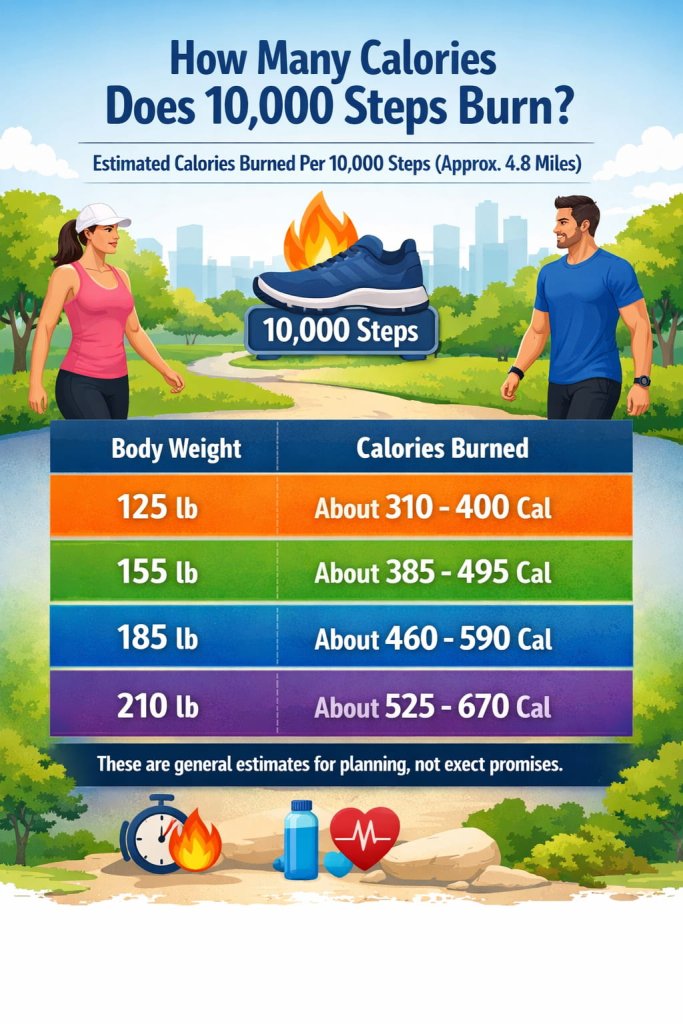
Here is a rough example of how that range can shift by body weight. These figures scale from the CDC’s 154-pound reference and assume the same approximate 10,000-step distance of 4.8 miles.
| Body weight | Approximate calories burned in 10,000 steps |
|---|---|
| 125 lb | About 310 to 400 |
| 155 lb | About 385 to 495 |
| 185 lb | About 460 to 590 |
| 210 lb | About 525 to 670 |
These are useful planning numbers, not exact promises. The CDC notes that calories burned are higher for people who weigh more than 154 pounds and lower for people who weigh less.
Why calorie burn in 10,000 steps is different for everyone

Body weight changes the total
In general, heavier bodies use more energy to move the same distance, while lighter bodies use less. That is why two people can both hit 10,000 steps and still get very different calorie totals from the day. The CDC’s own table is based on a 154-pound reference person and explicitly notes that the number rises or falls with body weight.
Walking speed changes calories per minute
The faster you walk, the more calories you usually burn per minute. The CDC lists walking at 3.5 mph as burning about 280 calories per hour for a 154-pound person, while walking at 4.5 mph burns about 460 calories per hour. So even with the same step count, a brisker pace can raise the total meaningfully.
Step length changes distance
Ten thousand steps does not always equal the same mileage. Taller people or people with longer strides may cover more ground in 10,000 steps, while shorter people may cover less. The NHLBI example of 5,000 steps equaling 2.4 miles is a practical benchmark, but it is still an average, not a rule for every person.
Terrain and effort matter too
Flat treadmill walking, outdoor hills, frequent stop-and-go movement, and carrying your body uphill do not cost the same amount of energy. Even if your watch shows the same step count, the effort level can change the calorie result. The CDC notes that aerobic activity intensity depends on how hard your body is working, not just the movement itself.
The easiest way to personalize the estimate is to check how many miles your own 10,000 steps usually equals on your phone, watch, or walking app. If your 10,000 steps is closer to 4.2 miles than 4.8 miles, your calorie burn will usually be lower than the main estimate. If it is closer to 5 miles and you walk briskly, it may be higher. For a more accurate number, use your actual body weight, pace, and activity pattern in a personalized planning tool instead of relying on a generic step chart.
How long does 10,000 steps usually take?
If 10,000 steps is about 4.8 miles, it would take roughly 82 minutes at 3.5 mph and about 64 minutes at 4.5 mph. Real life is usually messier than that because people pause, cross streets, split steps across the day, and change pace. Still, this gives you a useful estimate for planning a walk or checking whether your daily steps are likely to meet weekly activity targets.
Is 10,000 steps enough for weight loss?
It can help, but it does not guarantee weight loss by itself. Weight loss usually depends on your overall calorie balance over time, including food intake, daily movement, structured exercise, and how consistently you maintain a calorie deficit. That is why the NIDDK offers a Body Weight Planner for personalized calorie and activity planning instead of a single universal rule.
In practical terms, burning around 380 to 500 calories from 10,000 steps can be meaningful. For some people, that amount of walking helps create part of the daily deficit they need. For others, it mainly supports weight maintenance, appetite control, fitness, and better overall activity levels. The most useful way to think about 10,000 steps is not as a magic fat-loss switch, but as one strong habit inside a bigger routine.
Do you need 10,000 steps a day for health benefits?
No. Ten thousand steps is a popular target, but it is not an official minimum for health. The CDC says adults need at least 150 minutes of moderate-intensity activity a week, such as brisk walking, plus muscle-strengthening activity on 2 days each week.
Research also shows that meaningful health gains can happen below 10,000 steps. In an NIH-reported study, adults taking 8,000 steps per day had a 51% lower risk of all-cause mortality than those taking 4,000 steps per day, and 12,000 steps was associated with a 65% lower risk. The same report found that total daily steps mattered more than step intensity for mortality risk.
More recently, a 2025 Lancet systematic review reported that around 7,000 steps per day was associated with lower risk across several outcomes, including all-cause mortality, cardiovascular disease, type 2 diabetes, dementia, depression, and falls. The authors also noted that health benefits were seen even around 4,000 steps compared with very low activity levels. That makes 10,000 steps a strong goal for many people, but not the only meaningful one.
How to burn more calories in the same 10,000 steps
Walk at a brisk pace
The CDC lists brisk walking at 2.5 mph or faster as moderate-intensity activity. A faster pace generally means more calories burned per minute and can help the same 10,000 steps do more work for fitness and energy expenditure.
Make more of your steps intentional
Ten thousand casual steps spread across errands and household movement can still be helpful, but purposeful walking usually raises your pace and your total effort. A dedicated walk in the morning, at lunch, or in the evening often burns more calories than slowly accumulating the same number in tiny fragments. This also makes it easier to line your routine up with the CDC’s weekly activity guidance.
Add hills or inclines when it feels comfortable
Walking uphill or on an incline usually raises intensity compared with the same number of flat steps. That means more work from your muscles and, often, more calories used for the same step total. You do not need extreme incline sessions to benefit. Even small increases in effort can make a difference.
Common questions about calories burned in 10,000 steps
Is 10,000 steps about 5 miles?
Often, yes. A useful real-world estimate is about 4.8 miles, based on the NHLBI example that 5,000 steps was about 2.4 miles in an adult group. Some people will be a bit below or above that depending on stride length.
How many calories burned in 10,000 steps on a treadmill?
It can be similar to outdoor walking if your pace and effort are similar. The exact number still depends on body weight, treadmill incline, and speed. Flat treadmill walking at an easy pace may burn less than faster outdoor walking with hills, even if the step count is identical. The same CDC walking calorie rates are a useful starting point.
Why does my watch show a different calorie number?
Your watch or fitness tracker can be useful for spotting trends, but its calorie estimate is not a perfect measurement. Different devices use different formulas, and calorie-burn estimates can vary quite a lot from one device to another. That is why it is better to treat your watch as a helpful estimate, not a precise calorie total for 10,000 steps. Stanford Medicine reported that consumer wearables measured heart rate reasonably well, but none of the tested devices measured energy expenditure accurately.
Is 10,000 steps a day too much?
For many healthy adults, it is a reasonable target. But if you are very inactive, recovering from injury, or dealing with pain, jumping straight to 10,000 steps can be too aggressive. The CDC emphasizes that some activity is better than none, and building up gradually is often the smarter approach.
Bottom line
A realistic answer to how many calories burned in 10000 steps is usually about 380 to 500 calories for a 154-pound person, with lower totals for lighter people and higher totals for heavier people. Your pace, distance, terrain, and body size all matter, so treat any single number as an estimate, not a guarantee. If you want the most accurate figure for your own body and goals, use the NIDDK Body Weight Planner and pair your step goal with a routine you can actually maintain.
Safety note
If you are new to exercise, have joint pain, heart or lung symptoms, dizziness, or a recent injury, build up your walking gradually and check with a qualified healthcare professional before sharply increasing your activity. The NIDDK Body Weight Planner is intended for adults and is not a substitute for medical advice.
This content is for informational purposes only and not medical advice.
Sources and References
- Centers for Disease Control and Prevention — Physical Activity and Your Weight and Health
- Centers for Disease Control and Prevention — Adult Activity: An Overview
- Centers for Disease Control and Prevention — How to Measure Physical Activity Intensity
- National Institute of Diabetes and Digestive and Kidney Diseases — About the Body Weight Planner
- National Heart, Lung, and Blood Institute — Short-Term Incentives for Exercise Can Lead to Sustained Increases in Activity
- National Institutes of Health — Higher Daily Step Count Linked With Lower All-Cause Mortality
- EurekAlert — Aiming for 7,000 Daily Steps Can Reduce Risk of Chronic Diseases, Cognitive Decline, and Death
- Stanford Medicine — Fitness Trackers Accurately Measure Heart Rate but Not Calories Burned