
For most adults, 6 hours of sleep is not enough on a regular basis. Major U.S. health authorities recommend at least 7 hours for adults, and many adults do best in the 7 to 9 hour range. Understanding this matters because sleep affects not just energy, but also mood, concentration, driving safety, heart health, and long-term wellbeing. (CDC)
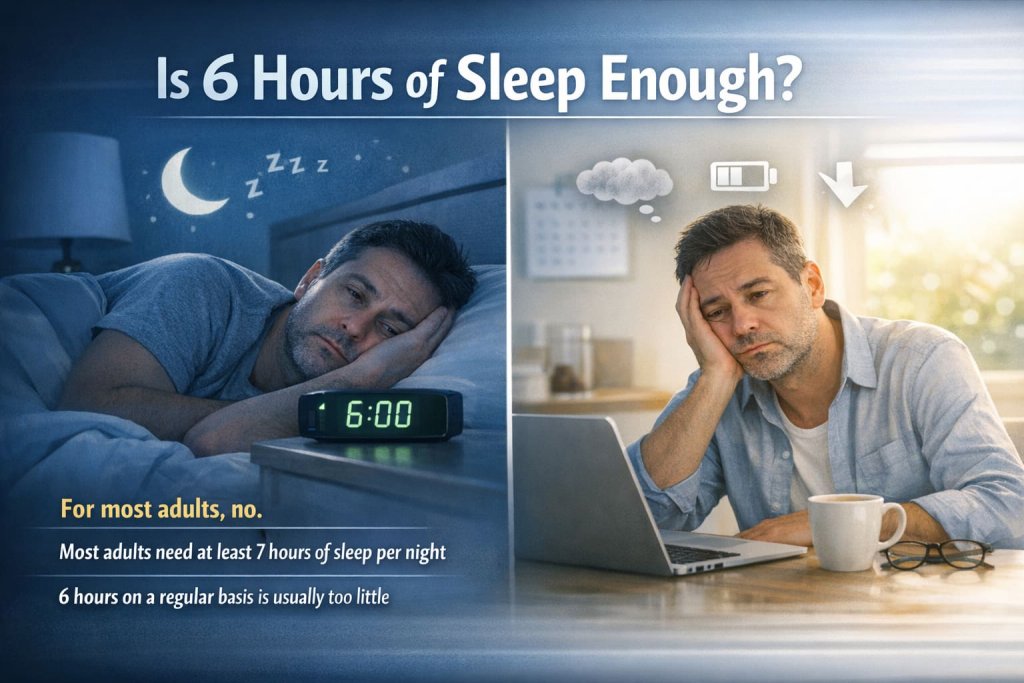
If you are wondering whether you can get by on 6 hours, the practical answer is this: an occasional short night happens, but a steady pattern of 6-hour sleep is usually too little for healthy adults. The better question is not whether you can push through the day, but whether your sleep is enough to keep you alert, functioning well, and healthy over time. (CDC heart health guidance)
Is 6 Hours of Sleep Enough for Adults?
According to CDC sleep recommendations, adults ages 18 to 60 should get 7 or more hours of sleep per night. The National Heart, Lung, and Blood Institute says adults generally need 7 to 9 hours, and the American Academy of Sleep Medicine recommends 7 or more hours on a regular basis to support health, productivity, and daytime alertness. That means 6 hours falls below the recommended range for most adults.
This recommendation is not just about comfort. A joint sleep-medicine consensus statement concluded that adults should sleep 7 or more hours per night on a regular basis, and that sleeping less than 7 hours is associated with adverse health outcomes. In plain terms, 6 hours is usually not enough just because you can still function the next morning. (Sleep consensus statement)
Why 6 Hours of Sleep Is Usually Too Little
Regular short sleep is linked with a higher risk of several important health problems. The NHLBI overview of sleep deprivation and CDC both connect insufficient sleep with problems such as high blood pressure, heart disease, stroke, type 2 diabetes, obesity, depression or anxiety, injury risk, and reduced mental performance. NIH also notes that too little sleep can hurt attention, learning, memory, decision-making, and reaction time. (NHLBI)
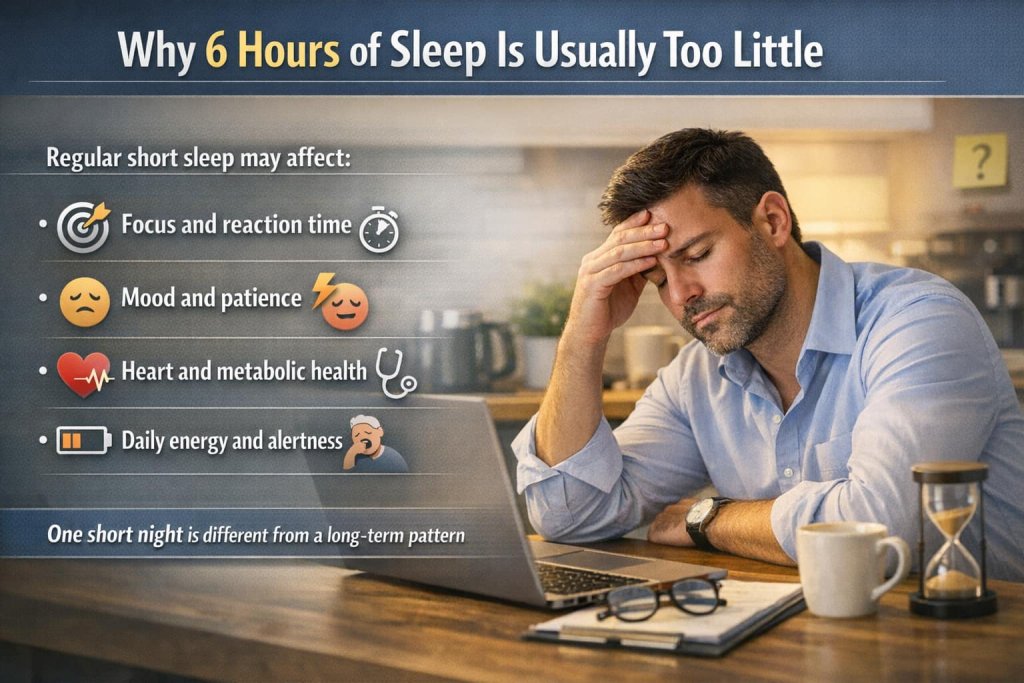
That long-term pattern matters more than one rough night. CDC explains that not getting enough sleep may be manageable for a day or two, but over time it can lead to serious health problems or worsen existing ones. So if you sleep 6 hours once because of travel, a deadline, or a sick child, that is very different from sleeping 6 hours nearly every night for months. (CDC heart health guidance)
Sleep is also a safety issue. The American Academy of Sleep Medicine says healthy sleep supports daytime alertness and reduces risks such as drowsy driving and workplace accidents. If 6 hours leaves you foggy, irritable, or struggling to focus, your body is already telling you it is not enough. (AASM)
Can Some People Function Well on 6 Hours?
Yes, but that is not the norm. NIH research and MedlinePlus describe a small group of natural short sleepers who appear to need much less sleep because of genetic variation and do not have abnormal daytime sleepiness. But most adults are not natural short sleepers, and most still need at least 7 hours. (NIH research update)
That is why saying “I feel okay on 6 hours” is not always a reliable test. Some people adapt to feeling tired, or they normalize poor concentration, irritability, or afternoon sleepiness. Health guidance focuses on what supports health on a regular basis, not just what feels barely manageable. (AASM)
Is 6 Hours of Sleep Enough if the Sleep Quality Is Good?
Good sleep quality matters, but it does not erase the need for enough total sleep. CDC says healthy sleep includes both enough hours and good-quality sleep. Quality sleep means uninterrupted, refreshing sleep, while signs of poor sleep quality include trouble falling asleep, waking up repeatedly during the night, or still feeling sleepy or tired even after sleeping.
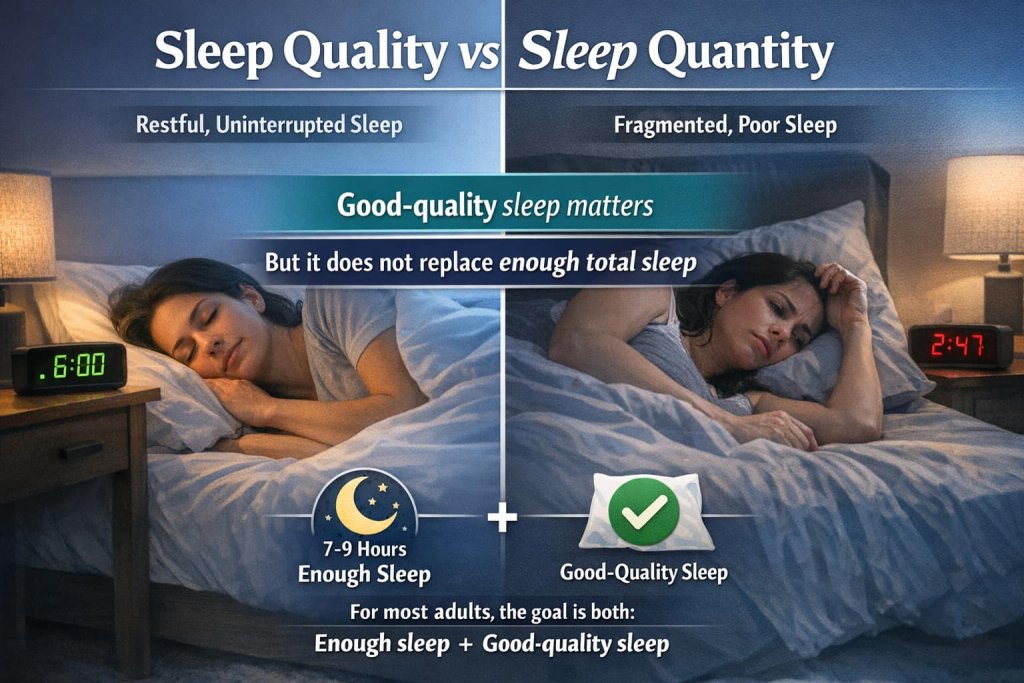
So if you sleep 6 solid hours and wake up refreshed, that is better than 8 hours of broken, poor-quality sleep. But for most adults, the healthiest target is still enough sleep and good-quality sleep, not one instead of the other.
What if you work nights or rotating shifts?
This is one of the biggest exceptions worth mentioning. Sometimes the problem is not just sleeping too little, but sleeping at the wrong time for your body clock. NHLBI says sleep deficiency can happen when you do not get enough sleep, sleep at the wrong time of day, sleep poorly, or have a sleep disorder.
That means someone working night shifts may still struggle even if total hours look reasonable on paper. If 6 hours is happening because of shift work or an irregular schedule, it becomes even more important to protect sleep timing, keep your routine as consistent as possible, and reduce bright light exposure before bedtime.
Is 6 Hours of Sleep Enough for Teens or Older Adults?
For teens, no. CDC says teenagers ages 13 to 17 should get 8 to 10 hours of sleep per night, so 6 hours is clearly too little for most teens. Short sleep in children and adolescents is linked to higher risks of poor mental health, injuries, attention problems, behavior problems, and poor school performance.
For older adults, 6 hours is still usually below the recommended amount. One useful detail here is that the guidance gets a little more specific with age. CDC says adults ages 61 to 64 should generally get 7 to 9 hours, while adults 65 and older should usually get 7 to 8 hours per night. That does not mean every older adult will sleep exactly the same amount, but it does reinforce the main point: 6 hours is still below the usual recommended range for most older adults.
The National Institute on Aging also notes that sleep patterns often change with age, which can make sleep feel lighter or more broken up, but that does not automatically mean older adults need much less sleep. In other words, getting older does not usually mean your body suddenly only needs 6 hours.
How to Tell if 6 Hours of Sleep Is Not Enough for You
A simple way to assess this is to look at how you feel and function during the day. Common clues that you may not be getting enough sleep include:
- waking up unrefreshed or relying heavily on an alarm
- feeling sleepy, tired, or mentally dull during the day
- trouble focusing, frequent blinking, heavy eyelids, or repeated yawning
- irritability, lower patience, or worse mood
- sleeping much longer on days off because your body is trying to catch up
If these sound familiar, 6 hours is probably not enough for you, even if you have gotten used to it.
What to Do if You Are Only Getting 6 Hours of Sleep
The first step is to make more room for sleep if your schedule is squeezing it out. NIH recommends going to bed and waking up at the same time every day, keeping weekend sleep schedules close to weekday schedules, using the hour before bed for quiet time, avoiding heavy meals and alcohol before bed, and keeping your bedroom quiet, cool, and dark. NHLBI also recommends avoiding nicotine and caffeine close to bedtime and getting daytime light and physical activity when possible.
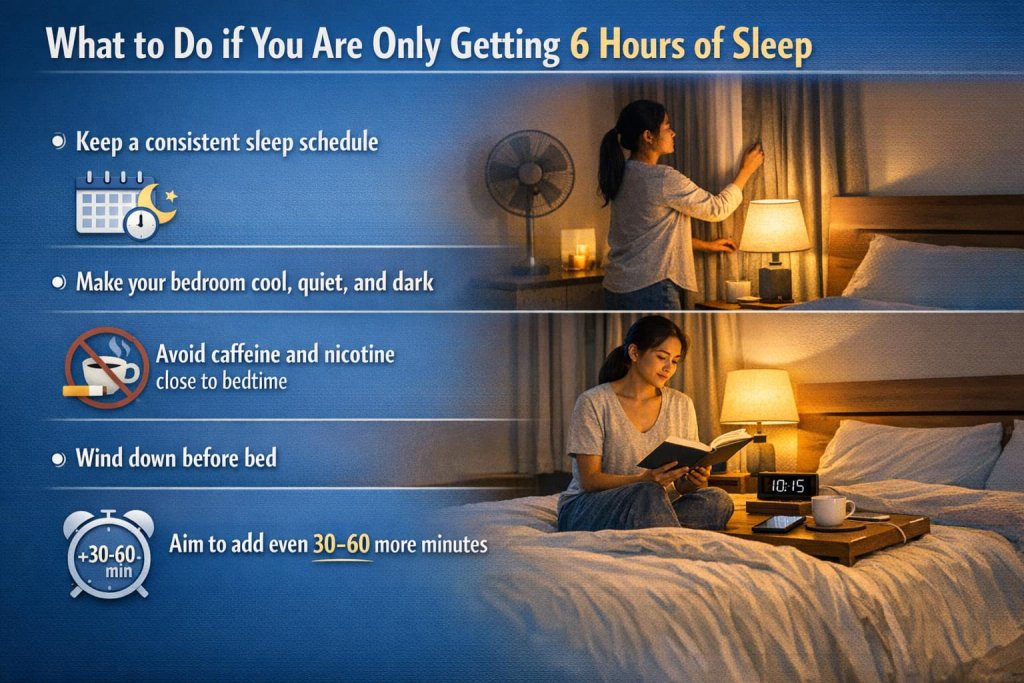
If you are sleeping 6 hours because of habits rather than unavoidable circumstances, even adding 30 to 60 minutes can help move you closer to the recommended range. The goal is not perfection overnight. The goal is to stop treating 6 hours as a healthy default if your body is showing you otherwise.
A note on weekend catch-up sleep
Sleeping in on weekends may help you feel somewhat better in the short term, but it is not a reliable fix for chronic sleep loss. NIH reported that weekend recovery sleep did not reverse all of the metabolic disruptions caused by repeated short sleep in a controlled study. That makes a consistent sleep routine more useful than repeatedly running a sleep deficit and trying to repay it later.
Can naps make up for sleeping only 6 hours?
Naps can help with short-term alertness, but they are not a full replacement for enough sleep at night. NHLBI explains that if you regularly lose sleep, that loss adds up as sleep debt. A short nap may briefly improve alertness and performance, but it does not provide all the benefits of nighttime sleep, so it cannot fully make up for chronic 6-hour nights.
If you do nap, keep it short. NHLBI says adults should usually nap for no more than about 20 minutes, especially if longer naps make it harder to fall asleep at night. That makes naps a useful backup tool, not a real solution to ongoing short sleep.
When 6 Hours of Sleep May Point to a Bigger Problem
Sometimes short sleep is not just a schedule problem. If you are giving yourself enough time in bed but still only sleeping about 6 hours, the issue may be insomnia, fragmented sleep, shift-work disruption, or a sleep disorder such as sleep apnea. NHLBI says sleep apnea can involve snoring, gasping for air during sleep, and excessive daytime sleepiness.
Talk with a clinician if you regularly feel sleepy during the day, struggle to get enough sleep despite trying, or have symptoms like loud snoring, choking, gasping, or witnessed breathing pauses during sleep. The National Institute on Aging specifically advises talking with a doctor if you are always sleepy or find it hard to get enough sleep at night.
FAQ: Is 6 Hours of Sleep Enough?
Is 6 hours of sleep enough for weight loss or fitness goals?
Usually no. There is no official rule that 6 hours blocks progress by itself, but major health authorities link short sleep with obesity risk, poorer metabolic health, and lower overall wellbeing. If you are trying to manage weight, train consistently, or recover well, sleeping in the recommended range is the safer evidence-based target.
Is 6 hours of sleep enough if I wake up naturally?
Not necessarily. Waking up without an alarm can happen for many reasons, including habit, stress, or timing. The more useful question is whether you feel consistently alert, rested, and well during the day. Because most adults still need at least 7 hours, waking up after 6 hours does not automatically mean 6 hours is ideal for you.
Can you train yourself to need only 6 hours of sleep?
There is no mainstream medical guidance saying most people can safely train themselves to need less sleep. Some people naturally need less sleep because of genetic variation, but that is different from chronically restricting sleep. For most adults, the recommended amount remains at least 7 hours.
Is 6 hours of sleep enough for older adults?
Usually not. Older adults generally still need around 7 to 9 hours, and adults 65 and older usually need 7 to 8 hours, even though sleep patterns often change with age. If an older adult is regularly sleeping only 6 hours and feels sleepy, unwell, or unrefreshed, it is worth discussing with a healthcare professional.
Safety Box: When to Get Checked
Ask a healthcare professional about your sleep if you have any of these:
- ongoing daytime sleepiness
- trouble getting enough sleep despite making schedule changes
- loud snoring, choking, or gasping during sleep
- someone notices pauses in your breathing
- sleep problems that are affecting driving, work, mood, or daily function
Conclusion
Is 6 hours of sleep enough? For most adults, no. The most reliable evidence says adults should usually get at least 7 hours, and many do best with 7 to 9 hours. If 6 hours is your normal, use your daytime alertness, mood, and overall health as your reality check, and do not ignore signs that your body needs more rest. If your sleep stays short even when you try to improve it, getting medical advice is a smart next step.
This content is for informational purposes only and not medical advice.
References
- Centers for Disease Control and Prevention — Sleep | Chronic Disease Indicators
- National Heart, Lung, and Blood Institute — Healthy Sleep Habits
- National Heart, Lung, and Blood Institute — Heart-Healthy Living: Get Enough Good-Quality Sleep
- National Heart, Lung, and Blood Institute — What Is Sleep Apnea?
- National Institute on Aging — Sleep and Older Adults
- MedlinePlus — Natural Short Sleeper
- National Institutes of Health — Gene identified in people who need little sleep
- National Institutes of Health — Weekend catch-up can’t counter chronic sleep deprivation