
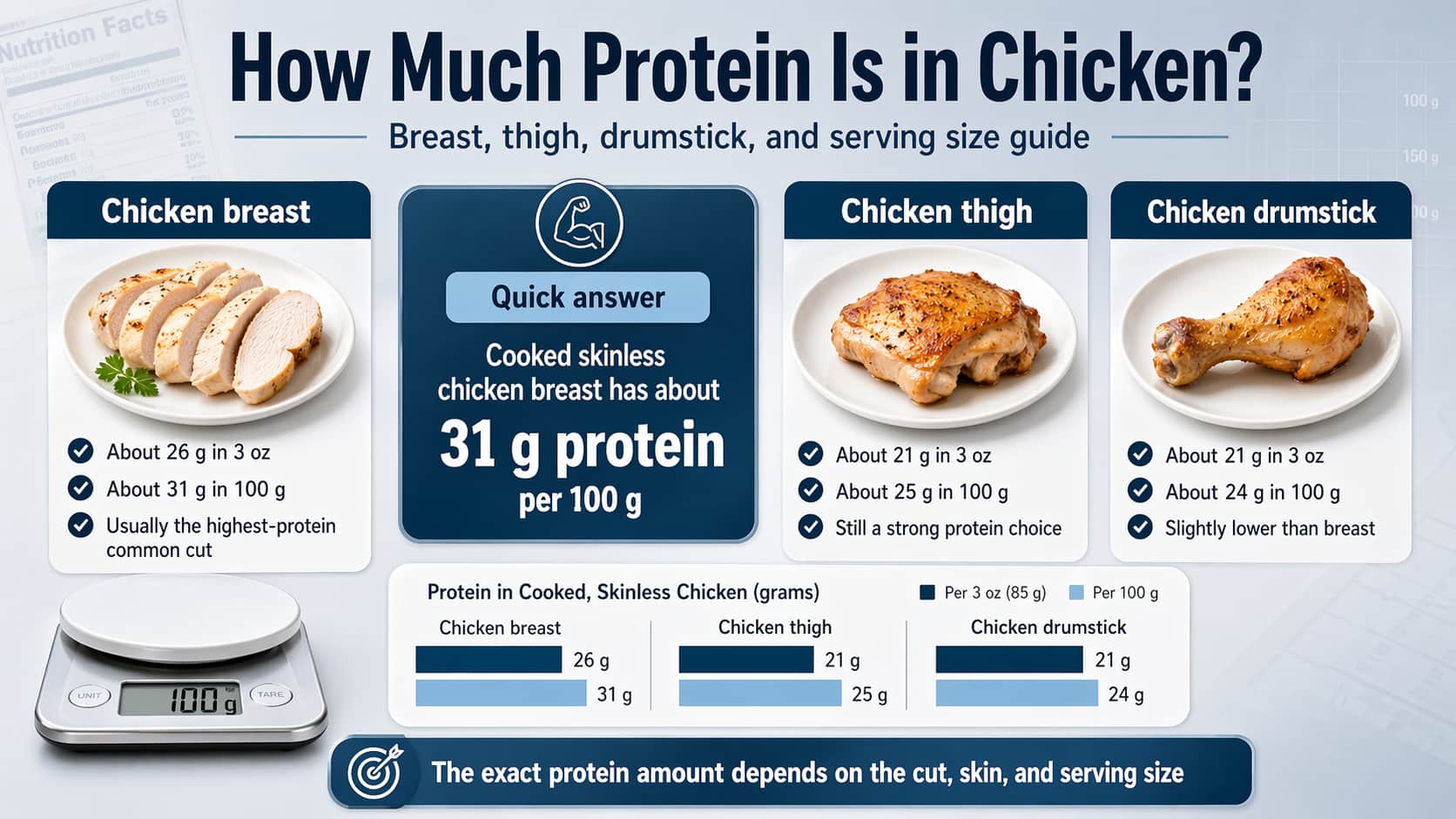
Cooked skinless chicken breast has about 31 grams of protein per 100 grams, or about 26 grams in a 3-ounce serving. That makes chicken one of the easiest high-protein foods to use when you want a lean, practical protein source. The exact amount can still vary based on the cut, whether the skin is on, and whether you are comparing raw or cooked portions.
A USDA-derived chicken nutrient table summarized by the National Chicken Council lists cooked roasted skinless boneless chicken breast at 31.02 grams of protein per 100 grams. The same table shows that chicken thigh and drumstick are also rich in protein, just a little lower per equal cooked weight.
Quick answer: protein in common chicken cuts
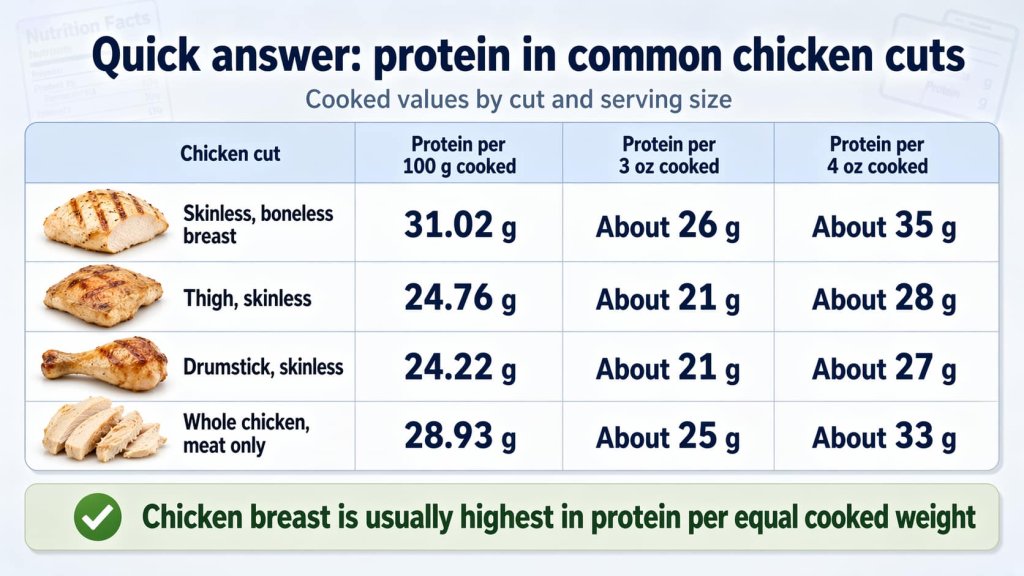
The table below uses cooked, roasted values from the USDA-derived reference data. The 3-ounce and 4-ounce values are practical estimates based on the 100-gram figures.
| Chicken cut | Protein per 100 g cooked | Protein per 3 oz cooked | Protein per 4 oz cooked |
|---|---|---|---|
| Skinless, boneless breast | 31.02 g | about 26 g | about 35 g |
| Thigh, skinless | 24.76 g | about 21 g | about 28 g |
| Drumstick, skinless | 24.22 g | about 21 g | about 27 g |
| Whole chicken, meat only | 28.93 g | about 25 g | about 33 g |
These numbers are close enough for everyday meal planning. If you want a more exact number, weigh the cooked portion in grams and compare it with the Nutrition Facts label or a USDA-style entry for the exact product.
How much protein is in chicken breast?
Chicken breast is usually the highest-protein common chicken cut per equal cooked weight. The USDA-derived table lists cooked roasted skinless boneless breast at 31.02 grams of protein per 100 grams.
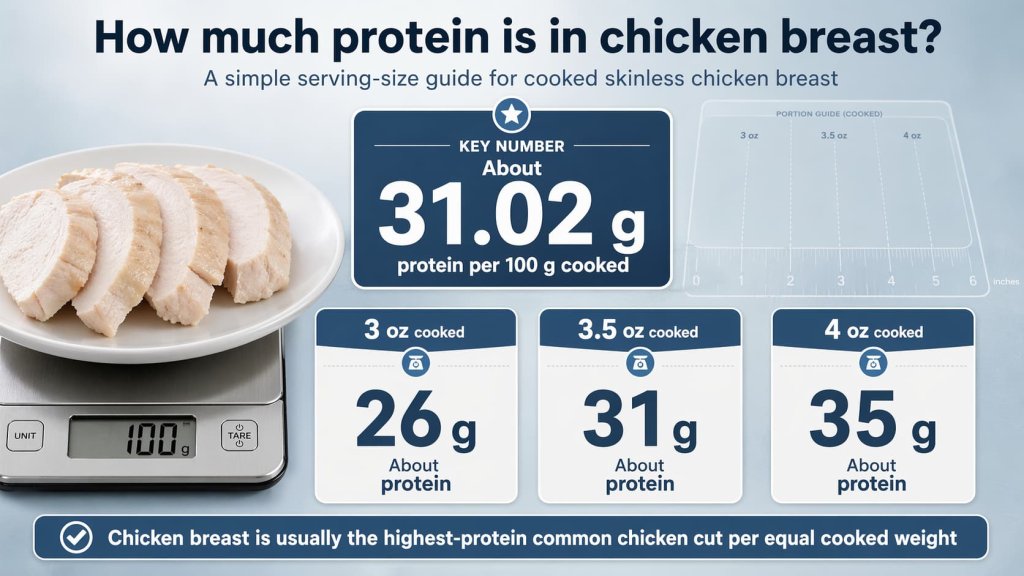
That works out to these easy estimates:
- 3 ounces cooked: about 26 grams of protein
- 3.5 ounces cooked: about 31 grams of protein
- 4 ounces cooked: about 35 grams of protein
That is why chicken breast is such a common choice in high-protein meal plans. It provides a lot of protein without much fat and is easy to portion.
How much protein is in one chicken breast?
One chicken breast does not have a fixed protein amount because breast sizes vary quite a bit. The most accurate method is to weigh the cooked portion and use the USDA-based reference of about 31 grams of protein per 100 grams of cooked skinless chicken breast.
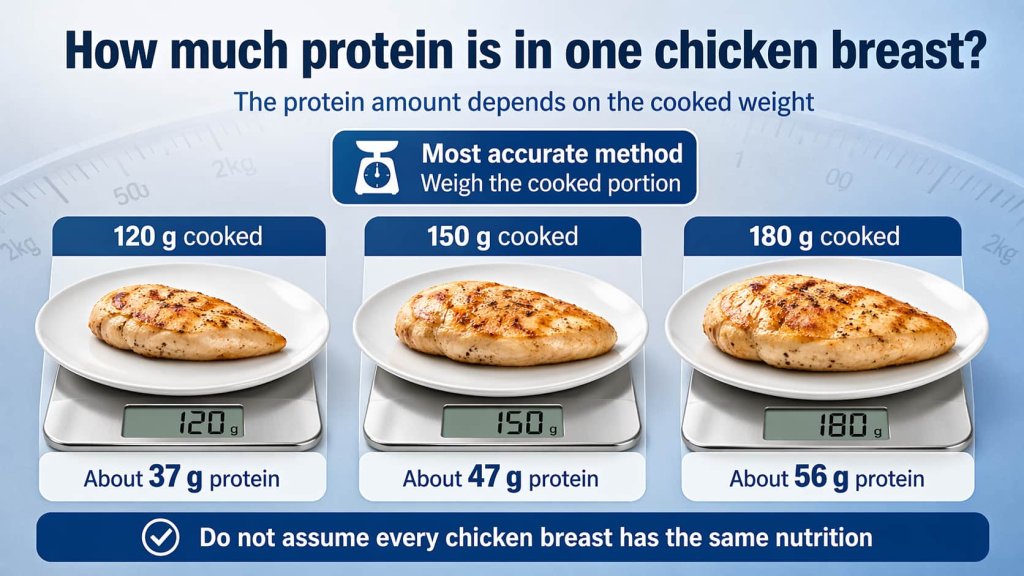
That works out to these quick estimates:
- 120 g cooked chicken breast: about 37 g protein
- 150 g cooked chicken breast: about 47 g protein
- 180 g cooked chicken breast: about 56 g protein
This is much more accurate than assuming every chicken breast has the same nutrition.
How much protein is in chicken thigh and drumstick?
Chicken thigh and drumstick still provide a strong amount of protein, just a bit less than breast when you compare the same cooked weight. The USDA-derived table lists skinless thigh at 24.76 grams of protein per 100 grams and skinless drumstick at 24.22 grams per 100 grams.
That means a typical 3-ounce cooked serving of either one gives you roughly 21 grams of protein. If you prefer darker meat, the difference is not huge for most people. The main practical takeaway is simple: breast is the leanest high-protein option, but thighs and drumsticks are still very good protein choices.
Is skin-on chicken lower in protein per 100 grams?
Usually, yes. In the same USDA-derived table, skinless thigh is listed at 24.76 grams of protein per 100 grams, while skin-on thigh is 23.26 grams. Skinless drumstick is 24.22 grams, while skin-on drumstick is 23.35 grams. Whole chicken meat only is also higher in protein per 100 grams than whole chicken meat with skin.
That does not mean skin-on chicken is a poor choice. It simply means that more of the weight comes from skin and fat rather than lean meat, so the protein density is lower when you compare equal weights.
How much chicken do you need for 25, 30, or 50 grams of protein?
Using cooked skinless chicken breast as the reference point, these are good estimates:
- About 2.8 ounces cooked chicken breast for 25 grams of protein
- About 3.4 ounces cooked chicken breast for 30 grams of protein
- About 5.7 ounces cooked chicken breast for 50 grams of protein
This is helpful when you are planning meals around a protein target instead of guessing by eye. A modest cooked chicken breast portion often gets you close to 25 to 30 grams of protein, which is one reason it is such a popular meal-prep food.
Why protein numbers on chicken labels can look different
This is one of the biggest reasons people get confused. Two packages of chicken may not show the same protein number, even when both are chicken.
Cut and skin matter
Breast, thigh, drumstick, wing, and whole chicken do not have the same protein content. Skin-on versions also tend to have lower protein density per 100 grams than skinless versions because more of the weight comes from fat and skin.
Serving size matters
The FDA guide to serving size on the Nutrition Facts label explains that labels show both a household serving and the metric weight in grams. If one product uses an 85-gram serving and another uses 112 grams, the protein numbers will naturally look different unless you compare them at the same weight.
Added water or solution matters
The USDA FSIS guidance on water in meat and poultry notes that it is not unusual for poultry to declare 8% to 12% retained water on the label. That can lower the protein amount shown per serving compared with plain chicken.
Raw and cooked values are not the same thing
Cooked chicken often looks higher in protein per 100 grams than raw chicken because cooking changes the water content. The most accurate comparison is to match the form listed on the label or in the database entry.
The easiest way to track chicken protein accurately
The simplest rule is to match the form you weigh with the form you log.
- If you weigh chicken after cooking, use cooked nutrition values
- If you weigh chicken raw, use the raw label or raw database entry
- Compare chicken by grams or ounces, not by “1 breast” or “1 thigh,” because piece sizes vary
This helps prevent one of the most common food-tracking mistakes: weighing cooked chicken but logging it as raw, or the reverse.
Plain chicken vs breaded or fried chicken
The protein numbers in this article refer to plain chicken cuts. Breaded tenders, nuggets, fried chicken, and heavily marinated products can have very different amounts of protein, calories, fat, sodium, and carbohydrates per serving.
For these products, the Nutrition Facts label is usually more useful than a generic chicken estimate. If the product includes breading, seasoning blends, or added solution, do not assume it matches plain chicken breast or thigh.
How chicken fits into your daily protein needs
For label context, the FDA Daily Value guide sets the Daily Value for protein at 50 grams per day. That means 100 grams of cooked chicken breast, at about 31 grams of protein, provides roughly 62% of that amount.
For broader nutrition guidance, the National Academies Dietary Reference Intakes table lists protein recommendations of 56 grams per day for adult men and 46 grams per day for adult women. It also notes the general adult baseline of 0.8 grams of protein per kilogram of body weight per day. The same table lists 71 grams per day during pregnancy and 71 grams per day during lactation.
Safe cooking note
Protein content matters, but food safety matters too. The USDA FSIS safe minimum internal temperature chart says chicken should reach 165°F (74°C) before eating.
FAQ
How much protein is in 4 oz of chicken breast?
A 4-ounce cooked serving of skinless chicken breast has about 35 grams of protein, based on the USDA-derived value of 31.02 grams per 100 grams.
Does chicken thigh have less protein than chicken breast?
Yes, when you compare the same cooked weight. In the USDA-derived table, skinless thigh has 24.76 grams per 100 grams, while skinless boneless breast has 31.02 grams per 100 grams.
Is 3 oz of chicken a good serving size?
For many people, yes. A 3-ounce cooked serving of chicken breast provides about 26 grams of protein, which is a meaningful amount for one meal. Exact needs still vary by person.
Why does one chicken package show less protein than another?
The most common reasons are the cut, whether the skin is on, the serving size in grams, and whether the product contains retained water or added solution. USDA FSIS notes that poultry labels may declare 8% to 12% retained water, which can affect the protein amount shown per serving.
Conclusion
If you want the simplest answer, use this: cooked skinless chicken breast has about 31 grams of protein per 100 grams, or about 26 grams in 3 ounces. Thighs and drumsticks are slightly lower, but they are still excellent protein choices.
The key is to compare the same cut, the same serving weight, and the same raw-or-cooked form. When you shop, read the label carefully, compare the gram weight, and watch for retained water or added solution. That gives you a much clearer picture of how much protein is really in your chicken.
References
- USDA Agricultural Research Service — FoodData Central
- National Chicken Council — Nutrition & Health
- U.S. Food and Drug Administration — Daily Value on the Nutrition and Supplement Facts Labels
- U.S. Food and Drug Administration — Serving Size on the Nutrition Facts Label
- National Academies of Sciences, Engineering, and Medicine — Dietary Reference Intakes (DRIs): Recommended Dietary Allowances and Adequate Intakes, Total Water and Macronutrients
- USDA Food Safety and Inspection Service — Water in Meat & Poultry
- USDA Food Safety and Inspection Service — Safe Minimum Internal Temperature Chart