
There is no single official civilian chart that says exactly how many pull-ups everyone should do at each age. For kids and teens, age-based systems usually use modified pull-ups or school fitness standards. For adults, health authorities focus on doing regular strength training rather than hitting a fixed pull-up number. The clearest official age-banded pull-up chart comes from the Marine Corps, which uses different scoring tables by age group.

That matters because “how many pull-ups by age” sounds simple, but the right answer depends on what kind of test is being used, whether the reps are strict, and why you are comparing yourself in the first place. If you are checking youth fitness, school standards, general health, or a military test, you may be looking at four very different systems.
Is There an Official Pull-Up Standard by Age?
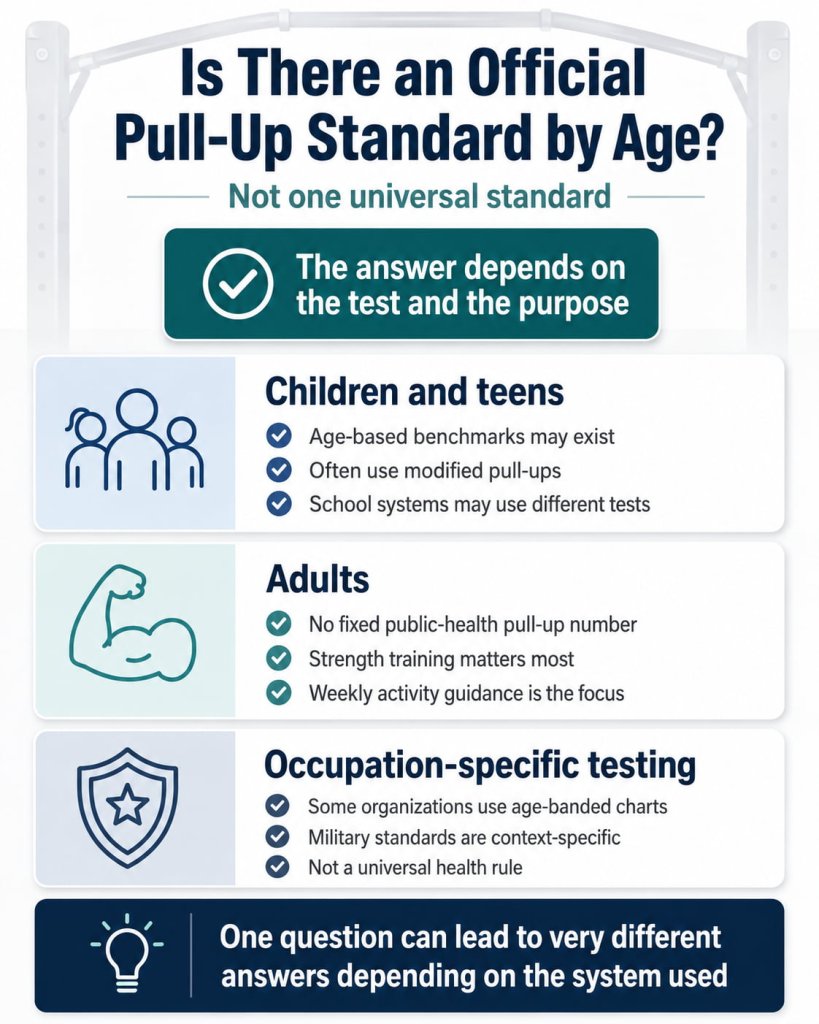
Not one universal standard.
For children and teens, age-based benchmarks do exist, but they often rely on modified pull-ups rather than strict dead-hang pull-ups. In CDC youth fitness data, boys ages 6 to 11 averaged 5.0 modified pull-ups and girls averaged 4.3. Among ages 12 to 15, boys averaged 9.8 and girls averaged 3.7.
For adults, public-health guidance does not tell you that a 30-year-old, 40-year-old, or 60-year-old should hit a certain pull-up number. Instead, the CDC adult activity guidelines say adults should do muscle-strengthening work on 2 or more days per week. For adults 65 and older, CDC adds that weekly activity should also include balance work.
For occupation-specific testing, the answer changes. The Marine Corps physical fitness system uses official age-banded pull-up standards, so that is one of the few real examples where “pull-ups by age” has a formal answer.
Pull-Up Standards by Age: The Main Official Sources
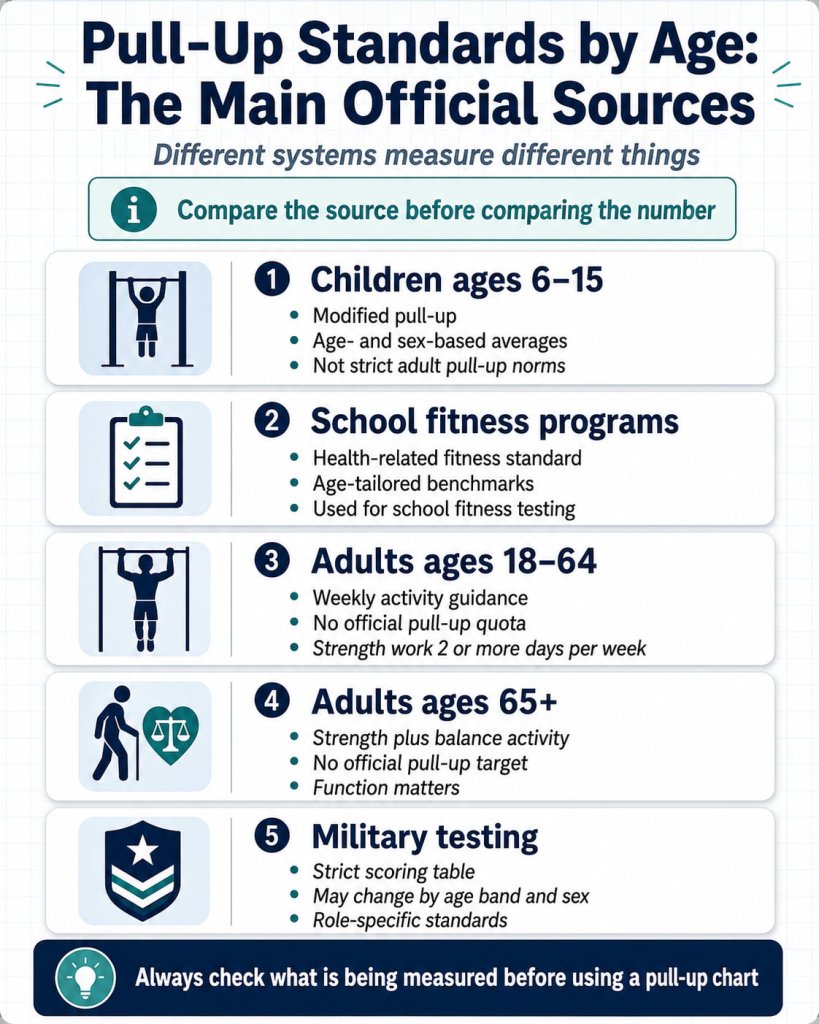
| Group | What is measured | What the official source shows |
|---|---|---|
| Children ages 6–15 | Modified pull-up | CDC youth data reports age- and sex-specific averages, not strict adult bar pull-up norms |
| School fitness programs | Health-related fitness standard | FitnessGram says standards are tailored by age and gender and are meant to reflect health-related fitness |
| Adults ages 18–64 | Weekly activity guidance | CDC recommends muscle-strengthening activities on 2 or more days per week, with no pull-up quota |
| Adults ages 65+ | Weekly activity guidance | CDC recommends strength work plus balance activity, with no official pull-up target |
| Military testing | Strict pull-up scoring table | Marine Corps PFT standards change by age band and sex |
The table above is based on the CDC youth fitness survey, FitnessGram’s Healthy Fitness Zone framework, CDC adult activity guidance, and the official Marine Corps scoring tables.
Why “How Many Pull-Ups by Age” Is Harder to Answer Than It Looks
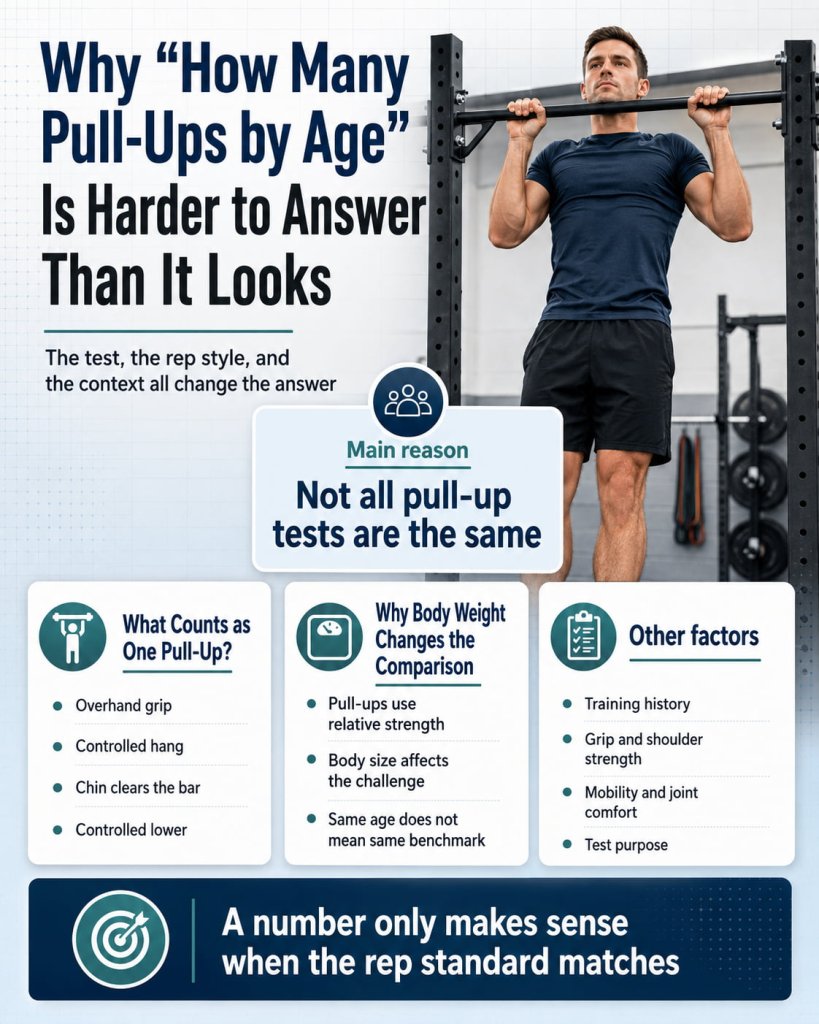
The biggest reason is that not all pull-up tests are the same.
What Counts as One Pull-Up?
Before comparing numbers, make sure the rep standard matches. A standard pull-up is usually counted with an overhand grip, a controlled hang at the bottom, a pull until the chin clears the bar, and a controlled lower back down. That matters because modified pull-ups, chin-ups, and momentum-based reps are not the same test, so age comparisons can become misleading fast.
In the CDC’s youth testing, the modified pull-up was not the same thing as a strict bodyweight pull-up from a bar. The CDC testing protocol says the modified version uses about 30% of body weight for resistance, which makes those numbers useful for youth fitness tracking but not directly comparable to adult strict pull-up counts.
Age is only one part of the picture. Your result is also influenced by:
- whether the reps are strict or modified
- body weight and relative strength
- training history
- grip and shoulder strength
- mobility and joint comfort
- whether you are comparing against health standards, school standards, or job-specific tests
Why Body Weight Changes the Comparison
Pull-ups are a relative-strength exercise, so age is only one part of the story. Because you are moving your own body against gravity, two people of the same age can have very different pull-up counts if their body size, training history, or recent weight change differ. That is one reason youth testing has used a modified pull-up protocol and why your own progress over time is often more useful than comparing yourself with a generic chart.
That is why two people of the same age can have very different pull-up numbers and both still be progressing appropriately.
What Age Actually Changes
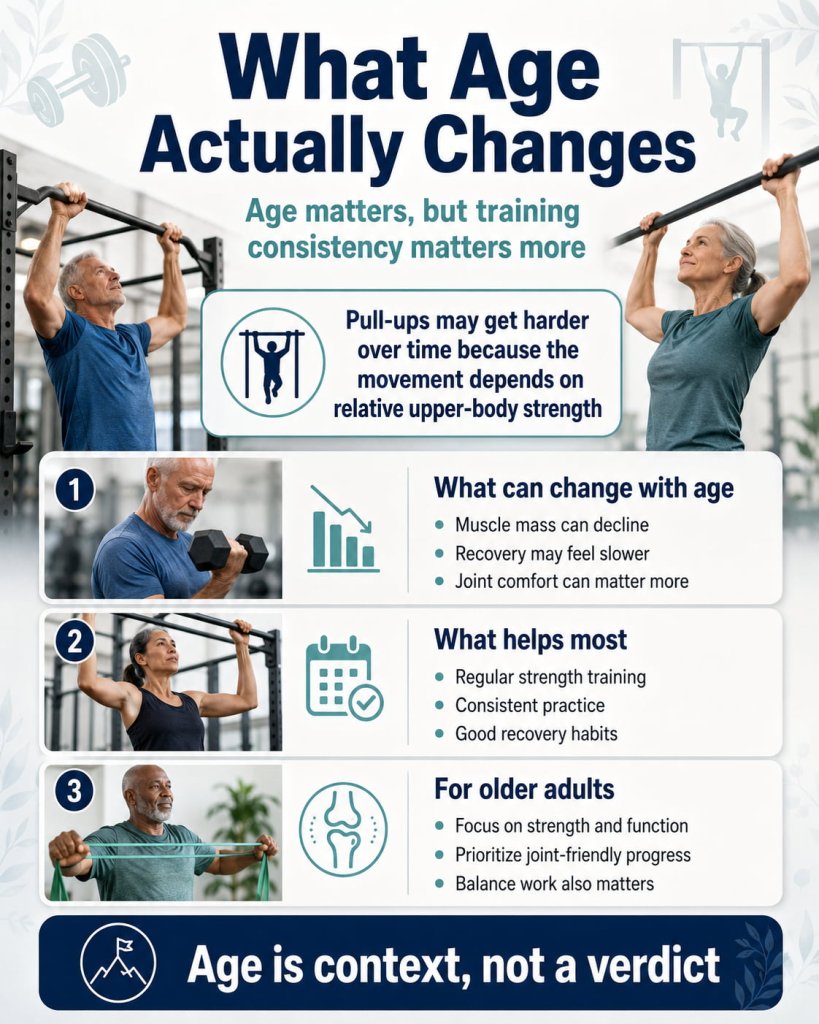
Age can make pull-ups harder over time, but not because there is a magic birthday when performance suddenly drops.
The National Institute on Aging notes that strength training helps older adults maintain muscle mass and improve mobility as they age. That matters for pull-ups because the movement depends heavily on relative upper-body strength, which can become harder to maintain without regular training.
For older adults, the goal usually shifts from chasing a random internet number to maintaining strength, function, and joint-friendly progress. CDC also says adults 65 and older should include balance activities alongside aerobic and muscle-strengthening work each week.
So yes, age matters. But training consistency matters more than age alone.
Marine Corps Pull-Up Standards by Age
If you want one of the clearest real-world examples of official age-banded pull-up standards, the Marine Corps is it.
On the official Marine Corps PFT scoring table, age bands run from 17–20 through 51+. Across those bands, male max-score pull-ups range from 18 to 23, while female max-score pull-ups range from 4 to 12. Minimum passing pull-ups range from 3 to 5 for males and 1 to 4 for females, depending on the age band.
For entry into recruit training, the Marine Corps Initial Strength Test currently lists a minimum of 3 pull-ups for males or 1 pull-up for females, with push-up alternatives also available.
This is also a good reminder that pull-up standards can change when the context changes. In December 2025, the Marine Corps announced updated physical fitness standards for Marines in combat-arms occupations, using male, age-normed scoring with a 210-point minimum starting January 1, 2026.
Marine Standards Are Not the Same as General Fitness Standards
The Marine Corps is useful because it offers one of the clearest official age-banded pull-up systems, but it should not be treated as a universal rule for everyone. Different organizations measure fitness differently. For example, the U.S. Army’s current Army Fitness Test uses the deadlift, hand-release push-up, sprint-drag-carry, plank, and two-mile run, not pull-ups. That is a good reminder that official fitness standards are context-specific, and a military chart is not the same thing as a general health benchmark.
What Matters More Than Your Age
If you want a useful benchmark, ask better questions than just “How many pull-ups should I do for my age?”
A better self-check looks like this:
- Are your reps strict and controlled?
- Do you start from a full hang?
- Do you avoid excessive kicking or swinging?
- Can you repeat your performance consistently?
- Are you getting stronger over the next 6 to 8 weeks?
For general health, there is no official rule saying you must do a certain number of pull-ups by age. Meeting overall strength-training guidelines matters more than matching an age chart that may not apply to your body, training history, or goals.
How to Interpret Your Pull-Up Number in Real Life
Teens
If you are a teen comparing your number with school data, first check which test your school or program uses. Many youth systems use modified pull-ups, flexed-arm hang, or other school fitness measures rather than strict bar pull-ups. FitnessGram also says its standards are tailored by age and gender and are meant to reflect health-related fitness, not just performance ranking.
Adults in Their 20s, 30s, and 40s
There is no official public-health rep target for these age groups. A more useful benchmark is whether you can perform clean reps and build your number gradually while also meeting overall strength-training guidelines.
Adults in Their 50s and Beyond
Aging does not mean you must stop training pull-ups. It means recovery, consistency, shoulder comfort, and strength maintenance become more important. NIA notes that strength training supports muscle mass and mobility with age, and CDC says older adults should include both muscle-strengthening and balance work each week.
How to Improve Your Pull-Up Count at Any Age
If you cannot do many pull-ups yet, the smartest approach is gradual.
Start with these basics:
- assisted pull-ups or band-assisted pull-ups
- lat pulldowns or bodyweight rows
- dead hangs for grip strength
- scapular pull-ups to learn shoulder control
- slow negatives
- full rest between hard sets
- 2 or more weekly strength sessions that train the major upper-body pulling muscles
That approach lines up well with public-health guidance that adults should do regular muscle-strengthening work each week.
The Best Way to Benchmark Yourself
Use the benchmark that matches your goal.
- For school fitness: use your school’s official testing system or FitnessGram style standards.
- For general health: focus on regular strength training, not a mandatory pull-up number.
- For military preparation: use the exact official table for your branch or test. For Marines, use the official PFT and IST standards.
- For personal fitness: compare your current strict reps to your own past performance.
That last one is often the most honest benchmark of all.
FAQs
Is There a Universal Good Number of Pull-Ups for Every Age?
No. There is no single official civilian standard that gives one required pull-up number for every age group. Youth systems, health guidelines, and military tests all measure different things.
Do Modified Pull-Ups Count the Same as Strict Pull-Ups?
No. The CDC’s modified pull-up protocol is a different test and uses about 30% of body weight for resistance, so those scores should not be read as strict dead-hang pull-up numbers.
How Many Pull-Ups Should Adults Do for Health?
There is no official adult pull-up quota for health. CDC guidance focuses on doing muscle-strengthening activities on 2 or more days per week.
What About Pull-Ups After Age 65?
There is still no official rep target. CDC says adults 65 and older need weekly muscle-strengthening, aerobic, and balance activity, while NIA highlights strength training as a way to help maintain muscle and mobility with age.
What Is the Marine Corps Minimum for Pull-Ups?
For the Initial Strength Test used to begin recruit training, the Marine Corps currently lists 3 pull-ups for males and 1 pull-up for females, with push-up alternatives available. The full PFT scoring tables then change by age band and sex.
Are School Pull-Up Tests and Gym Pull-Ups the Same Thing?
Not always. School fitness programs may use modified pull-ups, flexed-arm hang, or age- and sex-tailored health standards, which is different from counting strict gym pull-ups from a pull-up bar.
Conclusion
The most accurate answer to “how many pull-ups by age” is simple: there is no one official number for everyone. Kids and teens are often measured with modified or school-based standards, adults are guided by weekly strength-training recommendations, and the Marine Corps is one of the clearest examples of a true age-banded pull-up standard.
Use age as context, not as a verdict. Focus on strict form, consistent training, and steady progress. That is a far better benchmark than chasing a random chart that may not apply to you.
This content is for informational purposes only and not medical advice.
References
- CDC: Measures of Muscular Strength in U.S. Children and Adolescents, 2012
- CDC: National Youth Fitness Survey Modified Pull-Up Protocol
- CDC: Older Adult Physical Activity Guidelines
- National Institute on Aging: How Can Strength Training Build Healthier Bodies as We Age?
- Marine Corps: Hybrid Pull-Up/Push-Up Scoring Tables
- Marine Corps: Updated Physical Fitness Standards Announcement
- U.S. Army: Army Establishes New Fitness Test of Record