
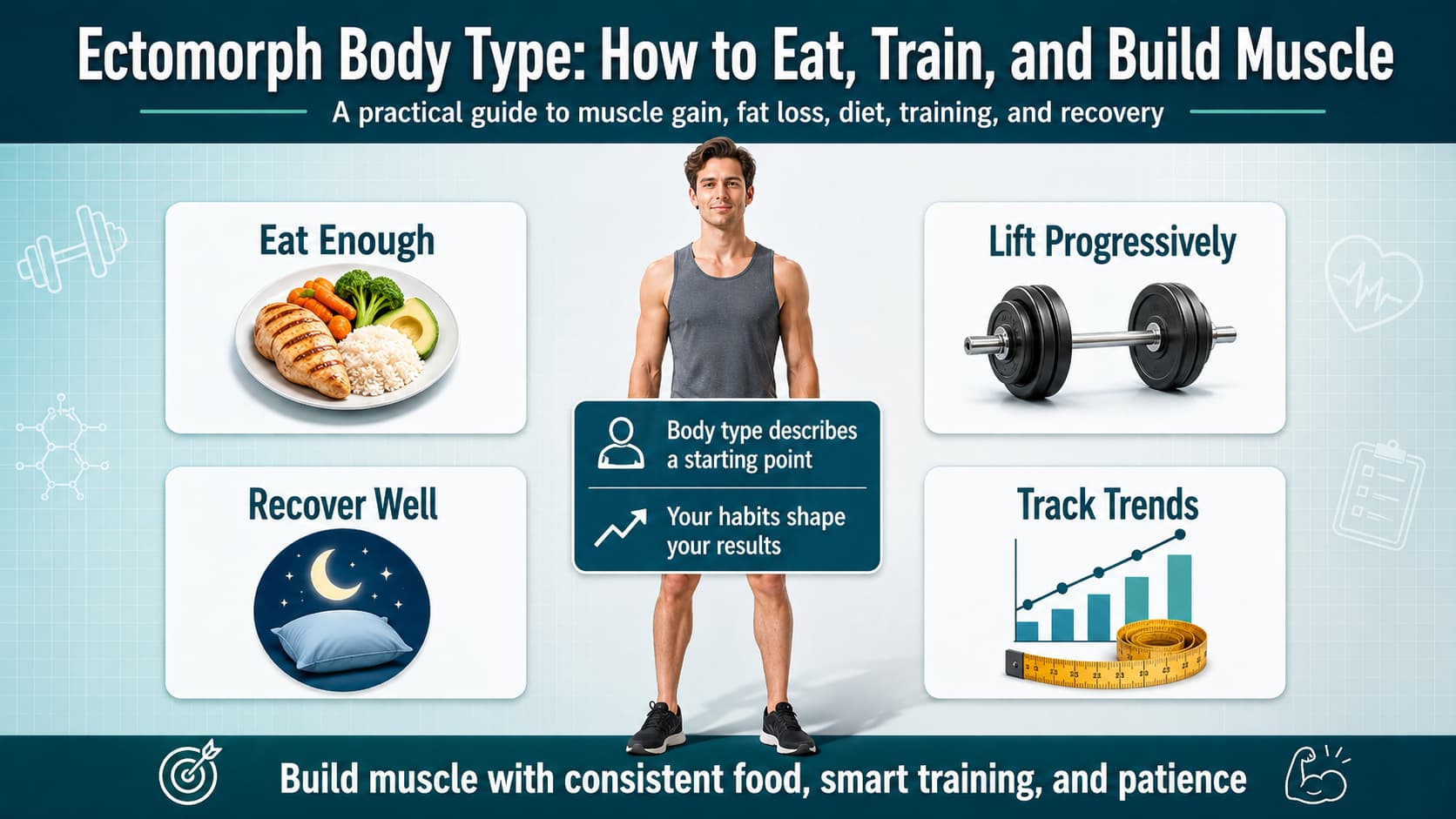
The ectomorph body type usually describes a naturally leaner build with a smaller frame, longer limbs, and lower visible muscle mass. But it is not a medical diagnosis, and it does not mean you are stuck being skinny, weak, or unable to change your body composition.
Understanding the ectomorph body type can be helpful if you struggle to gain muscle, lose weight too easily, or feel unsure how to eat and train for your goals. The key is simple: build your plan around enough food, adequate protein, progressive strength training, recovery, and realistic expectations.
What Is an Ectomorph Body Type?
An ectomorph body type is commonly described as a leaner body build with:
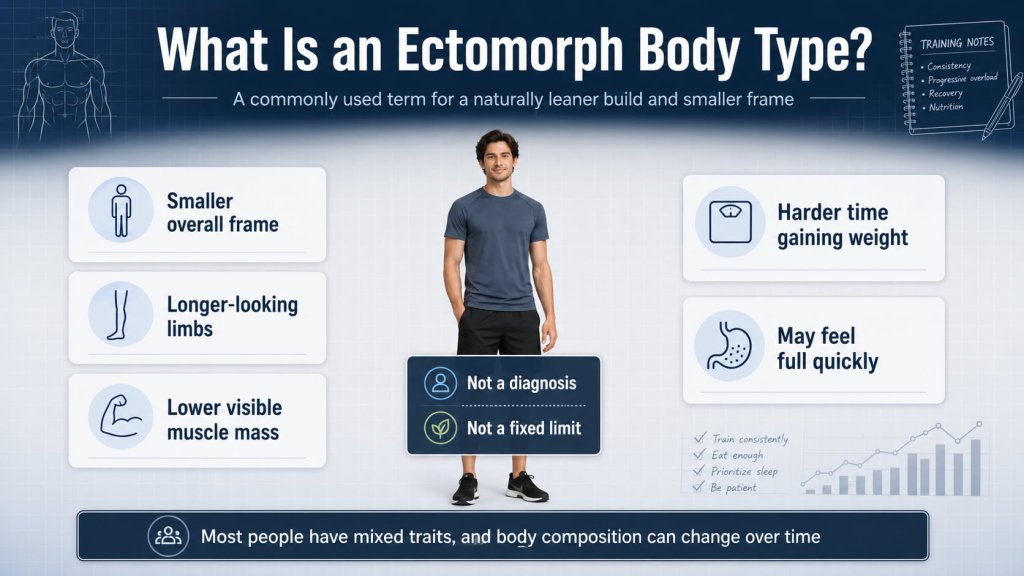
- A smaller overall frame
- Narrower shoulders and hips
- Longer-looking arms or legs
- Lower body fat in many cases
- Less natural muscle mass
- A harder time gaining weight or muscle
The American Council on Exercise describes ectomorphs as people who often have a slim frame, smaller shoulders and hips, long limbs, and less muscle mass. ACE also points out an important myth: ectomorphs should not simply eat unlimited junk food just because they may want to gain weight. Nutrient quality still matters.
In real life, most people do not fit perfectly into one body type. You may look mostly ectomorphic but still gain fat in certain areas, build muscle well with training, or have traits from more than one body type.
Is the Ectomorph Body Type Scientifically Reliable?
The ectomorph label can be useful as a simple description, but it should not be treated as a fixed rule. Body type language comes from somatotype theory, which grouped people into ectomorph, mesomorph, and endomorph categories. Modern fitness guidance uses these labels more cautiously.
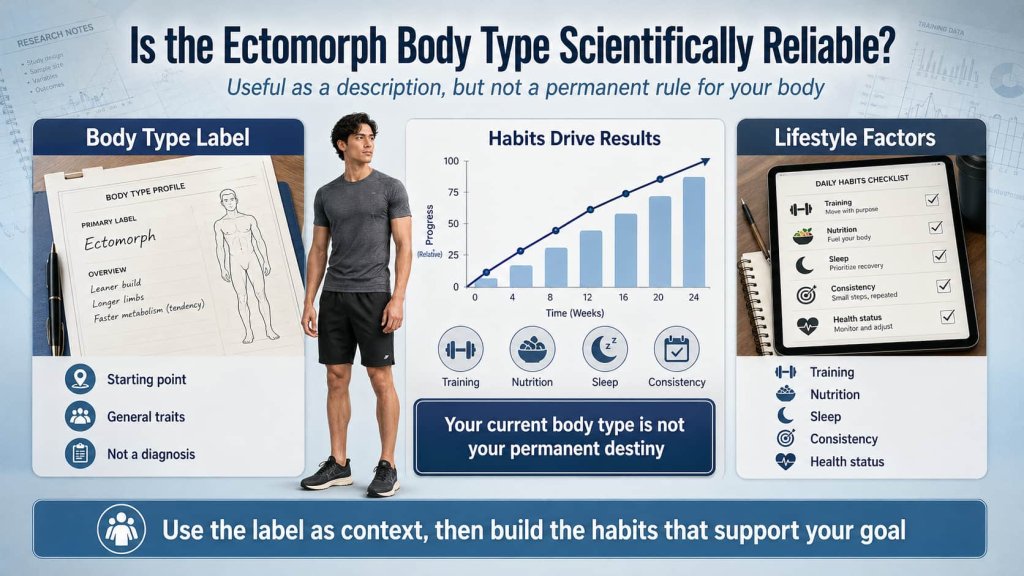
The National Academy of Sports Medicine explains that training, nutrition, lifestyle, and health conditions can strongly influence body composition. In other words, your current body type is not your permanent destiny.
A better way to think about it is this:
- Your body type may describe your starting point.
- Your habits influence your results.
- Your genetics may affect speed and ease of progress.
- Your training, food intake, sleep, and consistency still matter most.
So, if you identify as an ectomorph, the goal is not to “beat” your body type. The goal is to work with your needs.
Ectomorph or Just Under-Eating?
Before you build your whole plan around body type, check your habits first. Some people who think they are ectomorphs are actually eating inconsistently, moving more than they realize, skipping meals, or not recovering well from training.
For 7 to 14 days, pay attention to:
- How many meals and snacks you eat each day
- Whether you get protein at most meals
- How often you skip breakfast or lunch
- Your training schedule and daily activity level
- Sleep quality and recovery
- Your weekly body-weight trend
If your weight is stable or dropping while you are trying to gain muscle, your first fix is usually more consistent food intake, not a completely different body type strategy.
Common Ectomorph Traits
People who identify with the ectomorph body type often notice a few common patterns. These traits are not universal, but they can help explain why some people need a different approach to muscle gain or fat loss.
Common ectomorph traits may include:
- Feeling full quickly
- Having a smaller appetite
- Losing weight when meals are skipped
- Finding it hard to eat enough during busy days
- Needing more consistency to gain muscle
- Looking lean even with minimal training
- Having trouble increasing scale weight
Some ectomorphs may also have a high daily movement level without realizing it. Fidgeting, walking often, playing sports, standing frequently, or having an active job can all increase total daily calorie use.
That is why an ectomorph muscle-gain plan often starts with one question: are you eating enough to support training and recovery?
Ectomorph Body Type and Muscle Gain
Ectomorphs can build muscle. The process may require more patience, but the principles are the same as they are for anyone else.
To gain muscle, you need:
- A consistent strength-training program
- Enough total calories
- Enough protein
- Progressive overload
- Sleep and recovery
- Time
Muscle gain does not happen just because you train hard. Training gives your body a reason to adapt, but food and recovery help support that adaptation.
The Mayo Clinic notes that strength training can increase lean muscle mass, support stronger bones, and help the body burn calories more efficiently. Mayo Clinic also recommends working all major muscle groups at least two times per week for general strength-training benefits.
For ectomorphs, the biggest muscle-gain mistake is usually not “bad genetics.” It is often inconsistent eating, random workouts, poor recovery, or changing programs too quickly.
Best Diet for the Ectomorph Body Type
The best diet for an ectomorph depends on the goal. For muscle gain, most ectomorphs need a calorie surplus. For fat loss, they need a modest calorie deficit. For general health, they need balanced meals that support energy, training, and nutrient needs.
The foundation should be nutrient-dense foods. The Academy of Nutrition and Dietetics advises that healthy weight gain should focus on nutrient-rich foods rather than empty-calorie foods such as soda, candy, and chips. This is especially important for ectomorphs who want to gain muscle, not just add body weight.
Good ectomorph diet staples include:
- Eggs, poultry, fish, lean meat, tofu, tempeh, beans, lentils, Greek yogurt, and cottage cheese
- Rice, oats, potatoes, whole-grain bread, pasta, quinoa, and other filling carbohydrates
- Olive oil, avocado, nuts, seeds, nut butter, and other calorie-dense fats
- Fruits and vegetables for fiber, vitamins, minerals, and overall health
- Milk, fortified dairy alternatives, smoothies, or balanced snacks if appetite is low
The current Dietary Guidelines for Americans, 2025-2030 emphasize whole, healthy, nutritious foods while limiting highly processed foods, added sugars, and refined carbohydrates. That approach fits both muscle-gain and fat-loss goals because food quality affects fullness, performance, and long-term consistency.
How Ectomorphs Can Eat for Muscle Gain
If you are an ectomorph trying to build muscle, the goal is not to eat as much as possible. The goal is to eat enough, consistently, from foods that support training.
A smart muscle-gain diet may include:
- Three meals per day, plus one or two snacks if needed
- Protein at each meal
- Carbohydrates before or after training
- Calorie-dense add-ons such as olive oil, nuts, avocado, or nut butter
- Smoothies if chewing large meals feels difficult
- A consistent eating schedule instead of relying on appetite alone
For example, a muscle-gain meal could be rice, chicken or tofu, vegetables, olive oil, and fruit. A simple snack could be Greek yogurt with oats and nut butter, or a smoothie made with milk, banana, peanut butter, and protein-rich yogurt.
A small calorie surplus is usually more useful than aggressive overeating. Eating far beyond your needs may lead to unnecessary fat gain, digestive discomfort, and poor food habits.
How to Increase Calories Without Feeling Stuffed
Many ectomorphs struggle less with food quality and more with eating enough total food consistently. If large meals feel uncomfortable, increase calories in smaller steps instead of forcing huge portions.
Easy ways to add calories include:
- Add olive oil, avocado, nuts, seeds, or nut butter to meals.
- Choose rice, oats, potatoes, pasta, or whole-grain bread with protein meals.
- Drink a smoothie made with milk, yogurt, fruit, oats, or nut butter.
- Add one planned snack between meals.
- Eat at regular times instead of waiting until you feel hungry.
If your weight is not moving after a few weeks, add one more snack or slightly increase portions. This keeps weight gain more controlled and helps reduce unnecessary fat gain.
How Much Protein Do Ectomorphs Need?
Protein matters because it provides amino acids that help support muscle repair and growth after resistance training.
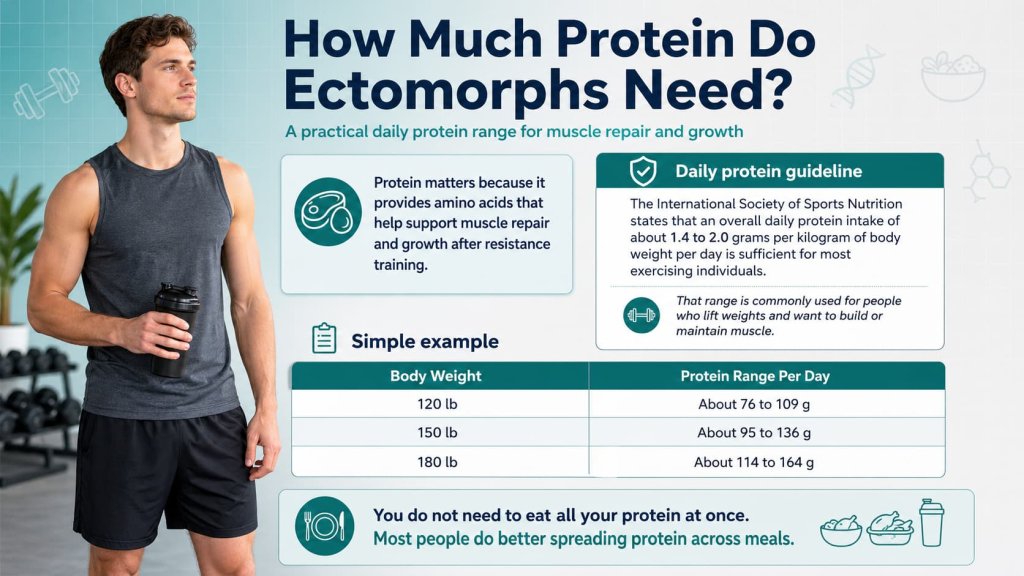
The International Society of Sports Nutrition states that an overall daily protein intake of about 1.4 to 2.0 grams per kilogram of body weight per day is sufficient for most exercising individuals. That range is commonly used for people who lift weights and want to build or maintain muscle.
For a simple example:
| Body Weight | Protein Range Per Day |
|---|---|
| 120 lb | About 76 to 109 g |
| 150 lb | About 95 to 136 g |
| 180 lb | About 114 to 164 g |
You do not need to eat all your protein at once. Most people do better spreading protein across meals.
Good protein choices include:
- Eggs
- Greek yogurt
- Chicken
- Turkey
- Fish
- Lean beef
- Tofu
- Tempeh
- Lentils
- Beans
- Cottage cheese
- Protein smoothies when needed
Protein supplements are optional. They can help fill gaps, but they are not required if you can meet your needs through regular food.
Best Workout Approach for Ectomorphs
The best workout plan for an ectomorph is usually a structured strength-training program built around progressive overload.
Progressive overload means gradually increasing the challenge over time. That can happen by adding weight, doing more reps, improving control, adding sets, or using better technique.
A good ectomorph workout plan should include:
- Squats or leg presses
- Hip hinges such as Romanian deadlifts
- Rows
- Pull-ups or pulldowns
- Bench presses or push-ups
- Overhead presses
- Lunges or split squats
- Core stability work
The American College of Sports Medicine published updated resistance-training guidance in 2026 noting that goals should shape training variables. For hypertrophy, ACSM highlights higher weekly volume, commonly around 10 sets per muscle group per week, while strength-focused training often uses heavier loads for multiple sets.
For many ectomorphs, a practical weekly plan may look like this:
| Goal | Practical Training Approach |
|---|---|
| Beginner muscle gain | Full-body strength training 2 to 3 days per week |
| Intermediate muscle gain | Upper/lower or push/pull/legs split 3 to 5 days per week |
| Strength focus | Compound lifts, longer rest periods, gradual load increases |
| Hypertrophy focus | Moderate-to-higher weekly volume, controlled reps, consistent progression |
More training is not always better. If you are not eating enough or sleeping well, adding extra workouts can make muscle gain harder.
How to Know Your Training Volume Is Working
A good ectomorph workout plan should help you improve over time without leaving you constantly drained. More sets and more exercises are not always better if your body cannot recover from them.
Your training volume is probably appropriate if:
- Your strength or reps slowly improve.
- Muscle soreness fades before the next hard session.
- You feel ready to train most days.
- Your appetite, sleep, and energy are steady.
- Your technique stays controlled.
Your training volume may be too high if:
- Your lifts keep getting weaker.
- Soreness lasts for several days.
- Sleep gets worse.
- You feel run down or unmotivated.
- You need more caffeine just to complete workouts.
If that happens, reduce extra sets, add a rest day, or keep the same exercises but train with better control. Recovery is part of muscle growth.
Cardio for the Ectomorph Body Type
Ectomorphs do not need to avoid cardio completely. Cardio supports heart health, conditioning, recovery, and overall fitness. The key is matching cardio to the goal.
If your main goal is muscle gain, keep cardio moderate and avoid doing so much that it makes eating enough harder. Walking, cycling, light jogging, swimming, or sports can all fit into a healthy plan.
The CDC recommends that adults get at least 150 minutes of moderate-intensity aerobic activity per week, or 75 minutes of vigorous-intensity activity, plus at least 2 days of muscle-strengthening activity weekly.
For ectomorphs trying to gain muscle, cardio may work best when it is:
- Short to moderate in duration
- Not placed right before heavy lifting
- Balanced with enough food intake
- Used for health and conditioning, not punishment
Can Ectomorphs Gain Fat?
Yes, ectomorphs can gain fat. A naturally lean build does not make someone immune to fat gain.
Fat gain can happen when calorie intake consistently exceeds calorie needs over time. It may happen slowly, especially if someone has a high activity level, but it can still happen.
Common reasons ectomorphs gain fat include:
- Eating high-calorie processed foods often
- Drinking many calories from sugary drinks or alcohol
- Reducing activity without adjusting food intake
- Bulking too aggressively
- Training inconsistently
- Sleeping poorly
This is why the best ectomorph diet is not “eat anything.” It is a balanced, goal-based eating plan.
Ectomorph Body Type and Fat Loss
Some ectomorphs still want fat loss, especially if they have gained fat during a bulk or want better body composition. The safest approach is not crash dieting. It is a modest, sustainable calorie deficit paired with strength training and enough protein.
A fat-loss plan for an ectomorph should focus on:
- Keeping protein high enough
- Continuing strength training
- Reducing calories gradually
- Keeping carbohydrates around workouts if they help performance
- Prioritizing sleep
- Avoiding extreme restriction
A leaner person may not have much body fat to lose. If weight loss causes fatigue, poor mood, poor sleep, loss of strength, dizziness, or obsessive food thoughts, the plan may be too aggressive.
For fullness during fat loss, the Mayo Clinic explains that high-fiber foods such as vegetables, fruits, and whole grains provide volume and take longer to digest, which can help people feel full on fewer calories.
Muscle Gain vs Fat Gain for Ectomorphs
Ectomorphs who want to gain size often worry about gaining fat. Some fat gain can happen during a muscle-gain phase, but the goal is to keep it controlled.
A better approach is a slow, steady gain rather than a rushed bulk.
| Goal | Better Strategy | What to Avoid |
|---|---|---|
| Build muscle | Small calorie surplus, progressive training, enough protein | Eating anything just to gain scale weight |
| Stay lean while gaining | Track strength, energy, appetite, and waist changes | Panicking over small weight changes |
| Improve performance | Eat enough carbs and protein around training | Under-eating on training days |
| Reduce fat after gaining | Use a modest deficit and keep lifting | Crash dieting or cutting protein too low |
The scale can be useful, but it should not be the only measure. Strength, workout performance, energy, sleep, measurements, and how clothes fit can give a better picture.
Common Mistakes Ectomorphs Make
Many ectomorphs do not fail because their body type is impossible to change. They struggle because the plan does not match the goal.
Eating Too Little Without Realizing It
Some ectomorphs have a smaller appetite or very active routine. They may feel like they eat a lot, but their weekly intake may still be too low for muscle gain.
Helpful fixes include:
- Adding one planned snack per day
- Drinking a smoothie when appetite is low
- Adding olive oil, avocado, nuts, or nut butter to meals
- Eating at consistent times
- Preparing easy meals ahead of time
Changing Workouts Too Often
Muscle gain needs repeated practice and measurable progress. Constantly switching workouts makes it harder to know whether you are improving.
Stick with a program long enough to track:
- Reps
- Sets
- Weight used
- Exercise form
- Recovery
- Strength improvements
Doing Too Much Cardio During a Bulk
Cardio is healthy, but very high amounts can make gaining weight harder if you do not eat enough to cover the extra energy use.
The solution is not to remove all cardio. The solution is to balance cardio with your calorie needs and muscle-gain goal.
Training Without Recovery
Muscle growth needs stress and recovery. If you train hard but sleep poorly, skip meals, and repeat the same muscle groups too often, progress can slow.
Mayo Clinic’s strength-training guidance also notes that people should avoid exercising the same muscle groups two days in a row. Recovery is part of the program, not a break from it.
Using Body Type as an Excuse
The ectomorph label can explain tendencies, but it should not become a limit. You may need more patience and more consistent eating, but you can still build strength and improve body composition.
Who Should Be Careful With Ectomorph Diet or Training Advice?
Some people should avoid following generic bulking, cutting, or training advice without professional guidance.
When Fat Loss May Not Be the Right Goal
If you are already very lean, underweight, or losing weight without trying, fat loss may not be the healthiest goal. Adults with a BMI below 18.5 fall into the underweight range, and the Cleveland Clinic advises seeing a healthcare provider because being underweight can affect health or signal an underlying issue.
For teens, adult BMI categories do not apply the same way because growth, puberty, and development change body composition. Anyone under 18 should speak with a parent, guardian, doctor, or registered dietitian before trying to gain or lose weight intentionally.
Be careful and consider speaking with a healthcare professional or registered dietitian if you:
- Are under 18 and still growing
- Are underweight or losing weight without trying
- Have a history of an eating disorder or disordered eating
- Have diabetes, thyroid disease, digestive disease, kidney disease, or another medical condition
- Have ongoing fatigue, dizziness, missed periods, or poor recovery
- Feel anxious or obsessive about food, weight, or exercise
- Are recovering from illness, injury, or surgery
MedlinePlus defines unintentional weight loss as losing 10 pounds or 5% of normal body weight over 6 to 12 months or less without knowing the reason, and advises contacting a medical professional when this happens or when other symptoms are present.
Simple Ectomorph Muscle-Gain Plan
Here is a practical starting point for an ectomorph who wants to gain muscle in a healthy, sustainable way.
Nutrition Focus
- Eat regular meals instead of skipping breakfast or lunch.
- Include protein at each meal.
- Add calorie-dense whole foods such as nuts, olive oil, avocado, dairy, or nut butter.
- Use carbohydrates to support training energy.
- Keep fruits and vegetables in the plan for fiber and micronutrients.
- Use smoothies if solid food feels too filling.
Training Focus
- Lift weights 2 to 4 days per week if you are starting out.
- Focus on compound movements.
- Track your lifts.
- Add reps or weight gradually.
- Train with good form.
- Rest each muscle group before training it hard again.
Recovery Focus
- Sleep enough to support training.
- Take rest days seriously.
- Avoid adding more workouts before fixing food and recovery.
- Reduce training volume if performance keeps dropping.
- Be patient with visible changes.
Simple Ectomorph Fat-Loss Plan
If fat loss is appropriate, the goal should be steady and health-focused.
Nutrition Focus
- Keep protein consistent.
- Build meals around lean protein, high-fiber carbs, vegetables, fruits, and healthy fats.
- Reduce highly processed snacks and sugary drinks.
- Avoid extreme calorie cuts.
- Keep enough carbohydrates to support workouts if they help performance.
Training Focus
- Keep lifting weights.
- Use cardio for health and conditioning.
- Track strength so muscle loss is less likely.
- Avoid turning every workout into a calorie-burning session.
- Take recovery days.
Progress Focus
- Watch weekly trends, not daily scale changes.
- Use strength, energy, sleep, measurements, and workout quality as progress markers.
- Stop and reassess if weight loss feels too aggressive or affects health.
FAQs About the Ectomorph Body Type
Is an ectomorph naturally skinny?
An ectomorph is commonly described as naturally lean, slim-framed, and less muscular. However, “naturally skinny” is not a complete explanation. Appetite, activity level, food intake, health, training history, and genetics all matter.
Can ectomorphs build muscle?
Yes. Ectomorphs can build muscle with progressive strength training, enough calories, adequate protein, and recovery. Progress may be slower for some people, but it is absolutely possible.
Should ectomorphs eat more carbs?
Many ectomorphs do well with enough carbohydrates because carbs support training energy and make it easier to eat enough calories. Good options include rice, oats, potatoes, fruit, whole-grain bread, pasta, and quinoa.
Do ectomorphs need supplements?
No supplement is required. Protein powder, creatine, or meal-replacement shakes may help some people meet nutrition goals, but food, training, sleep, and consistency matter more. Anyone under 18 or managing a medical condition should ask a qualified professional before using supplements.
Can an ectomorph become overweight?
Yes. Ectomorphs can gain body fat if they consistently eat more calories than they use. A leaner frame may make fat gain seem slower, but it can still happen.
Is cardio bad for ectomorphs?
No. Cardio is not bad for ectomorphs. It supports heart health and fitness. The key is balancing cardio with enough food and recovery, especially if muscle gain is the main goal.
What is the best workout split for ectomorphs?
Beginners often do well with full-body strength training 2 to 3 days per week. Intermediate lifters may use an upper/lower split or push/pull/legs plan. The best split is the one you can recover from and progress on consistently.
Conclusion
The ectomorph body type can describe a naturally lean starting point, but it should never be treated as a limit. If you struggle to gain muscle, focus on consistent meals, enough protein, progressive strength training, and recovery. If fat loss is appropriate, avoid crash dieting and keep strength training in your plan.
Your body type may influence your strategy, but your daily habits shape your results. Start with a realistic plan, track progress calmly, and adjust based on strength, energy, recovery, and health.
This content is for informational purposes only and not medical advice.
References
- National Academy of Sports Medicine — How to Train and Diet for Your Body Type
- International Society of Sports Nutrition — Position Stand on Protein and Exercise
- Mayo Clinic — Strength Training: Get Stronger, Leaner, Healthier
- CDC — Adult Physical Activity Guidelines
- Academy of Nutrition and Dietetics — Healthy Weight Gain
- USDA Food and Nutrition Service — Dietary Guidelines for Americans, 2025-2030
- American College of Sports Medicine — Updated Resistance Training Guidelines
- Cleveland Clinic — Underweight
- MedlinePlus — Unintentional Weight Loss