
Memory exercises for seniors can help practice recall, attention, language, reasoning, and processing speed when the activities are enjoyable, appropriately challenging, and performed regularly. They cannot guarantee that someone will avoid dementia, but they can provide a practical way to keep the mind active and practice skills used in everyday life.
You do not need an expensive app or complicated training program. Word lists, household objects, playing cards, books, photographs, and conversations can all become useful brain activities.
The key is to choose exercises that require active thinking—not simply repeating an activity that has become automatic.
Do Memory Exercises Really Work for Seniors?
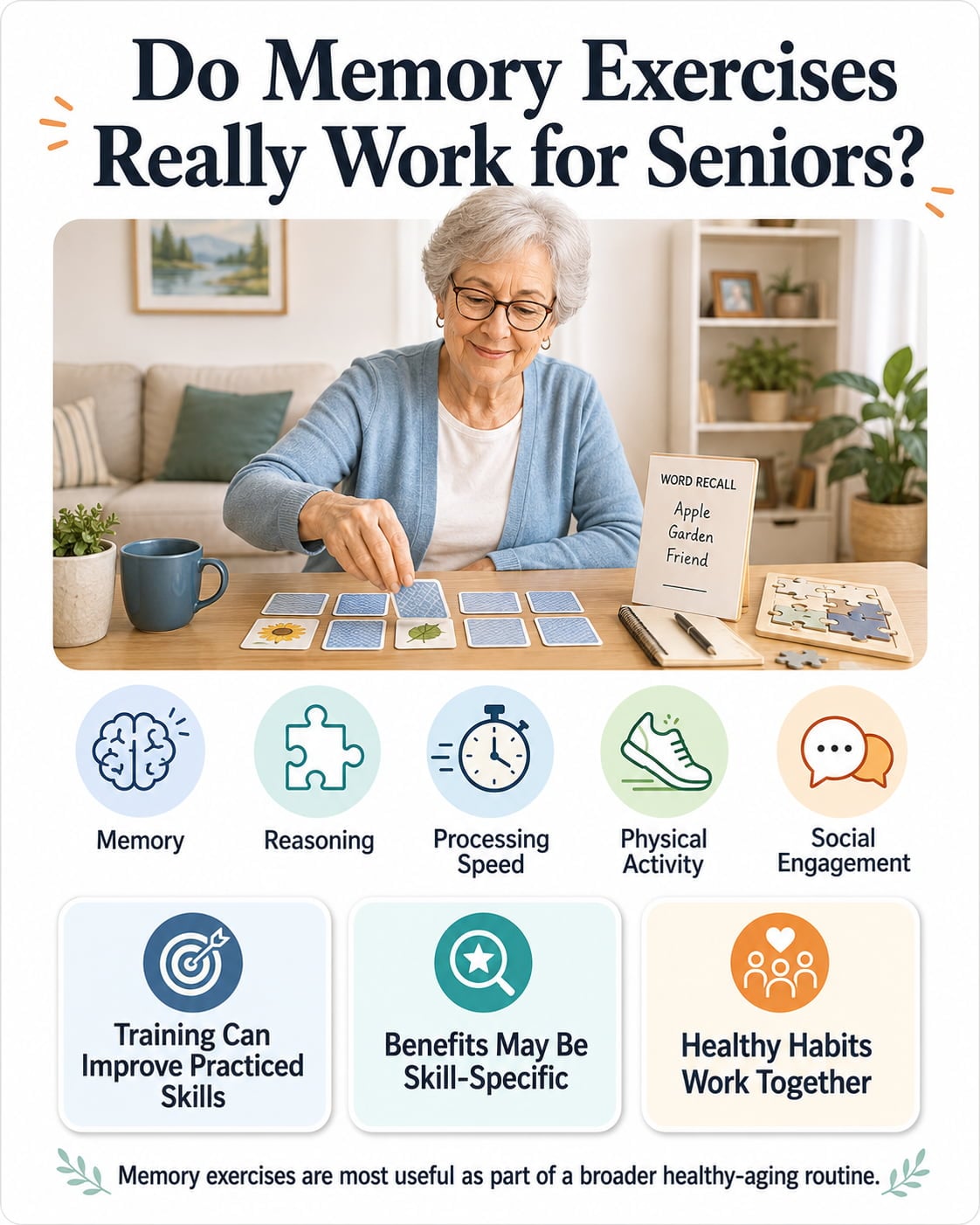
Research supports a measured answer: mental exercises can improve or maintain certain skills, especially the abilities being practiced. However, the benefits do not necessarily transfer to every type of memory or thinking task.
A 2025 JAMA U.S. POINTER trial followed 2,111 adults ages 60 to 79 who had an increased risk of cognitive decline. Participants in a structured program combining cognitive challenge, physical activity, social engagement, a healthy eating pattern, and cardiovascular risk monitoring had slightly greater improvement in overall cognition than those following a lower-intensity, self-guided program.
The difference between the groups was modest, and the study did not test home puzzles by themselves. It supports a broader approach in which mental activity is combined with other healthy habits.
A 10-year follow-up of the ACTIVE trial available through the National Library of Medicine also found that some improvements in trained reasoning and processing-speed abilities lasted for years. However, the long-term objective memory benefit was less clear, showing that cognitive training often has skill-specific effects.
The World Health Organization updated its dementia-risk-reduction guidance in July 2026. It recommends cognitive training, cognitive stimulation, and social activities for adults with normal cognition and those with mild cognitive impairment. These activities are recommended as part of a wider plan that also addresses movement, diet, tobacco use, alcohol, hearing loss, social isolation, blood pressure, diabetes, and cholesterol.
What Memory Exercises Can and Cannot Do
| Memory exercises may help you | Memory exercises cannot |
|---|---|
| Practice recall, attention, language, and reasoning | Guarantee prevention of Alzheimer’s disease or another dementia |
| Learn strategies for remembering information | Diagnose the cause of memory problems |
| Stay mentally and socially engaged | Replace sleep, physical activity, or medical care |
| Build a regular mental-activity routine | Correct medication side effects or an untreated health condition |
| Become more comfortable learning new things | Serve as a reliable at-home dementia test |
12 Easy Memory Exercises for Seniors
These activities can be adjusted for different interests and ability levels. Start with an easy version. Add more information, a longer delay, or a second task only when the activity becomes comfortable.
The purpose is active practice—not achieving a perfect score.
1. Recall a Short Word List
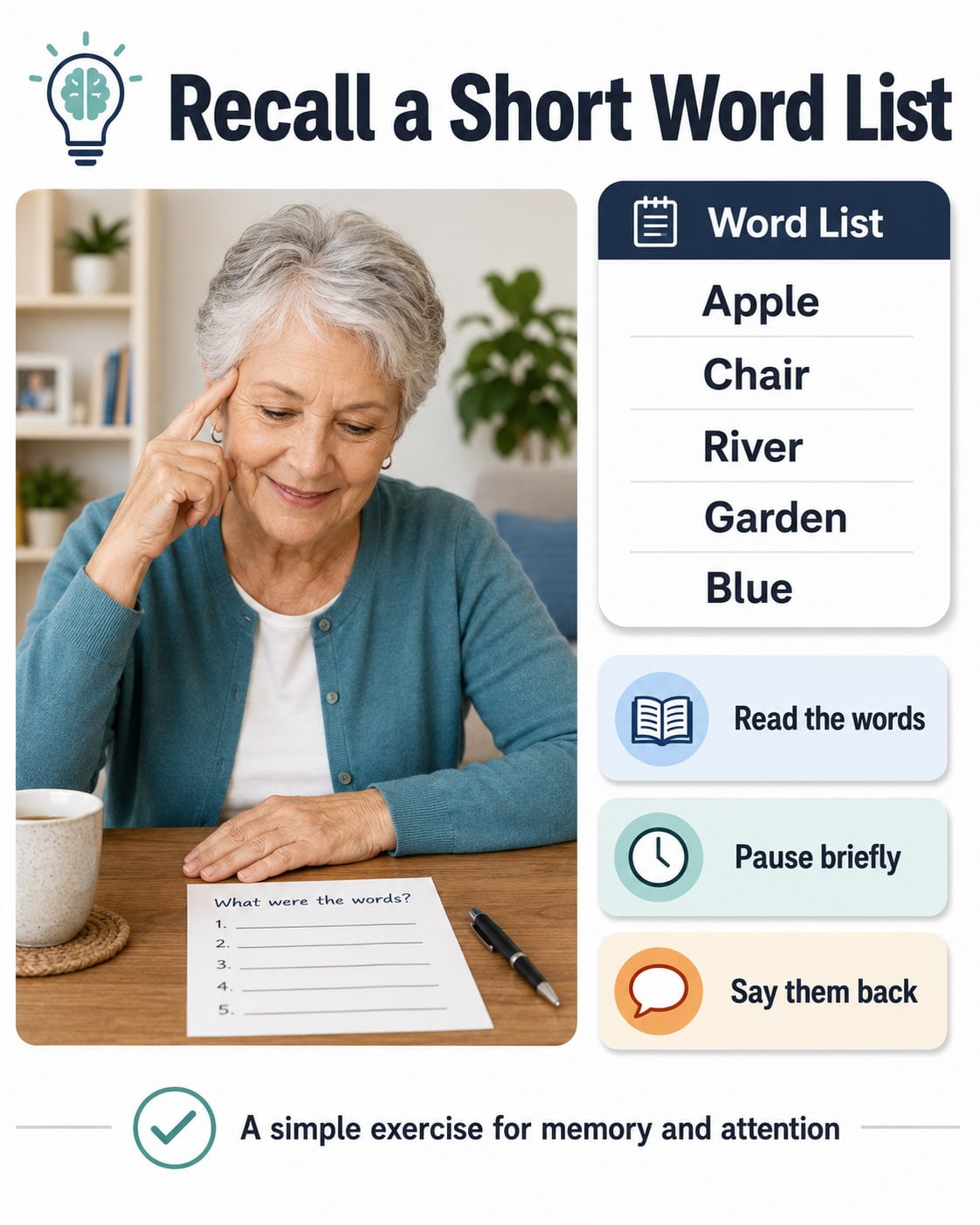
Choose three to five unrelated words, such as:
- Apple
- Window
- Train
- Candle
- Garden
Read the words slowly or ask another person to say them. Repeat them once, cover the list, and do something else for approximately five minutes. Then try to recall as many words as possible.
To make it easier, use only three words or choose words from one category. To make it harder, increase the delay or add one additional word.
Try creating a mental picture that connects the words. For example, imagine an apple sitting on a windowsill while a train passes a candlelit garden. Unusual images are often easier to remember than isolated words.
2. Build and Recall a Grocery List
Write a list of six to eight grocery items. Organize the items into categories before trying to remember them:
| Category | Example items |
|---|---|
| Produce | Apples, carrots |
| Dairy | Milk, yogurt |
| Pantry | Rice, beans |
| Household | Paper towels, soap |
Read the list, cover it, and recall the items by category.
Grouping information into smaller units is sometimes called “chunking.” It can make a longer list easier to manage because you are remembering several organized groups rather than many separate items.
Practice with a pretend list first. Do not rely on memory alone when purchasing essential food, medications, or other important supplies. Carry the written list as a backup.
3. Practice Name-and-Face Associations
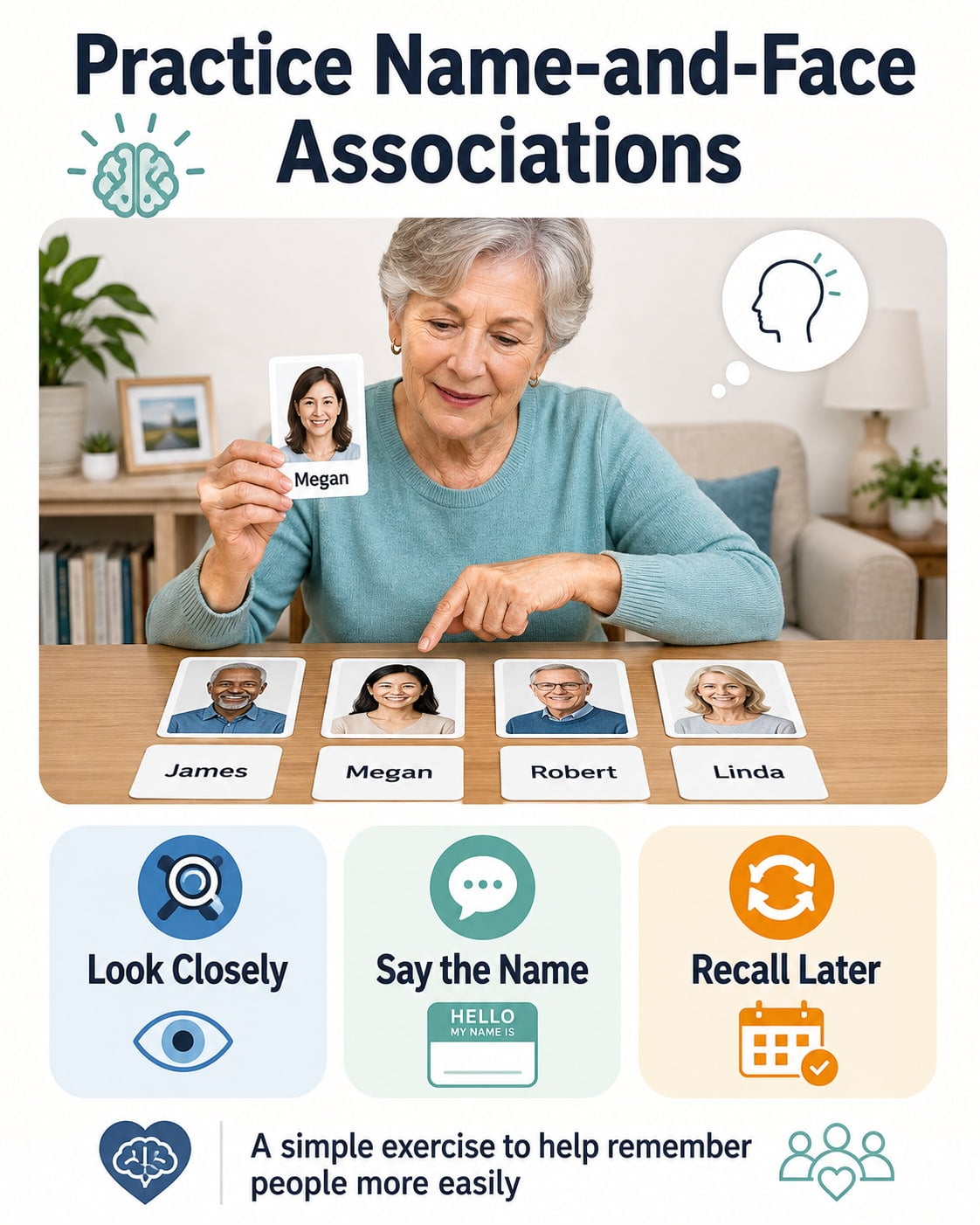
Use photographs of relatives, friends, public figures, or people in a magazine. Read each person’s name and connect it with one noticeable detail.
For example:
- “Rose wears red glasses.”
- “Sam has a silver beard.”
- “Maria works with music.”
Repeat the name while looking at the face. Cover the name and try to recall it a few minutes later.
For someone you have just met, silently repeat the person’s name during the conversation and connect it with something meaningful they mentioned.
Avoid relying only on appearance. Connecting the name with a hobby, profession, hometown, or shared interest often creates a stronger association.
4. Retell a Short Story
Read a short paragraph, listen to part of an audiobook, or watch a brief educational video. Then explain the main points in your own words.
Use four simple questions:
- Who was involved?
- What happened?
- Where or when did it happen?
- What was the main point?
Try summarizing it immediately and then again after 10 or 15 minutes.
An easier version is to recall only the central idea. A more challenging version is to remember names, locations, sequence, and smaller details.
This exercise practices comprehension as well as recall. It can also become a social activity when completed with a friend or family member.
5. Play a Look-Cover-Recall Game
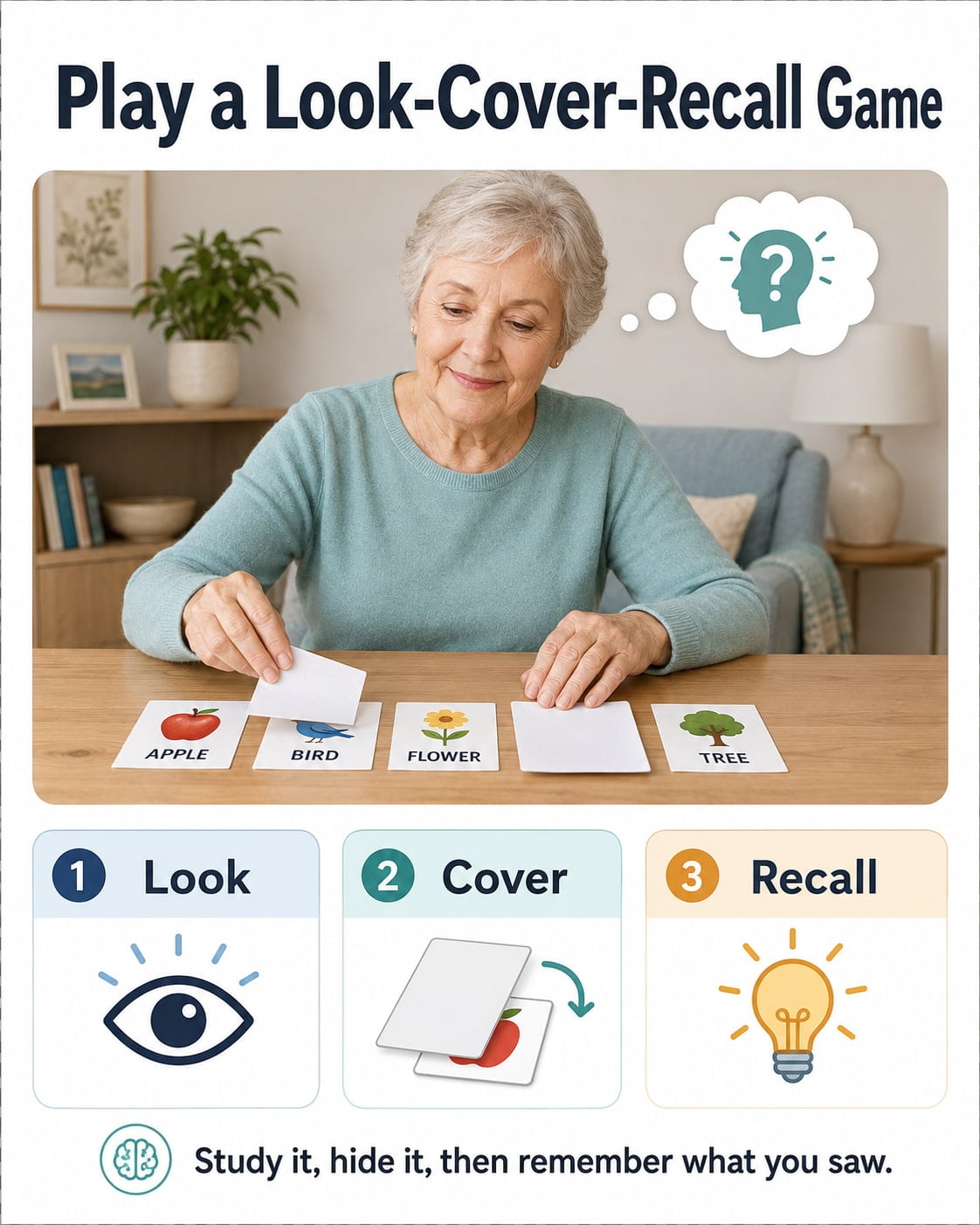
Place five familiar objects on a table, such as a spoon, key, coin, pen, and comb.
Study the objects for 30 to 60 seconds. Cover them with a towel and name everything you remember.
You can gradually vary the activity by asking:
- What color was each object?
- Where was each object positioned?
- Which object was closest to the edge?
- Did anything change after the objects were uncovered?
A partner can secretly remove or move one item before uncovering the table. The goal is to identify what changed.
Large, colorful objects can make the activity more accessible for someone with reduced vision.
6. Repeat Number or Word Sequences
Ask a partner to read three numbers slowly, such as:
4–7–2
Repeat the numbers in the same order. Once three numbers become easy, try four.
For a greater challenge, repeat a short sequence in reverse:
6–3–8 becomes 8–3–6.
The same activity can be completed with words, days of the week, or familiar names.
Keep the sequence short enough to be challenging without becoming discouraging. This is a working-memory activity, not a medical test. A poor result on a particular day may reflect distraction, stress, fatigue, hearing difficulty, or unfamiliarity with the exercise.
7. Play a Category-Naming Game
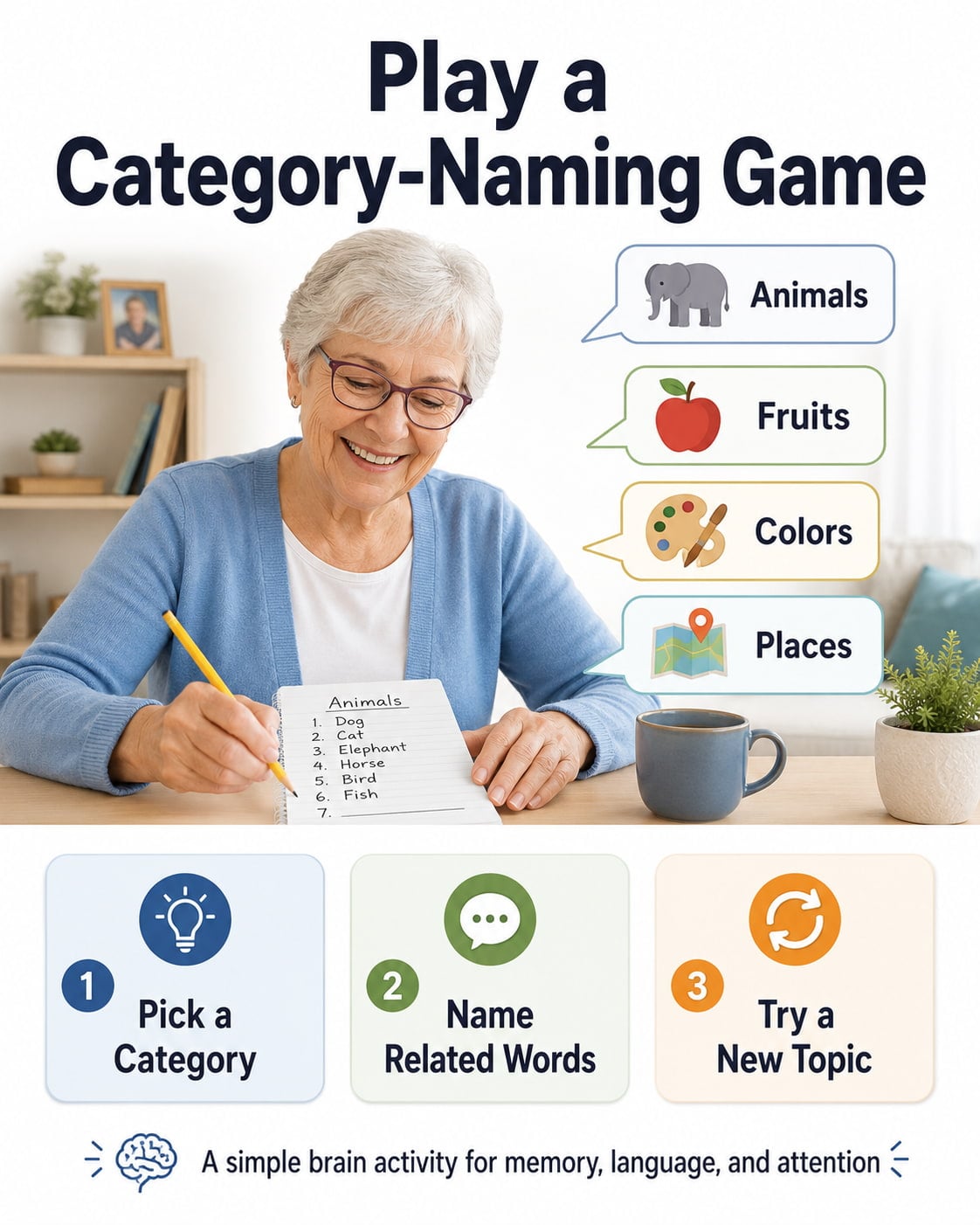
Choose a familiar category and name as many examples as possible.
Possible categories include:
- Fruits
- Animals
- Flowers
- Foods served at breakfast
- Items found in a kitchen
- Cities or states
- Words beginning with a selected letter
Complete the activity alone or take turns with another person. A timer is optional. Some people enjoy a 60-second challenge, while others find time pressure distracting.
To make the game more challenging, switch between two categories. For example, alternate between an animal and a food:
Dog, apple, horse, rice, cat, yogurt.
This version requires both word retrieval and mental flexibility.
8. Solve Word and Logic Puzzles
Crosswords, word searches, anagrams, Sudoku, jigsaw puzzles, and simple logic problems can practice attention, vocabulary, visual scanning, and reasoning.
Choose a level that requires thought but still feels manageable. A puzzle that is far too difficult may create frustration, while one that can be completed automatically may provide little new challenge.
Try varying the type of puzzle instead of completing the same format every day. For example:
- Monday: crossword
- Wednesday: number puzzle
- Friday: jigsaw puzzle
- Sunday: simple strategy game
Puzzles can be useful mental activities, but they should not be treated as a proven method of preventing dementia.
9. Play a Matching-Card Game
Choose six pairs of matching cards. Shuffle them and place all 12 cards face down.
Turn over two cards at a time. If they match, keep them face up. If they do not, turn them back over and try to remember their locations.
Begin with fewer pairs when necessary. Add more cards after the original layout becomes easy.
Use large-print playing cards, homemade picture cards, or cards containing familiar words. High-contrast images and an uncluttered table can make the activity easier to see.
A digital matching game can also work, but a screen is not required.
10. Practice Visual Search and Processing Speed
Create or print a page filled with letters, numbers, or simple shapes. Select one target and find every example on the page.
For instance, circle every number 7 in a grid containing different numbers.
Start with a spacious page and a few symbols. Gradually increase the number of symbols or include similar-looking items, such as 6 and 9.
Focus on accuracy before speed. Timing the activity is optional and should not create anxiety.
Specialized adaptive speed-of-processing training has been studied in older adults, but an ordinary visual-search page is not identical to those research programs. Treat this as a simple attention exercise rather than a dementia-prevention program.
11. Learn a New Skill
Learning something unfamiliar requires the brain to pay attention, make connections, correct mistakes, and remember new steps.
Suitable options may include:
- Learning basic words in another language
- Trying a new recipe
- Playing a musical instrument
- Knitting or crocheting
- Painting or drawing
- Using a new phone feature
- Learning photography
- Taking an online or community class
- Practicing a new board or card game
The Alzheimer’s Association recommends choosing mentally challenging activities and adding something new when an activity becomes too easy. The best choice is not necessarily the most complicated one. It is something interesting enough that you will continue practicing it.
Break the skill into small steps. Practice one step until it feels familiar, then add the next.
12. Read, Discuss, and Teach Back
Read a short article, book section, recipe, or set of instructions. Then explain the information to someone else without reading directly from the page.
A useful structure is:
- State the main idea.
- Explain three important details.
- Give one example.
- Answer one question about the material.
This “teach-back” approach requires you to organize information rather than simply recognize it on the page.
The exercise can also support social connection. Complete it with a spouse, friend, grandchild, book group, or community class.
A Simple Weekly Memory Exercise Routine
There is no single medically established schedule for ordinary home memory exercises. A practical starting point is 10 to 15 minutes, three or four days per week.
Here is one example:
| Day | Activity | Suggested time |
|---|---|---|
| Monday | Word-list recall and grocery-list grouping | 10–15 minutes |
| Tuesday | Look-cover-recall or matching cards | 10–15 minutes |
| Wednesday | Story recall and teach-back | 15 minutes |
| Thursday | Crossword, Sudoku, or logic puzzle | 10–20 minutes |
| Friday | Practice a new skill | 15–20 minutes |
| Weekend | Social game, class, or group discussion | As comfortable |
This is an example, not a medical prescription. Five focused minutes may be enough for someone who becomes tired easily. Other people may enjoy longer sessions.
Consistency is more important than completing every activity.
How to Make Memory Exercises More Effective
Choose the Right Level of Challenge
A good exercise requires attention but remains achievable. You should need to think, but you should not feel defeated every time.
Use these signs to adjust the activity:
| What happens | How to adjust |
|---|---|
| You answer everything immediately | Add one item, use a longer delay, or try a new activity |
| You make a few mistakes but improve | Keep the current level |
| You become frustrated or cannot begin | Reduce the number of items or provide a cue |
| You feel tired or lose concentration | Stop and continue another day |
Practice Recall Instead of Only Rereading
Rereading a list can feel productive, but actively trying to remember it requires more mental effort.
Study the information, cover it, and retrieve it from memory. Check the answer afterward. Repeat the activity later rather than repeating it continuously in one sitting.
Use More Than One Sense
Combine spoken, written, and visual information when possible.
For example, when learning a new name:
- Look at the person.
- Say the name aloud.
- Write it down.
- Connect it with a personal detail.
- Use the name again during the conversation.
This creates several ways to access the information later.
Remove Unnecessary Distractions
Turn off the television and reduce background noise. Use adequate lighting and sit comfortably.
Trying to remember information while following several conversations or notifications can make the task unnecessarily difficult.
Rotate Different Types of Activities
Do not focus exclusively on one crossword or game. A balanced routine can include:
- Verbal recall
- Visual memory
- Attention
- Reasoning
- Processing speed
- New learning
- Social conversation
Different activities practice different skills.
Keep Using Real-World Memory Aids
Calendars, alarms, written lists, pill organizers, labels, and designated places for keys or glasses are useful safety tools. Using them is not “cheating.”
Memory exercises are practice. Memory aids protect everyday routines and reduce avoidable mistakes.
Adapting Brain Activities for Different Needs
Memory exercises should be accessible and respectful. They should not feel like school tests or childish games.
| Need or limitation | Helpful adjustment |
|---|---|
| Reduced vision | Use large print, strong contrast, larger cards, good lighting, or spoken exercises |
| Reduced hearing | Reduce background noise, face the speaker, use captions, and wear prescribed hearing devices |
| Arthritis or hand tremor | Use oversized cards, verbal answers, a tablet stylus, or a partner to write responses |
| Fatigue | Use five-minute sessions and complete one activity at a time |
| Limited mobility | Choose seated activities with materials placed within easy reach |
| Language differences | Use familiar words, culturally relevant topics, and the person’s strongest language |
| Mild cognitive impairment | Keep instructions brief, allow extra time, and ask the healthcare team about appropriate cognitive activities |
| Dementia | Emphasize enjoyment, familiarity, conversation, and successful participation rather than testing performance |
For a person living with dementia, repeated correction can create distress. Offer cues, simplify choices, and move to another activity when frustration appears.
Brain Health Involves More Than Brain Games
Mental exercises are only one part of supporting cognitive health.
The 2026 WHO guidance recommends a broad approach that may include:
- Regular physical activity
- Cognitive training and stimulation
- Social participation
- A nutritious eating pattern
- Avoiding tobacco
- Limiting harmful alcohol use
- Managing high blood pressure, diabetes, and high cholesterol
- Addressing hearing loss when appropriate
- Reducing social isolation
WHO also states that vitamins B and E, omega-3 supplements, and multivitamin or mineral supplements are not recommended specifically for reducing cognitive decline or dementia risk when a person does not have a diagnosed deficiency.
Sleep also matters. Poor sleep, sleep apnea, depression, anxiety, medication effects, and excessive alcohol use can affect concentration and memory. A puzzle cannot correct an untreated health problem.
When to Talk With a Doctor About Memory Changes
Occasional forgetfulness can happen with normal aging. Dementia is not a normal part of aging.
The National Institute on Aging recommends medical evaluation when memory or thinking problems begin interfering with everyday life.
Possible Age-Related Changes vs. Concerning Changes
| A change that may occur with aging | A reason to contact a healthcare professional |
|---|---|
| Temporarily forgetting a name but remembering it later | Frequently forgetting recently learned information |
| Occasionally misplacing an item | Placing items in unusual locations and being unable to retrace steps |
| Needing more time to learn a new device | Becoming unable to complete familiar tasks |
| Occasionally needing an appointment reminder | Repeatedly missing important appointments despite reminders |
| Making an occasional calculation mistake | Developing ongoing difficulty managing bills or medications |
| Briefly forgetting why you entered a room | Becoming lost in a familiar neighborhood |
| Sometimes struggling to find a word | Frequently being unable to follow or join a conversation |
These signs do not prove that someone has dementia. Memory changes may also be connected with depression, medication side effects, sleep problems, vitamin B12 deficiency, thyroid problems, head injuries, alcohol use, or other medical conditions.
Contact a healthcare professional when symptoms are new, worsening, noticed by other people, or interfering with safety and independence.
Sudden confusion requires urgent medical attention. The Centers for Disease Control and Prevention advises calling 911 in the United States or your local emergency number when confusion begins suddenly, particularly when it occurs with facial drooping, weakness or numbness on one side, difficulty speaking, vision changes, loss of balance, or a sudden severe headache. These can be warning signs of a stroke.
Frequently Asked Questions
What is the best memory exercise for seniors?
There is no single best exercise for everyone. A useful routine combines recall, attention, reasoning, language, and new learning.
For direct recall practice, start with a short word list, grocery list, or story-summary activity. The best long-term choice is an activity that is challenging enough to require attention but enjoyable enough to repeat.
How often should seniors do brain exercises?
There is no universal clinical schedule for ordinary home brain activities. A reasonable starting point is 10 to 15 minutes, three or four times per week.
Shorter sessions may be better for someone experiencing fatigue, headaches, eye strain, or frustration. Regular practice is generally more practical than one very long session.
Do crossword puzzles improve memory?
Crosswords mainly practice vocabulary, word retrieval, general knowledge, and problem-solving. They may be mentally engaging, but completing crosswords alone is not proven to prevent dementia or improve every form of memory.
For greater variety, combine crosswords with visual-memory tasks, story recall, physical activity, social interaction, and new learning.
Can brain games prevent dementia?
No individual brain game has been proven to guarantee dementia prevention.
Cognitive training and stimulation are included in current dementia-risk-reduction recommendations, but they work best as part of a broader lifestyle that also includes physical activity, social connection, healthy eating, adequate sleep, and management of cardiovascular risk factors.
What exercise is useful for short-term memory?
Try repeating a three- or four-item sequence, recalling a short word list after a brief delay, or studying several objects before covering them.
Increase the amount of information gradually. Stop adding items when the activity becomes overly frustrating.
Are memory exercises helpful for mild cognitive impairment?
Cognitive training and cognitive stimulation may be appropriate for some adults with mild cognitive impairment. Activities should match the person’s abilities and should not replace medical monitoring.
A healthcare professional, occupational therapist, speech-language pathologist, or neuropsychologist may recommend more individualized strategies.
When should forgetfulness become a concern?
Contact a healthcare professional when forgetfulness is getting worse, affects familiar tasks, causes repeated questions, creates medication or financial errors, leads to getting lost, or concerns friends and family.
Seek urgent help for sudden confusion or memory loss, especially when accompanied by weakness, speech difficulty, severe headache, or other neurological symptoms.
Conclusion
Memory exercises for seniors do not need to be expensive or complicated. Start with two activities that feel interesting, such as word-list recall and a matching-card game. Practice for approximately 10 minutes, then gradually add variety or difficulty.
The most useful routine is one that remains mentally engaging without creating constant frustration. Combine brain activities with movement, social connection, good sleep, healthy eating, and appropriate medical care for a more complete approach to cognitive health.
This content is for informational purposes only and not medical advice.
References
- World Health Organization — New WHO guidelines: Up to 45% of dementia risk could be prevented or delayed
- JAMA — Structured vs. Self-Guided Multidomain Lifestyle Interventions for Global Cognitive Function
- PubMed — Ten-Year Effects of the ACTIVE Cognitive Training Trial
- National Institute on Aging — Memory Problems, Forgetfulness, and Aging
- Alzheimer’s Association — Challenge Your Mind
- Centers for Disease Control and Prevention — Signs and Symptoms of Stroke