
Rosemary oil may support modest hair growth in some people with androgenetic alopecia, but the evidence is limited and it has not been proven to work for every type of hair loss. The most encouraging research involved a standardized rosemary scalp lotion used consistently for six months—not undiluted essential oil or a typical rosemary shampoo.

For the safest approach, identify the cause of your hair loss first, choose a properly formulated scalp product, patch-test it, and follow the label directions. Do not expect rapid results, and see a dermatologist if your hair loss is sudden, patchy, painful, or accompanied by scalp inflammation.
Does Rosemary Oil for Hair Growth Really Work?
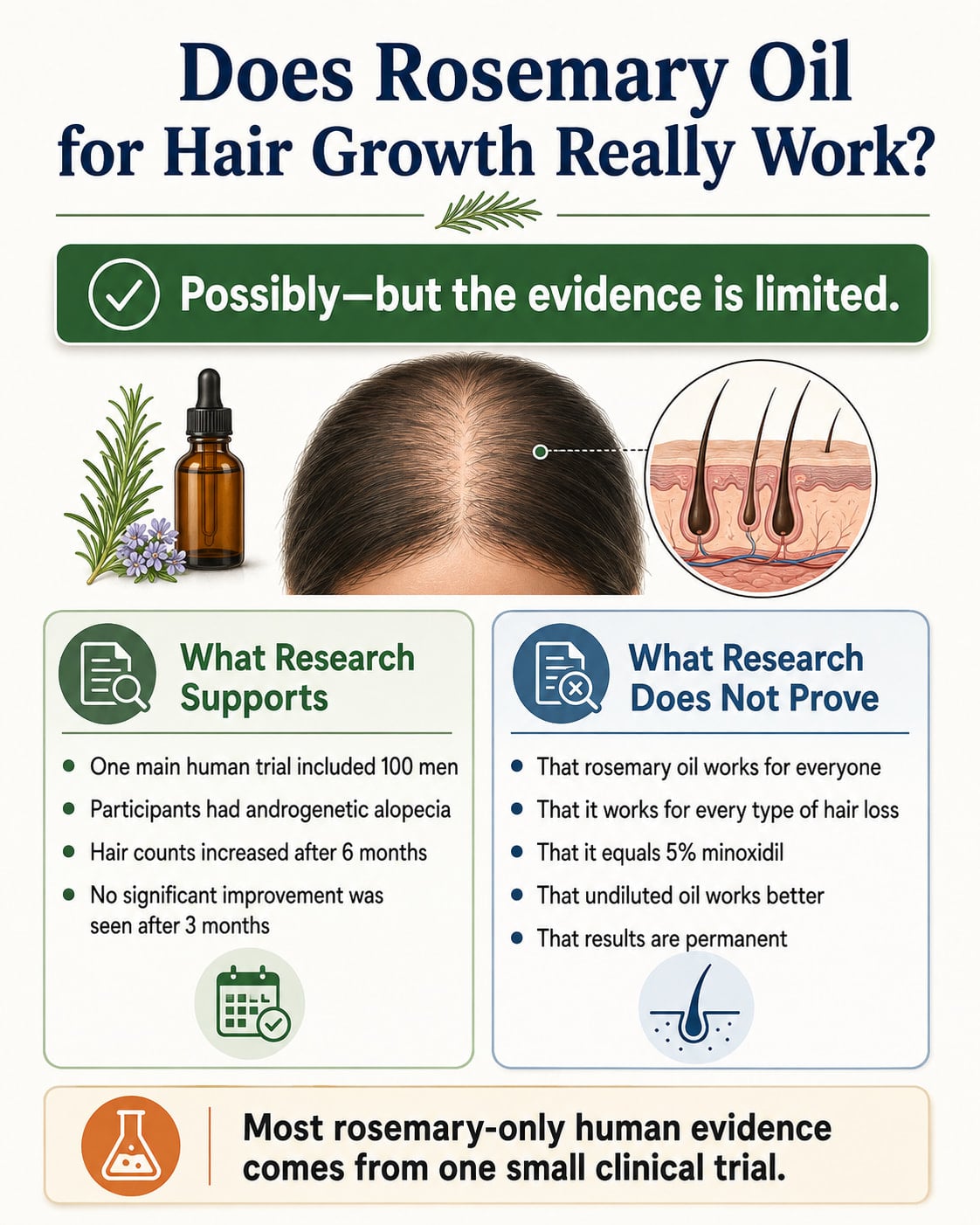
Rosemary oil has some legitimate evidence behind it, but online claims often exaggerate what researchers have actually found.
The strongest rosemary-only evidence comes from one small human trial involving 100 men with androgenetic alopecia, commonly called male-pattern hair loss. The study found that both rosemary oil and 2% minoxidil increased hair counts after six months, and researchers found no statistically significant difference between the groups at that point. Neither group had a significant improvement after three months.
That finding is promising, but it does not prove that rosemary oil:
- Works for everyone
- Works for every cause of hair loss
- Is equal to 5% minoxidil
- Produces permanent hair regrowth
- Works when added to shampoo or used occasionally
- Is more effective when applied undiluted
A 2025 evidence review found that rosemary oil had been evaluated as a stand-alone option in only one qualifying randomized controlled trial. The authors concluded that nonprescription hair products show promise but require larger studies and longer-term safety data.
Rosemary Oil Evidence at a Glance
| Question | Evidence-based answer |
|---|---|
| Can rosemary oil help hair growth? | Possibly, especially in androgenetic alopecia |
| How strong is the evidence? | Limited; largely based on one rosemary-only human trial |
| How long did results take? | Hair counts improved after six months, not three months |
| Is it equal to minoxidil? | One trial found similar results to 2% minoxidil, but equivalence was not definitively established |
| Does it work for all hair loss? | No evidence supports using it for every cause |
| Is rosemary oil FDA-approved for hair growth? | No |
| Should pure essential oil be applied directly? | Generally no; concentrated essential oils may irritate the skin |
What the Main Rosemary Oil Study Found
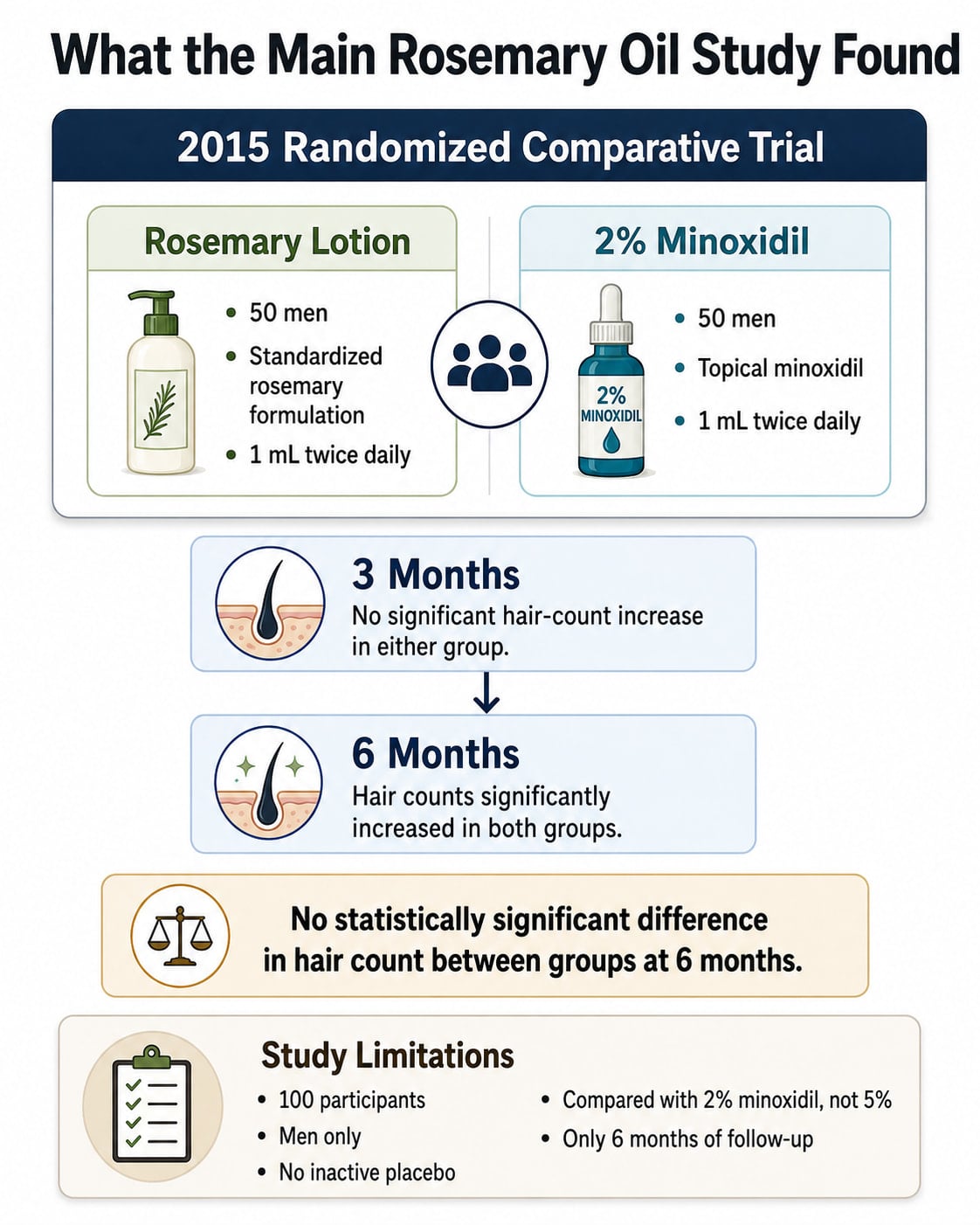
A 2015 randomized comparative trial reported the following results:
- Researchers enrolled 100 men with androgenetic alopecia.
- Fifty participants used a standardized rosemary lotion.
- Fifty used 2% topical minoxidil.
- Participants applied 1 milliliter twice daily for six months.
- Neither group experienced a significant hair-count increase after three months.
- Both groups had a statistically significant increase after six months.
- There was no statistically significant difference in hair count between the groups at six months.
- Scalp itching occurred in both groups but was more common in the minoxidil group.
The rosemary product was not an ordinary bottle of pure essential oil. A review of the trial reported that it was a standardized lotion containing 3.7 milligrams of 1,8-cineole per milliliter. This matters because the composition of retail essential oils, homemade mixtures, infused oils, shampoos, and scalp serums can vary considerably.
Important Study Limitations
The trial provides a reason to study rosemary oil further, but it had several important limitations:
- It included only 100 people.
- All participants were men.
- There was no inactive placebo group.
- It compared rosemary with 2% minoxidil, not 5% minoxidil.
- The researchers did not clearly report the size of the scalp area used for hair counting.
- The study lasted six months, so long-term benefits and risks remain unclear.
- The exact lotion is not necessarily equivalent to products sold online or mixed at home.
A review of the available evidence noted these limitations when evaluating nonprescription products for androgenetic alopecia.
The accurate conclusion is not that rosemary oil is “just as effective as minoxidil.” A better conclusion is that one small study found similar six-month hair-count results between a standardized rosemary lotion and 2% minoxidil.
What About Newer Rosemary Hair Studies?
Newer research has evaluated products combining rosemary with ingredients such as lavender oil, castor oil, rice water, botanical extracts, and commercial hair-growth compounds.
For example, a 2025 randomized study compared rosemary-lavender oil, rosemary-castor oil, and coconut oil. The rosemary-containing products produced favorable changes in several hair measurements over 90 days. However, the study tested combination products, not rosemary oil alone, so the improvements cannot be attributed specifically to rosemary. Larger independent trials are still needed.
Combination studies may help researchers develop future products, but they should not be used as proof that any bottle of rosemary essential oil will regrow hair.
How Rosemary Oil May Support Hair Growth
Researchers have proposed several possible explanations for rosemary’s effects.
Antioxidant Activity
Rosemary contains compounds with antioxidant properties. These compounds may help limit oxidative stress around scalp tissues and hair follicles.
Anti-Inflammatory Activity
Some rosemary compounds have demonstrated anti-inflammatory activity in laboratory research. Reducing unnecessary scalp irritation may help create a healthier environment for existing hair, although this does not prove that rosemary reverses hair loss.
Possible Effects on Scalp Circulation
Rosemary has been proposed to influence local blood flow. Better scalp circulation is frequently offered as an explanation for its potential effects, but this mechanism has not been conclusively demonstrated as the reason for hair growth in humans.
Possible Effects on Androgen Pathways
Animal and laboratory research suggests that certain rosemary-derived compounds may influence 5-alpha-reductase, the enzyme involved in converting testosterone to dihydrotestosterone, or DHT.
DHT contributes to follicle miniaturization in androgenetic alopecia. However, rosemary oil has not been clinically proven to block DHT in humans to the same extent as established medications. A review of nonprescription hair-loss products concluded that claims about rosemary’s antiandrogenic effects remain less established than conventional treatments.
Rosemary Oil vs. Minoxidil
Rosemary oil and minoxidil should not be treated as interchangeable options.
Topical minoxidil has a much larger body of research and is FDA-approved for certain forms of hereditary hair loss in men and women. The American Academy of Dermatology notes that it can reduce hair loss and stimulate growth, although continued use is normally needed to maintain results.
| Feature | Rosemary Oil | Topical Minoxidil |
|---|---|---|
| Human evidence | Limited, with one main rosemary-only trial | Supported by a much larger research base |
| FDA status | Not FDA-approved for hair regrowth | FDA-approved for certain hereditary hair-loss patterns |
| Strength used in the comparison study | Standardized rosemary lotion | 2% minoxidil |
| Typical timeline | Improvement appeared at six months in the main trial | Often evaluated after approximately four to six months |
| Long-term data | Limited | More extensive |
| Possible side effects | Itching, burning, redness, rash, scaling, allergy | Itching, dryness, irritation, unwanted hair growth and other possible effects |
| Best role | Optional complementary approach | Established option for appropriate candidates |
The study did not compare rosemary oil with 5% minoxidil, oral minoxidil, finasteride, spironolactone, or other medical options. It also did not show that switching from a successful minoxidil routine to rosemary oil would maintain the same results.
The American Academy of Dermatology explains that early diagnosis and individualized care are important because hereditary hair loss can become harder to reverse as follicles continue to shrink.
What Types of Hair Loss May Respond to Rosemary Oil?
Hair loss is a symptom, not one single condition. Rosemary oil is more relevant to some patterns than others.
Androgenetic Alopecia
Androgenetic alopecia includes male-pattern and female-pattern hair loss. It generally develops gradually and follows a recognizable pattern.
This is the form of hair loss with the most relevant rosemary-oil research. Rosemary oil may be reasonable as an optional complementary approach for adults with mild pattern thinning, provided they understand that the supporting evidence is limited.
Alopecia Areata
Alopecia areata usually causes smooth, clearly defined bald patches. An older study reported benefits from an aromatherapy mixture containing rosemary, lavender, thyme, and cedarwood oils. However, because multiple oils were used together, the study did not establish that rosemary oil alone was responsible.
People with sudden patches of hair loss should seek professional evaluation rather than relying on essential oil.
Telogen Effluvium
Telogen effluvium is widespread shedding that may follow illness, surgery, childbirth, severe stress, rapid weight loss, nutritional deficiency, or medication changes.
There is no strong evidence that rosemary oil corrects the underlying triggers of telogen effluvium. The cause usually needs to be identified and addressed.
Traction Alopecia and Hair Breakage
Tight braids, ponytails, extensions, frequent chemical processing, and excessive heat can damage hair or place repeated tension on follicles.
An oil may reduce friction and make hair feel softer, but it cannot compensate for continued pulling, burns, or chemical injury. Reducing the source of damage is the priority.
Scarring Hair Loss
Scarring alopecias can permanently damage follicles. Symptoms may include scalp pain, burning, inflammation, pustules, scaling, or smooth shiny areas.
Rosemary oil has not been shown to reverse scarring. Early medical evaluation is important because delaying appropriate care may lead to permanent loss.
Hair Growth Is Not the Same as Reduced Breakage
Hair can look fuller for several different reasons:
- New hairs are growing from follicles.
- Existing hairs are becoming thicker.
- Fewer hairs are shedding.
- Hair fibers are breaking less often.
- Oil temporarily coats the strands and improves shine.
A conditioning oil may reduce tangling or breakage, making hair appear healthier. That does not necessarily mean it has stimulated new growth at the follicle.
When evaluating a rosemary product, take monthly photographs of the scalp rather than judging only by shine, softness, or how the hair feels.
How to Use Rosemary Oil for Hair Growth Safely
There is no universally proven rosemary essential-oil concentration, contact time, or application frequency for hair growth. The following method prioritizes safety and consistency.
Step 1: Identify the Likely Cause of Your Hair Loss
Rosemary oil is most relevant to gradual pattern thinning. Do not delay an evaluation if your hair loss is sudden, patchy, painful, inflamed, or associated with another health change.
Step 2: Choose a Pre-Diluted Scalp Product
A professionally formulated leave-on lotion, serum, or scalp oil is easier to use safely than concentrated rosemary essential oil.
Look for:
- A complete ingredient list
- Clear scalp-application instructions
- A stated concentration, when available
- A batch or lot number
- Manufacturer contact information
- Packaging that protects the product from light and heat
- No exaggerated claims of guaranteed or permanent regrowth
“Rosemary water,” rosemary-infused oil, rosemary shampoo, and rosemary essential oil are not interchangeable. They have different concentrations, ingredients, and contact times.
Step 3: Patch-Test the Product
The AAD’s product-testing guidance recommends applying a new skin-care product to a small test area twice daily for seven to 10 days. Use it for the same amount of time you would normally leave it on. Do not continue if the area becomes red, itchy, swollen, or painful.
A successful home test reduces risk but cannot guarantee that your scalp will not react.
Step 4: Apply It to the Scalp, Not Only the Hair
Part the hair and place a small, label-directed amount on the thinning scalp. Spreading oil only over the hair lengths may condition the strands but is unlikely to reproduce the scalp application used in clinical research.
Use clean fingertips to distribute the product gently. Aggressive rubbing, scratching, or prolonged massage may irritate the scalp and pull fragile hairs.
Step 5: Follow the Product’s Contact-Time Instructions
Some products are intended to remain on the scalp, while others must be rinsed out.
There is no good evidence that leaving rosemary oil on overnight produces better hair growth. Longer contact may increase irritation, especially when using a homemade blend or a product containing fragrance, menthol, peppermint, or several essential oils.
Step 6: Wash Your Hands and Avoid Your Eyes
Wash your hands after application. Keep the product away from the eyes, face, mouth, and broken skin.
If it enters an eye, rinse thoroughly with clean, lukewarm water. Seek medical guidance if pain, redness, or vision changes continue.
Step 7: Track Your Results Consistently
Take a baseline photograph before beginning. Repeat the photograph approximately once a month using the same:
- Lighting
- Camera distance
- Hair part
- Hairstyle
- Head position
- Wet or dry hair condition
Daily mirror checks are unreliable because lighting, styling, and oil on the scalp can significantly change the appearance of density.
Can You Apply Rosemary Essential Oil Directly to the Scalp?
Pure rosemary essential oil should not routinely be placed directly on the scalp.
Essential oils are concentrated plant extracts and can cause irritation or allergic contact dermatitis. Poison Control advises diluting pure essential oils in a carrier oil and avoiding application to damaged skin. Essential oils should also never be swallowed and must be stored securely away from children and pets.
Because droppers, essential-oil composition, and manufacturer recommendations vary, there is no single drops-per-tablespoon recipe proven to regrow hair. A pre-diluted product with clear directions is the more practical choice.
Do not assume that tingling, burning, or redness means the product is “working.” Those symptoms indicate irritation.
How Often Should You Use Rosemary Oil?
The main clinical trial used 1 milliliter of standardized rosemary lotion twice daily. However, a review of the trial noted that this does not establish twice-daily use as the correct schedule for every retail serum, carrier-oil blend, or essential-oil product.
Use the frequency printed on the label of a properly formulated product. Applying extra product or using it more frequently has not been shown to speed hair growth and may increase:
- Greasiness
- Folliculitis-like bumps
- Hairline acne
- Itching
- Redness
- Scaling
- Allergic reactions
People with sensitive scalps should be particularly cautious with products containing multiple essential oils, added fragrance, alcohol, menthol, or strong botanical extracts.
How Long Does Rosemary Oil Take to Work?
Expect months, not days.
The main study found no significant hair-count improvement at three months. Significant increases appeared after six months. Therefore, a reasonable assessment period is approximately six months, provided the scalp remains comfortable and the hair loss is not rapidly worsening.
Stop sooner and seek advice if you develop irritation or increased shedding. Continuing an irritating product for six months is not necessary or helpful.
Results vary. Some people may notice no measurable change even with consistent use.
Rosemary Oil Side Effects
Rosemary scalp products may cause:
- Itching
- Burning or stinging
- Redness
- Dryness
- Flaking
- Rash
- Swelling
- Allergic contact dermatitis
- Bumps along the hairline
- Eye irritation
The 2015 trial recorded increased scalp itching in both the rosemary and minoxidil groups, although itching was more frequent with minoxidil. The study was too small and too short to rule out uncommon or long-term adverse effects.
Stop using the product and wash the area gently if a reaction develops. Seek urgent medical help for difficulty breathing, widespread hives, facial swelling, or swelling of the mouth or throat.
Who Should Use Extra Caution?
Speak with a healthcare professional before using rosemary oil regularly if you:
- Are pregnant, trying to become pregnant, or breastfeeding
- Are using prescription scalp medications
- Have eczema, psoriasis, seborrheic dermatitis, or a fragrance allergy
- Have broken, infected, painful, or severely inflamed scalp skin
- Are considering using it on a child
- Have unexplained hair loss
- Recently had scalp surgery or a cosmetic scalp procedure
The American Academy of Dermatology advises using essential oils, including rosemary oil, sparingly during pregnancy because pregnancy safety has not been adequately researched.
Can You Use Rosemary Oil With Minoxidil?
There is not enough controlled human research to show that combining rosemary oil and minoxidil works better than using either one alone.
Do not mix rosemary essential oil directly into a minoxidil bottle. Doing so may:
- Change the medication’s concentration
- Affect how evenly it is applied
- Increase scalp irritation
- Make it difficult to identify which ingredient caused a reaction
- Interfere with the product’s labeled directions
Someone already using minoxidil should ask a dermatologist or pharmacist before adding a rosemary product. A clinician may recommend using products at separate times, selecting a gentler formulation, or avoiding the combination if the scalp is already irritated.
How to Choose a Rosemary Hair Product
Product quality and formulation matter more than attractive packaging or viral reviews.
Check the Type of Product
A leave-on scalp lotion is closer to the formulation used in the main clinical trial than a shampoo that is rinsed away quickly. However, even two leave-on products may contain very different amounts of rosemary.
Read the Full Ingredient List
Watch for potential irritants such as:
- Added fragrance
- Peppermint or menthol
- High amounts of alcohol
- Several essential oils combined together
- Ingredients that have previously caused a reaction
A long botanical ingredient list is not automatically better.
Be Skeptical of Guaranteed Claims
The FDA explains that claims about restoring hair growth can cause a product to be regulated as a drug rather than merely a cosmetic. The FDA also does not preapprove cosmetic products or most cosmetic ingredients before they reach the market. Its current cosmetics law page was updated on August, 2026.
Be cautious of products promising:
- Guaranteed regrowth
- Permanent reversal of baldness
- Results in a few days
- Complete restoration of a receding hairline
- Results identical to prescription options
- “Clinically proven” benefits without naming the study or formulation
Compare the Product With What Was Studied
A study of a standardized rosemary lotion does not validate every product that contains rosemary.
Similarly:
- Rosemary shampoo is not the same as a leave-on lotion.
- Rosemary water is not the same as essential oil.
- Rosemary-infused carrier oil is not the same as a standardized extract.
- A rosemary-and-castor-oil blend does not prove that castor oil increases growth.
- A product containing five active ingredients cannot show which ingredient produced the result.
When to See a Dermatologist
Make an appointment rather than relying on rosemary oil alone if you notice:
- Sudden or rapidly increasing shedding
- Round or sharply defined bald patches
- Loss of eyebrows or eyelashes
- Scalp pain, burning, crusting, sores, or pustules
- Significant redness or scaling
- Smooth, shiny, or scar-like scalp areas
- Hair loss following a new medication
- Symptoms of possible thyroid, hormonal, iron, or nutritional problems
- Persistent shedding after pregnancy
- Progressive thinning despite six months of consistent care
The American Academy of Dermatology explains that a dermatologist can examine the scalp, review medications and health history, and determine whether testing is appropriate. Finding the cause early is especially important when inflammation or scarring may permanently damage follicles.
Frequently Asked Questions
Does Rosemary Oil Actually Regrow Hair?
Rosemary oil may support modest growth in some adults with androgenetic alopecia. One trial found increased hair counts after six months, but larger studies are needed. It has not been proven effective for every type of shedding or baldness.
How Long Does Rosemary Oil Take to Grow Hair?
The strongest human study found no significant improvement after three months but did find improvement after six months. Claims of major regrowth within days or weeks are not supported by good evidence.
Can I Use Rosemary Oil Every Day?
That depends on the formulation. Follow the label directions for a pre-diluted scalp product. The main study used a standardized lotion twice daily, but that schedule should not automatically be applied to pure essential oil or homemade mixtures.
Can I Put Pure Rosemary Essential Oil Directly on My Scalp?
Direct application is not recommended because concentrated essential oil may cause burning, redness, rash, or allergic contact dermatitis. Choose a pre-diluted product or follow professional dilution guidance.
Can I Leave Rosemary Oil on Overnight?
There is no strong evidence that overnight application improves results. Leave it on only when the product is specifically formulated and labeled for overnight use. Longer exposure may increase irritation.
Does Rosemary Oil Work for a Receding Hairline?
There is no strong evidence specifically showing reliable restoration of a receding hairline. The available trial involved men with pattern hair loss, but individual responses and thinning patterns vary.
Can Rosemary Oil Make Hair Loss Worse?
Rosemary oil has not been shown to directly cause pattern baldness. However, irritation, allergic dermatitis, scalp inflammation, or aggressive massage could increase shedding or breakage. Stop using it if your scalp becomes uncomfortable or hair loss noticeably worsens.
Conclusion
Rosemary oil for hair growth has more scientific support than many viral home remedies, but the evidence is still preliminary. One controlled trial found modest improvement after six months in men with androgenetic alopecia, yet the study does not prove that rosemary oil works for everyone or matches stronger, better-established options.
Start by identifying the cause of your hair loss. Then choose a pre-diluted scalp product, patch-test it, follow the label, take consistent monthly photographs, and allow several months for assessment. Seek a dermatologist promptly for sudden, patchy, inflamed, painful, or rapidly progressing hair loss.
This content is for informational purposes only and not medical advice.
References
- Rosemary oil vs. 2% minoxidil randomized comparative trial — PubMed
- Review of nonprescription products for androgenetic alopecia — PubMed Central
- Randomized trial of rosemary combination oils — PubMed
- American Academy of Dermatology guidance on genetic hair loss
- American Academy of Dermatology product-testing guidance
- FDA guidance on cosmetics and hair-growth claims
- Poison Control essential-oil safety guidance