
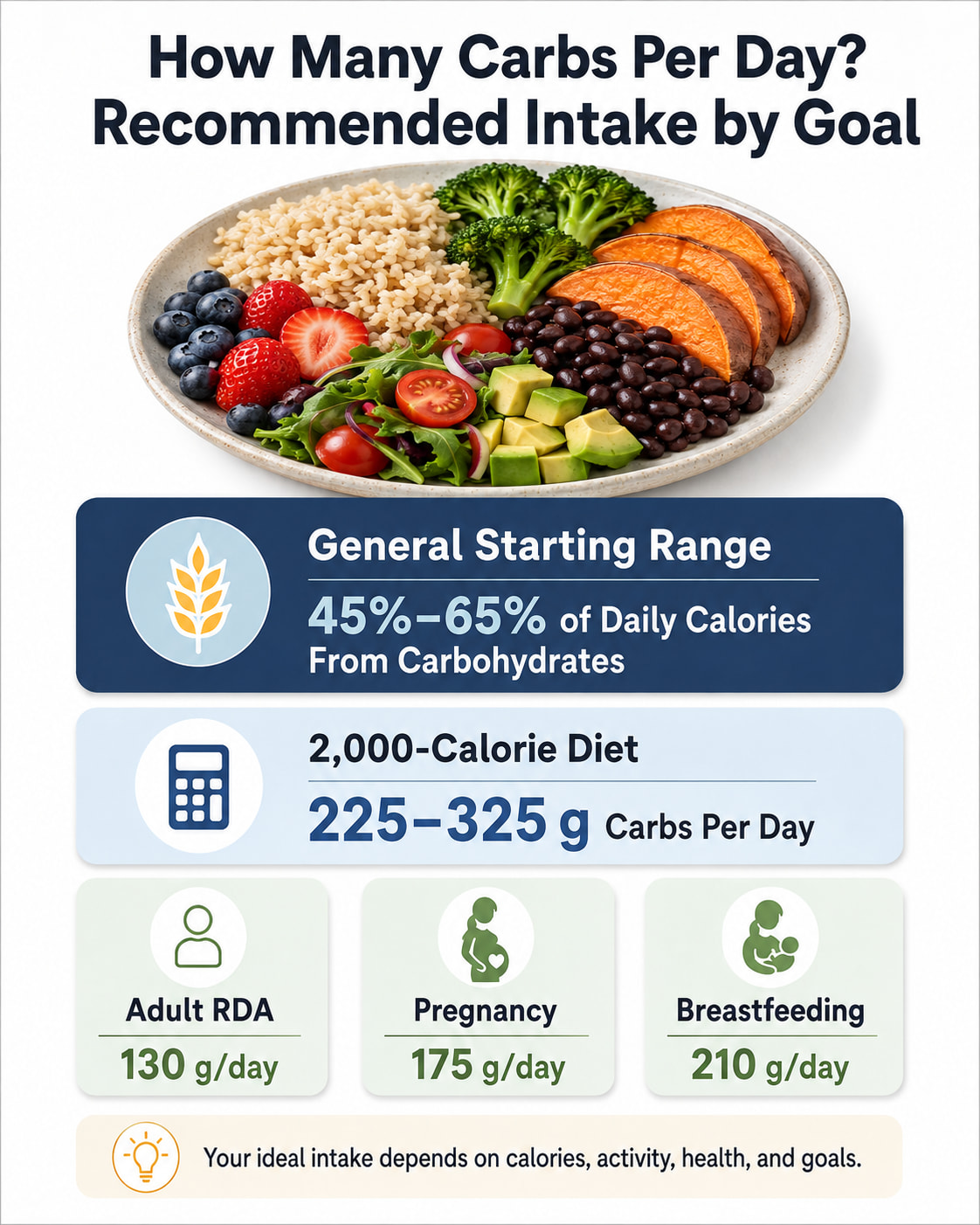
Most healthy adults can aim for 45% to 65% of their daily calories from carbohydrates, which equals about 225 to 325 grams of carbs per day on a 2,000-calorie diet. Your ideal amount may be lower or higher depending on your calorie needs, activity level, weight goal, health conditions, and whether you are pregnant or breastfeeding.
The adult Recommended Dietary Allowance, or RDA, is 130 grams per day. However, this is an adequacy benchmark rather than the ideal target for every person. The National Academies’ Dietary Reference Intakes also provide the broader 45%–65% planning range for healthy adults.
The current Dietary Guidelines for Americans, 2025–2030, released in January 2026, does not give every adult one universal carbohydrate target. Instead, it emphasizes eating fiber-rich whole grains and other nutrient-dense foods while reducing highly processed, refined carbohydrates and added sugars.
How Many Carbs Per Day? Quick Answer by Goal
| Goal or situation | Daily carbohydrate reference |
|---|---|
| General health and weight maintenance | 45%–65% of total calories |
| 2,000-calorie diet | 225–325 grams |
| Adult carbohydrate RDA | 130 grams |
| Weight loss | No required carb limit; calculate from your weight-loss calorie target |
| Low-carbohydrate eating pattern | 26%–45% of calories |
| Very-low-carbohydrate or keto-style pattern | Less than 26% of calories, often 20–50 grams of non-fiber carbs |
| Light or lower-volume athletic training | Approximately 3–5 g/kg of body weight |
| Moderate exercise around one hour per day | Approximately 5–7 g/kg |
| Endurance training for one to three hours per day | Approximately 6–10 g/kg |
| Diabetes or prediabetes | Individualized; no universal gram target |
| Pregnancy | 175 grams per day |
| Breastfeeding | 210 grams per day |
The adult, pregnancy, and breastfeeding figures come from the Dietary Reference Intakes. The low-carbohydrate categories are used by the American Diabetes Association, while the exercise ranges come from a joint sports-nutrition position statement. These numbers are starting references, not personalized prescriptions.
Understanding the Main Daily Carb Recommendations
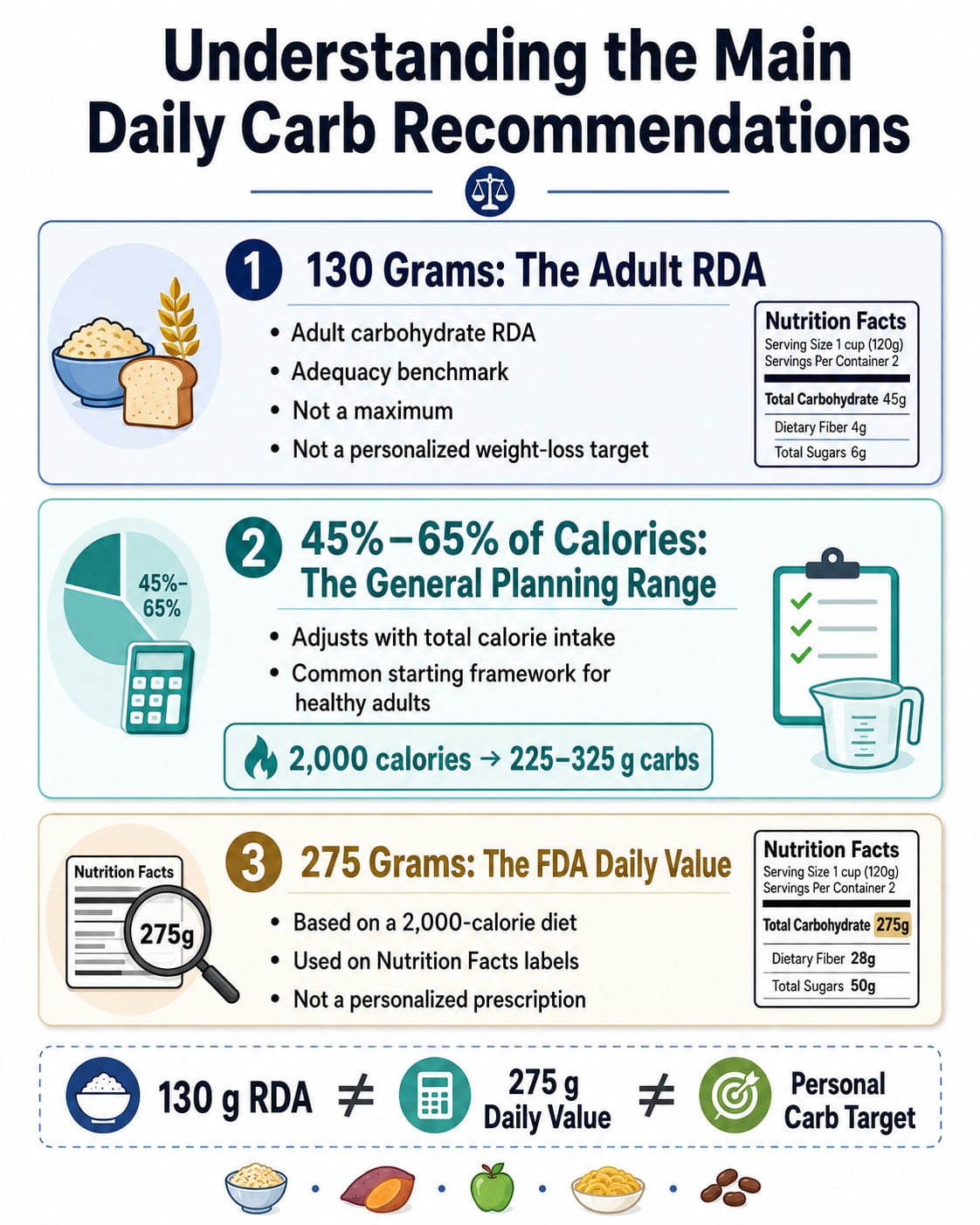
Several different carbohydrate numbers appear in nutrition advice. Each serves a different purpose.
130 Grams: The Adult RDA
The carbohydrate RDA is 130 grams per day for healthy, nonpregnant adults. An RDA is designed to meet the needs of nearly all healthy people in a life-stage group.
The 130-gram figure should not be interpreted as:
- The perfect amount for every adult
- A weight-loss target
- A maximum limit
- The amount required by an athlete
- The amount shown as 100% Daily Value on food labels
Someone who trains several hours per day may require far more than 130 grams. Someone following a medically supervised very-low-carbohydrate plan may consume less.
45%–65% of Calories: The General Planning Range
The Acceptable Macronutrient Distribution Range, or AMDR, recommends that adults obtain 45%–65% of total calories from carbohydrates.
This range is usually more helpful than the RDA because it adjusts to total calorie intake. A person eating 1,600 calories will have a lower carbohydrate range than someone eating 2,500 calories.
275 Grams: The FDA Daily Value
The FDA Daily Value for total carbohydrate is 275 grams per day, based on a 2,000-calorie diet. It appears on Nutrition Facts labels so shoppers can understand how one serving contributes to a standardized daily amount.
The FDA’s current Daily Value reference also lists 28 grams for dietary fiber and 50 grams for added sugars. These are labeling references, not individualized targets that everyone must reach.
Because 275 grams of carbohydrate provides 1,100 calories, it represents approximately 55% of a 2,000-calorie diet—the midpoint of the 45%–65% range.
How to Calculate How Many Carbs You Need
Carbohydrates provide approximately four calories per gram. Use this formula:
Daily calories × desired carbohydrate percentage ÷ 4 = grams of carbs per day
For example, suppose you eat 2,000 calories and want 50% of those calories to come from carbohydrates:
2,000 × 0.50 ÷ 4 = 250 grams of carbs per day
Daily Carb Intake by Calorie Level
| Daily calories | 45% from carbs | 55% from carbs | 65% from carbs |
|---|---|---|---|
| 1,600 | 180 g | 220 g | 260 g |
| 1,800 | 203 g | 248 g | 293 g |
| 2,000 | 225 g | 275 g | 325 g |
| 2,200 | 248 g | 303 g | 358 g |
| 2,500 | 281 g | 344 g | 406 g |
| 3,000 | 338 g | 413 g | 488 g |
These figures are calculated from the National Academies’ 45%–65% range. You do not need to hit the same number perfectly every day. Your average intake and overall dietary pattern are more useful than small day-to-day differences.
Recommended Carbs Per Day for General Health
For general health and weight maintenance, begin within the standard 45%–65% of calories range.
Someone who eats 2,000 calories might start near the middle of the range at approximately 250–275 grams per day. That number can then be adjusted according to:
- Hunger and fullness
- Total calorie needs
- Physical activity
- Food preferences
- Digestive comfort
- Blood glucose response
- Ability to obtain enough fiber and essential nutrients
The quality of those carbohydrates matters. A 250-gram intake built around beans, oats, vegetables, fruit, potatoes, and minimally processed whole grains is nutritionally different from 250 grams coming primarily from soda, candy, pastries, and refined snack foods.
How Many Carbs Per Day to Lose Weight?
There is no specific carbohydrate intake that guarantees weight loss. Weight loss can occur with moderate-carbohydrate, lower-carbohydrate, or higher-carbohydrate eating patterns when the overall plan creates a manageable calorie deficit and can be maintained.
For example, on a 1,600-calorie weight-loss plan:
- 45% from carbohydrates equals 180 grams per day
- 40% equals 160 grams per day
- 35% equals 140 grams per day
Any of these amounts may work. The lower number is not automatically more effective.
A 2022 Cochrane review analyzed 61 trials involving 6,925 adults with overweight or obesity. The researchers found little to no difference in weight loss between low-carbohydrate and balanced-carbohydrate diets for up to two years. Results were similar among participants with and without type 2 diabetes.
A Practical Weight-Loss Approach
Instead of cutting carbohydrates as low as possible:
- Choose a realistic daily calorie target.
- Select a carbohydrate level you can maintain.
- Keep protein and fiber-rich foods in most meals.
- Reduce sugary drinks, sweets, and easily overeaten refined snacks first.
- Monitor your weight trend, hunger, energy, and dietary consistency.
- Adjust portions gradually rather than eliminating an entire food group.
A person who enjoys fruit, beans, oatmeal, and whole grains may find a moderate-carbohydrate plan more sustainable. Someone who feels more satisfied with fewer starches and more protein may prefer a lower-carbohydrate pattern.
How Many Carbs Per Day for Muscle Gain and Strength Training?
There is no separate federal carbohydrate RDA for building muscle. Resistance training, sufficient protein, adequate energy, sleep, and progressive overload are the primary components of a muscle-building plan.
Carbohydrates support training by helping supply energy and replenish muscle glycogen. They become more important as workout volume, frequency, and intensity increase.
Sports-nutrition guidance uses body weight and training demand:
- Light or lower-volume training: approximately 3–5 g/kg per day
- Moderate exercise around one hour daily: approximately 5–7 g/kg per day
- Higher-volume endurance training: approximately 6–10 g/kg per day
These are athletic fueling benchmarks, not minimum requirements for everyone who lifts weights. Someone completing three brief strength workouts per week may need considerably less than an athlete training for several hours each day.
Example for a 165-Pound Adult
First, convert pounds to kilograms:
165 ÷ 2.2 = 75 kilograms
At 3–5 grams per kilogram:
75 × 3–5 = 225–375 grams of carbs per day
A recreational lifter may begin near the lower end and increase intake if training volume rises or performance and recovery appear to suffer.
How Many Carbs Per Day for Running and Endurance Training?
Endurance athletes often require more carbohydrates than sedentary adults because repeated or prolonged exercise uses stored muscle and liver glycogen.
| Daily training demand | Suggested carbohydrate range |
|---|---|
| Light or low-intensity activity | 3–5 g/kg |
| Moderate exercise, about one hour daily | 5–7 g/kg |
| Moderate-to-hard exercise, one to three hours daily | 6–10 g/kg |
| Extreme endurance training, four to five hours daily | 8–12 g/kg |
For a 150-pound runner, body weight is approximately 68 kilograms. A moderate training range of 5–7 g/kg would equal approximately 340–476 grams per day.
These higher amounts are intended for people with substantial training demands. They should not be applied automatically to someone who is mostly sedentary or performs only short recreational workouts.
How Many Carbs Per Day With Diabetes or Prediabetes?
There is no universal daily carbohydrate recommendation for everyone with diabetes or prediabetes.
The American Diabetes Association’s 2026 Standards of Care states that there is no ideal percentage of calories from carbohydrate, protein, and fat that applies to every person with diabetes. Intake should be personalized according to metabolic goals, medications, food preferences, culture, activity, and blood glucose response.
Practical priorities may include:
- Choosing minimally processed, fiber-rich carbohydrates
- Keeping carbohydrate portions reasonably consistent when helpful
- Pairing carbohydrate foods with protein, healthy fat, or fiber
- Monitoring how different meals affect blood glucose
- Using total carbohydrate on the Nutrition Facts label
- Working with a registered dietitian nutritionist or diabetes care team
Generic advice such as “eat 45 grams at every meal” is not appropriate for everyone. A person using mealtime insulin may need individualized carbohydrate counting and an insulin-to-carbohydrate ratio established with their diabetes care team.
Important Medication Warning
Major carbohydrate reductions can change blood glucose and medication needs. Insulin, sulfonylureas, and other medications associated with hypoglycemia may require adjustment by a qualified clinician.
The 2026 ADA Standards also advise avoiding very-low-carbohydrate eating plans in people taking SGLT2 inhibitors because the combination may increase the risk of ketoacidosis. Do not stop or change diabetes medication on your own when changing your carbohydrate intake.
How Many Carbs Per Day on a Low-Carb or Keto Diet?
“Low-carb” does not describe one exact number.
The American Diabetes Association’s professional nutrition resource uses these definitions:
- Low-carbohydrate: 26%–45% of total calories
- Very-low-carbohydrate: less than 26% of total calories
- Common very-low-carb goal: 20–50 grams of non-fiber carbohydrate per day
On a 2,000-calorie diet, 26%–45% equals approximately 130–225 grams per day. This explains why an intake can be classified as lower-carbohydrate even when it is well above the 20–50 grams commonly associated with keto.
A keto-style plan is not required for weight loss. It may also make it harder to obtain enough fiber or maintain a varied diet when fruit, legumes, whole grains, and starchy vegetables are heavily restricted.
Medical guidance is particularly important before starting a very-low-carbohydrate plan if you:
- Take diabetes or blood pressure medication
- Are pregnant or breastfeeding
- Have kidney, liver, pancreatic, or gallbladder disease
- Have a history of disordered eating
- Are preparing for high-volume athletic training
Carb Requirements During Pregnancy and Breastfeeding
Carbohydrate needs increase during pregnancy and lactation:
- Pregnancy RDA: 175 grams per day
- Breastfeeding RDA: 210 grams per day
These values are higher than the standard adult RDA of 130 grams. The Dietary Reference Intakes also list fiber targets of 28 grams during pregnancy and 29 grams during breastfeeding.
Pregnancy and breastfeeding are not appropriate times to begin a highly restrictive carbohydrate plan without guidance from a prenatal health professional or registered dietitian.
Choose High-Quality Carbohydrate Foods
Carbohydrates include starches, sugars, and fiber. Rather than treating all carbohydrates as equal, consider how much fiber, protein, vitamins, minerals, added sugar, and processing a food contains.
| Choose more often | Limit more often |
|---|---|
| Beans, peas, and lentils | Sugar-sweetened soda |
| Oats, barley, quinoa, and brown rice | Candy and sweetened desserts |
| Whole-grain bread and pasta | Highly refined snack foods |
| Potatoes, sweet potatoes, corn, and squash | Sugary breakfast products |
| Whole fruit | Fruit drinks with added sugar |
| Non-starchy vegetables | Refined baked goods |
| Plain milk and unsweetened yogurt | Heavily sweetened dairy products |
| Nuts and seeds | Foods high in refined carbs but low in fiber |
The current 2025–2030 Dietary Guidelines recommend prioritizing fiber-rich whole grains and consuming approximately two to four whole-grain servings per day, adjusted for calorie needs. They also recommend significantly reducing highly processed refined carbohydrates and avoiding sugar-sweetened beverages.
Do Not Judge a Food by Carbs Alone
Beans contain carbohydrates, but they also provide fiber and plant protein. Fruit contains natural sugar, but whole fruit also provides water, fiber, vitamins, and minerals. Plain milk contains lactose, yet it supplies protein, calcium, and other nutrients.
A food with fewer carbs is not automatically more nutritious. For example, a highly processed low-carb snack may provide less fiber and fewer essential nutrients than a piece of fruit or a serving of beans.
How Much Fiber Should You Get?
Fiber is included within total carbohydrate on Nutrition Facts labels, but the body does not digest all fiber in the same way it digests starch and sugar.
The FDA Daily Value is 28 grams of fiber per day on a 2,000-calorie diet. Age- and sex-specific Dietary Reference Intakes for adults range from approximately 21 to 38 grams per day.
Good sources include:
- Beans, lentils, and peas
- Berries, pears, and apples
- Vegetables
- Oats and barley
- Whole-grain bread and cereal
- Nuts and seeds
Increase fiber gradually when your current intake is low, and drink adequate fluids. A sudden large increase—especially from isolated fiber supplements—may cause bloating, gas, or constipation.
What About Added Sugar?
Added sugar is part of total carbohydrate, but it should not make up a large portion of your daily carb intake.
The 2025–2030 Dietary Guidelines recommend avoiding sugar-sweetened beverages and state that a meal should contain no more than 10 grams of added sugar. The FDA’s 50-gram Daily Value for added sugar remains on food labels, but that value is a labeling reference rather than an amount you need to consume.
Naturally occurring sugars in whole fruit and plain milk are not classified as added sugars.
Should You Count Total Carbs or Net Carbs?
For general nutrition tracking, use total carbohydrate unless a qualified health professional has given you different instructions.
Total carbohydrate on a Nutrition Facts label includes:
- Starch
- Sugar
- Dietary fiber
“Net carbs” are commonly calculated by subtracting fiber and some or all sugar alcohols from total carbohydrate. However, the term has no legal FDA definition, and the American Diabetes Association does not recognize it as a standardized measurement.
Different fibers and sugar alcohols can be absorbed or metabolized differently. As a result, subtracting all of them may underestimate how a product affects calories or blood glucose. The ADA recommends using total carbohydrate, especially when making diabetes-management decisions.
How to Find Your Personal Carb Target
Use the following process to choose a realistic starting amount.
1. Estimate Your Daily Calorie Needs
Your calorie needs depend on age, body size, activity, health status, and goals. Weight maintenance, weight loss, and weight gain require different calorie targets.
2. Choose the Appropriate Carb Framework
Use:
- 45%–65% of calories for general healthy eating
- A personally sustainable percentage for weight loss
- Grams per kilogram for structured athletic training
- An individualized plan for diabetes
- Pregnancy or breastfeeding RDAs when applicable
3. Calculate Your Grams
Suppose your calorie target is 2,200 calories and you choose 50% from carbohydrates:
2,200 × 0.50 ÷ 4 = 275 grams per day
4. Build the Target Around Whole Foods
Include vegetables, fruit, beans, minimally processed grains, dairy if used, and other foods that provide fiber and essential nutrients.
5. Monitor the Results
Over several weeks, consider:
- Hunger and fullness
- Energy throughout the day
- Workout performance and recovery
- Digestive comfort
- Weight trend, if relevant
- Blood glucose response, if monitored
- Whether the eating pattern is realistic to maintain
6. Adjust Gradually
You may need more carbohydrates when training volume increases. You may prefer fewer when activity declines or when a moderate reduction helps with calorie control.
Make one manageable adjustment at a time instead of repeatedly switching between extreme high- and low-carbohydrate plans.
Example of Spreading Carbs Through the Day
A person targeting 200 grams per day might distribute them like this:
| Eating occasion | Example carb amount |
|---|---|
| Breakfast | 45 g |
| Lunch | 55 g |
| Snack | 25 g |
| Dinner | 75 g |
| Daily total | 200 g |
This is only an example. Carbohydrates do not need to be divided equally. Athletes may place more around training, while people using insulin may require a distribution coordinated with their medication plan.
When to Get Personalized Nutrition Guidance
Consult a physician or registered dietitian nutritionist before making a major carbohydrate change when you:
- Take insulin, sulfonylureas, SGLT2 inhibitors, or other glucose-lowering medication
- Experience frequent high or low blood glucose
- Are pregnant, trying to become pregnant, or breastfeeding
- Have kidney, liver, digestive, or pancreatic disease
- Have a history of an eating disorder
- Are planning a ketogenic or highly restrictive diet
- Train competitively or for several hours per day
- Have persistent fatigue, digestive problems, or unintended weight changes
Frequently Asked Questions
Is 100 Grams of Carbs Per Day Low-Carb?
Yes. One hundred grams provides 400 calories. On a 2,000-calorie diet, that is 20% of total calories, which falls within the very-low-carbohydrate category of less than 26%.
However, it is above the 20–50 grams commonly used in ketogenic plans.
Is 150 Grams of Carbs Too Much for Weight Loss?
Not necessarily. One hundred fifty grams provides 600 calories. Whether you lose weight depends on total calorie intake, activity, food quality, and consistency—not the carbohydrate number alone.
For someone eating 1,600 calories, 150 grams represents 37.5% of calories and can fit a lower-carbohydrate weight-loss plan.
Is 130 Grams of Carbs the Minimum Everyone Needs?
No. It is the adult RDA and an important adequacy reference, but it is not a strict threshold that determines whether every individual diet is safe or effective.
People who consume less should plan carefully to maintain fiber, nutrient intake, dietary variety, and appropriate medical monitoring.
How Many Carbs Should a Person With Diabetes Eat Per Day?
There is no universal amount. The appropriate intake depends on medication, activity, blood glucose response, food preferences, and metabolic goals.
A registered dietitian nutritionist or diabetes care professional can help establish a daily and per-meal target. People using insulin should not calculate medication doses from a general online recommendation.
Should I Count Total Carbs or Net Carbs?
Use total carbohydrate for general tracking and diabetes management. Net carbs are not standardized and may not accurately reflect how different fibers and sugar alcohols affect blood glucose or calories.
How Many Carbs Should I Eat Per Meal?
Divide your daily target according to your schedule and preferences. For example, someone eating 180 grams per day might consume approximately 45–60 grams at each of three meals, with the remainder used for snacks.
This is not a universal diabetes recommendation. Medication users may need a more precise plan.
Are Fruit, Potatoes, and Whole Grains Too High in Carbs?
They contain carbohydrates, but that does not make them unsuitable for a healthy diet. Whole fruit, potatoes, beans, and whole grains can provide fiber, potassium, vitamins, minerals, and other beneficial nutrients.
Portion size and the overall dietary pattern matter more than labeling every carbohydrate food as “good” or “bad.”
Conclusion
For most healthy adults, 45%–65% of daily calories from carbohydrates is the best general starting point. That equals 225–325 grams per day on a 2,000-calorie diet.
Your ideal intake may differ. Weight loss does not require one specific carb limit, athletes may need substantially more, and people with diabetes need an individualized plan. Pregnancy and breastfeeding also increase carbohydrate requirements.
Start with an appropriate calorie-based range, prioritize fiber-rich and minimally processed foods, monitor how the amount affects you, and make gradual adjustments that support both your goals and long-term consistency.
This content is for informational purposes only and not medical advice.
References
- National Academies — Dietary Reference Intake Tables for Carbohydrates and Fiber
- National Academies and AHRQ — Association of Digestible Carbohydrate Intake With Chronic Disease and Body Composition
- FDA — Daily Values on Nutrition and Supplement Facts Labels
- USDA and HHS — Dietary Guidelines for Americans, 2025–2030
- American Diabetes Association — Standards of Care in Diabetes—2026, Nutrition and Health Behaviors