
Getting thicker hair for women starts with reducing breakage, creating visible volume, and addressing any underlying cause of thinning. For female pattern hair loss, topical minoxidil may support regrowth, but ordinary thickening shampoos and hair vitamins do not offer the same benefit.

The right approach depends on what has changed: the condition of your strands, the amount you shed, or your overall hair density. The American Academy of Dermatology explains that identifying the cause is the starting point for choosing appropriate care.
Fine Hair and Thinning Hair Are Not the Same
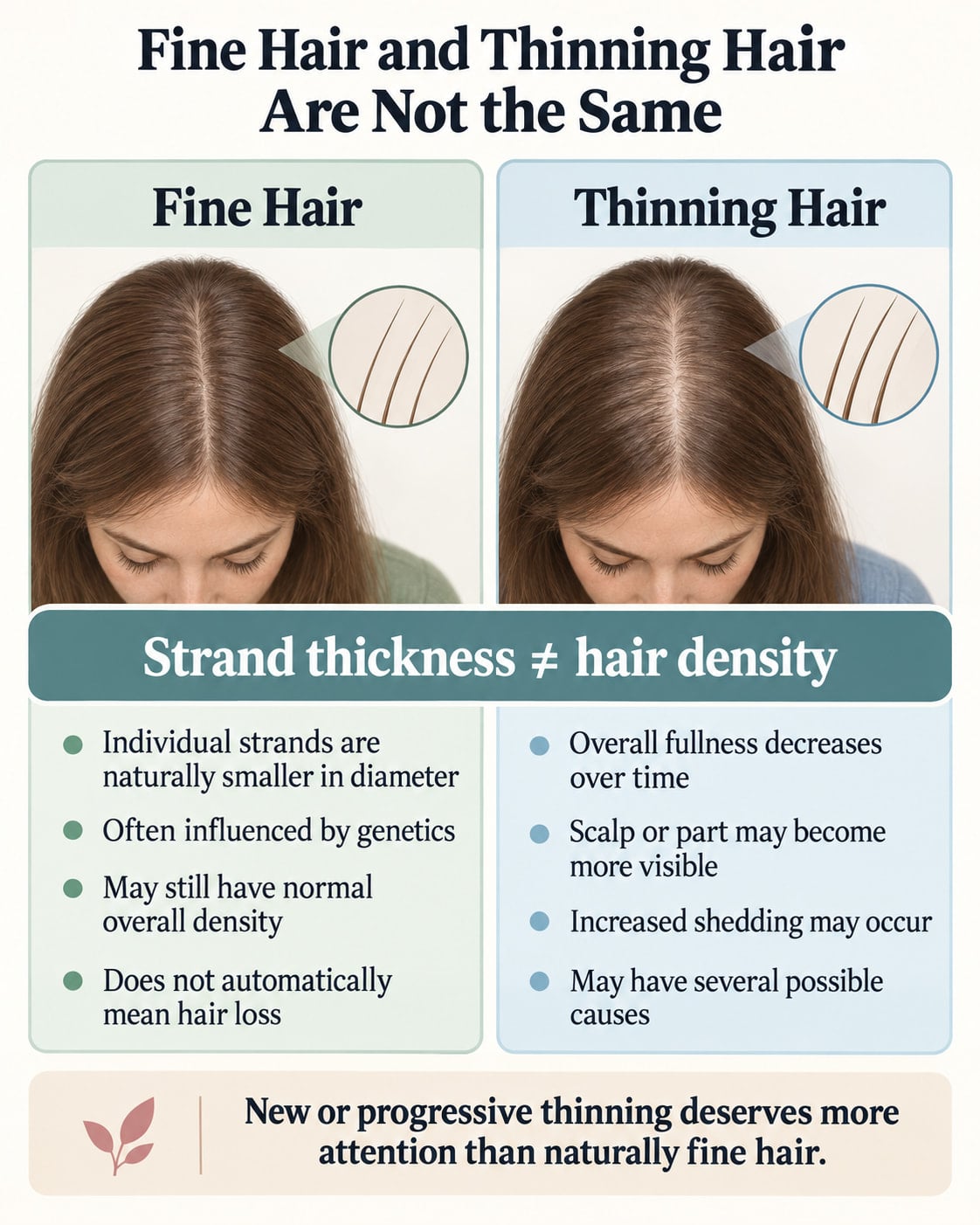
Naturally fine hair has slender individual strands. Genetics strongly influences strand thickness, so fine hair is not automatically unhealthy or something you need to “fix.” Hormones, aging, medications, and chemical processing can also affect hair characteristics.
Thinning involves a change in fullness over time. A widening part, more visible scalp, or increased shedding deserves different attention than hair that has always been fine. These changes can have several causes, rather than one universal solution.
Keep your goal clear: making hair look fuller, protecting existing strands, and supporting regrowth are different outcomes.
Thicker Hair for Women: 10 Practical Ways to Improve Fullness
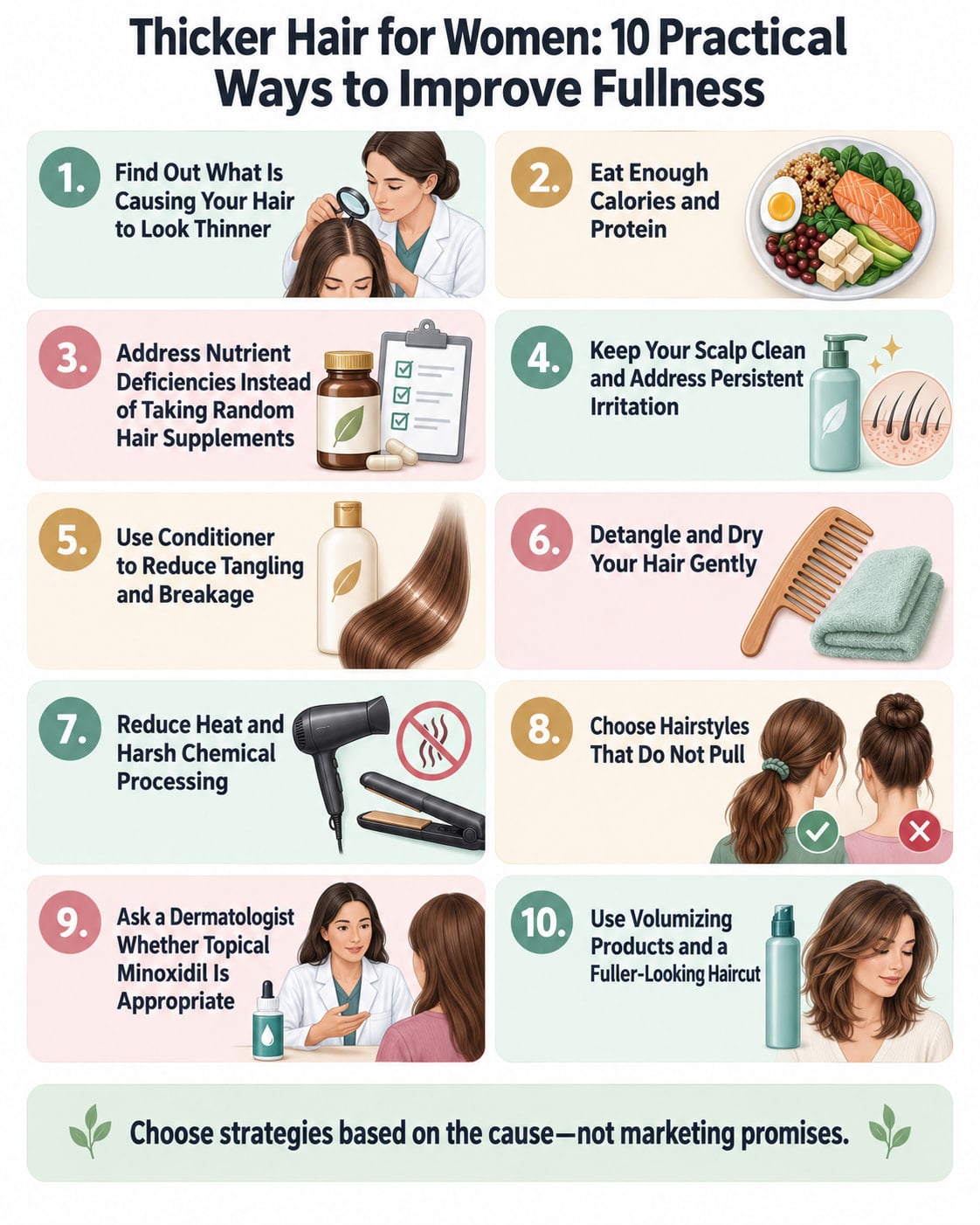
1. Find Out What Is Causing Your Hair to Look Thinner
Before buying another serum, consider when the change began.
Gradual thinning around the part or crown may suggest female pattern hair loss. Increased shedding can follow illness, childbirth, major stress, or significant weight loss. Thyroid problems, certain medications, and scalp conditions are other possible contributors. These patterns provide clues, not a diagnosis.
Make a brief record of when you first noticed thinning, recent health changes, your eating habits, and the medications or supplements you use. Bring this information to an appointment.
A dermatologist can examine your scalp and assess whether you have shedding, breakage, or another form of hair loss. Blood tests or a scalp biopsy may be appropriate when the examination suggests a particular problem; everyone does not need the same testing panel.
Do not stop a prescribed medication on your own because you suspect it is affecting your hair. Discuss the concern with the prescribing clinician.
2. Eat Enough Calories and Protein
Undereating can affect more than your energy. The AAD identifies inadequate calorie intake and insufficient nutrients, including protein and iron, as possible contributors to hair loss. Aggressive dieting is therefore not a hair-friendly strategy.
Build regular meals around a variety of foods. Protein options include eggs, fish, poultry, dairy foods, tofu, beans, lentils, nuts, and seeds. You do not need animal products to meet your protein needs, but variety matters.
For example, add beans or tofu to a vegetable-and-grain bowl rather than relying on vegetables alone as your entire meal.
Think nutritional adequacy, not an extreme “hair-growth diet.” A registered dietitian can help you review your intake when food restrictions make balanced eating difficult.
3. Address Nutrient Deficiencies Instead of Taking Random Hair Supplements
Supplements are most useful when they address an identified need. A dermatologist may recommend a particular nutrient when an assessment shows a deficiency, rather than automatically prescribing a collection of hair gummies.
Biotin deserves particular caution. The NIH Office of Dietary Supplements states that biotin deficiency is very rare in the United States and that little scientific evidence supports routine biotin supplements for hair benefits.
Biotin can also interfere with laboratory results. The FDA warns that some affected tests include troponin tests used when assessing possible heart injury. Tell your healthcare team about supplements before blood testing, and follow their instructions rather than choosing your own stopping interval.
More is not necessarily better: excessive amounts of certain nutrients, including vitamin A and selenium, have been linked to hair loss.
4. Keep Your Scalp Clean and Address Persistent Irritation
There is no universal washing schedule for fuller hair. Your scalp’s oiliness, hair texture, and product buildup matter.
The AAD recommends washing according to your hair’s needs. Straight hair with an oily scalp may need frequent washing, sometimes daily. Dry, curly, or tightly textured hair may need less frequent cleansing.
Focus shampoo on the scalp rather than scrubbing it through the entire length. This helps remove oil and buildup without unnecessarily drying the ends.
Persistent flakes or itching should not simply be covered with more styling products. Follow appropriate dandruff-product instructions, and seek dermatology advice when symptoms continue despite basic care. Scalp care should address the problem, not just conceal it.
5. Use Conditioner to Reduce Tangling and Breakage
Skipping conditioner to avoid flat hair can leave you with a different problem: fragile strands that tangle and snap. Conditioner coats the hair and helps reduce breakage and split ends.
Match its application to your hair:
- Fine or straight hair: Concentrate conditioner on the ends.
- Dry or curly hair: Apply it through the lengths where moisture and detangling are needed.
A leave-in conditioner or detangler may also help when knots remain a problem after washing. Choose an amount and formula that make your hair manageable without leaving it excessively weighed down.
6. Detangle and Dry Your Hair Gently
Work through knots instead of pulling through them. Start near the ends with a wide-tooth comb, then gradually move upward.
Adjust the timing to your texture. Straight hair can dry slightly before gentle combing. Curly or tightly textured hair is generally better detangled while damp; conditioner can help the comb move through tangles.
After washing, gently wrap or blot your hair with a towel instead of rubbing it vigorously. Avoid repeated brushing simply to reach a certain number of strokes. The goal is to detangle and style—not create unnecessary friction.
7. Reduce Heat and Harsh Chemical Processing
Frequent high-heat styling and repeated chemical services can damage existing hair. Reducing that damage protects the strands you already have; it should not be confused with producing new growth.
Use a lower heat setting, shorten contact with hot tools, and leave more days between heat-styling sessions. Let your hair air-dry when practical.
For coloring, relaxing, or perming, discuss spacing services farther apart with your stylist. Avoid stacking several harsh processes into one session. A routine that requires less repeated processing can be easier on fragile hair.
8. Choose Hairstyles That Do Not Pull
The issue is not whether you wear braids, a bun, or a ponytail. It is how much tension the style places on your hair and how often that tension occurs.
Repeated pulling can lead to traction alopecia, a form of hair loss associated with tight hairstyles. Heavy extensions and tightly installed weaves can also contribute. Long-standing traction can cause permanent loss.
Choose looser styles, reduce the weight of added hair, and change hairstyles regularly. Pay particular attention to the hairline, where broken hairs or thinning may appear.
Pain means the style is too tight. Loosen or remove a style that causes pain, stinging, or visible pulling of the scalp.
9. Ask a Dermatologist Whether Topical Minoxidil Is Appropriate
For diagnosed female pattern hair loss, topical minoxidil is an evidence-supported option. It is not a general thickening product for every cause of shedding.
A 2016 randomized clinical trial found that once-daily 5% minoxidil foam improved hair density and scalp coverage compared with inactive foam in 404 women. At 24 weeks, the minoxidil group averaged approximately 9.1 additional hairs per square centimeter compared with the control group. Individual results varied.
Product Directions Are Not Interchangeable
The US women’s product labels reviewed for this article give different directions. For example, the official women’s 5% foam label specifies once-daily application.
| Women’s formulation | Labeled application | When the label says to stop and ask a doctor if there is no regrowth |
|---|---|---|
| 5% minoxidil foam | Half a capful directly to the affected scalp once daily | After 6 months |
| 2% minoxidil solution | 1 mL directly to the affected scalp twice daily | After 4 months |
These are product-label facts, not a recommendation that every reader should begin using minoxidil. Using more does not improve results, and continued use is necessary to maintain benefits.
Important Safety Considerations
Temporary increased shedding may occur early on. Scalp irritation and unwanted facial hair are possible. Avoid minoxidil during pregnancy, when planning pregnancy, and while breastfeeding.
Do not self-start it for sudden, patchy, unexplained, or childbirth-associated hair loss, or on a painful or inflamed scalp. The labels also exclude children under 18 and advise asking a doctor before use with heart disease.
Stop use and seek medical advice for chest pain, rapid heartbeat, dizziness, swelling, or sudden unexplained weight gain. Read the complete label for other warnings.
10. Use Volumizing Products and a Fuller-Looking Haircut
For a visible change without waiting for regrowth, consider cosmetic approaches.
Volumizing shampoos can coat existing strands so they appear fuller. Lightweight conditioners formulated for fine hair may help avoid a limp appearance. An experienced stylist can also suggest a haircut that makes the most of your current density.
At your next appointment, explain that your priority is fullness with minimal daily heat styling. Ask what shape will work with your natural texture rather than choosing a cut that requires constant manipulation.
Scalp-concealing powders or sprays are another option for temporarily reducing the visibility of thinning areas. They provide camouflage, not new growth.
Ordinary “hair-loss” shampoos may improve moisture retention or reduce breakage, but they do not replace an appropriate approach to ongoing hair loss.
How Long Does It Take to Get Thicker Hair?
The timeline depends on what you are trying to change.
| Goal or situation | Realistic expectation |
|---|---|
| Cosmetic fullness | A haircut, volumizing product, or concealer may improve appearance immediately. |
| Regrowth with minoxidil | Expect months rather than days. Follow the formulation’s instructions and medical-review timeline. |
| Temporary stress-related shedding | AAD describes fullness returning over roughly 6–9 months as the body readjusts. Persistent triggers can prolong shedding. |
| Postpartum shedding | Most women regain normal fullness by their child’s first birthday, although other causes may coexist. |
For your own record, consider taking a monthly photograph with the same part, lighting, and camera angle. Use the photos to document changes—not as a reason to postpone an assessment when thinning is worsening.
When to See a Dermatologist About Thinning Hair
Arrange an assessment for persistent or progressing thinning, especially when you notice:
- Sudden shedding, bald patches, or a newly receding hairline.
- Scalp pain, substantial scaling, redness, swelling, or oozing.
- Hair loss that is distressing or noticeably different from your usual pattern.
Do not wait through months of product experiments when these changes are occurring. Some forms of hair loss can become permanent, including advanced traction-related loss.
FAQs About Thicker Hair for Women
Can Thin Hair Become Thick Again?
It depends on the cause. Fullness may improve after temporary shedding, while naturally fine strands remain strongly influenced by genetics. Persistent thinning needs an individualized assessment; no approach works for everyone.
What Is the Fastest Way to Make Hair Look Fuller?
Cosmetic options work fastest. Volumizing products, a suitable haircut, and scalp concealers can change appearance without waiting for new growth. They should not be mistaken for evidence that hair density has increased.
What Is the Best Shampoo for Women With Thinning Hair?
There is no single best shampoo for everyone. Choose one suited to your scalp and hair texture. A lightweight volumizing formula may help fine hair look fuller, but ordinary thickening shampoos do not regrow hair.
Does Biotin Help When You Do Not Have a Deficiency?
There is little evidence that routine biotin supplements improve hair growth in people without a deficiency. Biotin can also affect laboratory results, so disclose it to your healthcare team.
Does Rosemary Oil Make Women’s Hair Thicker?
Rosemary preparations have some human research, including a 2025 study reporting improvements with rosemary-containing oil blends. However, because those formulations combined ingredients, their results cannot establish the effect of rosemary alone or guarantee that a different product or homemade mixture will work similarly.
Does Scalp Massage Increase Hair Growth?
Evidence remains limited. A 2016 study involving nine healthy men reported changes in hair thickness, but it found no significant difference in hair density or growth rate between the massage and comparison areas. That does not establish reliable regrowth benefits for women with thinning hair.
Conclusion
Start by deciding what you need: better styling, less breakage, or help understanding new thinning. Choose a manageable routine rather than adding many products at once.
Take one practical step today: simplify a damaging styling habit, review your hair-care routine, or book an assessment for unexplained hair loss. Let your next decision follow the cause—not the strongest marketing promise.
This content is for informational purposes only and not medical advice.
References
- American Academy of Dermatology: Hair-loss diagnosis and care options and female pattern hair loss guidance.
- American Academy of Dermatology: Tips for managing hair loss and tips for healthy hair.
- Mayo Clinic: Hair loss: Symptoms and causes.
- MedlinePlus: Genetics and hair texture and protein in the diet.
- NIH Office of Dietary Supplements: Biotin fact sheet for consumers.
- US Food and Drug Administration: Biotin interference with laboratory tests.