
A slice of pizza usually has about 250 to 400 calories, with a typical plain cheese slice landing around 280 to 300 calories. The exact number depends on the slice size, crust type, cheese amount, and toppings. That is why understanding pizza calories matters if you are trying to eat more mindfully, manage your weight, or compare pizza with other meal options. Official nutrition data from major pizza chains shows that pizza can provide protein and calcium, but it can also be high in sodium and saturated fat.
How Many Calories Are in a Slice of Pizza?
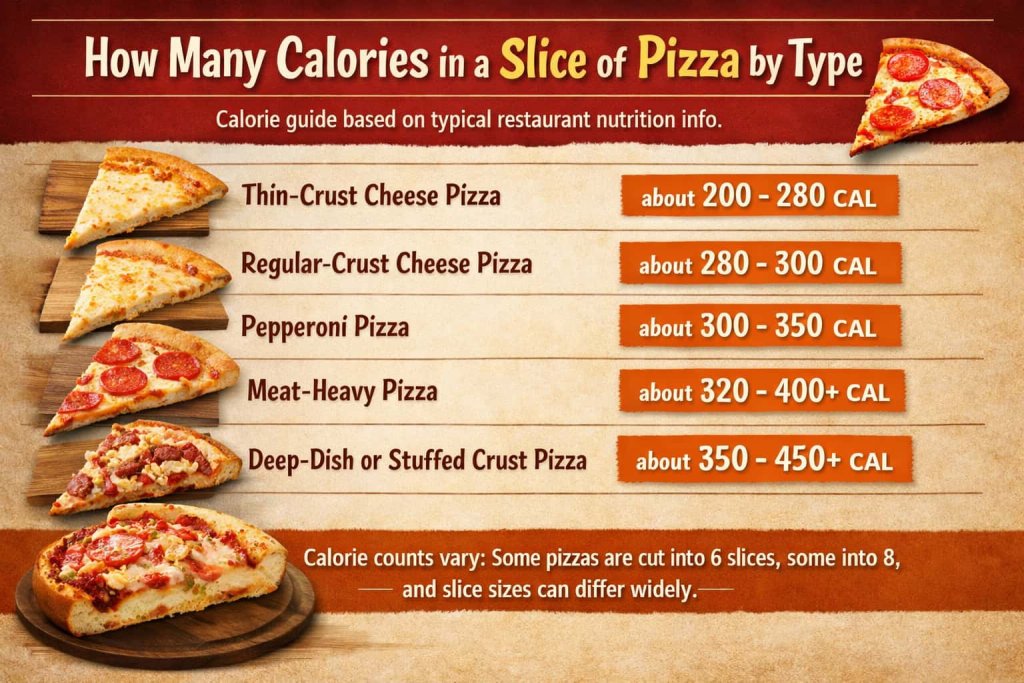
For most people, the most useful answer is this: a slice of pizza is rarely just one fixed number. A lighter thin-crust cheese slice may be closer to the lower end, while a larger slice with extra cheese or meat can climb well above 300 calories. In practical everyday terms, one plain cheese slice is often around 280 to 300 calories, while more loaded slices may reach 300 to 400 calories or more.
Current official nutrition guides from Domino’s and Papa Johns support that general range.
How Many Calories in a Slice of Pizza in Real Life?
A practical way to think about pizza calories is by common slice styles people actually order. In most cases:
- Thin-crust cheese pizza: about 200 to 280 calories per slice
- Regular cheese pizza: about 280 to 300 calories per slice
- Pepperoni pizza: about 300 to 350 calories per slice
- Meat lovers pizza: about 320 to 400+ calories per slice
- Deep-dish or stuffed-crust pizza: about 350 to 450+ calories per slice
The biggest reason for the difference is not just toppings. It is also the weight of the slice, the amount of crust, and how much cheese and oil are used. That is why a slice from one restaurant can be much lighter or much heavier than a slice from another.
Nutrition Profile of a Slice of Pizza
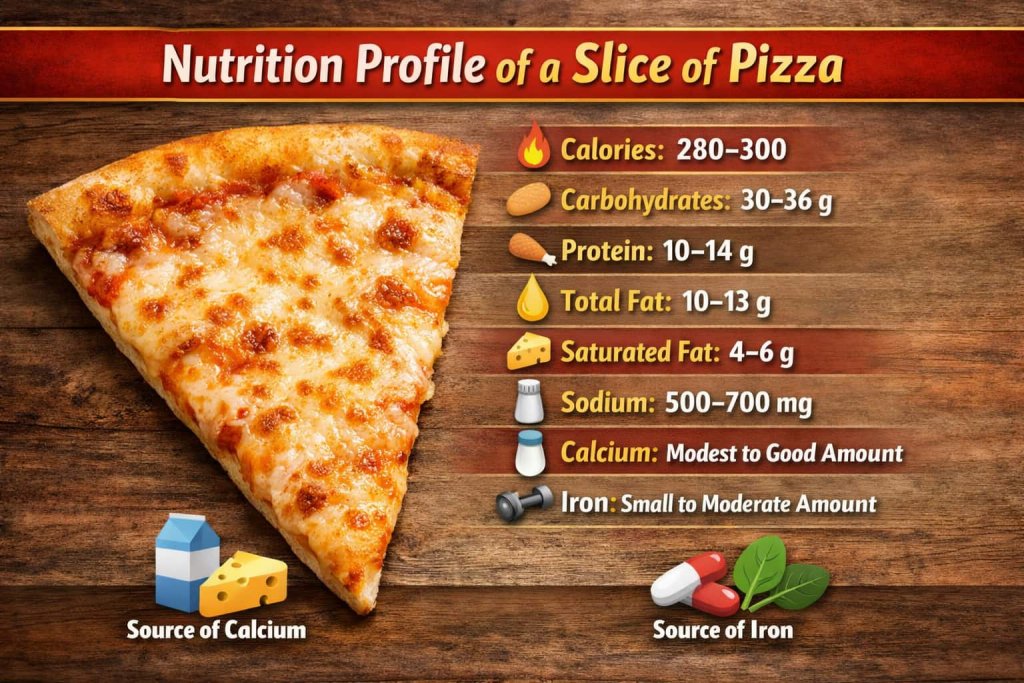
A slice of pizza is not just carbohydrates. It usually contains a mix of carbs, fat, and protein, especially when cheese is included. Pizza also provides some calcium and iron, which is one reason it can feel filling compared with very low-protein snack foods. Still, it is often higher in sodium and saturated fat than people expect.
The FDA Daily Values list 20 grams of saturated fat and 2,300 milligrams of sodium as full daily reference amounts, which helps show how quickly multiple pizza slices can add up.
Here is a realistic nutrition profile for one regular slice of plain cheese pizza:
| Nutrient | Typical amount per slice |
|---|---|
| Calories | about 280 to 300 |
| Carbohydrates | about 30 to 36 g |
| Protein | about 10 to 14 g |
| Total fat | about 10 to 13 g |
| Saturated fat | about 4 to 6 g |
| Sodium | about 500 to 700 mg |
| Calcium | modest to good amount |
| Iron | small to moderate amount |
These are practical estimates based on current restaurant nutrition guides and standard U.S. nutrition references. Actual values can rise quickly with extra cheese, processed meats, creamy sauces, or stuffed crust.
Why Pizza Calories Vary So Much
The biggest calorie differences usually come from four things.
Slice Size
A larger slice can add a surprising number of calories even if the recipe is similar. This is why a giant New York-style slice often contains much more than a smaller frozen-pizza slice.
Crust Type
Thin crust is often lighter, while hand-tossed, pan, deep-dish, and stuffed crust styles usually add more calories because they contain more dough, fat, or cheese.
Toppings
Vegetable toppings tend to add very few calories. Extra cheese, sausage, bacon, and pepperoni add more calories, fat, sodium, and often saturated fat.
Restaurant or Brand
There is no single universal pizza slice. Different chains, local restaurants, and frozen brands use different recipes, weights, and portion sizes.
What Counts as One Slice of Pizza?
One slice is not always the same portion. A pizza may be cut into 6, 8, or more slices, and larger pizzas usually create much bigger slices than smaller pizzas. Some frozen pizzas also list nutrition for a smaller serving than what many people would think of as a full slice.
That means two slices from different pizzas may not be nutritionally similar at all. When checking calories, the most accurate approach is to look at:
- the serving size listed
- the number of slices per pizza
- the crust style
- whether the slice is a standard slice, oversized slice, or deep-dish piece
This helps explain why calorie estimates for “one slice of pizza” can vary so widely.
Is Pizza Good for Weight Management?
Pizza can fit into a weight-management plan, but portion size matters more than the label “pizza” by itself. One slice paired with a salad or vegetables can work reasonably well in a balanced meal. The problem usually starts when two, three, or four slices turn a modest meal into a high-calorie one very quickly. That is especially true when the pizza is large, meat-heavy, or stuffed crust.
Pizza can be easier to fit into a calorie-conscious pattern when you:
- choose thinner crust
- keep toppings simpler
- add a side salad or vegetables
- stop at one or two slices instead of eating straight from the box
That does not make pizza a diet food, but it does make it easier to enjoy without letting the calories climb too fast.
What Happens When You Eat Two or Three Slices?
For many people, the real calorie total is not one slice. It is two or three slices. That changes the picture quickly.
A typical plain cheese slice may be around 280 to 300 calories, so:
- 2 slices may be about 560 to 600 calories
- 3 slices may be about 840 to 900 calories
If the pizza is pepperoni, meat-heavy, deep-dish, or stuffed crust, the total can climb much higher. This is why pizza can fit into a balanced diet, but portion size matters so much for weight management. One or two slices may work well in some meals. Three or more slices can turn it into a much higher-calorie meal than many people realize.
Key Nutrients in Pizza
Pizza can contribute some useful nutrients, especially when it includes cheese and tomato sauce.
Protein
Cheese pizza usually provides a moderate amount of protein per slice, which can help make it more satisfying than many low-protein snack foods.
Calcium
Cheese is a major source of calcium in pizza. That makes pizza one of the ways many people get at least part of their daily calcium intake, even though it is not the most nutrient-dense way to do it. The FDA lists 1,300 milligrams as the Daily Value for calcium.
Iron
The crust and some toppings can provide small to moderate amounts of iron. The FDA Daily Value for iron is 18 milligrams.
Carbohydrates for Energy
Pizza crust provides carbohydrates, which your body uses for energy. That can be useful, but it also means calories add up fast when the portion is large.
What Pizza Does and Does Not Provide Nutritionally
Pizza is not just empty calories. A slice can provide protein, calcium, carbohydrates for energy, and some iron, especially when it includes cheese and tomato sauce. For some people, that makes pizza more satisfying than snack foods like chips or pastries.
At the same time, pizza is usually not a high-fiber food, and many versions are relatively high in sodium and saturated fat for the number of calories they contain. That is why pizza works best as an occasional meal or a portion-conscious choice rather than something to eat in large amounts without thinking about the rest of the meal.
Who Should Be a Little More Careful
Some people may need to pay closer attention to pizza portions and frequency.
People Watching Sodium Intake
The CDC says Americans consume more than 3,300 milligrams of sodium per day on average, which is above the federal recommendation of less than 2,300 milligrams per day for teens and adults. Since one slice of pizza can easily contain 500 to 700 milligrams of sodium, two or three slices can take up a large share of the day’s limit.
People Limiting Saturated Fat
The Dietary Guidelines for Americans recommend keeping saturated fat to less than 10% of daily calories starting at age 2. Pizza with cheese, meat toppings, or stuffed crust can use up a meaningful share of that limit quickly.
People Trying to Lose Weight
Pizza is easy to overeat because it is convenient, tasty, and often served in large portions. That does not mean you need to avoid it, but it does mean portion awareness matters.
How to Make Pizza a Smarter Choice
You do not need to give up pizza to eat well. A few simple changes can make a big difference:
- choose thin crust instead of deep-dish or stuffed crust
- pick vegetable toppings more often
- go lighter on extra cheese and processed meats
- pair pizza with salad or vegetables
- eat slowly and decide your portion before you start
These steps help reduce total calories, sodium, and saturated fat without making pizza feel off-limits.
Frequently Asked Questions
How Many Calories Are in a Large Slice of Pizza?
A large slice often falls around 300 to 400 calories, but it can be higher if the crust is thick or the toppings are heavy. Slice size makes a major difference.
Is Cheese Pizza Lower in Calories Than Pepperoni Pizza?
Usually, yes. A plain cheese slice is often lower in calories than a pepperoni slice because pepperoni adds extra fat and calories.
Is Thin-Crust Pizza Better for Weight Management?
Often, yes. Thin-crust pizza is usually lower in calories per slice than thicker crust styles, although toppings still matter.
Can Pizza Be Part of a Healthy Diet?
Yes, pizza can fit into a healthy overall diet when portions are sensible and the rest of the meal is balanced. The biggest issue is not usually one slice. It is eating several high-calorie slices often.
The Bottom Line
A slice of pizza usually contains about 250 to 400 calories, with a typical cheese slice often coming in around 280 to 300 calories. Pizza can provide protein and calcium, but it can also be high in sodium and saturated fat. If you want pizza to work better for weight management, focus on slice size, crust choice, toppings, and total portion. A smarter order and a more realistic serving can make a big difference.
Sources/References
- Domino’s — Nutritional Information
- Papa Johns — Nutrition & Allergen Information
- FDA — How to Understand and Use the Nutrition Facts Label
- CDC — About Sodium and Health
- Dietary Guidelines for Americans — Cut Down on Saturated Fat