
Bicycle crunches are a bodyweight core exercise that can help strengthen your abs and obliques when you do them with slow, controlled rotation and a steady low back. They are worth learning because they train trunk flexion and rotation in one move, require no equipment, and fit easily into a home or gym routine.
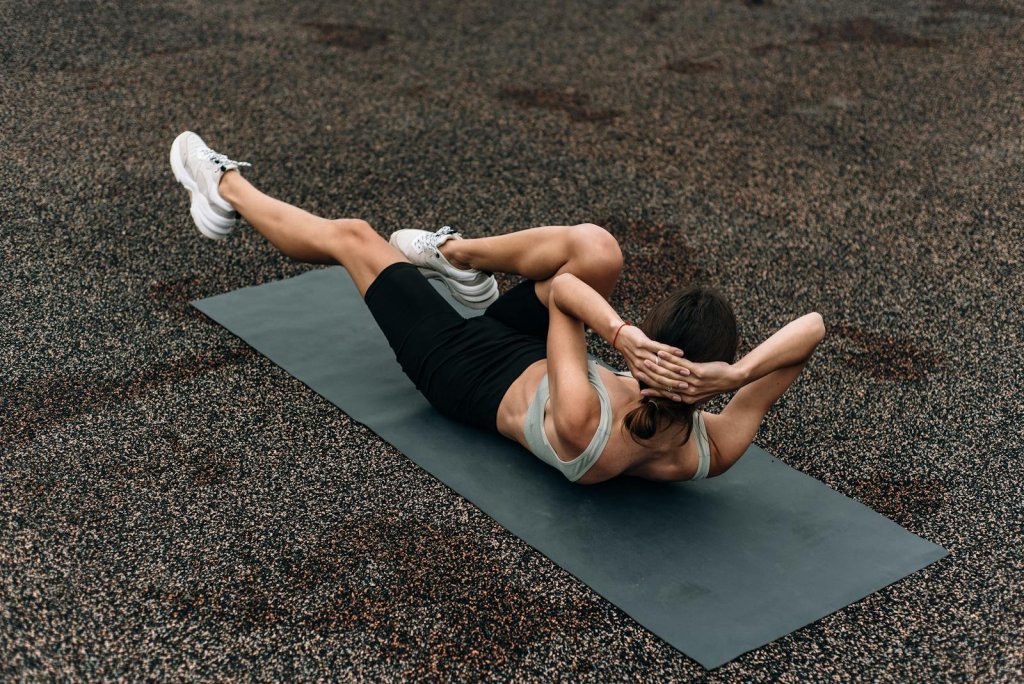
The key is simple: brace your core, rotate from your trunk, breathe steadily, and stop when your form starts to slip, as shown by the American Council on Exercise.
What Are Bicycle Crunches
Bicycle crunches are a floor-based core exercise where you lift into a crunch, rotate your torso, and alternate elbow-to-opposite-knee contact while the legs move in a pedaling pattern. The American Council on Exercise sets the movement up with the hips and knees around 90 degrees, a braced midsection, and a low back that stays pressed into the mat during the curl and rotation.
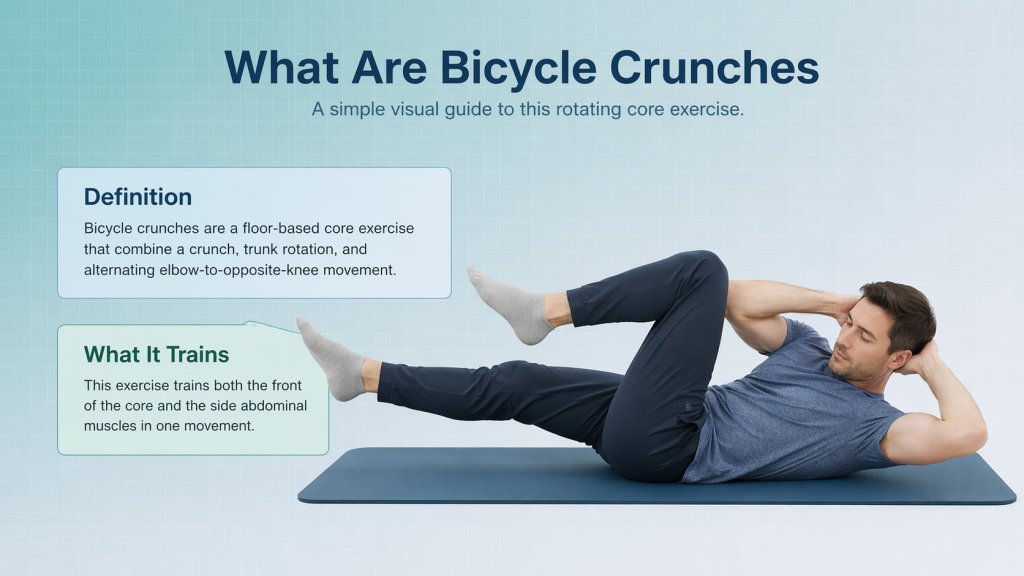
That combination matters because the exercise is not just a standard crunch with extra motion. It blends abdominal curling with controlled rotation, which is why it is commonly used to train both the front of the core and the side abdominal muscles in the same set.
How to Do Bicycle Crunches With Proper Form
Bicycle Crunch
This exercise combines a crunch with controlled trunk rotation, so you challenge the front of the core and the obliques at the same time. Done slowly, it also teaches you to keep your low back organized while your legs move.
How to do it
- Lie on your back on a mat.
- Brace your abdominal muscles.
- Lift your knees so your hips are about 90 degrees and your knees stay bent.
- Place your hands lightly behind your head without yanking on your neck.
- Exhale as you draw one knee toward your chest and extend the other leg out.
- At the same time, curl your trunk and rotate so the opposite elbow moves toward that knee.
- Keep your low back pressed into the floor.
- Return with control and repeat on the other side.
- Keep alternating until you finish a set of quality reps.
Trainer tip
Think about bringing your shoulder toward the opposite knee, not just swinging your elbow across. That cue usually helps people rotate from the trunk instead of twisting from the hips or pulling on the head.
Bicycle Crunches Muscles Worked
Bicycle crunches mainly work the muscles that help flex and stabilize your trunk.
Primary muscles worked:
- Rectus abdominis
- Obliques
Secondary or assisting muscles:
- Transverse abdominis and other deep core stabilizers
- Hip flexors
The American Council on Exercise describes bicycle crunches as training the rectus abdominis and obliques, with core stabilization demands and some hip-flexor involvement as the legs pedal.
It is also helpful to keep expectations realistic. In the often-cited 2001 ab study commissioned by the American Council on Exercise, researchers noted that most exercisers did not appear to isolate “upper” and “lower” abs as separate sections in the way fitness marketing often suggests. That means bicycle crunches are better understood as a full anterior-core and rotational-core exercise, not a magic “lower-ab” fix.
Benefits of Bicycle Crunches
Bicycle crunches stay popular for a reason. They can give you a lot from one bodyweight move.
Key benefits include:
- Training the abs and obliques in one exercise
- Adding rotation, not just straight-up crunching
- Requiring no equipment
- Fitting easily into short home workouts
- Helping build general core strength that supports balance and stability
A strong core supports balance and stability, according to MedlinePlus, and classic core exercises are part of that bigger picture. Bicycle crunches are also widely used because the 2001 study commissioned by the American Council on Exercise found the bicycle maneuver ranked first for rectus abdominis activity and second for oblique activity versus the other exercises tested. That study is older and measures muscle activity rather than long-term outcomes, but it still helps explain why the move remains a common ab staple.
Common Bicycle Crunch Mistakes
Most bicycle crunch problems come from rushing. A few small fixes usually make the exercise feel much better.
Common mistakes:
- Pulling forward on the head
- Letting the low back lift off the floor
- Rotating from the hips instead of the trunk
- Moving too fast to control the curl
- Chasing elbow-to-knee contact at the expense of form
The American Council on Exercise specifically advises performing the movement slowly, keeping the low back pressed into the mat, and avoiding pulling on the head during the trunk curl. It also notes that the rotation should come from the trunk rather than the hips.
How Many Reps and Sets Should You Do
A practical starting point for most people is 1 to 3 sets of 8 to 12 reps per side or a similar amount of controlled work, depending on how your program counts reps. For general core work, the Mayo Clinic gives a starting point of one set of 12 to 15 repetitions for core exercises, while the National Institute on Aging says one set of 8 to 12 repetitions is effective and two or three sets may be more effective.
For weekly frequency, bicycle crunches can fit into a routine about 2 to 3 times per week, especially when they are part of a broader strength plan. The CDC recommends adults get at least 150 minutes of moderate-intensity activity each week plus muscle-strengthening work on 2 or more days, and the National Institute on Aging advises avoiding the same muscle group on back-to-back days to allow recovery.
Who May Benefit From Bicycle Crunches
Bicycle crunches can be a good fit for:
- Beginners who want a simple bodyweight core move
- Home exercisers with little or no equipment
- People who want one exercise that challenges both abs and obliques
- Anyone building a short core circuit
Because they are equipment-free and easy to slot into a floor routine, bicycle crunches are one of the more accessible options for general core training. That said, accessibility does not replace proper control, so form still matters more than speed or rep count.
Who Should Be Careful Before Starting
Some people should take a more cautious approach with crunch-style exercises.
Be more careful if you:
- Have back problems
- Have osteoporosis
- Have other significant health concerns
- Feel pain, dizziness, or unusual shortness of breath during exercise
The Mayo Clinic advises people with back problems, osteoporosis, or other health concerns to talk with a healthcare professional before starting core-strength exercises. MedlinePlus also says to start slowly if you have not exercised in a while and to stop and seek help if you feel pain, dizziness, or extreme shortness of breath.
Bicycle Crunches vs Regular Crunches
The main difference is that a regular crunch focuses mostly on trunk flexion, while a bicycle crunch adds rotation and alternating leg action. That added rotation is one reason bicycle crunches are often used when the goal is to emphasize both the front abs and the obliques rather than only a basic curl-up pattern.
In the ab comparison study commissioned by the American Council on Exercise, the bicycle maneuver produced higher muscle-activity rankings than the traditional crunch for both the rectus abdominis and the obliques. That does not mean regular crunches are useless, but it does suggest bicycle crunches can be a stronger all-in-one choice for many ab workouts.
FAQs About Bicycle Crunches
Are bicycle crunches good for abs
Yes. Bicycle crunches are a solid abs exercise because they train the rectus abdominis while also challenging the obliques through rotation. The study commissioned by the American Council on Exercise found the bicycle maneuver ranked first for rectus abdominis activity among the exercises tested.
Do bicycle crunches work obliques
Yes. The twisting portion of the movement is a major reason bicycle crunches are used for oblique training, and the same American Council on Exercise study ranked the bicycle maneuver second for oblique activity in that test battery.
Are bicycle crunches bad for your back
Not automatically, but they are not ideal for everyone. The Mayo Clinic advises people with back problems or other health concerns to check with a healthcare professional before doing core exercises, and the American Council on Exercise emphasizes keeping the low back pressed into the floor and moving with control.
Should your elbow actually touch your knee
No. Touching is not the main goal. The American Council on Exercise says to move until the elbow touches or comes close to the opposite knee, but quality position matters more than forcing contact.
How many bicycle crunches should beginners do
Beginners usually do best with a small amount of clean work first, such as 1 set of 8 to 12 reps per side or a short timed set with good control. That fits the general rep guidance from the National Institute on Aging and the Mayo Clinic better than doing very high reps with sloppy form.
Can you do bicycle crunches every day
You can, but daily use is not necessary for most people. The National Institute on Aging advises avoiding the same muscle group on consecutive days, and many people will recover better by placing bicycle crunches in a broader routine two or three times per week.
Conclusion
Bicycle crunches are a simple, equipment-free way to train your abs and obliques with one move. Focus on control, keep your low back anchored, rotate from the trunk, and do not rush the reps. Start with a small number of high-quality repetitions, then build from there as your form improves. If you have back issues or other health concerns, check with a qualified professional before adding them to your routine.