
Yes, you can build a stronger chest with dumbbells even if you do not have a bench. Floor presses, squeeze presses, pullovers, and chest-focused push-up variations can all help train your chest at home when you use controlled form, enough resistance, and a consistent weekly routine, as shown in guidance from Mayo Clinic and the CDC.
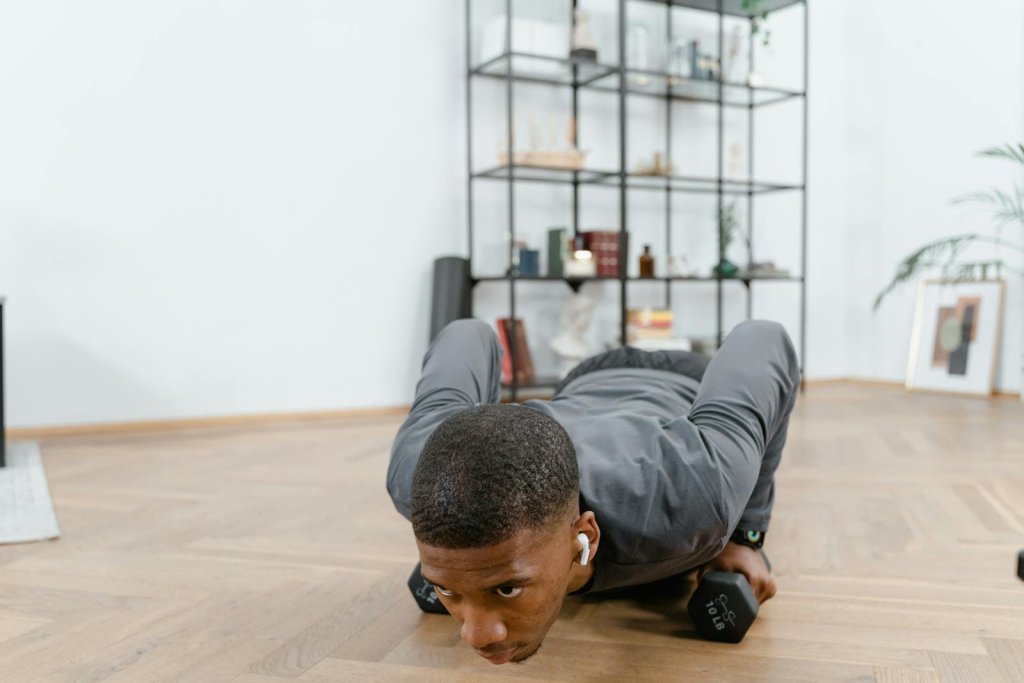
That matters because many people skip chest training if they do not own a bench, even though simple home setups can still support effective strength work. A smart plan usually includes a few pressing moves, a few chest-isolation-style options, and enough recovery between sessions, which aligns with advice from Mayo Clinic.
Why dumbbell chest exercises no bench can still work
The main job of chest training is still pressing and bringing the arms inward across the body. A bench can change the angle and range of motion, but it is not the only way to train those patterns. The dumbbell chest press is already recognized by Mayo Clinic as a chest exercise, and push-ups are also described by Mayo Clinic as working the pectorals, triceps, and core.
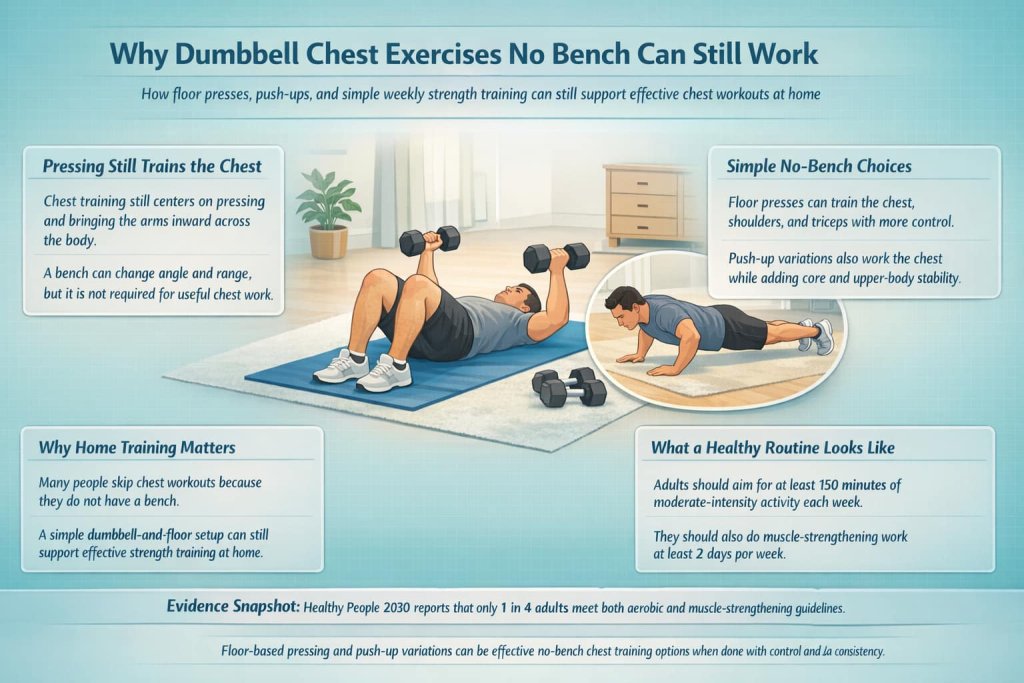
For health, chest training fits into a bigger weekly routine. Adults should get at least 150 minutes of moderate-intensity activity each week and do muscle-strengthening work at least 2 days per week. Healthy People 2030 also reports that only 1 in 4 U.S. adults meet both aerobic and muscle-strengthening guidelines, which helps explain why simple home-friendly routines matter.
The 10 best dumbbell chest exercises no bench needed
Build chest strength at home with these 10 dumbbell chest exercises no bench needed, from floor presses to push-up variations. This list helps you train your chest safely and effectively with minimal equipment.
1. Dumbbell Floor Press
Why it works: This is the most practical no-bench substitute for a standard dumbbell chest press. The floor helps limit shoulder depth, which many people find more comfortable while still letting them train chest, triceps, and front delts.
Muscles worked: Chest, triceps, anterior deltoids.
How to do it:
- Lie on your back with knees bent and feet flat.
- Hold a dumbbell in each hand with elbows bent and upper arms resting lightly on the floor.
- Press the dumbbells straight up over your chest.
- Lower slowly until your upper arms touch the floor again.
- Repeat without bouncing.
Trainer Tip: Pause briefly on the floor between reps to reduce momentum and keep the press controlled.
2. Neutral-Grip Dumbbell Floor Press
Why it works: Turning your palms to face each other often feels friendlier on the shoulders and can help some beginners keep better elbow position.
Muscles worked: Chest, triceps, anterior deltoids.
How to do it:
- Set up on the floor as you would for a regular floor press.
- Hold the dumbbells with palms facing each other.
- Press up while keeping wrists stacked over elbows.
- Lower until the upper arms reach the floor.
- Repeat with steady control.
Trainer Tip: Keep your elbows about 30 to 45 degrees from your sides rather than flared out wide.
3. Single-Arm Dumbbell Floor Press
Why it works: Training one side at a time increases anti-rotation demand on the trunk and can help expose left-right strength differences.
Muscles worked: Chest, triceps, anterior deltoid, core.
How to do it:
- Lie on your back with one dumbbell in one hand.
- Keep the free arm on the floor for balance.
- Press the weight straight up over the chest.
- Lower slowly until the upper arm reaches the floor.
- Finish your reps, then switch sides.
Trainer Tip: Keep your hips level and avoid rolling toward the loaded side.
4. Alternating Dumbbell Floor Press
Why it works: This keeps one arm working while the other stabilizes, which increases time under tension without needing heavy weights.
Muscles worked: Chest, triceps, anterior deltoids, core stabilizers.
How to do it:
- Lie on your back holding two dumbbells.
- Press both weights to the top position.
- Lower one dumbbell while the other stays extended.
- Press it back up, then switch sides.
- Continue alternating smoothly.
Trainer Tip: Move slowly enough that the top arm does not wobble.
5. Dumbbell Squeeze Press on the Floor
Why it works: Pressing the dumbbells inward against each other adds extra chest tension, especially through the middle of the press.
Muscles worked: Chest, triceps, anterior deltoids.
How to do it:
- Lie on your back with two dumbbells touching each other over your chest.
- Squeeze the dumbbells together.
- Lower them slowly toward your chest while keeping that inward pressure.
- Press back up without losing the squeeze.
- Repeat for controlled reps.
Trainer Tip: Use lighter dumbbells than you would for a regular floor press because the constant squeeze makes the set harder.
6. Dumbbell Crush Press on the Floor
Why it works: This is similar to the squeeze press, but many people think of it as a smaller-range, chest-tension-focused option. It is useful when you want a strong contraction without heavy loading.
Muscles worked: Chest, triceps, front shoulders.
How to do it:
- Lie on your back and hold the inner heads of the dumbbells tightly together.
- Keep them pressed into each other throughout the rep.
- Lower with control toward the center of your chest.
- Press back up while maintaining inward pressure.
- Repeat with steady tempo.
Trainer Tip: Think about pulling your upper arms inward toward each other during the whole set.
7. Dumbbell Floor Fly
Why it works: The floor limits the bottom stretch, which makes this a more conservative option than a deep bench fly. It can still help train chest adduction in a home workout.
Muscles worked: Chest, anterior deltoids.
How to do it:
- Lie on your back with a dumbbell in each hand over your chest.
- Keep a slight bend in your elbows.
- Open the arms out slowly until your upper arms approach the floor.
- Bring the dumbbells back together over your chest.
- Repeat without turning it into a press.
Trainer Tip: Use lighter weights and smaller range than you would on a press. Flies usually need more control.
8. Dumbbell Pullover on the Floor
Why it works: Pullovers are not a pure chest isolation move, but they can support chest training while also involving the shoulders and upper back. They are useful when you want variety in a no-bench setup.
Muscles worked: Chest, lats, triceps long head, shoulders.
How to do it:
- Lie on your back with one dumbbell held vertically in both hands.
- Start with the weight above your chest.
- Slowly lower it back overhead as far as you can control.
- Pull it back to the start position.
- Keep your ribs from flaring too much.
Trainer Tip: Use a smaller range if you feel your low back arching or your shoulders pinching.
9. Dumbbell Push-Up Using the Dumbbells as Handles
Why it works: Push-ups are already recognized by Mayo Clinic as a chest exercise, and using dumbbells as handles can help some people keep their wrists in a more comfortable neutral position.
Muscles worked: Chest, triceps, shoulders, core.
How to do it:
- Place two stable hex dumbbells on the floor shoulder-width apart.
- Grip the handles and step into a high plank.
- Lower your chest between your hands with control.
- Press back up to plank.
- Keep your body in one straight line.
Trainer Tip: Only use this if your dumbbells are stable and do not roll. Safety comes first.
10. Close-Grip Push-Up
Why it works: This is not a dumbbell move, but it fits a no-bench chest routine well as a finisher. Changing hand position shifts the training emphasis and can increase triceps demand.
Muscles worked: Chest, triceps, front shoulders, core.
How to do it:
- Start in a plank with hands slightly narrower than standard push-up width.
- Brace your core and keep your body straight.
- Lower your chest under control.
- Press back up without letting your hips sag.
- Adjust hand width if your wrists or shoulders feel strained.
Trainer Tip: A slightly narrow grip usually works better than an extremely narrow one.
A simple dumbbell chest workout with no bench
Try this beginner-friendly workout 2 times per week on nonconsecutive days:
- Dumbbell Floor Press: 3 sets of 8 to 12
- Dumbbell Squeeze Press on the Floor: 2 to 3 sets of 10 to 15
- Single-Arm Dumbbell Floor Press: 2 sets of 8 to 10 per side
- Dumbbell Floor Fly: 2 sets of 10 to 12
- Push-Up or Close-Grip Push-Up: 1 to 3 sets close to technical fatigue
For many people, a weight that feels challenging by about rep 12 to 15 is a practical starting point for general strength training, based on guidance from Mayo Clinic.
How often should you do these exercises?
Most people do well with chest training 2 times per week, especially if they are also training shoulders and triceps on other days. That lines up with the broader recommendation from the CDC to do muscle-strengthening work at least 2 days each week and with Mayo Clinic’s advice to avoid training the same muscles on consecutive days.
Common mistakes with dumbbell chest exercises no bench
Going too heavy too soon
Without a bench, some people rush to make floor exercises feel harder by choosing too much weight. That often leads to shortened reps, shoulder discomfort, or poor control.
Letting elbows flare too wide
A wide elbow path can feel awkward on presses and flies. A moderate elbow angle usually gives better control.
Turning every fly into a press
Flies should stay lighter and smoother. If the rep turns into a bent-arm press, the weight is probably too heavy.
Skipping push-up variations
Push-ups remain one of the simplest no-bench chest options and also train core stiffness, as shown by Mayo Clinic.
Training chest hard every day
Recovery matters. Muscle groups generally need rest between hard sessions, which is also emphasized by Mayo Clinic.
Are dumbbell chest exercises without a bench enough to build muscle?
For many beginners and intermediate home exercisers, yes. You can make floor-based chest training harder by:
- Adding reps
- Slowing the lowering phase
- Pausing at the bottom
- Using one-arm variations
- Increasing weight gradually
- Pairing presses with push-ups
A bench gives you more angle options and a deeper stretch for some movements, but it is not required for useful chest training. The bigger factors are consistency, progressive overload, and sound technique, which align with guidance from ACE Fitness and Mayo Clinic.
Who should be careful or get guidance first?
Use extra caution and consider professional guidance first if you have:
- Recent shoulder, chest, elbow, or wrist injury
- Pain during pressing or push-ups
- Major balance or floor-mobility limitations that make getting down and up difficult
- A recent surgery or medical restriction on upper-body loading
Mayo Clinic advises stopping an exercise if it causes pain and reassessing the load or movement choice.
FAQs
Can I build my chest with dumbbells and no bench?
Yes. Floor presses, squeeze presses, pullovers, and push-up variations can all train the chest effectively when done with enough resistance and consistency.
Is the dumbbell floor press as good as a bench press?
It is a very good substitute, especially for home workouts. It usually reduces bottom-end range of motion, but it still trains the chest, triceps, and shoulders well.
What is the best no-bench dumbbell chest exercise for beginners?
The dumbbell floor press is usually the best starting point because it is simple, stable, and easy to scale.
Are push-ups enough for chest growth?
Push-ups can help build chest strength and muscle, especially for beginners. Over time, adding dumbbell resistance often makes progression easier. Mayo Clinic notes that push-ups work the pectorals, triceps, and core.
How heavy should my dumbbells be?
Start with a weight you can control for about 12 to 15 good repetitions. Then progress gradually as your form improves, following the general strength-training guidance from Mayo Clinic.
How many chest exercises should I do in one workout?
Most people do well with 3 to 5 chest exercises in one session, depending on total training volume and experience.
Do I need to train chest more than twice a week?
Usually not. Twice a week is enough for many people, especially when the workouts are challenging and recovery is good.
Conclusion
Dumbbell chest exercises with no bench can still give you a strong, practical chest workout at home. Start with the floor press, add one or two squeeze or fly variations, and finish with push-ups if they suit your joints and current strength level. Focus on clean reps, gradual progression, and enough recovery between sessions.