
Yes, you can build stronger forearms at home with simple exercises that train gripping, wrist flexion, wrist extension, and forearm rotation. That matters because your forearms support everyday tasks like carrying bags, opening jars, typing, lifting weights, and holding onto pull-up bars or sports equipment. Harvard Health notes that strengthening forearm muscles can help improve grip, while CDC guidance recommends muscle-strengthening work at least 2 days per week as part of a complete routine.
Home forearm training does not have to be complicated. A smart routine usually includes squeezing, holding, curling the wrist, lifting the wrist the other way, and rotating the forearm. That balanced approach fits well with grip-training principles discussed by the NSCA, which highlights training the hand and forearm flexors while the wrist stabilizers also do important work.
Why forearm exercises at home are worth doing
Forearm exercises at home are useful for more than appearance. Grip strength is closely tied to function, and a 2024 review in PubMed Central describes handgrip strength as an important measure of muscle function and overall physical capability. Harvard Health also notes that stronger forearms can make gripping and grasping movements more effective in daily life.
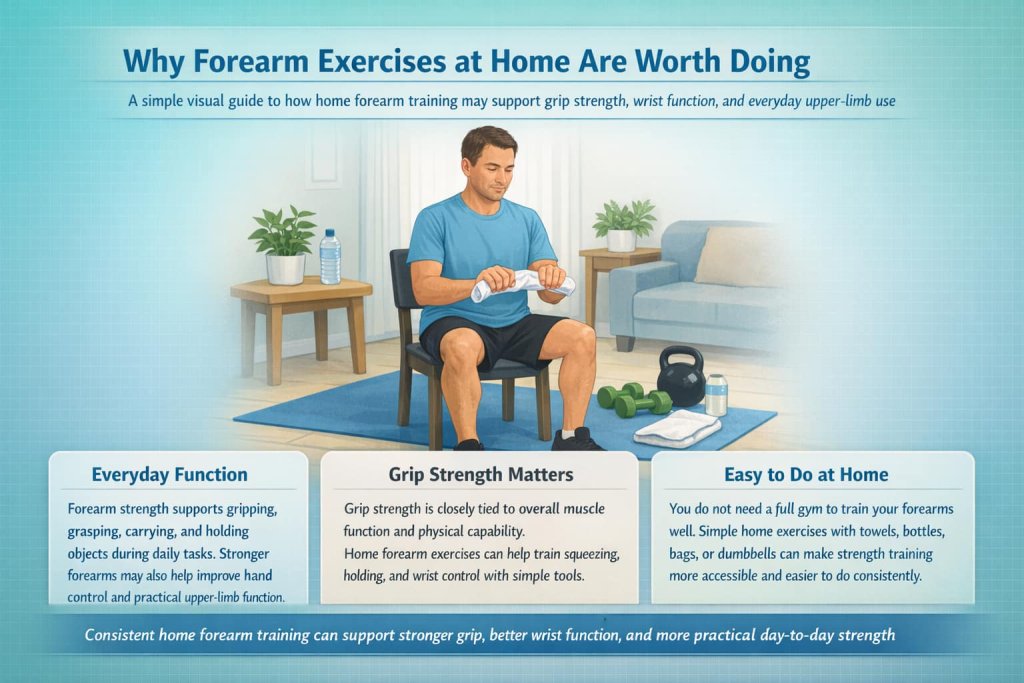
There is also a consistency advantage. You do not need a full gym to train your forearms well. Mayo Clinic says strength training can be done at home, and Healthy People 2030 says only about 1 in 4 U.S. adults meet both aerobic and muscle-strengthening guidelines. Simple home exercises remove a major barrier: equipment.
Before you start forearm exercises at home
Use a weight or resistance level you can control with smooth form. Mayo Clinic says many people can build strength effectively with resistance that tires the muscles after about 12 to 15 repetitions, and at least 2 weekly strength-training sessions remains a solid baseline for general fitness.
If your wrists or elbows get irritated from typing or repetitive tasks, start gently. Mayo Clinic shows simple forearm and wrist stretches that can be used through the day, and its office ergonomics guidance also points out that poor setup can contribute to wrist and shoulder discomfort during desk work.
10 best forearm exercises at home
Build stronger forearms at home with simple exercises that improve grip, wrist stability, and lower-arm strength. These 10 moves are practical, beginner-friendly, and easy to fit into a home workout routine.
1. Seated wrist curl
Why it works: This is one of the most direct ways to train the wrist flexors, which help you grip, squeeze, and hold objects firmly.
Muscles worked: Wrist flexors, finger flexors, forearm stabilizers.
How to do it:
- Sit beside a chair, bench, or table.
- Rest your forearm on the surface with your palm facing up and your wrist hanging just off the edge.
- Hold a light dumbbell, water bottle, backpack strap, or other household weight.
- Curl your wrist upward in a slow, controlled motion.
- Pause briefly at the top.
- Lower slowly back to the start.
- Repeat all reps, then switch sides.
Trainer Tip: Keep the forearm still. The movement should come from the wrist, not the shoulder or elbow, as shown in ACE.
2. Reverse wrist curl
Why it works: Reverse wrist curls train the wrist extensors, which are often undertrained compared with the forearm flexors. That helps create a more balanced forearm routine.
Muscles worked: Wrist extensors, forearm stabilizers.
How to do it:
- Sit beside a chair, bench, or table.
- Rest your forearm on the surface with your palm facing down and wrist just off the edge.
- Hold a light dumbbell, hammer handle, or water bottle.
- Lift the back of your hand upward.
- Pause briefly without shrugging your shoulder.
- Lower with control.
- Repeat, then switch sides.
Trainer Tip: Use a lighter weight than you use for regular wrist curls. The extensor muscles are usually smaller and fatigue sooner, which fits the general exercise guidance shown by ACE.
3. Towel squeeze
Why it works: A towel squeeze is simple, accessible, and effective for grip work at home. It challenges your crushing grip without needing special equipment.
Muscles worked: Finger flexors, thumb muscles, wrist stabilizers, forearm flexors.
How to do it:
- Roll up a small towel tightly.
- Hold it in one hand at chest or waist height.
- Squeeze as hard as you can while keeping your wrist neutral.
- Hold for 10 to 30 seconds.
- Relax and repeat.
- Switch hands.
Trainer Tip: Do not bend the wrist hard while squeezing. A neutral wrist usually feels stronger and more controlled, which aligns with grip-training principles from the NSCA.
4. Farmer’s carry or farmer’s hold
Why it works: This is one of the most practical forearm exercises at home because it trains your grip the way real life often does: by holding and carrying weight.
Muscles worked: Grip muscles, forearm flexors, wrist stabilizers, shoulders, core.
How to do it:
- Grab two heavy objects such as dumbbells, grocery bags, water jugs, or loaded backpacks.
- Stand tall with your shoulders down and core braced.
- Either walk slowly for distance or stand still and hold the weight for time.
- Keep your wrists straight and avoid leaning side to side.
- Stop when your grip starts to fail.
- Rest and repeat.
Trainer Tip: Start with holds before carries if space is limited or your balance is not great. This also fits the practical grip-loading ideas discussed by the NSCA.
5. Fingertip towel hang or bar hang
Why it works: Hanging drills challenge your grip endurance and force the forearm muscles to keep the hand closed against bodyweight. The NSCA specifically discusses towel-based grip challenges as a way to stress the forearm, hand, and finger flexors.
Muscles worked: Finger flexors, forearm flexors, wrist stabilizers, shoulders.
How to do it:
- Use a sturdy pull-up bar or another safe hanging surface.
- Grip the bar or loop a towel over the bar for a thicker grip.
- Hang with your shoulders engaged, not fully shrugged into your ears.
- Hold for as long as you can with control.
- Step down before your form breaks.
- Rest and repeat.
Trainer Tip: If full hangs are too hard, keep your feet lightly on the floor or use partial bodyweight support.
6. Plate pinch or book pinch hold
Why it works: Pinch grip is different from standard gripping. It challenges the thumb and fingers in a way many home workouts miss.
Muscles worked: Thumb muscles, finger flexors, forearm stabilizers.
How to do it:
- Hold two weight plates together smooth side out, or pinch the spine of a thick book between your fingers and thumb.
- Stand tall with the object at your side.
- Squeeze firmly without bending the wrist too much.
- Hold for time.
- Switch hands if doing one side at a time.
- Rest and repeat.
Trainer Tip: Start with a thinner object before moving to wider plates or thicker books. Wider pinch positions are usually harder, which matches the grip challenge concepts explained by the NSCA.
7. Hammer pronation and supination
Why it works: Rotational drills strengthen the muscles that turn your palm up and down. This is an important but often overlooked part of forearm training.
Muscles worked: Pronators, supinators, wrist stabilizers, brachioradialis.
How to do it:
- Hold a hammer, light club, or similar object by the end of the handle.
- Rest your forearm on your thigh or on a table.
- Start with your thumb pointing up.
- Slowly rotate the forearm so the palm turns down.
- Reverse the motion so the palm turns up.
- Move slowly and stay in control.
- Repeat, then switch sides.
Trainer Tip: The farther your hand is from the head of the hammer, the harder the exercise becomes. Start closer to the heavy end if needed.
8. Wrist roller
Why it works: A wrist roller builds forearm endurance and burn fast because it trains repeated wrist flexion and extension under tension.
Muscles worked: Wrist flexors, wrist extensors, grip muscles.
How to do it:
- Hold a wrist roller device, or make one using a stick, cord, and small weight.
- Extend your arms in front of you or hold them slightly lower if needed.
- Roll the weight upward by turning the wrists.
- Reverse the motion to lower it slowly.
- Continue until the full set is complete.
- Rest and repeat.
Trainer Tip: Lowering the weight under control matters as much as rolling it up. Do not let gravity do all the work on the way down.
9. Dead stop grip crush with a soft ball
Why it works: This is a beginner-friendly way to train crushing grip and hand endurance at home.
Muscles worked: Finger flexors, thumb muscles, forearm flexors.
How to do it:
- Hold a tennis ball, stress ball, or soft grip trainer.
- Relax your hand fully between reps.
- Squeeze the ball firmly.
- Hold each squeeze for 1 to 3 seconds.
- Release under control.
- Repeat for reps, then switch hands.
Trainer Tip: Fully relax between reps. That makes each squeeze more deliberate and can help you avoid turning the set into a partial-motion pulse, a practical point supported by Harvard Health.
10. Reverse curl
Why it works: Reverse curls train the brachioradialis and forearm muscles while also giving you a practical arm-strength exercise that carries over to pulling tasks.
Muscles worked: Brachioradialis, wrist extensors, biceps, grip muscles.
How to do it:
- Stand tall holding dumbbells, cans, or a backpack handle with palms facing down.
- Keep your elbows close to your sides.
- Curl the weight upward without swinging.
- Pause near the top.
- Lower slowly.
- Repeat for all reps.
Trainer Tip: Do not go too heavy. Swinging turns it into a shoulder-and-back movement instead of a controlled forearm-focused curl. That matches the form-first approach recommended by Mayo Clinic.
How to build an effective forearm workout at home
A simple and realistic home forearm workout can include one wrist-flexion exercise, one wrist-extension exercise, one hold or carry, and one grip or rotation drill. That gives you a more complete stimulus than repeating only curls. This matches the general idea from NSCA grip-training guidance that forearm development works best when multiple gripping demands are trained, not just one pattern.
A practical beginner setup looks like this: wrist curls, reverse wrist curls, towel squeezes, and farmer’s holds. Do 1 to 3 sets of each. For most people, 8 to 15 reps works well on moving exercises, while holds can last 10 to 30 seconds. Mayo Clinic says resistance that fatigues the muscles after about 12 to 15 repetitions is a reasonable target for many adults doing strength work.
How often should you do forearm exercises at home?
For most people, forearm exercises at home fit well 2 to 3 times per week. That lines up with CDC guidance for regular muscle-strengthening activity and gives your hands, wrists, and elbows time to recover between harder sessions.
If you already do pull-ups, rows, carries, racquet sports, climbing, or physically demanding hand work, you may need less direct forearm volume, not more. Forearms recover fairly well, but overuse still matters, especially around the wrist and elbow. Mayo Clinic notes that overuse can contribute to issues such as tennis elbow, which involves the muscles and tendons around the elbow.
Common mistakes to avoid
A common mistake is training only the gripping side of the forearm and ignoring wrist extension. Another is using too much weight and turning the movement into a shoulder or body swing. Balanced loading and controlled tempo usually work better than chasing heavy reps right away, as explained by the NSCA.
It is also easy to overdo volume when forearms already get work from other lifts and everyday tasks. If your wrists, fingers, or elbows stay sore for days, reduce total sets, use lighter loads, and check your desk or training setup. Mayo Clinic supports the idea that repetitive strain and setup quality matter.
When to be careful
Forearm exercises at home should feel challenging, not sharp or alarming. Modify or pause training and consider professional guidance if you have significant wrist pain, numbness, tingling, recent injury, or symptoms that worsen during gripping. Mayo Clinic notes that conditions such as carpal tunnel syndrome and overuse-related elbow pain can involve grip and upper-limb function.
FAQs about forearm exercises at home
Can forearm exercises at home really improve grip strength?
Yes. That is one of the main reasons to do them. Harvard Health explains that stronger forearm muscles can improve gripping and grasping, and grip strength is widely used as a marker of muscle function.
Do I need dumbbells for forearm exercises at home?
No. You can use towels, backpacks, water bottles, books, plates, balls, or a pull-up bar. Home forearm training works best when the movement pattern is right, even if the equipment is simple, as noted by Mayo Clinic.
How long does it take to see results?
That varies, but many people notice better grip endurance and control within a few weeks if they train consistently. Visible muscle changes usually take longer than performance changes, a practical takeaway consistent with guidance from Harvard Health.
Should I train forearms every day?
Usually no. Two to three sessions per week is enough for most people, especially if you also do other upper-body training. Daily hard gripping can add up quickly and may irritate the wrists or elbows, which is why CDC weekly strength guidance is a better anchor.
Are wrist curls enough for full forearm development?
Not really. Wrist curls are useful, but a complete routine should also include wrist extension, grip holds, and rotational work, which is consistent with the broader grip-training approach from the NSCA.
What is the best forearm exercise at home for beginners?
A great beginner combination is wrist curls, reverse wrist curls, towel squeezes, and farmer’s holds. Those drills are simple, scalable, and cover the main forearm functions, while the general load recommendation from Mayo Clinic supports starting light and controlled.
Conclusion
Forearm exercises at home can absolutely help you build stronger wrists, better grip, and more useful lower-arm strength without a full gym. The best results usually come from a balanced routine that includes curls, reverse curls, holds, squeezes, and rotation drills, done consistently and with controlled form. Start light, build gradually, and focus on quality before load. Harvard Health supports the idea that stronger forearms can improve everyday gripping and grasping.