
FUPA exercises for men are lower-core and hip-stability moves that train your deep abs, improve pelvic control, and build a stronger “tight” midsection; for visible fat loss, you’ll still need overall calorie balance plus full-body training. Core work changes how your lower belly functions (and often how it looks in posture and clothing), but it doesn’t reliably “spot burn” fat by itself—something the American Council on Exercise (ACE) highlights when discussing common fat-loss myths.
This guide gives you the best fupa exercises for men, how to do them safely, and how to combine them with smart weekly activity so your results actually show.
What “FUPA” means for men and what exercise can do
“FUPA” is a slang term people use for lower-belly/pubic-area fat and how that area looks under clothing. For men, the area can look more prominent because of:
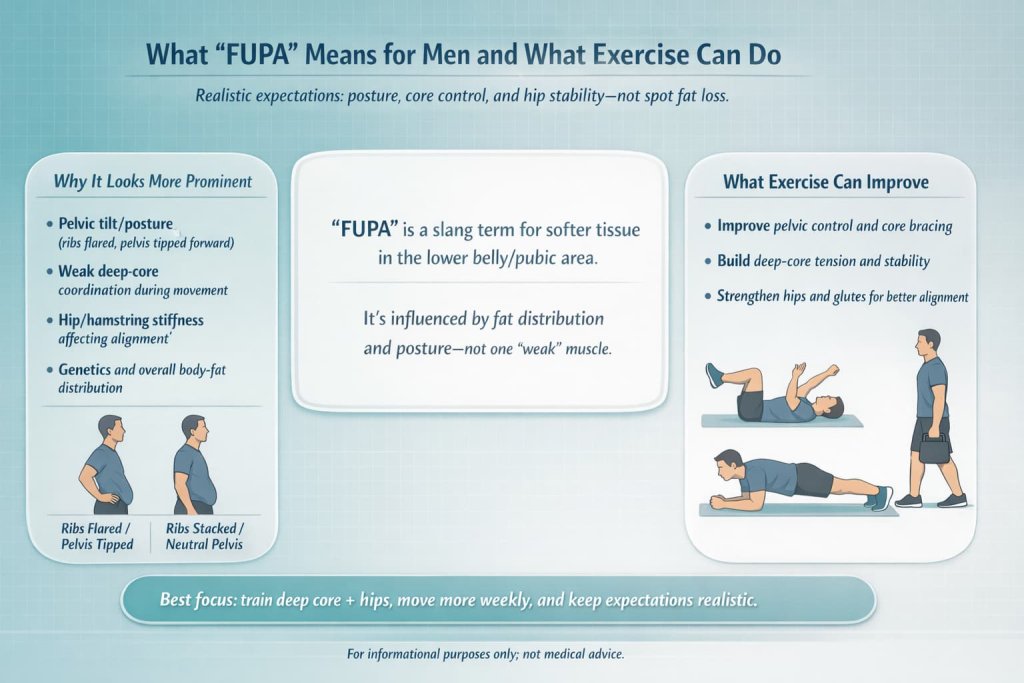
- Pelvic tilt and posture (ribs flared, pelvis tipped forward)
- Weak or poorly coordinated deep core muscles (especially during movement)
- Lower-body stiffness (hips/hamstrings) that changes alignment
- Overall body-fat level and where your body stores it genetically
Good fupa exercises for men focus on pelvic control, deep core tension, and hip stability—so your lower abs can do their job during daily life, lifting, and sports.
6 Best FUPA Exercises for Men
Build a stronger, tighter lower core with these 6 FUPA exercises for men that improve pelvic control, posture, and deep ab activation. Do them 3–4 times per week and pair with full-body training and daily activity for the best visible results.
1) Breathing With Posterior Pelvic Tilt (Deep Core “On” Switch)
How to do it:
- Lie on your back with knees bent, feet flat
- Exhale slowly and let your ribs drop (don’t flare)
- Gently tilt your pelvis so your low back gets closer to the floor
- Hold that position and take 3–5 slow breaths
- Do 4–6 breaths per set, 2–3 sets
Why it works: This teaches the lower abs to “own” pelvic position. If your pelvis stays tipped forward all day, many lower-belly exercises just turn into hip flexor work.
Muscles worked: Deep core (transverse abdominis), lower rectus abdominis, diaphragm coordination.
Trainer Tip: Think “zip up the front of your hips” on the exhale. If your neck tenses, reset and breathe slower.
2) Dead Bug With Exhale (Anti-Arch Core Control)
How to do it:
- Lie on your back, knees and hips at 90 degrees, arms up
- Exhale and gently flatten your low back (small posterior tilt)
- Slowly lower one heel toward the floor as the opposite arm reaches back
- Keep ribs down and pelvis steady
- Alternate sides for 6–10 reps each, 2–4 sets
Why it works: Dead bugs build control against lower-back arching, which is a common reason lower-belly work feels ineffective.
Muscles worked: Deep core, rectus abdominis, obliques, hip flexors (controlled).
Trainer Tip: Make the range smaller if your low back pops off the floor. Perfect control beats longer reps.
3) Reverse Crunch With Pelvic Curl (Lower-Ab Focus)
How to do it:
- Lie on your back with knees bent and hips flexed
- Exhale and curl your pelvis up so your tailbone lifts slightly
- Move slowly—no swinging the legs
- Lower with control until your pelvis is neutral again
- Do 8–12 reps, 2–4 sets
Why it works: The goal is pelvic movement driven by abs, not momentum. This is one of the most direct ways to train lower-ab shortening without straining the neck.
Muscles worked: Rectus abdominis (lower emphasis), deep core, obliques.
Trainer Tip: Keep knees in the same bend; think “tailbone up” rather than “knees to chest.”
4) RKC Plank (Short, Hard Plank for Lower Core)
How to do it:
- Get into a forearm plank with elbows under shoulders
- Squeeze glutes, lightly tuck pelvis, and pull ribs down
- Create full-body tension (as if you’re trying to shorten the space between elbows and toes)
- Hold 10–20 seconds, rest 40–60 seconds
- Repeat 4–6 rounds
Why it works: Many men “hang” in a plank and dump into the low back. The RKC style teaches bracing and pelvic control under high tension.
Muscles worked: Deep core, rectus abdominis, obliques, glutes, serratus anterior.
Trainer Tip: If you feel it mostly in your low back, reset the tuck and squeeze glutes harder.
5) Glute Bridge March (Pelvis Stability + Lower Abs)
How to do it:
- Lie on your back, feet flat, then lift into a strong glute bridge
- Keep hips level as you slowly lift one knee (march)
- Lower and switch sides without letting the pelvis drop
- Do 6–10 reps each side, 2–4 sets
Why it works: A stable pelvis makes lower-core training more effective and can reduce “hip flexor takeover” during ab work.
Muscles worked: Glutes, hamstrings, deep core, obliques.
Trainer Tip: Make your bridge a little lower if your hips wobble. Stability first.
6) Suitcase Carry (Anti-Side-Bend Core Builder)
How to do it:
- Hold one dumbbell or kettlebell at your side
- Stand tall with ribs stacked over hips
- Walk slowly for 20–40 seconds without leaning
- Switch sides and repeat
- Do 2–4 rounds per side
Why it works: Carries train the core in a real-life way—resisting unwanted motion while you move. This improves “tightness” and control around the waist and lower belly.
Muscles worked: Obliques, deep core, lats, grip, glutes.
Trainer Tip: If you keep tilting, go lighter and walk slower. Perfect posture beats heavier weight.
How to use these fupa exercises for men
Do this as a short routine 3–4 days per week (10–20 minutes), ideally after lifting or as a separate quick session.
A simple plan:
- Day A: Exercises 1–3 (core control + pelvic tilt)
- Day B: Exercises 4–6 (anti-extension + carries + hip stability)
- Alternate A/B across the week
For overall fat-loss support, match your weekly movement to widely used public-health targets like the CDC physical activity guidelines (at least 150 minutes/week moderate activity plus muscle-strengthening 2 days/week).
Common mistakes that make lower-core work less effective
- Doing reps fast and using momentum (especially in reverse crunches)
- Letting ribs flare up (turns abs “off” and loads the low back)
- Staying in anterior pelvic tilt during every exercise
- Overusing hip flexors (feels like tight hips, not abs)
- Training abs hard but skipping walking/cardio and total-body lifting
How to progress these fupa exercises for men safely
Use one progression at a time:
- Add reps (up to the top of the range)
- Add sets (up to 4)
- Slow the tempo (3 seconds down, 1 second up)
- Make the lever longer (harder dead bug reach, longer plank tension)
- Add load (heavier carries)
Stop and get medical guidance if you feel sharp pain, numbness/tingling, or symptoms that travel into the groin or down the leg.
Nutrition and daily activity tips that support fat loss
If your main goal is visible change in the lower belly area, these basics matter most:
- Hit a consistent weekly activity target (brisk walking counts) like the CDC recommendations
- Prioritize protein at meals and overall calorie consistency
- Lift 2–4 days/week and keep progressive overload (more reps, load, or sets over time)
- Add 7,000–10,000 steps/day if your lifestyle is sedentary (even without formal cardio)
- Sleep and stress management (poor sleep often raises hunger and lowers training quality)
When to expect results (realistic timeline)
You’ll usually feel changes before you see them. Core training improves control and posture fast, while visible lower-belly fat change depends on overall activity and nutrition.
- 1–2 weeks: Better lower-core activation and less low-back takeover
- 2–4 weeks: Improved posture, bracing, and core endurance
- 4–8 weeks: Noticeable strength gains (planks, dead bugs, carries feel easier)
- 8–12+ weeks: Most visible changes if paired with full-body training + consistent calorie deficit
If you feel sharp pain, groin bulging/pressure, or numbness/tingling, stop and get medical guidance.
FAQ
Can men actually “target” FUPA with lower-ab exercises?
Lower-ab exercises strengthen the area and improve posture, but visible fat loss is mostly driven by overall calorie balance and training volume.
How often should I train these fupa exercises for men?
Most men do best with 3–4 short sessions per week, especially when combined with full-body strength training.
What if I only feel these in my hip flexors?
Reduce range of motion, exhale to bring ribs down, and prioritize the posterior pelvic tilt drill first. Hip flexors often take over when the pelvis stays tipped forward.
Are reverse crunches safe for the lower back?
They can be when you move slowly and curl the pelvis instead of swinging the legs. If you feel back pain, switch to dead bugs and planks first.
Do I need cardio to reduce lower belly fat?
Cardio isn’t mandatory, but it’s strongly helpful for creating the weekly energy burn that supports fat loss. Large reviews show aerobic training is associated with reductions in waist measures over time.
How long until I notice results?
Core control and posture can improve in a few weeks. Visible fat change usually takes longer and depends on nutrition consistency, total training volume, and genetics.
Conclusion
FUPA exercises for men work best when they’re treated as lower-core control training—not magic fat burners. Start with pelvic tilt + dead bugs, build tension with RKC planks, and finish strong with carries. Then support it with consistent weekly movement and full-body strength work.
References
- National Strength and Conditioning Association. (2017). How to lose body fat? Spot reduction… dispelling the myth (Trainer tips) [PDF]. National Strength and Conditioning Association (NSCA)
- U.S. Department of Health and Human Services. (2018). Physical activity guidelines for Americans (2nd ed.) [PDF]. Office of Disease Prevention and Health Promotion (ODPHP)
- American Heart Association. (n.d.). American Heart Association recommendations for physical activity in adults. American Heart Association (AHA)
- World Health Organization. (n.d.). Physical activity. World Health Organization (WHO)