
Grounding exercises are quick, practical techniques that help you shift attention from anxious thoughts back to the present moment using your senses, breathing, and simple mental focus. They matter because when anxiety feels overwhelming, your body can act like you’re in danger even when you’re safe—grounding gives you a “right now” reset you can use at home, school, or anywhere.

Many clinicians and health organizations teach grounding as an in-the-moment coping skill (not a standalone “treatment”). One of the most common options is the 5-4-3-2-1 method described by NHS Inform, which guides you through what you can see, feel, hear, smell, and taste.
What grounding exercises are and when to use them
Grounding is a set of simple strategies that helps you re-orient to the here and now when you feel overwhelmed by anxiety, stress, panic feelings, or intense emotions. It often works by:
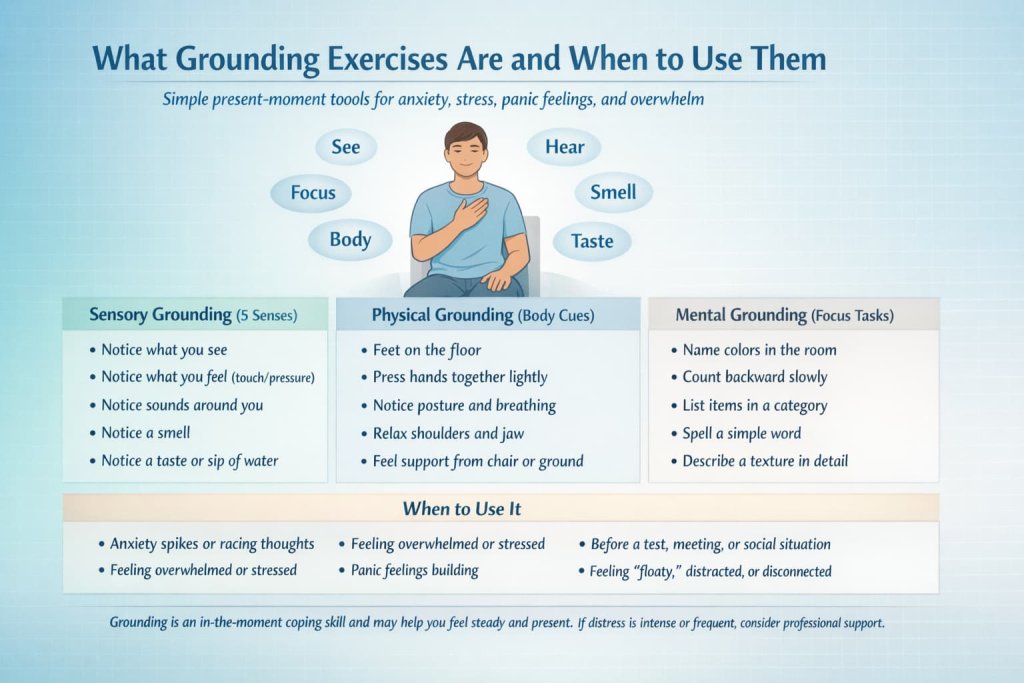
- engaging your five senses (sensory grounding)
- using body sensations (physical grounding)
- giving your mind a short “focus task” (mental grounding)
Trauma-informed guidance also describes grounding as useful when someone feels emotionally flooded or disconnected from the present moment, because it helps bring awareness back to current surroundings.
What grounding exercises can realistically do
Grounding exercises may help you:
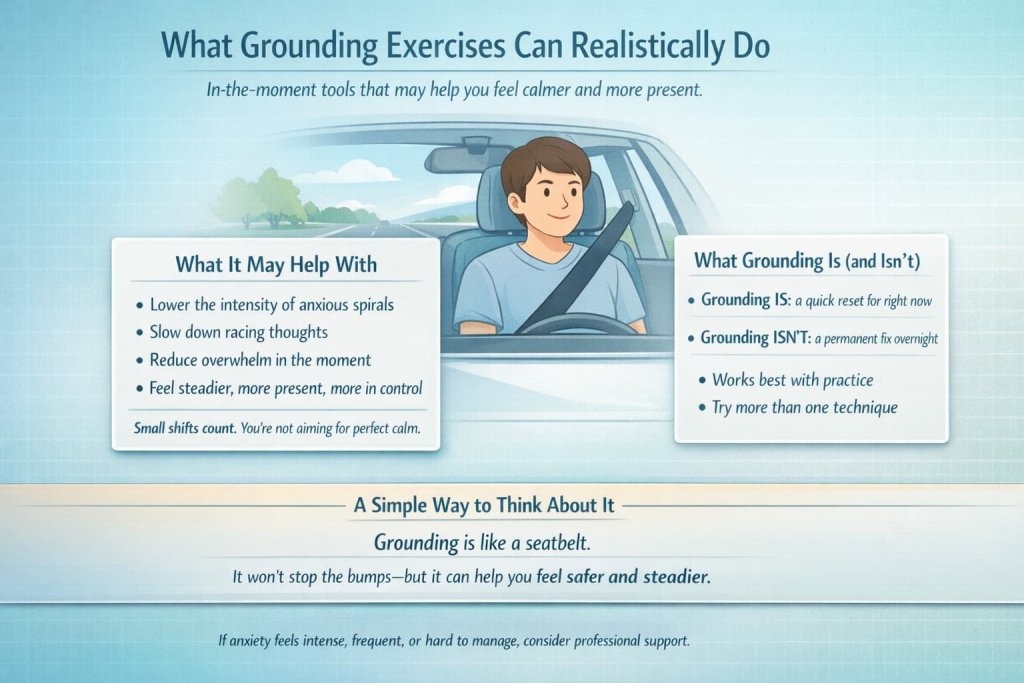
- lower the intensity of anxious spirals
- slow down racing thoughts
- reduce “overwhelm” in the moment
- feel more steady, present, and in control
They won’t instantly remove anxiety forever—and that’s okay. Think of grounding like a seatbelt: it doesn’t stop the road from being bumpy, but it helps you stay safer and more stable while you ride it out.
10 best grounding exercises to calm anxiety and feel present again
These grounding exercises help shift your attention away from racing thoughts and back to the present moment using your senses, breathing, and simple mental focus. They are quick, practical techniques you can use anywhere to reduce anxiety and regain a sense of calm and control.
1) 5-4-3-2-1 Sensory Scan
How to do it:
- Sit or stand tall and take one slow breath in and out.
- Name 5 things you can see.
- Name 4 things you can feel (fabric, chair, feet in shoes).
- Name 3 things you can hear.
- Name 2 things you can smell (or two smells you like).
- Name 1 thing you can taste (or take a sip of water and notice it).
Why it works: This technique pulls your attention away from “what if” thoughts and into real-time sensory information. When your brain is focused on what your senses are picking up right now, anxious spirals often lose intensity and feel easier to manage.
Trainer Tip: If you’re in public, do the whole scan silently. Just let your eyes move slowly as you “collect” items, and keep it subtle by choosing quiet sensations like fabric texture or your feet inside your shoes.
2) Feet-on-Floor Reset
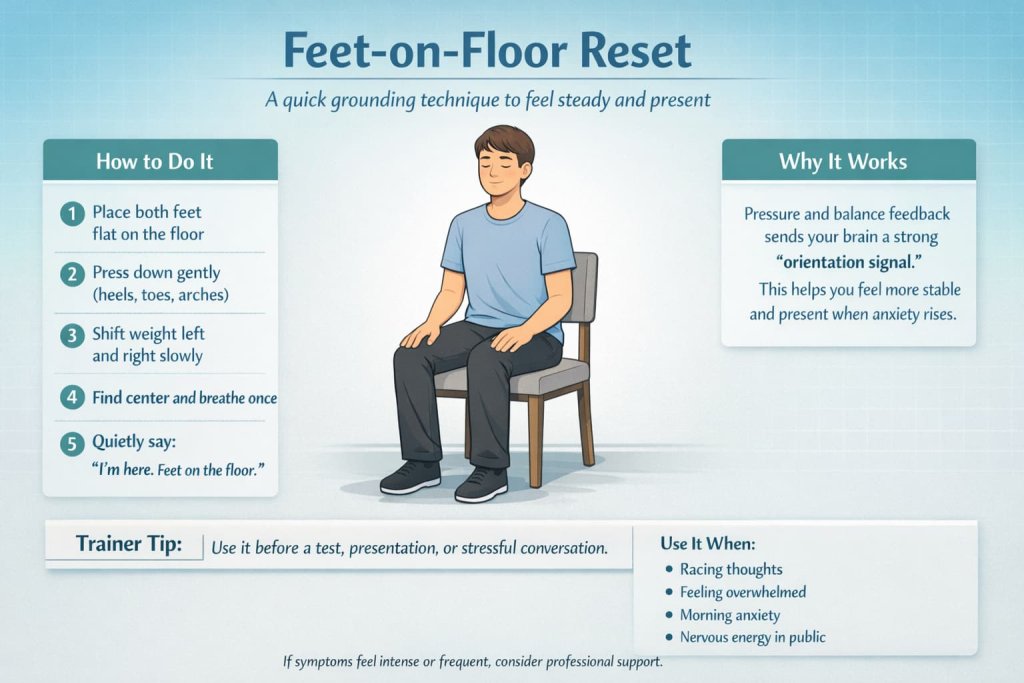
How to do it:
- Plant both feet on the ground.
- Press down gently and notice pressure under heels, toes, and arches.
- Slowly shift weight left/right and find a steady middle.
- Say to yourself: “I’m here. My feet are on the floor.”
Why it works: Pressure and balance feedback gives your brain a strong “orientation signal” from the body. That physical sense of stability can help reduce the feeling of being swept away by anxiety and bring you back into a steadier present-moment state.
Trainer Tip: Use this before a stressful moment like a test, presentation, or conversation. It’s also a great quick reset if you wake up feeling anxious—no special setup needed.
3) Box Breathing (4-4-4-4)
How to do it:
- Inhale through your nose for 4 counts.
- Hold gently for 4 counts.
- Exhale slowly for 4 counts.
- Hold gently for 4 counts.
- Repeat 3–5 rounds.
Why it works: A structured breathing pattern gives your mind something predictable to follow. That structure can interrupt mental chaos and help your nervous system shift from “revved up” toward more controlled, steady rhythms.
Trainer Tip: If breath-holds feel uncomfortable, don’t force them. Swap to a simple version: inhale for 4 counts, exhale for 6 counts, and keep the exhale smooth.
4) Cold-Water Cue
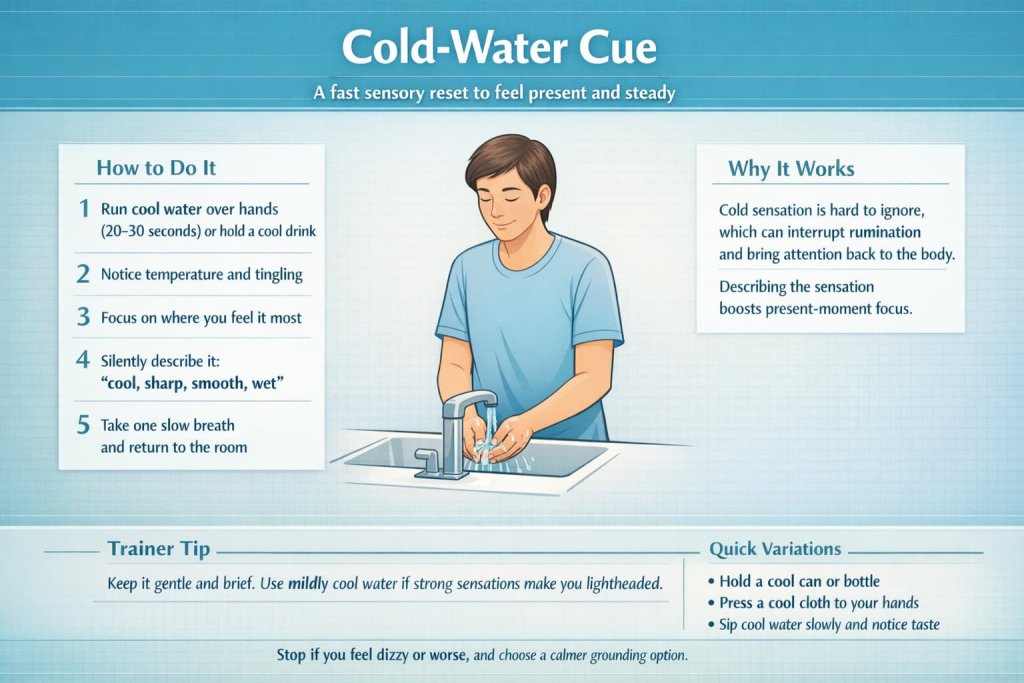
How to do it:
- Run cool water over your hands for 20–30 seconds, or hold a cool drink.
- Focus on the temperature, tingling, and where you feel it most.
- Describe it in your head: “cool, sharp, smooth, wet.”
Why it works: Cold sensation is hard for your brain to ignore, so it can break through rumination and pull attention back into the body. The added step of describing the sensation strengthens the “present-moment focus” even more.
Trainer Tip: Keep it gentle and brief. If you tend to feel lightheaded with strong sensations, use mildly cool water instead of very cold water.
5) Texture Focus (Pocket Grounding)
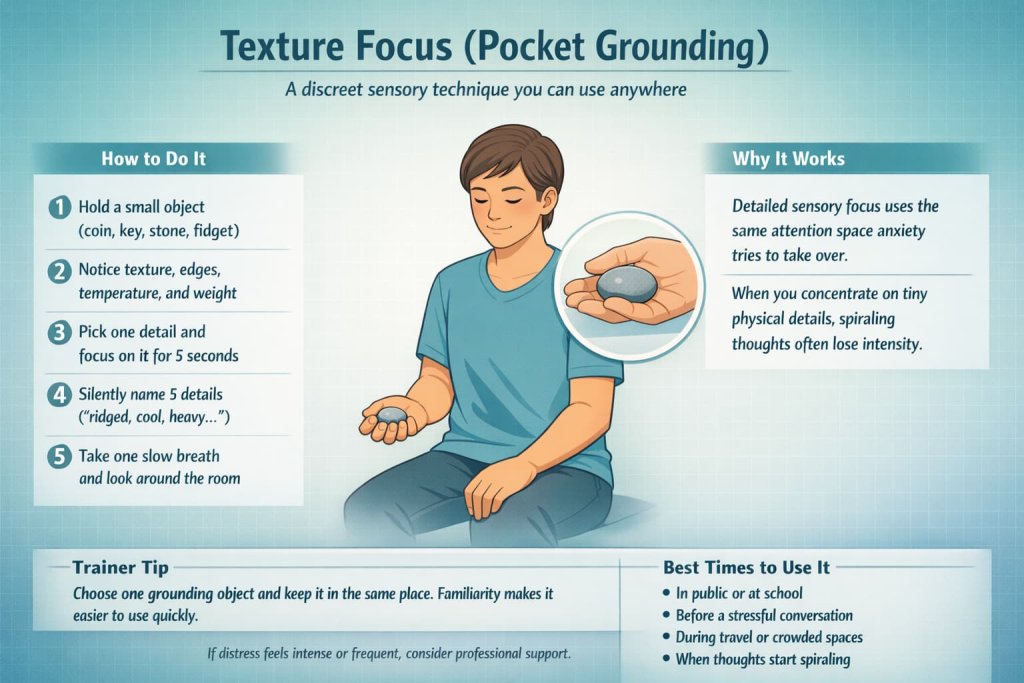
How to do it:
- Hold a small object (coin, key, smooth stone, fidget).
- Notice texture, edges, temperature, and weight.
- Describe 5 details silently: “ridged, cool, heavy…”
Why it works: Detailed sensory focus uses the same mental “space” anxiety tries to take over. When you concentrate on tiny physical details, it reduces how much attention your brain can give to spiraling thoughts.
Trainer Tip: Pick one grounding object and keep it in the same place (pocket, bag, desk). Familiarity helps—your brain starts to associate it with calming and control.
6) Name Five Colors
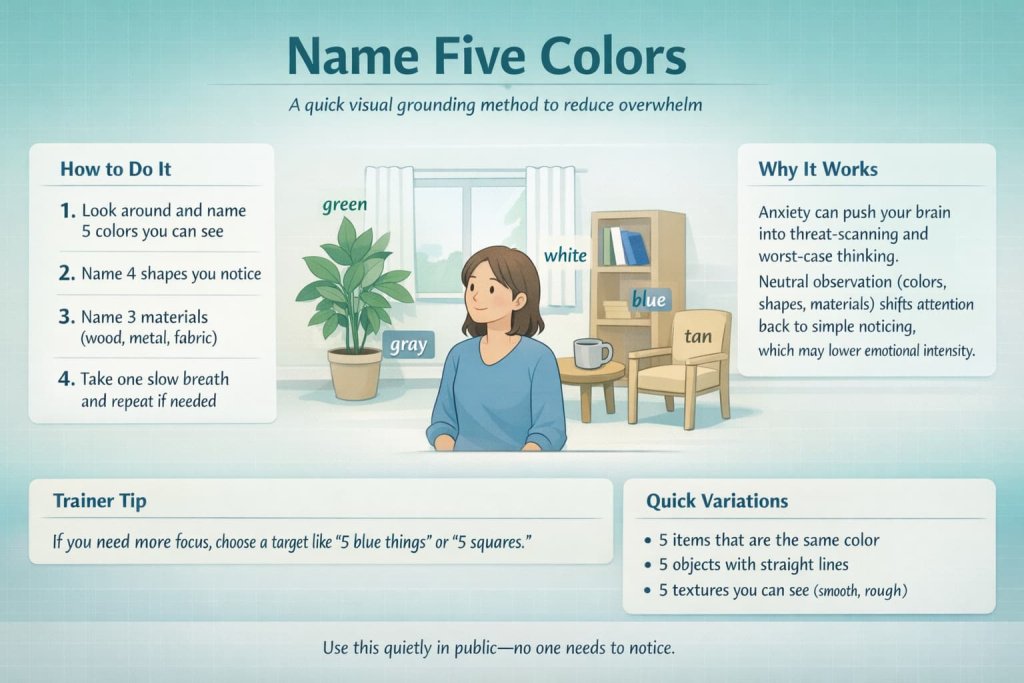
How to do it:
- Look around and name 5 colors you can see.
- Then name 4 shapes.
- Then name 3 materials (wood, metal, fabric).
Why it works: Anxiety often pulls attention into threat-scanning and worst-case thinking. Neutral observation tasks like colors and shapes shift your brain back toward simple noticing, which can lower emotional intensity.
Trainer Tip: If you need a stronger challenge, choose a specific target like “5 blue things” or “5 squares.” The extra focus can make it more effective during high stress.
7) Category Countdown
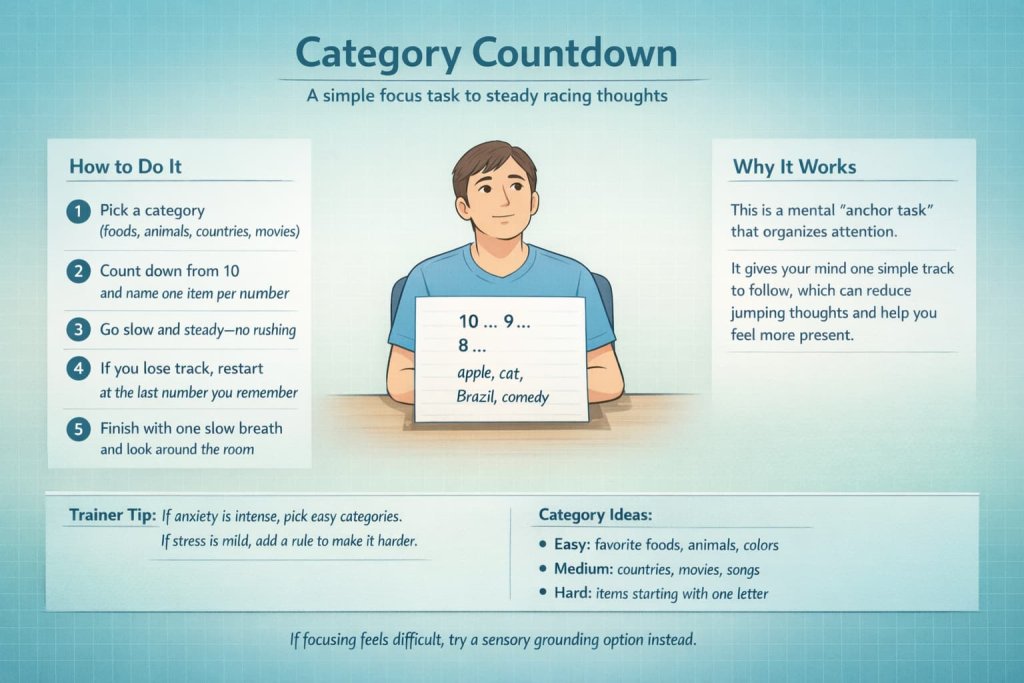
How to do it:
- Pick a category (foods, animals, countries, movies).
- Name 10 items slowly.
- If your mind wanders, gently restart at the number you remember.
Why it works: This is a mental “anchor task” that organizes attention. Instead of letting your mind jump from thought to thought, you give it one simple track to follow, which can steady racing thoughts.
Trainer Tip: When anxiety is intense, keep categories easy (foods you like, animals). When stress is mild, choose harder ones (countries starting with a certain letter).
8) 3-3-3 Scan
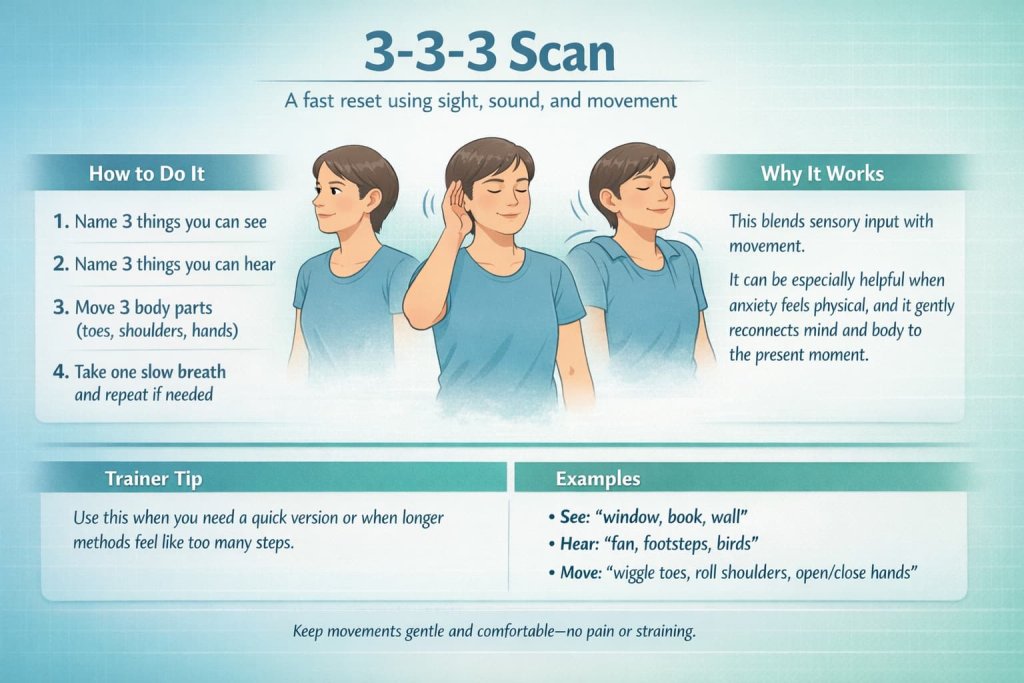
How to do it:
- Name 3 things you can see.
- Name 3 things you can hear.
- Move 3 body parts (wiggle toes, roll shoulders, open/close hands).
Why it works: This blends sensory input with movement, which can be especially helpful when anxiety feels physical (tight chest, restlessness, jittery energy). It gently reconnects your mind and body to the present moment.
Trainer Tip: Use this as a “quick version” when you don’t have time for a longer method. It’s also a good option if 5-4-3-2-1 feels like too many steps.
9) Progressive Muscle Squeeze and Release
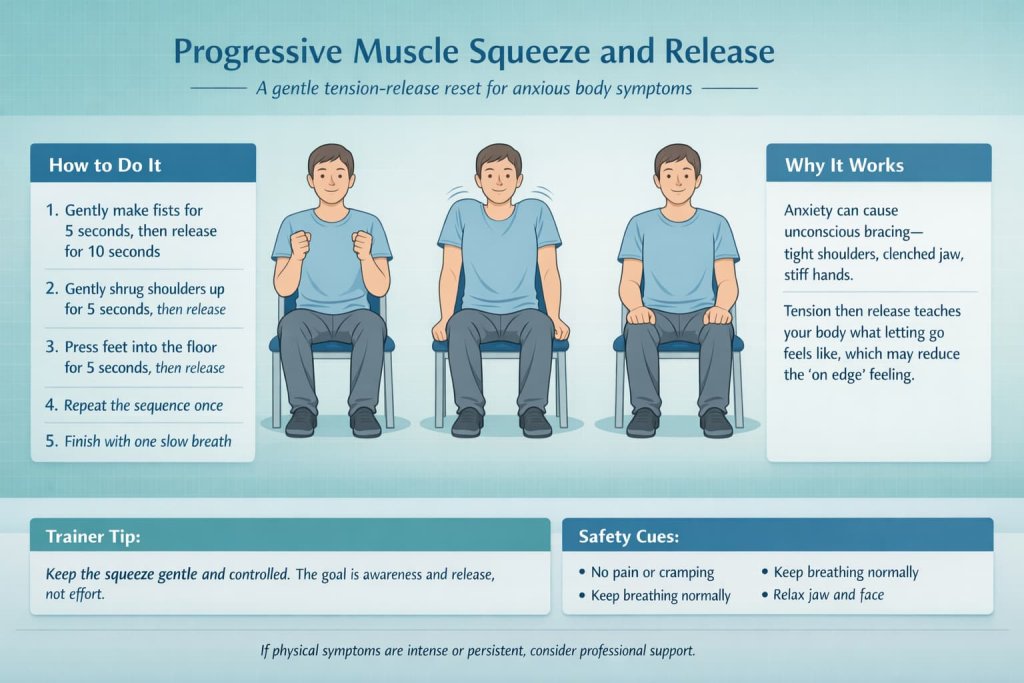
How to do it:
- Squeeze your hands into fists for 5 seconds, then release for 10 seconds.
- Shrug shoulders up for 5 seconds, then release.
- Press feet into the floor for 5 seconds, then release.
- Repeat once.
Why it works: Anxiety often comes with unconscious bracing—tight shoulders, clenched jaw, stiff hands. This exercise teaches your body the difference between tension and release, which can reduce the “on edge” feeling.
Trainer Tip: Keep the squeeze gentle and controlled. The goal is awareness and release, not maximum effort—avoid pain, cramping, or straining.
10) Orienting Statement (Where/When/Who)
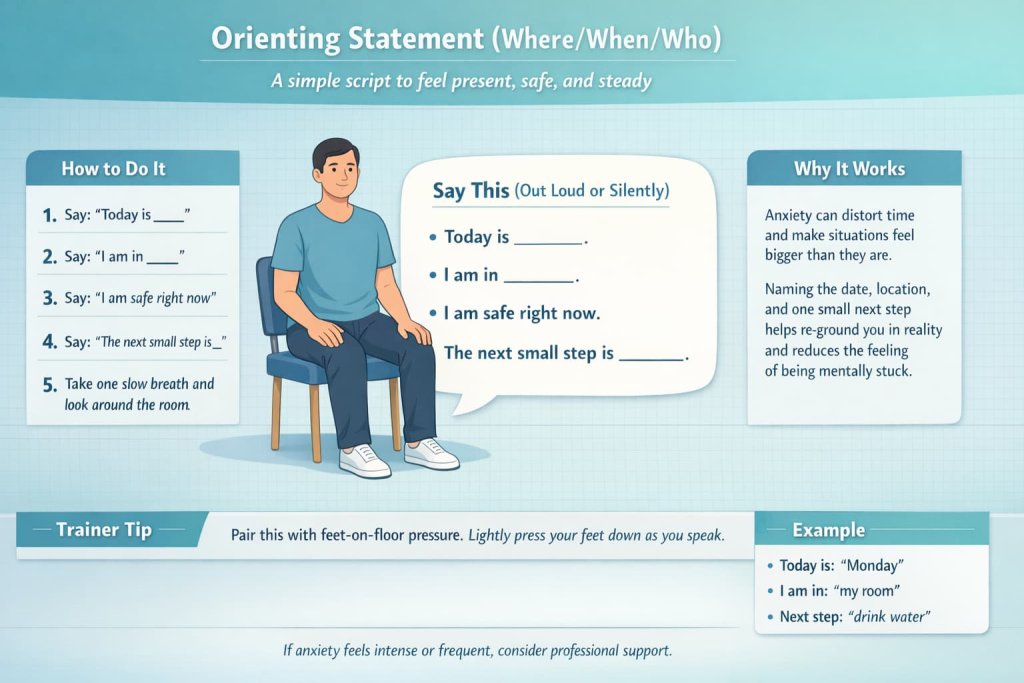
How to do it:
- Say (out loud or silently): “Today is ____.”
- Say: “I am in ____.”
- Say: “I am safe right now.”
- Say: “The next small step is ____ (drink water / text a friend / sit down).”
Why it works: Anxiety can make time feel distorted and situations feel bigger than they are. Naming the date, your location, and a small next step helps re-ground you in reality and reduces the feeling of being mentally “stuck.”
Trainer Tip: Pair this with feet-on-floor pressure for a stronger effect. While you speak the statements, press your feet down lightly and feel the floor supporting you.
How to choose the right grounding exercise
If you’re not sure where to start, match the tool to the moment:
- Mind is spinning: choose a mental task (counting, categories, spelling words)
- Body feels activated: choose physical grounding (feet on floor, muscle squeeze/release)
- Feeling “floaty” or disconnected: choose sensory grounding (cold water, texture focus, 5-4-3-2-1)
- Need something subtle in public: choose “quiet” grounding (breath count, fingertip pressure, naming colors)
A simple 2-minute grounding routine you can reuse
When anxiety spikes, try this sequence:
- 30 seconds: Feet-on-floor reset
- 60 seconds: 5-4-3-2-1 (or 3-3-3 if you’re rushed)
- 30 seconds: Box breathing (or slow exhale)
Consistency helps. Repeating the same routine trains your brain to recognize it as a safety cue over time.
Safety notes and when to get extra support
Grounding should feel stabilizing—not scary. Stop, scale down, or switch techniques if you notice:
- dizziness or feeling worse with certain breathing patterns
- panic rising when you close your eyes (keep eyes open and use visual grounding instead)
- intense distress that doesn’t settle after trying a few tools
If anxiety is frequent, intense, or disrupting school, sleep, or daily life, it’s a good idea to talk with a trusted adult and consider professional support. Anxiety is common, and getting help is a strength—not a failure.
Common questions about grounding exercises
What are the best grounding exercises for anxiety?
Many people start with 5-4-3-2-1, feet-on-floor pressure, and box breathing because they’re easy, fast, and can be done anywhere.
How fast do grounding exercises work?
Often within 30–120 seconds you may notice anxiety feel less “loud.” If not, try switching styles (sensory vs. mental vs. physical).
Can grounding help with panic feelings?
It may help reduce intensity by redirecting attention and giving your body a steadier rhythm. If panic is recurring, it’s worth discussing with a clinician for a full plan.
What if 5-4-3-2-1 doesn’t work for me?
That’s normal. Some people do better with cold-water cues, muscle squeeze/release, or category countdown. The “best” grounding tool is the one your brain accepts in that moment.
Should I practice grounding when I’m not anxious?
Yes. Practicing when you’re calm makes it easier to use when you’re stressed—like practicing a fire drill before an emergency.
Are grounding exercises the same as “earthing”?
Not usually. In mental health, “grounding exercises” typically means present-moment techniques using attention and senses (like 5-4-3-2-1), not physical contact with the earth.
Conclusion
Grounding exercises are practical “right now” tools that can help you feel calmer, more present, and more steady when anxiety spikes. Start with one technique (like 5-4-3-2-1 or feet-on-floor), practice it for a week, and build your own mini toolkit from there.
References
- NCBI Bookshelf (SAMHSA TIP 57) — Grounding Techniques exhibit
- NCBI Bookshelf (SAMHSA TIP 57) — Trauma-Informed Care in Behavioral Health Services
- NHS — Breathing exercises for stress
- American Psychological Association (APA) — Tips to manage stress
- PubMed Central (PMC) — Breathing practices for stress and anxiety reduction
- World Health Organization (WHO) — Anxiety disorders fact sheet