
To build muscle safely, lift weights 2–4 days per week with progressive overload and eat enough protein and total calories to support recovery. Getting the basics right matters because muscle growth is a slow adaptation process—your training is the signal, and your food, sleep, and consistency determine how well your body responds.
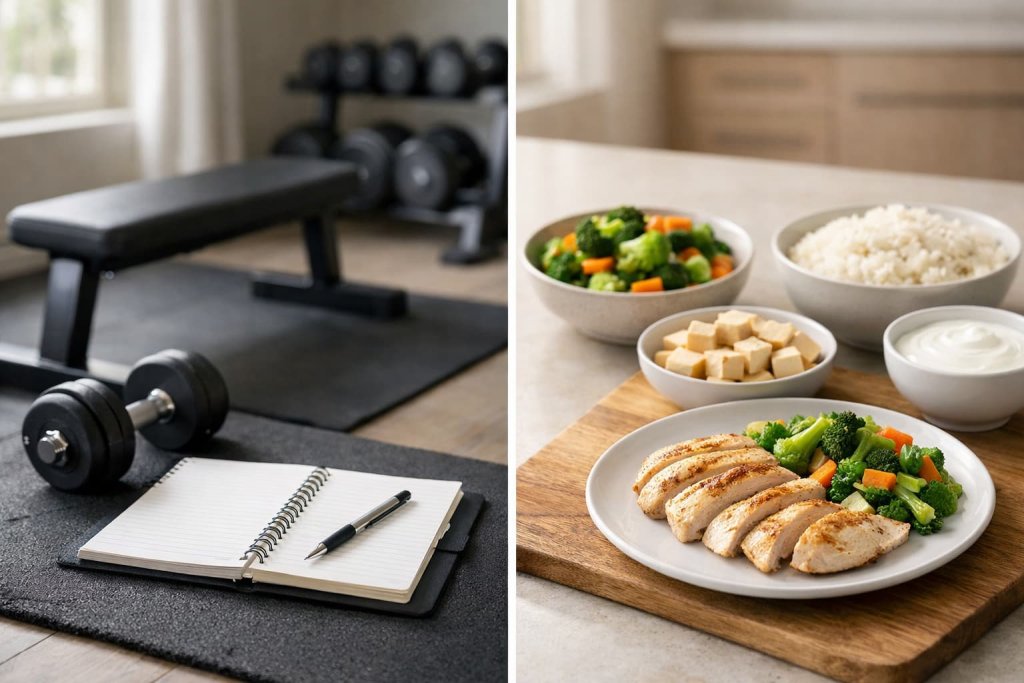
If you want a simple roadmap: follow a beginner-friendly plan, train with good form, add reps or small weight over time, hit a realistic daily protein target, and sleep enough to recover.
How muscle growth actually happens
Muscle grows when your body adapts to repeated resistance training. The most important drivers are:
- Progressive overload (gradually doing more over time)
- Enough hard weekly sets for each muscle group
- Adequate recovery (sleep, rest days, nutrition)
You do not need extreme workouts or max lifts to build muscle. Most progress comes from consistent, repeatable training that you can recover from.
How often to lift for muscle growth
General public-health guidance recommends muscle-strengthening at least 2 days per week. According to the Centers for Disease Control and Prevention (CDC), adults should do muscle-strengthening activities at least 2 days weekly. World Health Organization (WHO) guidance also supports strength training involving major muscle groups on 2+ days per week.
For building muscle (not just meeting minimum health guidelines), most people do best with:
- Beginners: 2–3 lifting days/week (full-body)
- Intermediate: 3–4 lifting days/week (upper/lower or push/pull/legs)
- Advanced: 4–6 days/week (higher volume, more specialization)
Beginner-friendly rule that works
Train each major muscle group about 2 times per week using full-body sessions or an upper/lower split.
The safest way to lift: technique first, then intensity
Safety is mostly about good form, controlled reps, and steady progression.
Your “effort level” should be challenging but controlled
Most muscle-building sets should feel like you could do 1–3 more reps with good form when you stop. This keeps the set hard enough to stimulate growth without turning every set into a form breakdown.
The easiest progression method
Pick a rep range (example: 8–12). When you can hit the top end for all sets with clean form, increase the weight slightly next time.
Warm-up, rest times, and form rules that prevent injuries
A good warm-up makes your sets feel smoother and reduces the chance you strain something when the weight gets challenging.
Warm-up (5–10 minutes)
- Do 3–5 minutes of light cardio (walk, bike, easy row).
- Then do 2–4 “ramp-up” sets for your first big lift (lighter weight, fewer reps), gradually building to your working weight.
Rest times (simple guideline)
- For most muscle-building sets, rest about 1–2 minutes between sets.
- For heavier compound lifts (squat, deadlift, bench, rows), rest 2–3 minutes if you need it to keep form and performance strong.
Progression should never break technique
- Keep reps controlled. If your form changes noticeably, the set is over.
- Use full, comfortable range of motion you can control.
- Increase load in small jumps. The American College of Sports Medicine (ACSM) describes progression approaches that increase load once you can exceed your target reps with the current weight.
A simple muscle-building workout plan
Below are two practical options. Choose the one you can do consistently.
Option A: 3-day full-body plan (great for beginners)
Do these sessions on non-consecutive days (example: Monday/Wednesday/Friday).
Workout A
- Squat or leg press: 3 sets of 6–10 reps
- Bench press or push-ups: 3 sets of 6–12 reps
- Row (machine/cable/dumbbell): 3 sets of 8–12 reps
- Romanian deadlift or hip hinge: 2–3 sets of 6–10 reps
- Plank: 2–3 sets of 30–60 seconds
Workout B
- Deadlift variation or hip thrust: 3 sets of 5–8 reps
- Overhead press: 3 sets of 6–12 reps
- Lat pulldown or pull-ups: 3 sets of 8–12 reps
- Split squat or lunge: 2–3 sets of 8–12 reps per side
- Carry (farmer carry) or core: 2–3 short rounds
Alternate A and B across the week.
Option B: 4-day upper/lower split (good once you have consistency)
Upper 1
- Bench press: 3 x 6–10
- Row: 3 x 8–12
- Overhead press: 2–3 x 6–12
- Pull (pulldown/pull-up): 2–3 x 8–12
- Optional arms: 1–2 x 10–15
Lower 1
- Squat/leg press: 3 x 6–10
- Hip hinge: 3 x 6–10
- Hamstring curl: 2 x 10–15
- Calves: 2 x 10–15
Upper 2
- Incline press or dumbbell press: 3 x 8–12
- Chest-supported row: 3 x 8–12
- Lateral raise: 2–3 x 12–20
- Pulldown/pull-up: 2–3 x 8–12
- Optional arms: 1–2 x 10–15
Lower 2
- Deadlift variation or hip thrust: 3 x 5–8
- Lunge/split squat: 2–3 x 8–12 per side
- Leg curl: 2 x 10–15
- Calves: 2 x 10–15
Weekly training target table (simple and effective)
| Goal | Lifting days/week | Sets per muscle/week (general range) | Notes |
|---|---|---|---|
| Build muscle as a beginner | 2–3 | 6–10 | Full-body works well |
| Build muscle with more volume | 3–4 | 10–16 | Upper/lower is efficient |
| Maintain muscle | 1–3 | 4–8 | Keep intensity, reduce volume |
Consistency beats perfection. Pick the smallest plan you can stick to for 8–12 weeks.
What to eat to build muscle
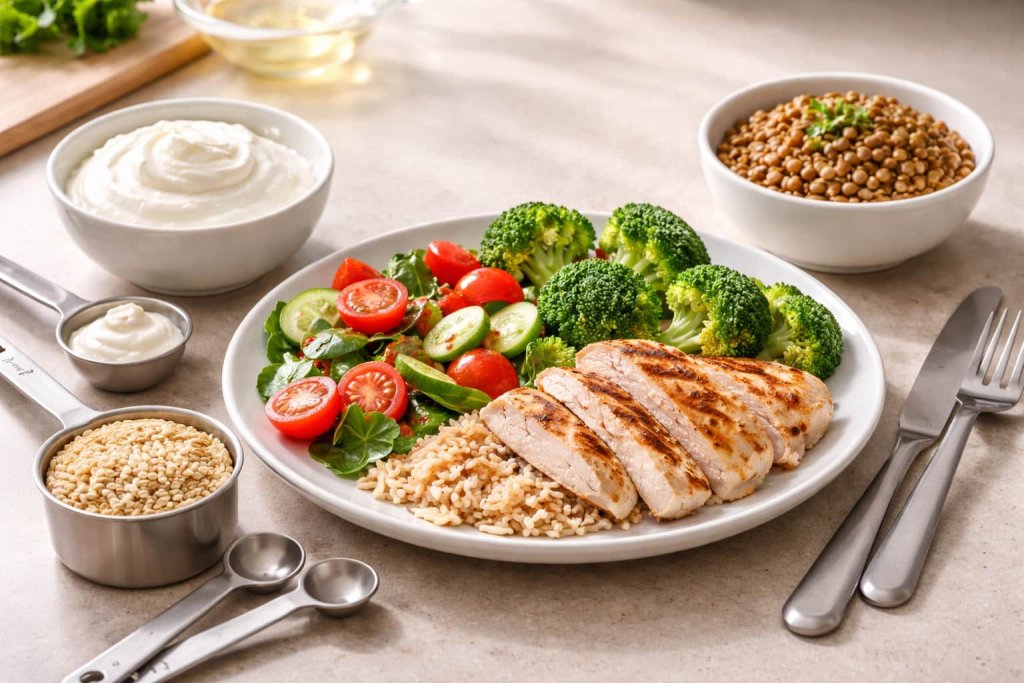
Protein: your daily target (the most important number)
A widely cited sports nutrition position stand notes that an overall intake of about 1.4–2.0 g of protein per kg of body weight per day is sufficient for most people who exercise regularly, including lifters, according to the International Society of Sports Nutrition (ISSN).
Quick protein calculator
- Weight in kg = body weight in pounds ÷ 2.2
- Daily protein range = kg × 1.4 to kg × 2.0
Example:
If you weigh 70 kg (154 lb)
- 70 × 1.4 = 98 g/day
- 70 × 2.0 = 140 g/day
Calories: you usually need “enough,” not extreme bulking
Muscle gain is easier when you’re not under-eating. A small, steady calorie surplus is often more sustainable than aggressive bulking, especially if you want to minimize fat gain.
Build your day around nutrient-dense foods across food groups, as emphasized in the Dietary Guidelines for Americans.
How to tell if you’re eating enough (without aggressive bulking)
You don’t need a huge calorie surplus to build muscle. A small, steady surplus is usually easier to recover from and easier to control.
Use this simple check for 2–3 weeks:
- Weigh yourself 2–4 mornings per week and look at the average trend.
- If your average body weight is not moving at all and your lifts are stalling, add a small amount of food daily (for example, one extra snack with carbs + protein).
- If weight is climbing quickly and your waist is expanding faster than your strength, reduce portions slightly and keep protein steady.
A controlled approach matters because larger surpluses can increase fat gain without meaningfully improving muscle-building outcomes for many lifters, based on recent evidence summaries in the National Library of Medicine (NIH/PMC).
Carbs and fats: don’t skip them
- Carbs help fuel training and support performance
- Fats support hormones and overall health
A practical plate approach:
- Protein at each meal
- Carbs around training (especially if workouts feel flat)
- Healthy fats daily (olive oil, nuts, seeds, avocado, fatty fish)
Muscle-building meal structure that’s easy to follow
Simple daily pattern (no complicated macro counting)
Aim for:
- 3–4 meals/day with a solid protein source each time
- 1–2 protein-rich snacks if needed
- Produce at most meals (fiber + micronutrients)
High-protein food examples (mix and match)
For food-group ideas, the USDA MyPlate Protein Foods Group overview is a useful reference.
| Food | Typical serving | Protein contribution (varies by brand/portion) |
|---|---|---|
| Greek yogurt | 1 cup | High |
| Eggs | 2–3 eggs | Moderate |
| Chicken/turkey/fish | palm-sized portion | High |
| Tofu/tempeh | 3–4 oz | Moderate–high |
| Beans/lentils | 1 cup cooked | Moderate |
| Milk/soy milk | 1 cup | Moderate |
Recovery: the hidden driver of muscle gain

Sleep targets
Muscle is built during recovery, not during the workout. If sleep is consistently short or inconsistent, progress often slows even with a good training plan.
The National Sleep Foundation generally recommends:
- Teens (14–17): 8–10 hours per night
- Adults: 7–9 hours per night
Rest days and soreness
Some soreness is normal, especially early on. But you should be able to repeat training week to week. If you’re constantly wrecked, reduce volume (fewer sets) before you reduce consistency.
Safety box
Who should be extra careful
- Teens who are new to lifting
- Anyone returning after an injury
- Anyone with ongoing joint pain, dizziness, or unexplained symptoms
Teen safety essentials
The American Academy of Pediatrics (AAP) supports resistance training for youth when there is proper supervision and good technique. Start with lighter loads, learn movement patterns first, and progress slowly.
If you’re a teen, make these three rules non-negotiable
- Learn technique first. Use weights you can control for every rep, every set.
- Avoid testing 1-rep max lifts. You can build plenty of muscle with moderate weights and clean form.
- Get qualified supervision when learning the main lifts. The National Strength and Conditioning Association (NSCA) emphasizes instruction and supervision by qualified adults who understand youth resistance training guidelines.
Stop and reassess if you have
- Sharp or worsening pain
- Numbness/tingling
- Pain that changes your movement pattern
- Symptoms that persist for more than a few sessions
Common mistakes that slow muscle gain
Training mistakes
- Random workouts with no progression
- Doing too many sets to failure (fatigue beats stimulus)
- Skipping compound lifts and only doing “mirror muscles”
- Changing programs every week
Nutrition mistakes
- Inconsistent protein intake
- Under-eating (especially at breakfast and post-workout)
- Relying on supplements instead of food and sleep
- Drinking calories instead of eating balanced meals (if you’re trying to stay lean)
Supplements: keep it simple and safety-first
You can build muscle without supplements. If you use them, use a food-first approach and avoid anything that feels like a shortcut.
Smart rules
- Prioritize protein from meals. Use a protein powder only if it helps you reliably hit your daily target.
- Skip “proprietary blends” and stimulant-heavy pre-workouts (especially if you’re sensitive to caffeine or sleep is inconsistent).
- Choose products that are third-party tested when possible.
If you’re under 18
- Be extra cautious with supplements. Talk with a parent/guardian and a clinician or sports dietitian before starting anything beyond basic food options.
- For evidence summaries and safety considerations across common performance supplement ingredients, see the NIH Office of Dietary Supplements (ODS).
People also ask about how to build muscle
How long does it take to build noticeable muscle?
Most people notice performance improvements in a few weeks. Visible changes often take 8–12 weeks of consistent training and nutrition, and bigger changes take months.
Can you build muscle without heavy weights?
Yes. Muscle can grow with lighter weights when sets are challenging and close to fatigue. Heavy weights are just one tool.
Do you need supplements to build muscle?
No. Food and consistency matter most. If you choose supplements, prioritize safety and quality, and don’t use them as a substitute for adequate protein and sleep.
FAQ
1) How many sets should I do per muscle group each week?
Beginners often grow well with about 6–10 hard sets per muscle group per week. More experienced lifters may do 10–16, but only if recovery stays solid.
2) Should I train to failure to build muscle?
You don’t have to. Stopping with 1–3 reps left in the tank for most sets is a reliable approach that balances stimulus and recovery.
3) How much protein do I need to build muscle?
A common evidence-based range for exercising individuals is about 1.4–2.0 g/kg/day, and you can spread it across meals.
4) What should I eat before and after lifting?
Before: a mix of carbs + protein (example: yogurt and fruit). After: a protein-rich meal plus carbs if training was hard or long.
5) Can teens lift weights safely?
Yes, with good coaching, proper form, and gradual progression. Focus on technique, consistency, and avoiding ego lifting.
6) What if I’m not gaining muscle?
Check the basics: are you progressing your lifts, hitting protein daily, sleeping enough, and eating enough overall? Fix those before changing everything.
7) Is soreness required for muscle growth?
No. Soreness can happen, especially early on, but growth is driven by progressive training and recovery—not how sore you feel.
Conclusion
Building muscle safely is simple, but it’s not instant: follow a consistent plan, train hard with good form, add small progress over time, and eat enough protein and total food to recover. If you want the fastest real-life results, start with a 3-day full-body plan, hit your daily protein target, and protect your sleep for the next 8–12 weeks.
This content is for informational purposes only and not medical advice.
Sources/References
- Centers for Disease Control and Prevention (CDC) — Adding Physical Activity as an Adult
- World Health Organization (WHO) — Physical activity (Be Healthy initiative page)
- American College of Sports Medicine (ACSM) — Progression Models in Resistance Training for Healthy Adults
- International Society of Sports Nutrition (ISSN) — Position stand: protein and exercise
- Dietary Guidelines for Americans — Dietary Guidelines for Americans
- USDA MyPlate — Protein Foods Group
- National Sleep Foundation — How Much Sleep Do You Really Need?
- American Academy of Pediatrics (AAP) — Guidance on Resistance Training for Children
- National Strength and Conditioning Association (NSCA) — Youth Resistance Training Position Statement
- National Library of Medicine (NIH/PMC) — Surplus Energy Intake and Resistance Training Review
- NIH Office of Dietary Supplements (ODS) — Dietary Supplements for Exercise and Athletic Performance