
Landmine back exercises are barbell movements done with one end of the bar anchored, letting you train rows and hinges on a smooth arc that’s easy to load and repeat. The landmine setup is popular because it’s space-efficient and versatile for full-body training, including back-focused pulling patterns, as highlighted by the American Council on Exercise (ACE).

Understanding the best landmine back moves matters because your back is a support system for posture, pulling strength, and stable lifting mechanics. Below you’ll get the most effective exercises, clean form cues, and simple programming you can use right away.
What Are Landmine Back Exercises?
A landmine setup anchors one end of a barbell so the free end travels in a controlled arc. That changes the feel of rows and hinges and makes it easy to:
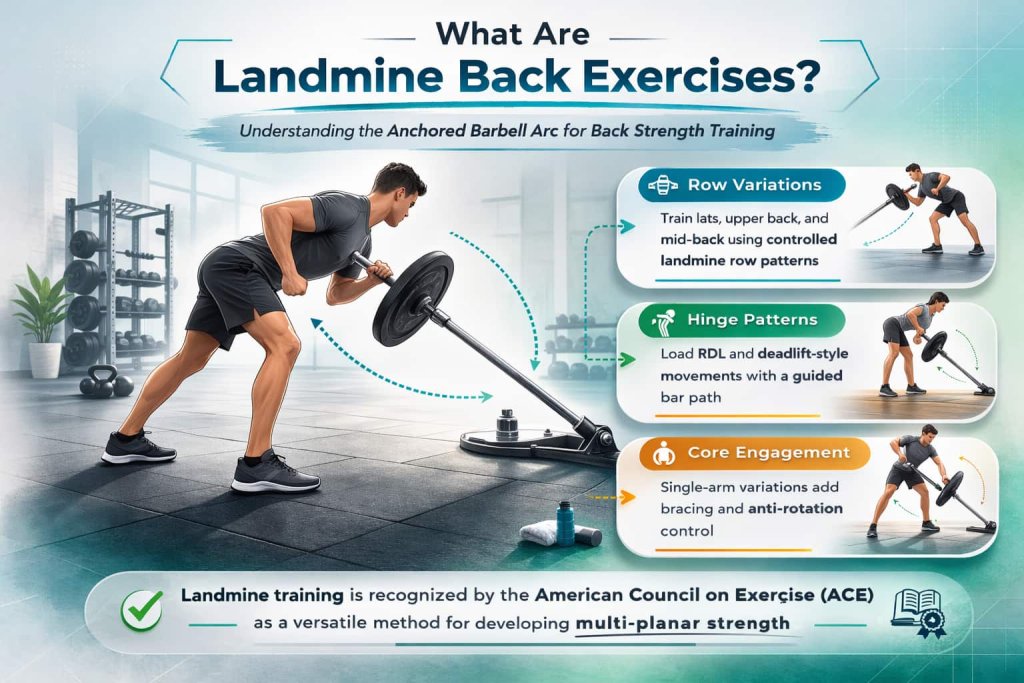
- Train your lats, upper back, and mid-back with row variations
- Load hinge patterns (RDL/deadlift-style) with steady bar path feedback
- Add core bracing and anti-rotation demands, especially with single-arm work
This anchored training style is commonly described by the American Council on Exercise (ACE) as a versatile option for multi-planar strength development.
Why Landmine Back Exercises Are Effective for Building Strength
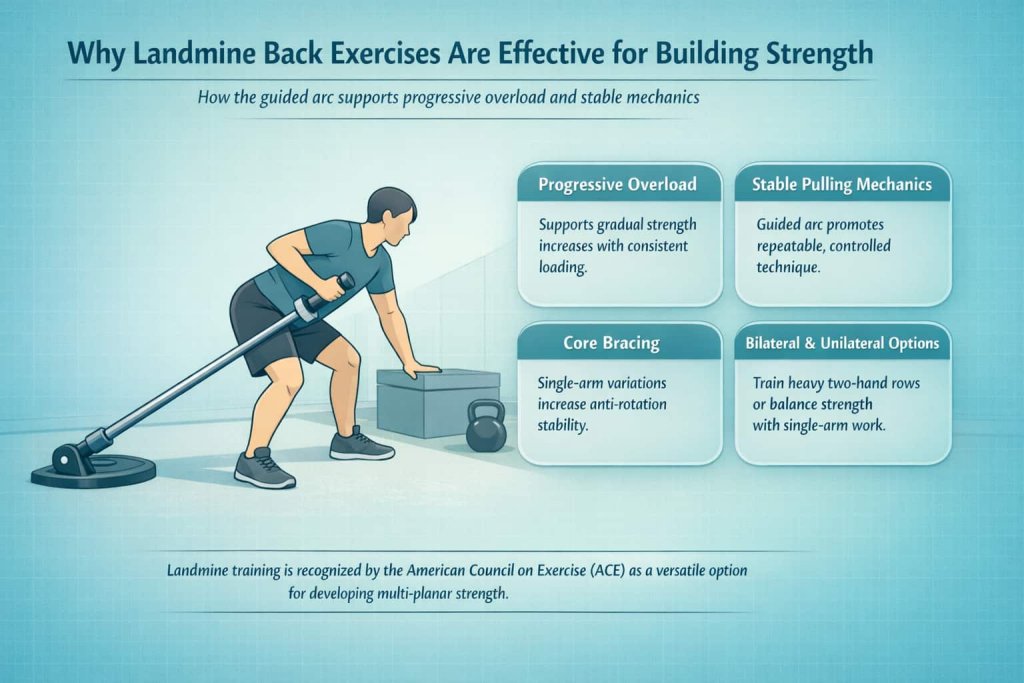
Landmine back exercises allow controlled, progressive loading through a guided arc. This makes it easier to train rows and hinge patterns with stable mechanics while building strength over time. The American Council on Exercise (ACE) recognizes landmine training as a versatile strength option.
Key reasons they’re effective:
- Support progressive overload
- Encourage stable pulling mechanics
- Combine back strength with core bracing
- Allow both bilateral and unilateral training
6 Best Landmine Back Exercises
Build a stronger, more powerful back with these six effective landmine exercises designed to target your lats, mid-back, and posterior chain. Each movement combines controlled loading with stable mechanics to support strength, muscle development, and improved pulling performance.
1) Two-Hand Landmine Row (T-Bar Style)
How to do it:
- Straddle the bar and hinge back with a neutral spine.
- Grip the sleeve or handle attachment and brace your core.
- Row the bar toward your lower ribs or upper stomach.
- Pause briefly, then lower under control without rounding your back.
Why it works:
This is the foundation lift of landmine back training. The stable arc allows you to progressively load the movement while maintaining strong mid-back tension, making it highly effective for building thickness and pulling strength.
Muscles worked:
Lats, rhomboids, mid traps, rear delts, biceps, and forearms all contribute to pulling and stabilizing the load.
Trainer Tip:
Think “elbows to back pockets” to keep the movement lat-driven instead of shrug-dominant.
2) Meadows Row (Single-Arm Landmine Row)
How to do it:
- Stand perpendicular to the bar.
- Stagger your stance and hinge with a neutral spine.
- Grip near the sleeve end and pull the bar toward your hip.
- Lower slowly with control before repeating.
Why it works:
Unilateral pulling improves side-to-side strength balance and challenges trunk control. The angled bar path can feel more natural than some dumbbell row setups.
Muscles worked:
Lats, lower traps, rhomboids, rear delts, biceps, and core stabilizers.
Trainer Tip:
Keep your hips square and avoid opening your torso during the pull.
3) Chest-Supported Landmine Row
How to do it:
- Set an incline bench facing the landmine.
- Lie chest-down with feet firmly planted.
- Grip the sleeve or handles and row toward the bench edge.
- Lower under control without bouncing off the bench.
Why it works:
Chest support reduces momentum and minimizes lower-back involvement, allowing you to isolate the upper back more effectively—especially when fatigue sets in.
Muscles worked:
Mid traps, rhomboids, lats, rear delts, and biceps.
Trainer Tip:
Avoid shrugging at the top; focus on controlled shoulder blade movement instead.
4) Single-Arm Square-Stance Landmine Row
How to do it:
- Face the bar in a square stance with feet shoulder-width apart.
- Grip with one hand and brace your core.
- Row toward your hip while keeping shoulders and hips facing forward.
- Lower slowly without allowing rotation.
Why it works:
This variation adds anti-rotation core demand to traditional rowing, helping improve trunk stability alongside back strength.
Muscles worked:
Lats, mid-back, biceps, obliques, and deep core stabilizers.
Trainer Tip:
If your torso twists, reduce the weight and slow the tempo to regain control.
5) Landmine Romanian Deadlift (RDL)
How to do it:
- Stand facing the sleeve end with feet hip-width apart.
- Push your hips back while keeping your spine neutral.
- Lower the bar along your thighs until you feel a hamstring stretch.
- Drive your hips forward to return to standing.
Why it works:
The landmine RDL strengthens the posterior chain while reinforcing proper hinge mechanics. The anchored bar path provides consistent feedback for controlled movement.
Muscles worked:
Hamstrings, glutes, spinal erectors, upper back (isometric stabilization), and lats.
Trainer Tip:
Keep the bar close to your body throughout the movement to maintain leverage and control.
6) Landmine Deadlift
How to do it:
- Stand close to the sleeve with feet hip-width apart.
- Hinge down and grip the bar securely.
- Push through the floor to stand tall.
- Lower the bar with a controlled hinge before bending the knees.
Why it works:
This beginner-friendly deadlift variation uses a guided arc, which can make it easier to learn pulling mechanics while building lower-body and back strength.
Muscles worked:
Glutes, hamstrings, quads, spinal erectors, lats, and grip.
Trainer Tip:
Keep breathing steady during each rep. The Mayo Clinic advises avoiding breath-holding during heavy effort.
How to Program Landmine Back Exercises
Most people benefit from training major muscle groups at least twice weekly. The American College of Sports Medicine (ACSM) recommends working each major muscle group 2 or more days per week for strength development.
Sample Landmine Back Workout
- Two-hand landmine row: 3–4 sets of 6–10 reps
- Meadows row: 2–3 sets of 8–12 reps per side
- Landmine RDL: 3 sets of 8–12 reps
- Chest-supported row: 2–3 sets of 10–15 reps
Rest 60–120 seconds between sets.
Benefits of Landmine Back Exercises
Landmine back training can be a smart option if you want back-building work without needing a big machine setup.
Key benefits:
- Easy to progressively overload rows for strength and muscle
- Multiple variations from the same station
- Predictable bar path that supports repeatable technique
Common Mistakes and Fixes
- Rounding the lower back
Fix: Reduce load and improve bracing - Shrugging excessively
Fix: Drive elbows back instead - Twisting during single-arm rows
Fix: Slow down and reduce weight - Holding your breath
Fix: Exhale during exertion, as recommended by the Mayo Clinic
Who Should Be Cautious With Landmine Back Exercises?
Landmine back exercises are loaded movements and should be approached carefully if you have an injury or movement limitations. The Mayo Clinic advises prioritizing proper form and stopping if pain worsens.
Be cautious if you have:
- Recent back, shoulder, or hip injury
- Post-surgical lifting restrictions
- Pain that increases during exercise
- Numbness, tingling, or sudden weakness
If unsure, consult a qualified healthcare professional before progressing.
FAQs
Are landmine back exercises good for beginners?
Yes. The guided arc can make technique easier to learn.
Do I need a handle attachment?
No. It improves comfort but is optional.
What’s the best landmine exercise for lats?
Two-hand rows and single-arm rows are typically most effective for lat emphasis.
How often should I train my back?
At least twice weekly is commonly recommended for strength progression.
Can landmine exercises replace machines?
They can provide effective back training without machines, especially when combined with hinge patterns.
How heavy should I lift?
Choose a load that allows controlled reps with proper form.
Conclusion
Landmine back exercises offer a practical, space-efficient way to build a stronger, more powerful back. Focus on one heavy row, one unilateral row, and one hinge pattern each session. Progress gradually, maintain clean form, and train consistently.
References
- Centers for Disease Control and Prevention (CDC) — Adult Physical Activity Guidelines
- Mayo Clinic — Weight Training: Do’s and Don’ts
- National Strength and Conditioning Association (NSCA) — Basics of Strength and Conditioning Manual (PDF)
- ACSM Position Stand on Resistance Training (PubMed)
- Resistance Training Loading Evidence Review (PubMed Central)