
Landmine shoulder exercises are a joint-smart way to build stronger delts and pressing power using a diagonal bar path that’s often easier to control than straight overhead pressing. Understanding the landmine setup matters because small changes in pressing angle, stance, and stability can make shoulder training feel smoother while still letting you progress strength safely.
Landmine work is widely used in strength and conditioning because the anchored barbell makes it easy to scale load, change angles, and train pressing with full-body stability demands, as highlighted by the American Council on Exercise (ACE).
Why landmine shoulder exercises often feel shoulder-friendly
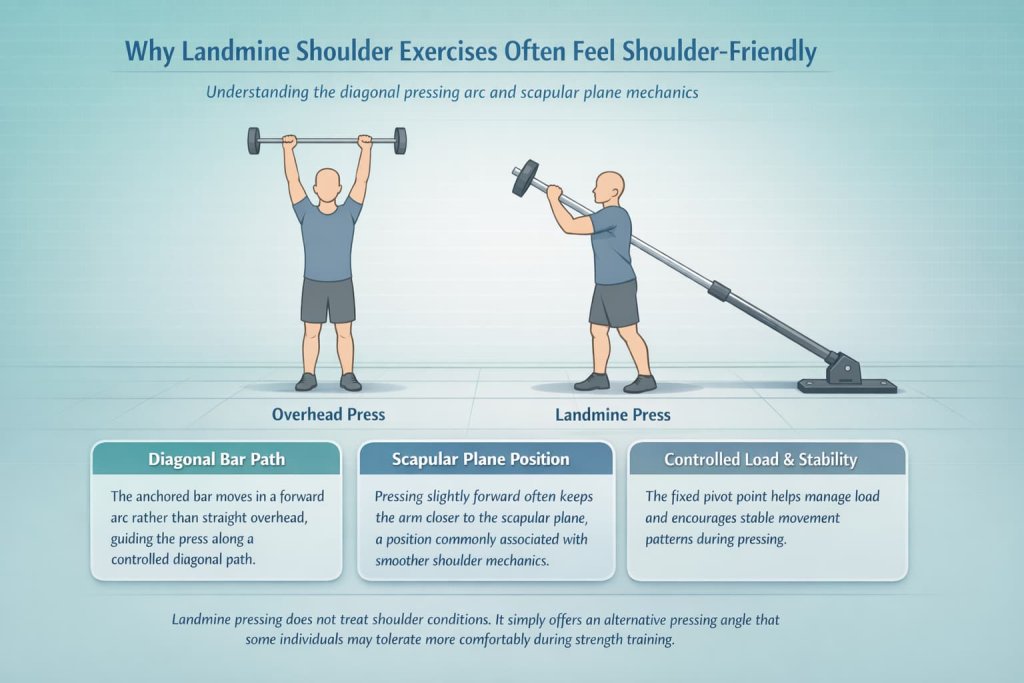
The landmine’s arc encourages pressing slightly forward (rather than straight up), which commonly keeps the arm closer to the scapular plane. Many biomechanics and coaching resources note that scapular-plane arm elevation can support better shoulder mechanics and stability for overhead work, as discussed in the NSCA Strength and Conditioning Journal.
That doesn’t mean landmine training fixes shoulder problems. It simply gives you an angle and loading style that many people can tolerate well while building strength.
What Are Landmine Shoulder Exercises?
Landmine shoulder exercises are pressing movements performed with one end of a barbell anchored to the floor. The free end moves in a diagonal arc instead of straight overhead.
This setup creates a controlled pressing path that combines shoulder strength with core stability.
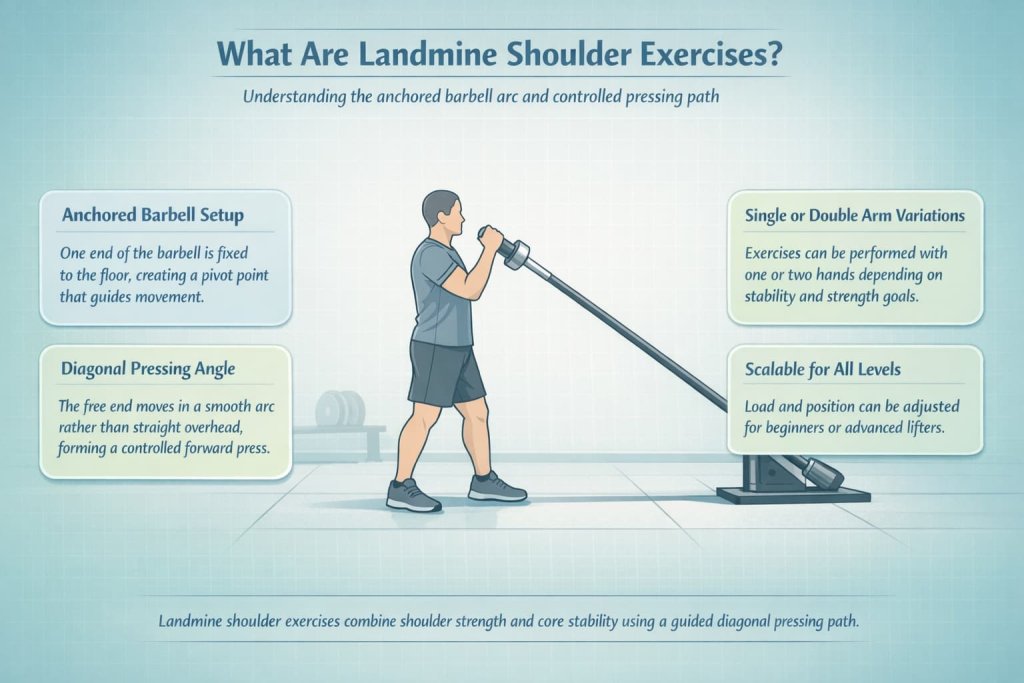
Key characteristics:
- Anchored barbell setup
- Diagonal pressing angle
- Single-arm or two-arm variations
- Scalable for beginners and advanced lifters
8 Best landmine shoulder exercises
These landmine shoulder exercises build pressing strength using a controlled diagonal bar path that many lifters find smoother than strict overhead pressing. Each variation targets the delts while adding core stability and joint-friendly loading options.
1) Half-Kneeling Single-Arm Landmine Press
How to do it:
- Set up in a half-kneeling position with the down knee under your hip
- Hold the bar sleeve at shoulder height with a neutral wrist
- Brace your core and keep ribs stacked over pelvis
- Press up and slightly forward in a smooth arc
- Lower slowly back to shoulder height and repeat
Why it works:
The half-kneeling position limits lower-body momentum and encourages proper torso alignment. It challenges anti-rotation control while allowing you to focus on clean shoulder mechanics and smooth scapular movement.
Muscles worked:
Anterior deltoid, upper chest, triceps, serratus anterior, and deep core stabilizers.
Trainer Tip:
If your low back arches, gently bring your ribs down and squeeze the glute on the kneeling side before pressing.
2) Standing Single-Arm Landmine Press
How to do it:
- Stand facing the bar with feet hip-width apart
- Hold the sleeve at shoulder height with elbow slightly in front
- Brace your core and press up-and-forward
- Lower under control to the starting position
Why it works:
This variation blends shoulder strength with anti-rotation core stability. Standing increases balance demands and builds pressing strength that transfers well to real-world movement.
Muscles worked:
Deltoids, triceps, upper chest, serratus anterior, and obliques.
Trainer Tip:
Think about gently “reaching” at the top without shrugging to encourage natural shoulder blade movement.
3) Two-Arm Landmine Press
How to do it:
- Hold the bar sleeve with both hands at chest height
- Brace your torso and keep elbows slightly tucked
- Press up-and-forward to near full extension
- Lower slowly with control
Why it works:
Using two hands increases stability and allows you to lift heavier loads safely. It’s excellent for building foundational pressing strength.
Muscles worked:
Deltoids, triceps, upper chest, and serratus anterior.
Trainer Tip:
Use this variation on heavier training days when single-arm versions feel unstable.
4) Tall-Kneeling Landmine Press
How to do it:
- Kneel tall with both knees on the floor
- Engage glutes lightly and brace your core
- Press the bar up-and-forward
- Lower with steady control
Why it works:
Tall-kneeling promotes stacked posture and minimizes lower-body compensation. It reinforces core engagement while training shoulder strength.
Muscles worked:
Deltoids, triceps, serratus anterior, and deep core stabilizers.
Trainer Tip:
If your hips drift backward or you feel unstable, reduce the load and focus on posture.
5) Landmine Push Press
How to do it:
- Start with the bar at shoulder height
- Perform a small, controlled dip by bending the knees
- Drive through the floor and press up-and-forward
- Reset at shoulder height before the next rep
Why it works:
The push press adds controlled leg drive, allowing you to train power and move slightly heavier loads while still following the landmine’s joint-friendly arc.
Muscles worked:
Deltoids, triceps, glutes, quadriceps, and core.
Trainer Tip:
Keep the dip shallow and vertical. Avoid leaning forward during the drive.
6) Rotational Landmine Press
How to do it:
- Begin slightly rotated away from the bar
- Rotate through your hips and torso as you press
- Finish tall with control
- Return smoothly to the start position
Why it works:
This variation integrates shoulder pressing with controlled trunk rotation, improving coordinated strength and athletic movement patterns.
Muscles worked:
Deltoids, triceps, serratus anterior, obliques, and hips.
Trainer Tip:
Keep the motion controlled rather than explosive to maintain shoulder stability.
7) Landmine Lateral Raise to Press
How to do it:
- Hold the sleeve near your hip
- Lift the bar slightly outward to shoulder height
- Transition into a press up-and-forward
- Lower slowly along the same path
Why it works:
Combining a raise with a press increases time under tension for the delts while maintaining the landmine’s smooth arc.
Muscles worked:
Medial deltoid, anterior deltoid, and serratus anterior.
Trainer Tip:
Keep the raise controlled and avoid turning it into a shrug.
8) Landmine Press Plus (Reach at the Top)
How to do it:
- Perform a standard single-arm landmine press
- At the top, add a small forward reach
- Hold briefly without shrugging
- Lower under control
Why it works:
The added reach encourages serratus anterior engagement and supports upward rotation control, a concept discussed in shoulder mechanics education from the American Council on Exercise (ACE).
Muscles worked:
Deltoids, triceps, serratus anterior, and lower trapezius.
Trainer Tip:
If you feel excessive shoulder shrugging, skip the reach and focus on clean pressing mechanics first.
How to program landmine shoulder exercises
Basic template:
- Main press: 3–5 sets of 5–8 reps
- Secondary press: 3 sets of 8–12 reps
- Stability finisher: 2–3 sets of 10–15 reps
If rebuilding shoulder capacity, pairing pressing with rotator cuff and scapular strengthening is commonly recommended in rehab-style education resources like the Massachusetts General Hospital shoulder home program.
Before you start
If you have a recent shoulder injury, post-surgery restrictions, or persistent pain, use a clinician-approved plan first. The American Academy of Orthopaedic Surgeons (AAOS) shoulder conditioning program emphasizes that exercise selection and progression should be appropriate for your situation.
Smart form rules for all landmine presses:
- Keep ribs stacked over pelvis (avoid big low-back arch)
- Press in a smooth up-and-forward arc
- Keep neck long and shoulders away from ears
- Use a pain-free range and stop if symptoms worsen
Landmine setup and equipment basics
You’ll need:
- A barbell anchored in a landmine base (or a secure corner setup)
- Plates
- Optional: a neutral-grip handle attachment
Quick setup cues:
- Set the bar sleeve at shoulder height
- Stand or kneel far enough back so the bar angles upward and forward
- Use controlled reps before adding load
How to Set Up a Landmine Safely
A stable setup is essential for safety and performance.
Two common options:
- Landmine attachment (most stable and recommended)
- Corner setup with padding to protect walls
Safety checklist:
- Ensure the anchor does not slide
- Secure plates with collars
- Start light to test stability
- Follow the diagonal bar path
- Stop if the setup shifts
Never press if the base feels unstable.
Common Mistakes That Reduce Shoulder Comfort
Small technique errors can reduce shoulder comfort.
Common mistakes:
- Over-arching the lower back
- Excessive shrugging at the top
- Elbows flaring too wide
- Using too much weight too soon
- Unstable anchor setup
Focus on controlled tempo, smooth pressing, and proper alignment over heavier loads.
Who Should Use Landmine Shoulder Exercises?
Landmine shoulder exercises are useful for:
- Beginners learning pressing mechanics
- Lifters wanting variety from overhead presses
- Athletes training rotational strength
- Individuals rebuilding pressing capacity
- Those seeking more controlled shoulder loading
If you have a recent injury or surgery, consult a qualified healthcare professional before starting.
Do landmine presses build delts effectively?
Yes. Pressing patterns meaningfully activate the deltoids, as summarized in research available through PubMed Central (PMC). Landmine variations adjust angle and stability demand, which can make training feel smoother for some individuals.
FAQs
Are landmine shoulder exercises good for beginners?
Yes. Two-arm and half-kneeling versions are especially beginner-friendly.
Can I replace overhead press with landmine press?
Often, yes—especially if you prefer a diagonal pressing angle.
How heavy should I go?
Start with a weight you can control for 8–12 reps and progress gradually.
How many days per week?
1–3 sessions per week depending on total volume.
What if I feel pain?
Stop and adjust load or range. Follow clinician guidance if symptoms persist.
Do I need a landmine attachment?
Helpful but not mandatory. Stability is the priority.
Single-arm or two-arm?
Two-arm for heavier strength; single-arm for stability and imbalance work.
Conclusion
Landmine shoulder exercises provide a controlled, diagonal pressing path that many people find comfortable and effective. Choose one main press, add a secondary variation, and finish with a stability-focused option to build stronger, more resilient shoulders over time.