
Pilates ring exercises are low-impact resistance movements that use a flexible ring (often called a Magic Circle) to help activate the core, arms, legs, and inner thighs at the same time.
They’re popular because they add gentle resistance, improve body awareness, and make classic Pilates moves more effective without heavy equipment.
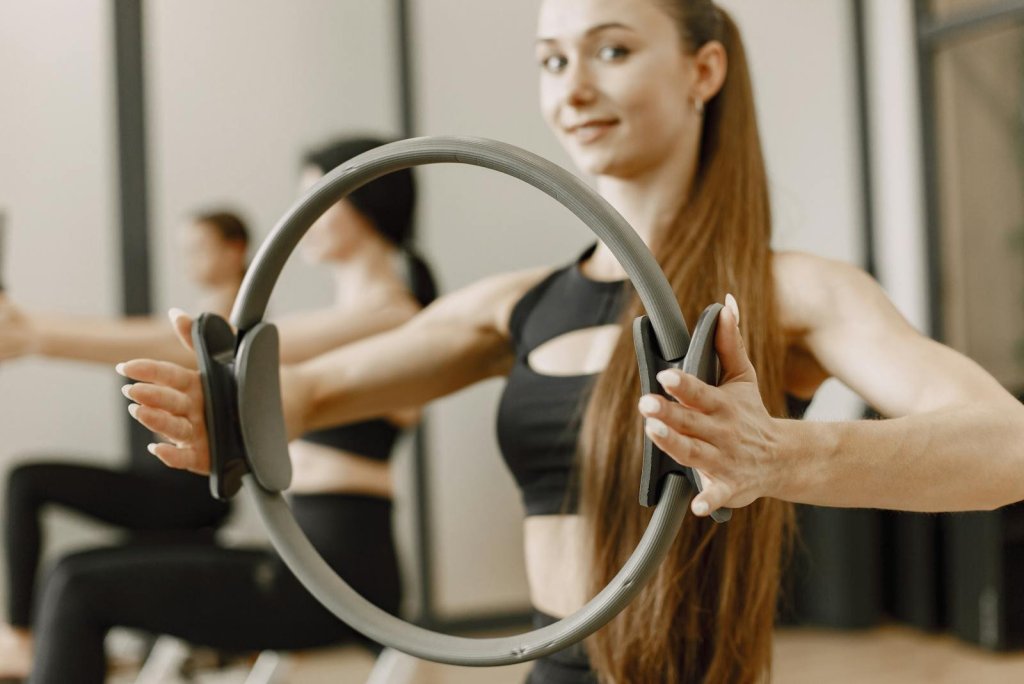
Understanding how Pilates ring exercises work is important if you want better muscle engagement, improved posture, and balanced strength—especially when training at home. Below, you’ll find the best exercises, how to do them safely, and how to use a Pilates ring effectively for full-body toning and core strength.
What Are Pilates Ring Exercises?
Pilates ring exercises are mat-based or seated movements performed using a flexible resistance ring held between the hands, thighs, ankles, or knees. The ring provides constant feedback, encouraging controlled muscle activation rather than momentum.
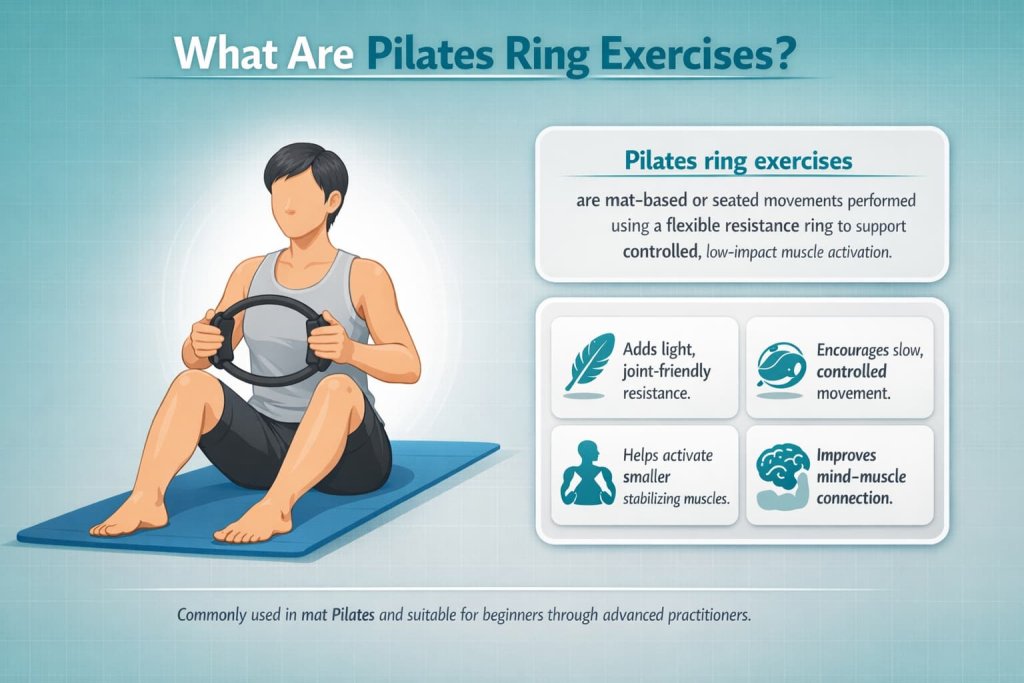
Unlike traditional weights, a Pilates ring:
- Adds light, joint-friendly resistance
- Encourages slow, controlled movement
- Helps activate smaller stabilizing muscles
- Improves mind-muscle connection
These exercises are commonly used in mat Pilates classes and are suitable for beginners through advanced practitioners.
Why Pilates Ring Exercises Are Effective
Well-designed Pilates ring exercises may help support:
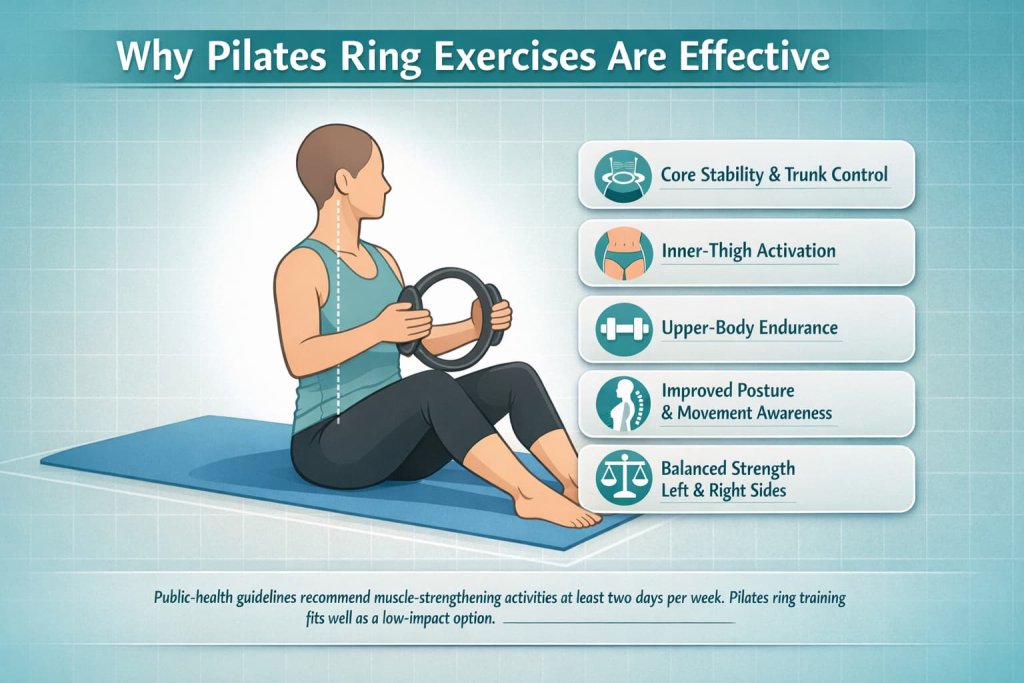
- Core stability and trunk control
- Inner-thigh (adductor) activation
- Upper-body endurance without heavy loads
- Improved posture and movement awareness
- Balanced strength between the left and right sides
Public-health guidance from organizations such as the Centers for Disease Control and Prevention and the World Health Organization recommends regular muscle-strengthening activities at least two days per week. Pilates ring training fits well into these recommendations as a low-impact strength option.
8 Best Pilates Ring Exercises for Full-Body Toning
Pilates ring exercises add gentle resistance to classic movements, helping improve muscle engagement, control, and alignment. These exercises focus on full-body toning by activating the core, inner thighs, arms, and glutes in a low-impact, joint-friendly way.
1. Pilates Ring Chest Press
Targets the chest, shoulders, arms, and core.
How to do it
- Sit tall or lie on your back with knees bent
- Hold the Pilates ring between your palms at chest height
- Gently press the ring inward while keeping shoulders relaxed
- Release slowly with full control
Why it works
The chest press uses isometric resistance to activate the upper body while encouraging proper shoulder positioning. Because the ring provides constant feedback, it promotes controlled strength rather than momentum.
Muscles worked
This exercise primarily engages the pectorals, anterior deltoids, triceps, and deep core stabilizers that help maintain posture during the press.
Trainer Tip
Think “soft shoulders and long neck.” If your shoulders creep up, reduce pressure and focus on control.
2. Inner Thigh Squeeze
Focuses on inner thighs and pelvic stability.
How to do it
- Lie on your back with knees bent and feet flat
- Place the ring between your inner thighs
- Exhale and gently squeeze the ring
- Inhale and release without fully relaxing
Why it works
The inner thigh squeeze activates the adductors while supporting pelvic alignment. The slow squeeze-and-release pattern encourages endurance and neuromuscular control.
Muscles worked
Adductor muscles, pelvic floor support muscles, and deep abdominal stabilizers work together during this movement.
Trainer Tip
Avoid squeezing at maximum effort—aim for about 60–70% pressure for better muscle control.
3. Pilates Ring Bridge
Strengthens glutes, hamstrings, and core.
How to do it
- Lie on your back with the ring between your thighs
- Press lightly into the ring
- Lift hips into a bridge position
- Lower slowly with control
Why it works
Adding the ring to a bridge improves lower-body alignment and increases glute activation while preventing knees from drifting outward.
Muscles worked
Gluteus maximus, hamstrings, inner thighs, and spinal stabilizers are all engaged.
Trainer Tip
Keep ribs down and avoid arching your lower back at the top of the bridge.
4. Seated Ring Overhead Press
Engages shoulders, arms, and deep core muscles.
How to do it
- Sit tall with legs crossed or extended
- Hold the ring overhead with soft elbows
- Gently press inward on the ring
- Maintain upright posture throughout
Why it works
This movement challenges shoulder endurance while requiring core engagement to prevent spinal arching, improving postural strength.
Muscles worked
Deltoids, triceps, upper back stabilizers, and deep abdominal muscles.
Trainer Tip
If you feel tension in your neck, lower the ring slightly and refocus on posture.
5. Side-Lying Inner Thigh Lift
Targets adductors and hip stabilizers.
How to do it
- Lie on your side with the ring between your ankles
- Gently squeeze the ring
- Lift both legs slightly off the mat
- Lower with slow control
Why it works
This exercise isolates the inner thighs while challenging lateral hip stability, which is often undertrained.
Muscles worked
Inner thighs, gluteus medius, and core stabilizers supporting side-lying balance.
Trainer Tip
Keep your torso completely still—movement should come only from the legs.
6. Standing Ring Squat
Works glutes, thighs, and core balance.
How to do it
- Stand with feet hip-width apart
- Place the ring between your thighs
- Lightly squeeze as you squat down
- Return to standing with control
Why it works
The ring helps maintain proper knee alignment while increasing inner-thigh and glute activation during squatting.
Muscles worked
Quadriceps, glutes, hamstrings, adductors, and core stabilizers.
Trainer Tip
Keep weight evenly distributed through your feet, not just the toes.
7. Arm Circles With Ring
Builds shoulder endurance and control.
How to do it
- Hold the ring straight out in front of you
- Apply light inward pressure
- Draw small controlled circles
- Keep neck and shoulders relaxed
Why it works
This exercise strengthens the shoulders isometrically while improving joint stability and control.
Muscles worked
Deltoids, rotator cuff muscles, upper chest, and upper back stabilizers.
Trainer Tip
Smaller circles are more effective than larger, faster movements.
8. Pilates Ring Roll-Down
Improves spinal control and core engagement.
How to do it
- Sit tall holding the ring in front of you
- Slowly roll down one vertebra at a time
- Press lightly into the ring for control
- Roll back up with precision
Why it works
The roll-down reinforces spinal articulation while the ring encourages controlled abdominal engagement.
Muscles worked
Abdominals, spinal stabilizers, hip flexors, and upper-body postural muscles.
Trainer Tip
Move slowly—this exercise is about control, not range.
How to Choose the Right Pilates Ring
Before starting Pilates ring exercises, choose a ring that matches your comfort and strength level:
- Size: Most rings are 12–14 inches in diameter
- Resistance: Light to moderate tension is ideal for control
- Pads: Padded handles improve grip and comfort
A ring that’s too stiff can encourage excessive squeezing, while a very soft ring may not provide enough feedback.
Common Mistakes to Avoid
- Over-squeezing the ring instead of moving with control
- Shrugging shoulders during upper-body exercises
- Holding breath during effort
- Rushing through movements
Pilates ring exercises work best with slow, intentional motion.
Who Should Try Pilates Ring Exercises?
Pilates ring exercises may be suitable for:
- Beginners new to strength training
- Adults seeking low-impact workouts
- People working on posture and body awareness
- Home exercisers with limited space
Those with ongoing pain, recent surgery, or pregnancy should consult a qualified professional before starting.
Frequently Asked Questions
Are Pilates ring exercises good for beginners?
Yes. The resistance is light and adjustable, making them beginner-friendly when performed with proper technique.
How often should I do Pilates ring exercises?
Most people benefit from 2–4 sessions per week, depending on overall activity level.
Can Pilates ring exercises build muscle?
They support muscular endurance and tone rather than maximal muscle size.
Do Pilates rings help with core strength?
Yes. The ring encourages constant core engagement during movement.
Are Pilates rings safe for joint health?
When used correctly, they are considered low-impact and joint-friendly.
Can I use a Pilates ring at home?
Absolutely. Pilates rings are lightweight, portable, and ideal for home workouts.
Conclusion
Pilates ring exercises are a simple yet effective way to add resistance, improve control, and enhance full-body toning without heavy equipment. By focusing on slow, controlled movement and proper alignment, you can build core strength, improve posture, and support long-term movement quality.
If you’re looking for a low-impact, space-saving workout tool, Pilates ring exercises are a practical and accessible option to include in your weekly routine.
References
- ACSM: Physical Activity Guidelines and Recommendations
- ACOG (2020): Physical Activity and Exercise During Pregnancy and the Postpartum Period
- Barker et al. (2015) PubMed: Pilates and Balance in Older Adults (Systematic Review/Meta-analysis)
- Franks et al. (2023) PMC: Pilates and Core Muscle Activation (Review)