
The TRX row is a suspension-training pulling exercise that helps build back strength, upper-body control, and core stability when you keep your body in a straight line and pull with control.
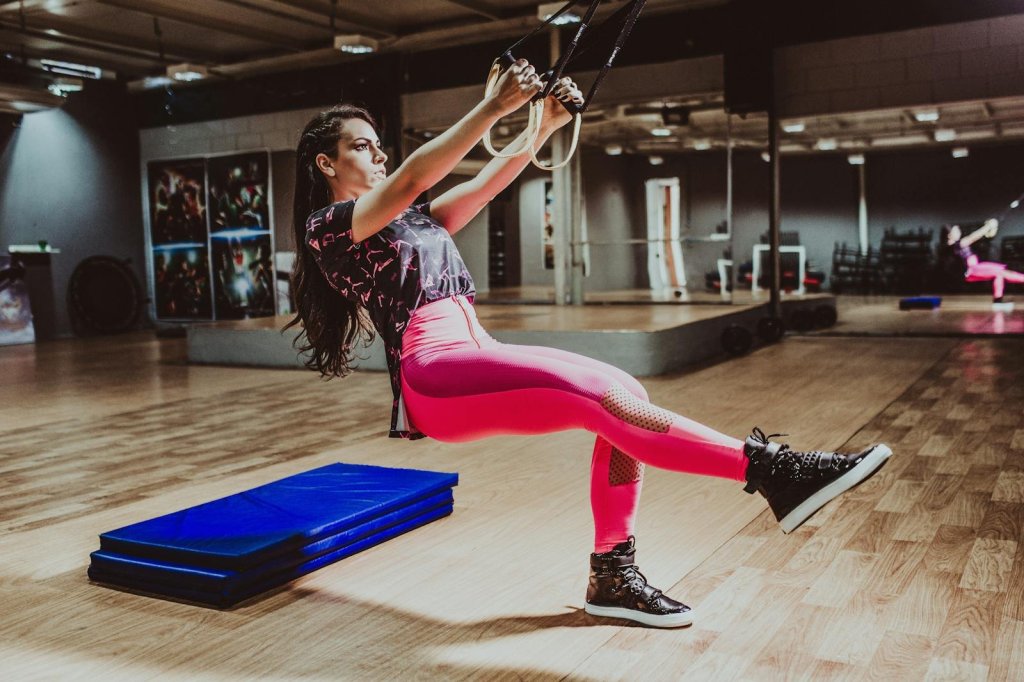
It is worth learning because it is easy to scale for beginners, useful for home or gym training, and fits well into a balanced strength routine that includes regular pulling work.
What Is the TRX Row?
The TRX row is a bodyweight row done with suspension straps anchored overhead. You lean back while holding the handles, keep tension through the straps, and pull your chest toward your hands. TRX Training describes the inverted row as a highly effective back exercise that targets the latissimus dorsi and other supporting muscles while also serving as a useful pulling movement for building upper-body strength.
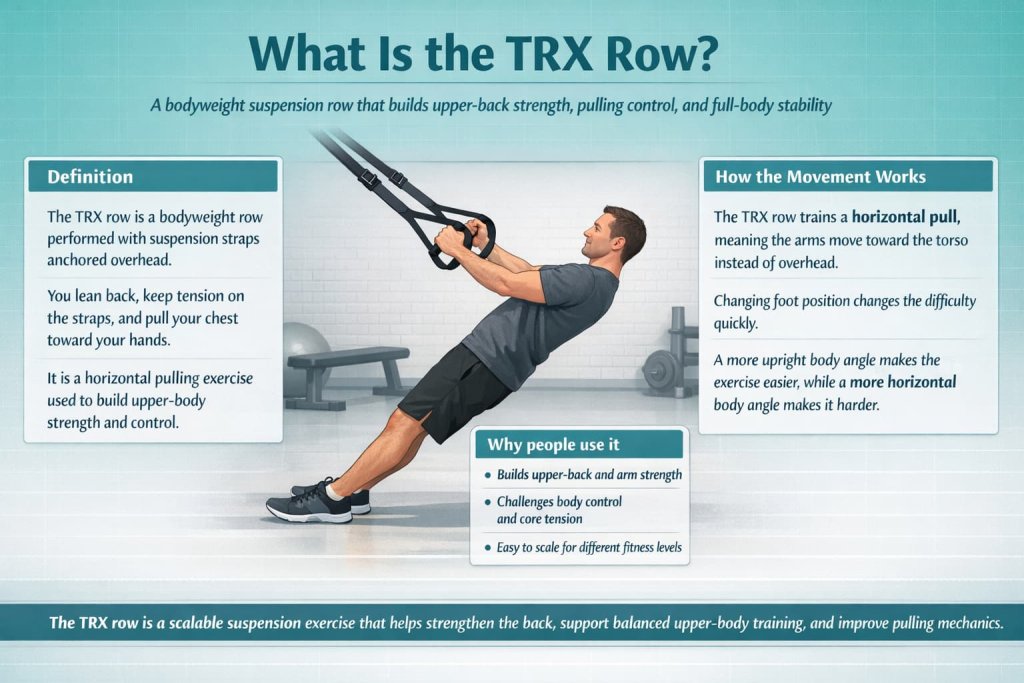
In simple terms, the TRX row is a horizontal pull. That means it trains the muscles used to pull your arms toward your torso, which can help balance out pressing-heavy routines. It is also one of the easiest row variations to adjust because moving your feet changes the difficulty right away. This scalability is a big reason suspension training remains popular in both home and professional settings.
How to Do the TRX Row Correctly
Setup
Start by adjusting the straps to a comfortable rowing length, then stand facing the anchor point with one handle in each hand. Walk your feet forward, lean back, and keep your body in one straight line from head to heels. The more horizontal your body is, the harder the exercise becomes. Guidance from the National Academy of Sports Medicine supports this general setup pattern and notes that a more horizontal position increases difficulty.
Step-by-Step TRX Row Form
- Hold the handles with your palms facing each other.
- Lean back until the straps are tight.
- Keep your body straight, glutes lightly engaged, and core braced.
- Start with arms extended and shoulders set down and back.
- Pull your chest toward the handles by driving your elbows back.
- Pause briefly at the top without shrugging.
- Lower yourself slowly until the arms are straight again.
- Repeat for controlled reps.
A useful coaching cue is to think about pulling your shoulder blades back and down without letting the chest collapse or the hips sag. TRX Training also emphasizes maintaining a plank-like body position and controlling the top position during row progressions.
Muscles Worked in the TRX Row
The main muscles worked in the TRX row include:
- Latissimus dorsi
- Rhomboids
- Middle trapezius
- Rear deltoids
- Biceps
- Forearm grip muscles
- Core stabilizers
TRX Training specifically notes that the inverted row engages the latissimus dorsi and other supporting muscles. Because the body stays suspended and braced during the rep, the trunk also has to work to keep the ribs, hips, and shoulders aligned.
TRX Row Variations and Alternatives
These exercises change the angle, support level, or stability demand of the row to target your back in slightly different ways. They can help you match the movement to your strength level, training goal, and available equipment
1. TRX High Row
Why it works:
The TRX high row changes the pulling angle by bringing the elbows out higher and wider than in a standard TRX row. That shift usually increases the training demand on the upper back, especially the muscles that help control the shoulder blades and support the rear shoulders. It can be a smart variation if you want more upper-back emphasis instead of making the lats do most of the work.
Muscles worked:
The TRX high row mainly works the rear deltoids, rhomboids, middle trapezius, and biceps, while the core and glutes help keep the body aligned throughout the movement.
How to do it:
- Hold the TRX handles and lean back with your body in a straight line.
- Start with your arms extended and palms facing inward or slightly down.
- Pull your body upward while driving the elbows out and back.
- Aim to bring the hands closer to the sides of the face or upper chest.
- Pause briefly at the top with the shoulders controlled.
- Lower yourself slowly back to the starting position.
Trainer Tip:
Do not shrug your shoulders as you pull. Think about spreading the chest and moving the shoulder blades back with control.
2. TRX Single-Arm Row
Why it works:
The TRX single-arm row adds a bigger stability challenge because one side of the body has to resist rotation while the working arm pulls. This makes it useful for improving unilateral strength, side-to-side control, and trunk stiffness. It can also help highlight strength or control differences between the left and right sides.
Muscles worked:
This version trains the lats, rhomboids, middle traps, rear delts, and biceps on the working side, while the obliques, deep core muscles, and glutes work harder to resist twisting.
How to do it:
- Hold one TRX handle with one hand and square your body to the anchor point.
- Lean back with your feet planted and your body in a straight line.
- Keep the free arm relaxed or slightly out for balance.
- Pull your chest toward the working hand without letting the torso rotate.
- Pause briefly when the elbow comes back.
- Lower slowly until the arm is fully extended again.
- Complete all reps on one side, then switch sides.
Trainer Tip:
Keep your hips and shoulders as level as possible. If your body twists too much, make the angle easier and rebuild control first.
3. Inverted Row on a Bar
Why it works:
The inverted row on a bar gives you a similar bodyweight horizontal pulling pattern but with a more stable setup than suspension straps. That extra stability can make it easier to focus on clean pulling mechanics and consistent rep quality. It is a strong alternative for people who want a bodyweight row without the extra instability of TRX straps.
Muscles worked:
This exercise mainly works the lats, rhomboids, middle trapezius, rear deltoids, and biceps, with the core and glutes helping keep the body rigid.
How to do it:
- Set a bar at a height that lets you hang underneath it with straight arms.
- Lie under the bar and grip it slightly wider than shoulder width.
- Keep your body straight from head to heels.
- Pull your chest toward the bar by driving the elbows down and back.
- Pause briefly at the top.
- Lower yourself under control until the arms are straight again.
Trainer Tip:
Keep your ribs down and do not let your hips sag. The more rigid your body line is, the cleaner the rep will feel.
4. Seated Cable Row
Why it works:
The seated cable row offers a more supported and stable environment than the TRX row. Because you are seated and pulling against a guided cable path, it is often easier to learn basic rowing mechanics without worrying as much about full-body balance. It is a practical option for beginners or anyone who wants steady resistance through the full range of motion.
Muscles worked:
The seated cable row trains the lats, rhomboids, middle traps, rear delts, and biceps, while the trunk helps maintain posture during the pull.
How to do it:
- Sit at a cable row station with your feet braced on the platform.
- Grab the handle and sit tall with your arms extended.
- Keep your chest up and shoulders controlled.
- Pull the handle toward your midsection by driving the elbows back.
- Squeeze briefly at the end of the pull.
- Return the handle slowly without rounding the upper body forward.
Trainer Tip:
Do not turn the exercise into a full-body swing. Keep the movement controlled and let the back do the work instead of using momentum.
5. Chest-Supported Row
Why it works:
The chest-supported row reduces the need for whole-body stabilization by supporting the torso on a bench or pad. That makes it easier to focus directly on upper-back training with less demand on the lower back and hips. It is a useful alternative if you want rowing volume without asking as much from posture or trunk control.
Muscles worked:
This variation mainly targets the rhomboids, middle trapezius, lats, rear deltoids, and biceps, with less support demand from the core compared with unsupported row variations.
How to do it:
- Set an incline bench and lie face down with your chest supported.
- Hold a dumbbell in each hand or use the available machine handles.
- Start with the arms hanging straight down.
- Pull the weights upward by driving the elbows back.
- Pause briefly when your upper arms reach your torso.
- Lower the weights slowly to the start position.
Trainer Tip:
Let the shoulder blades move naturally, but do not jam the neck upward. Keep your head neutral and focus on a smooth pull with full control.
Why the TRX Row Matters for Back Strength and Posture
A good pulling exercise can strengthen the muscles that help support the upper back and shoulder blades. TRX Training notes that TRX rows are great for building the back, hips, and overall posture. That does not mean the move alone will fix posture, but it can support better shoulder positioning and upper-body balance when paired with smart programming and daily movement habits.
The bigger picture matters too. The CDC says adults should do muscle-strengthening activity at least 2 days per week and work all major muscle groups, including the back, shoulders, chest, arms, abdomen, hips, and legs. A TRX row can be one practical way to cover part of that back-and-arms work.
Best Form Tips for Better Results
Use these form cues to make the exercise cleaner and safer:
- Keep the ribs down instead of flaring the chest too much.
- Do not let the lower back arch.
- Keep wrists neutral and grip the handles evenly.
- Pull with the back and arms together, not just the biceps.
- Lower under control instead of dropping quickly.
- Stop the set if the shoulders roll forward or the hips start sagging.
These details matter because suspension training depends on body position. Small changes in line, tension, and tempo can change the quality of the rep a lot more than people expect.
Common TRX Row Mistakes
Using momentum
Swinging or jerking through the rep reduces tension on the back and can make the movement less effective. A smooth pull and slow return usually work better.
Letting the hips drop
The TRX row is not just an arm exercise. If your hips sag, you lose body tension and the rep becomes sloppy.
Shrugging the shoulders
Lifting the shoulders toward the ears can shift the work away from a clean back-focused pull. Keep the neck relaxed and shoulders controlled.
Pulling the handles too high
For most people, pulling toward the rib cage or lower chest works better than yanking the handles up near the face unless you are intentionally doing a higher row variation.
Choosing an angle that is too hard
If you cannot keep a straight body line, walk your feet back and make the exercise easier. Proper form matters more than forcing a steep angle. NASM’s row guidance supports progressing difficulty by changing body position rather than sacrificing technique.
TRX Row Benefits
Builds upper-back strength
The TRX row directly trains key pulling muscles in the back and arms. That makes it useful for general strength, exercise balance, and pulling skill development.
Trains the core at the same time
Because you are suspended and leaning back, the trunk has to stay organized throughout the rep. That means the exercise can challenge bracing and body control in addition to back strength. The American Council on Exercise notes that suspension training can help develop core stability and functional strength.
Easy to scale
One of the best things about the TRX row is how easy it is to adjust. Stand more upright to make it easier. Walk your feet forward and lean back more to make it harder. This flexibility makes it beginner-friendly and still useful for experienced lifters.
Useful for home workouts
A suspension trainer takes up very little space. That makes the TRX row a practical option for people who do not have access to a full cable machine or row station.
Fits well into general health guidelines
Both the World Health Organization and the CDC recommend muscle-strengthening work involving major muscle groups at least 2 days per week for adults. The TRX row can be part of that plan, especially in simple full-body programs.
Who Should Try the TRX Row?
The TRX row can be a good fit for:
- Beginners who need a scalable pulling exercise
- People training at home
- Lifters who want more upper-back work
- Athletes who want better body control
- People looking for a joint-friendly bodyweight row option
It can also be a helpful alternative when traditional bent-over rows are uncomfortable, since the body position is more supported and there is less spinal loading than with many free-weight row variations. That is a training comparison based on movement mechanics, not a medical claim.
Who Should Use Caution?
Use caution or get guidance from a qualified professional if you have:
- Current shoulder pain
- Recent elbow, wrist, or hand injuries
- Trouble gripping the handles
- Balance limitations that make leaning back unsafe
- Symptoms that worsen during pulling exercises
If pain is sharp, radiating, or persistent, stop and get individual advice. Exercise form articles cannot replace personalized medical care.
How to Make the TRX Row Easier
To regress the TRX row:
- Stand more upright
- Bend the knees slightly
- Reduce the range of motion
- Slow the movement down and focus on control
- Use fewer reps per set
These changes reduce the load while still letting you practice the pattern.
How to Make the TRX Row Harder
To progress the TRX row:
- Walk the feet farther forward
- Keep the body closer to horizontal
- Add a pause at the top
- Slow the lowering phase
- Elevate the feet
- Try a single-arm-assisted variation
TRX Training’s progression guidance also notes that grip changes, top-position holds, and foot elevation can increase difficulty.
Sample Beginner TRX Row Workout
Here is one simple way to use the TRX row in a beginner routine:
Option 1: Full-body day
- TRX row: 2 to 4 sets of 8 to 12 reps
- Push-up or incline push-up: 2 to 4 sets of 6 to 12 reps
- Bodyweight squat: 2 to 4 sets of 10 to 15 reps
- Hip hinge or glute bridge: 2 to 4 sets of 10 to 15 reps
- Plank: 2 to 3 rounds
Option 2: Upper-body focus
- TRX row: 3 sets of 8 to 12 reps
- Shoulder-friendly press variation: 3 sets
- Rear-delt or upper-back accessory: 2 to 3 sets
- Biceps curls: 2 to 3 sets
The American Council on Exercise has also reported on suspension-training research showing meaningful improvements in muscular fitness and some cardiometabolic markers after an eight-week program. That does not mean every TRX row session will produce the same results, but it supports suspension training as a legitimate part of a broader fitness plan.
TRX Row vs Inverted Row
The TRX row is a type of inverted row, but people often use the terms a little differently. In many gyms, inverted row can mean a fixed-bar bodyweight row, while TRX row usually means the suspension-strap version.
The main differences are stability and setup:
- A TRX row is less stable and asks for more control
- A fixed-bar inverted row often feels more locked in
- TRX rows are easier to adjust quickly by foot position and strap angle
- Both train similar pulling muscles
FAQs
Is the TRX row good for beginners?
Yes. It is one of the better beginner row options because you can stand more upright and reduce the difficulty without changing equipment.
Does the TRX row help posture?
It may help support better posture by strengthening the upper back and shoulder-supporting muscles, but it is not a stand-alone fix. Daily habits, total training balance, and mobility also matter.
What muscles does the TRX row work most?
It mainly works the lats, rhomboids, middle traps, rear delts, biceps, and core stabilizers.
How many reps should I do for TRX rows?
A common starting range is 8 to 12 controlled reps for 2 to 4 sets. Beginners can start lower and focus on clean form first.
Is the TRX row better than a seated cable row?
Not necessarily better, just different. The TRX row adds more body-control demand, while the seated cable row gives a more stable setup and easier load adjustment.
Can I do TRX rows every day?
Most people do better with 2 to 4 weekly exposures rather than hard daily sets, especially if the exercise is challenging. Recovery still matters.
What is the biggest mistake in the TRX row?
Usually it is losing body alignment. When the hips sag or the shoulders shrug, the rep gets messy fast.
Conclusion
The TRX row is a simple but very effective pulling exercise for building back strength, improving upper-body balance, and adding scalable resistance training to your routine. It works well for beginners, still challenges advanced exercisers, and fits neatly into current guidance for regular muscle-strengthening activity. Focus on a straight body line, smooth control, and a difficulty level you can actually own. Then build from there. For the best results, add the TRX row to a balanced weekly program with both pushing and pulling work.
References
- TRX Training — Exercise Tutorial: How to Do a TRX Inverted Row
- TRX Training — 9 Ways to Progress a Row
- American Council on Exercise — ACE Sponsored Research: Investigating the Acute and Chronic Health Benefits of TRX Suspension Training
- PubMed Central — TRX Suspension Training: A New Functional Training Approach for Older Adults