
TRX ab exercises are suspension-based core movements that use your body weight and instability to strengthen the entire core, not just the abs. Because your feet or hands are suspended, your core must work continuously to maintain alignment and control, which makes these exercises especially effective for building core strength, stability, and definition.
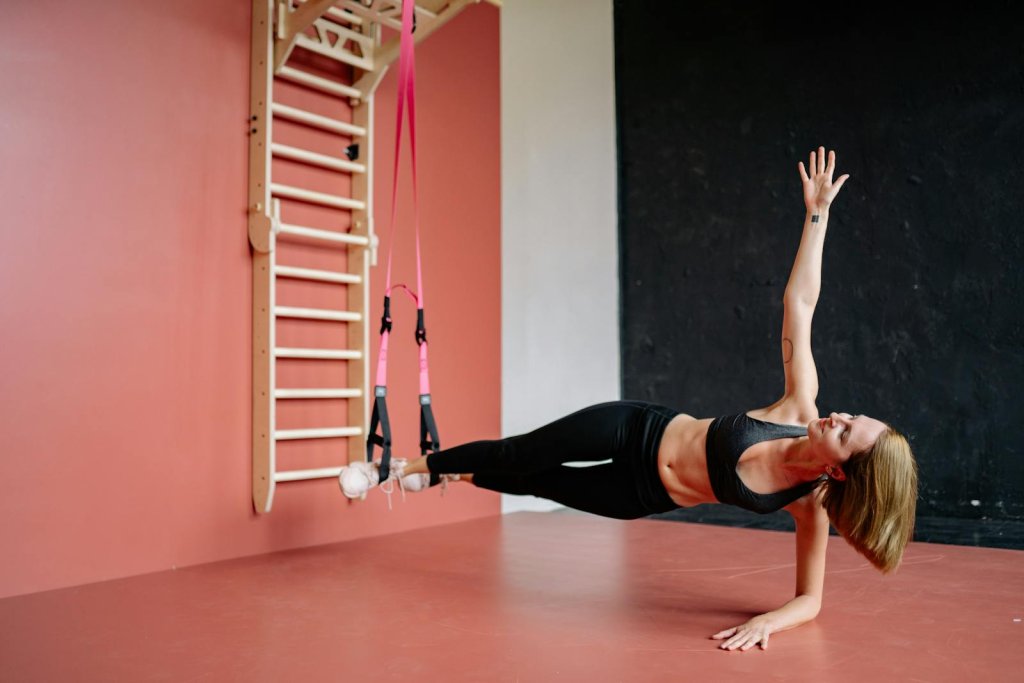
Understanding how TRX ab exercises work matters because core strength supports posture, balance, athletic performance, and everyday movement. This guide explains what TRX ab exercises are, why they matter, and how to perform the 8 best TRX ab exercises safely and effectively—using evidence-based principles and clear coaching cues.
What Are TRX Ab Exercises?
TRX ab exercises are core-focused movements performed using a TRX suspension trainer anchored overhead. Instead of relying on external weights, resistance comes from your body position and the instability created by the straps.
Key characteristics include:
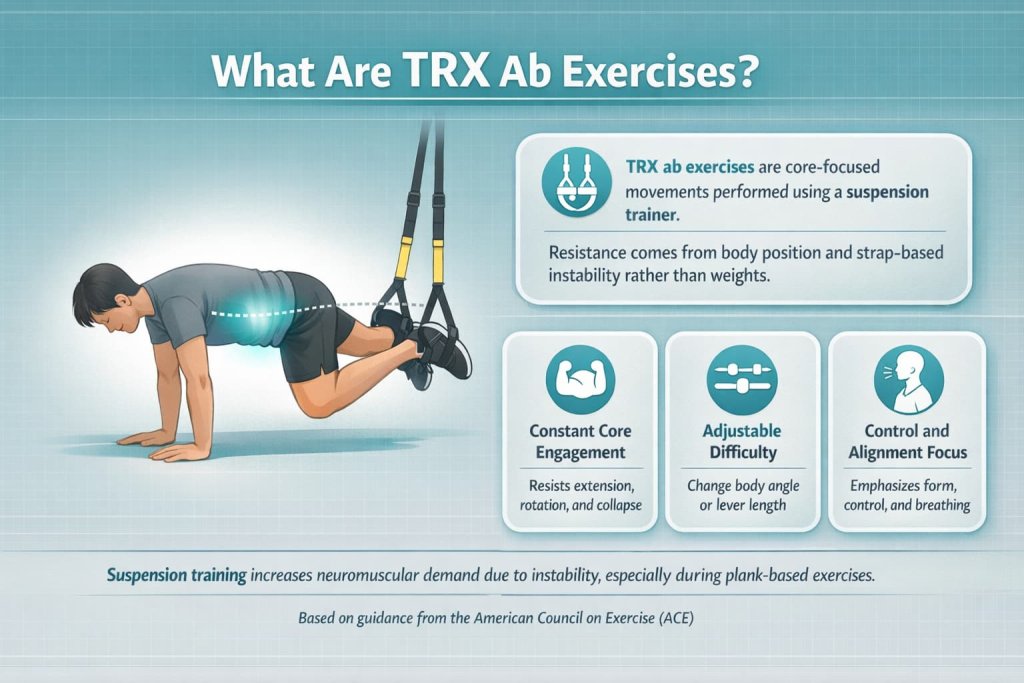
- Constant core engagement to resist extension, rotation, or collapse
- Adjustable difficulty by changing body angle or lever length
- Emphasis on control, alignment, and breathing rather than momentum
According to the American Council on Exercise (ACE), suspension training increases neuromuscular demand because the body must stabilize itself throughout the movement, especially during plank-based exercises.
8 Best TRX Ab Exercises
Below are the 8 best TRX ab exercises commonly recommended by strength coaches and exercise professionals. They progress from foundational stability to advanced core control.
1. TRX Forearm Plank
A foundational core stability exercise that trains the abs to maintain full-body alignment under instability.
How to do it:
- Place both feet securely in the TRX foot cradles, straps hanging evenly
- Position your forearms on the floor directly under your shoulders
- Brace your core by gently drawing your ribs down and tightening your midsection
- Keep your body in a straight line from head through hips to heels
- Hold the position while breathing steadily and maintaining control
Why it works:
Suspending the feet removes a stable base of support, forcing the deep core muscles to stay active to prevent the hips from sagging or rotating. This builds foundational anti-extension strength essential for all advanced TRX ab exercises.
Trainer Tip:
Start with 15–30 second holds. Increase duration only if you can maintain perfect alignment without lower-back strain.
2. TRX Body Saw
An advanced plank variation that intensifies core engagement through controlled movement.
How to do it:
- Begin in a forearm plank with both feet suspended in the straps
- Engage your core and slowly shift your body backward by pushing through your shoulders
- Glide forward again to the starting position under control
- Keep hips level and spine neutral throughout the movement
Why it works:
As your body moves away from the anchor point, the lever arm increases, raising the load on the anterior core. The abs must work harder to resist spinal extension.
Trainer Tip:
Short, smooth glides are more effective than large swings. If your hips drop, reduce the range of motion.
3. TRX Suspended Knee Tuck
A dynamic core exercise that combines stabilization with controlled hip movement.
How to do it:
- Start in a high plank with hands under shoulders and feet in the straps
- Brace your core and slowly pull your knees toward your chest
- Keep shoulders stacked over wrists as the legs move
- Extend the legs back to plank with control
Why it works:
The exercise teaches the core to remain stable while the hips move, a key function for real-world and athletic movement patterns.
Trainer Tip:
Focus on slow returns to plank. Rushing the extension phase reduces core engagement.
4. TRX Knee Tuck to Pike
A progression that increases abdominal load and control demands.
How to do it:
- Perform a controlled knee tuck from a plank position
- Without swinging, extend your legs upward into a pike
- Pause briefly at the top, then lower back to plank slowly
Why it works:
Transitioning into a pike lengthens the lever arm and places greater demand on the anterior core, especially during the lifting phase.
Trainer Tip:
Master knee tucks first. If hips swing or shoulders shift excessively, regress the movement.
5. TRX Suspended Pike
One of the most demanding TRX ab exercises for core strength and control.
How to do it:
- Begin in a strong plank with legs straight and feet suspended
- Brace your core and lift your hips upward toward the ceiling
- Keep legs straight and shoulders stable
- Lower slowly back to plank without losing control
Why it works:
Lifting the pelvis against gravity requires high levels of abdominal activation, especially in the upper and lower abs.
Trainer Tip:
Slow tempo is critical. Momentum shifts work away from the abs and increases injury risk.
6. TRX Pendulum (Side-to-Side Knees)
An effective anti-rotation exercise that targets the obliques.
How to do it:
- Start in a plank with knees slightly bent and feet in the straps
- Rotate your knees to one side under control
- Return to center, then rotate to the opposite side
- Keep shoulders square and chest facing the floor
Why it works:
The core must resist rotational forces while suspended, strengthening the obliques and deep stabilizers.
Trainer Tip:
If rotation becomes uncontrolled, reduce range of motion or slow the tempo.
7. TRX Standing Oblique Crunch
A standing core exercise that targets lateral trunk strength.
How to do it:
- Hold one TRX handle overhead with both hands or one hand
- Lean slightly away from the anchor point
- Crunch sideways by drawing your ribs toward your hip
- Return slowly to the starting position
Why it works:
The offset angle creates lateral resistance, forcing the obliques to control side-bending without spinal compression.
Trainer Tip:
Avoid pulling with the arms. The movement should come from the torso, not the shoulders.
8. TRX Atomic Push-Up
A high-intensity exercise combining upper-body strength with advanced core control.
How to do it:
- Start in a push-up position with feet suspended
- Lower into a push-up while keeping the core braced
- At the top, pull knees toward the chest
- Extend legs back to plank and repeat
Why it works:
The combination of pushing and knee-tucking demands constant core engagement to maintain balance and alignment.
Trainer Tip:
If alignment breaks down, separate the movement into TRX push-ups and knee tucks until strength improves.
Why TRX Ab Exercises Matter
Regular TRX ab training may help support:
- Stronger deep core muscles that stabilize the spine
- Improved posture and body control
- Better balance and coordination
- Efficient force transfer during daily and athletic movements
- Joint-friendly core strengthening without spinal flexion overload
Research cited by the American College of Sports Medicine (ACSM) notes that instability-based exercises can increase muscle activation demands when technique and intensity are properly managed.
How to Program TRX Ab Exercises for Best Results
Effective TRX ab training focuses on quality, control, and consistency rather than high repetition counts.
General programming guidelines include:
- Frequency: 2–3 sessions per week on nonconsecutive days
- Exercise selection: 2–4 TRX ab exercises per session
- Sets: 2–3 controlled sets per exercise
- Reps or time:
- Dynamic movements: 6–12 slow, controlled repetitions
- Static holds: 15–45 seconds, depending on ability
- Progression: Increase difficulty by lengthening the lever arm, slowing tempo, or advancing to more complex variations
TRX ab exercises work best when integrated into a balanced strength program that also includes lower-body, upper-body, and mobility training.
Common Mistakes to Avoid
- Letting hips sag or over-pike
- Rushing reps instead of controlling movement
- Holding breath instead of breathing steadily
- Progressing too quickly without proper control
Who Should Use TRX Ab Exercises?
TRX ab exercises are suitable for a wide range of fitness levels because resistance and difficulty can be adjusted by changing body position and range of motion.
They are especially appropriate for:
- Beginners, who benefit from supported planks and controlled movements that emphasize alignment and core awareness
- Intermediate and advanced trainees, who want higher core activation through instability and longer lever arms
- Home and gym users, since TRX systems are compact and adaptable to different environments
- Athletes and active individuals, who need core stability for strength transfer, balance, and movement efficiency
People who should proceed with caution include those with current lower-back pain, shoulder instability, recent surgery, or pregnancy. In these cases, modifications or professional guidance are recommended before starting suspension-based core training.
Safety Guidelines Before Starting TRX Ab Exercises
Following basic safety principles is essential to keep TRX ab exercises effective and low risk.
Key safety guidelines include:
- Ensure the TRX anchor point is secure and properly installed before every session
- Maintain a neutral spine throughout each exercise; avoid excessive arching or rounding
- Brace the core gently rather than holding your breath
- Move slowly and with control—avoid swinging or using momentum
- Stop the exercise immediately if you feel sharp pain, joint discomfort, or loss of control
If you are new to suspension training or have a history of musculoskeletal issues, consider consulting a qualified fitness professional before performing advanced TRX ab exercises.
Frequently Asked Questions About TRX Ab Exercises
Are TRX ab exercises good for beginners?
Yes. Many TRX ab exercises can be modified by adjusting body angle or range of motion, making them suitable for beginners.
Do TRX ab exercises build visible abs?
They can help strengthen and define the core when combined with consistent training, proper nutrition, and overall activity.
Are TRX ab exercises better than crunches?
TRX ab exercises emphasize stability and full-core engagement rather than repeated spinal flexion, which many professionals prefer for long-term core training.
Can I do TRX ab exercises at home?
Yes. A door-anchored TRX system allows safe home training when installed correctly.
How long should a TRX ab workout be?
Most effective TRX ab workouts last 10–20 minutes, depending on intensity and rest.
Do TRX ab exercises help posture?
Improved core stability may help support better posture by enhancing trunk control.
Conclusion
TRX ab exercises offer a highly effective way to build core strength, stability, and control using your own body weight. By progressing gradually and focusing on alignment and breathing, these exercises can support better movement quality and long-term core development.
If you’re looking to upgrade your core training, start with the foundational TRX ab exercises above and progress as control improves.
References
- Muscle Activation during Push-Ups with Different Suspension Training Systems (Calatayud et al., 2014) — Journal of Sports Science & Medicine (Full Text)
- Electromyographic Comparison of Traditional and Suspension Push-Ups (Snarr & Esco, 2013) — PubMed Central (Full Text)
- Muscle Activation in Suspension Training: A Systematic Review (Aguilera-Castells et al., 2020) — PubMed
- ACSM Position Stand: Progression Models in Resistance Training for Healthy Adults (2009) — PubMed
- Adult Activity: An Overview (includes muscle-strengthening 2+ days/week) — CDC (Dec 20, 2023)
- Physical Activity (includes muscle-strengthening 2+ days/week) — World Health Organization (WHO)
- TRX Suspended Pike (exercise setup + form cues) — American Council on Exercise (ACE) Exercise Library
- TRX Suspended Knee Tucks (exercise setup + form cues) — American Council on Exercise (ACE) Exercise Library