
Peroneal tendonitis exercises focus on gradually strengthening and stabilizing the outer ankle to support recovery and restore normal movement. When done correctly, these exercises may help improve ankle control, build load tolerance in the peroneal tendons, and support a safe return to daily and athletic activities.
Understanding how and when to use the right exercises is important because the peroneal tendons play a key role in ankle stability, balance, and side-to-side movement. This guide explains what peroneal tendonitis is, why exercise matters, and how to train safely using evidence-based principles.
What Is Peroneal Tendonitis?
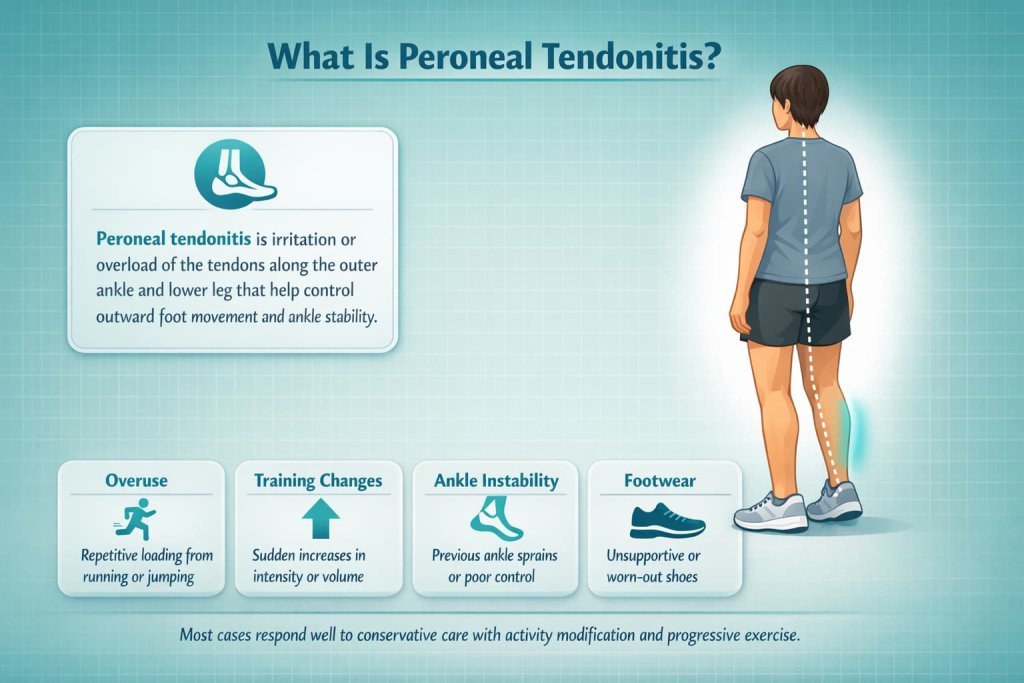
Peroneal tendonitis (also called peroneal tendinopathy) refers to irritation or overload of the peroneal tendons, which run along the outer side of the lower leg and behind the outer ankle bone. These tendons help control ankle eversion (turning the foot outward) and contribute to ankle stability during walking, running, and cutting movements.
Common contributing factors include:
- Repetitive overuse (running, jumping, or uneven terrain)
- Sudden increases in training volume or intensity
- Ankle instability or a history of ankle sprains
- Poor footwear or worn-out shoes
Medical and sports medicine sources note that most cases respond well to conservative management, including activity modification and progressive exercise.
8 Best Peroneal Tendonitis Exercises
These eight exercises focus on improving outer-ankle strength, stability, and control through gradual, pain-aware loading. Performed consistently, they may help support safer movement and long-term ankle function without over-stressing the tendons.
1. Ankle Eversion with Resistance Band
Why it works:
This exercise directly strengthens the peroneal muscles, which are responsible for controlling outward ankle movement and resisting excessive inward rolling. Improving eversion strength helps the ankle tolerate daily walking, running, and uneven surfaces with better control and reduced strain on the tendons.
How to do it:
- Sit on the floor or a chair with one leg extended
- Loop a resistance band around the forefoot of the working leg
- Anchor the other end of the band to a stable object on the opposite side
- Slowly turn your foot outward against the band’s resistance
- Pause briefly at the end range
- Return to the starting position with control
- Perform 2–3 sets of 10–15 reps
Trainer tip:
Use the lightest band that still challenges control—tendon loading should feel steady, not aggressive.
2. Calf Raises (Double-Leg to Single-Leg)
Why it works:
Strong calf muscles assist with ankle stability during push-off and help distribute forces more evenly across the ankle complex. This reduces excessive demand on the peroneal tendons during walking, running, and stair climbing.
How to do it:
- Stand upright with feet hip-width apart
- Slowly rise onto the balls of your feet
- Hold briefly at the top
- Lower your heels back down in a controlled manner
- Progress to single-leg calf raises once comfortable
- Perform 2–3 sets of 8–15 reps
Trainer tip:
Focus on the slow lowering phase—controlled descent is key for tendon adaptation.
3. Ankle Alphabet
Why it works:
The ankle alphabet promotes gentle, multi-directional ankle movement without heavy load. It supports neuromuscular control and joint awareness, which are often reduced when pain leads to protective movement patterns.
How to do it:
- Sit or lie down with the leg supported and relaxed
- Lift the foot slightly off the ground
- Use your toes to “draw” the letters of the alphabet in the air
- Move slowly and stay within a comfortable range
Trainer tip:
This drill should feel smooth and easy—avoid forcing any letter shapes.
4. Single-Leg Balance
Why it works:
Single-leg balance training improves proprioception and ankle stability by teaching the nervous system to react to small shifts in body weight. This is especially important after ankle irritation or previous sprains.
How to do it:
- Stand near a wall or chair for support
- Lift one foot off the ground
- Balance on the standing leg for 20–40 seconds
- Progress by closing your eyes or using a soft surface
- Perform 2–3 rounds per side
Trainer tip:
Aim for steady control rather than stillness—small ankle adjustments are normal and beneficial.
5. Heel-to-Toe Walking
Why it works:
This walking drill reinforces controlled ankle movement and alignment during a gait-like pattern. It helps retrain ankle coordination needed for daily walking and balance.
How to do it:
- Stand tall with eyes forward
- Step forward by placing the heel directly in front of the toes
- Move slowly and deliberately
- Take 10–20 controlled steps
Trainer tip:
If balance feels challenging, shorten your steps or use a wall for light support.
6. Seated Ankle Inversion and Eversion (Unweighted)
Why it works:
This low-load movement allows early-stage ankle motion without placing excessive stress on the tendons. It helps maintain joint mobility and muscle activation during the initial recovery phase.
How to do it:
- Sit upright with both feet flat on the floor
- Slowly roll the ankles outward and inward
- Keep movements controlled and pain-free
- Perform 2–3 sets of 10–15 reps
Trainer tip:
This exercise is ideal on flare-up days or as part of a warm-up.
7. Lateral Step-Outs
Why it works:
Lateral step-outs challenge side-to-side control and teach the ankle to stabilize during functional movement patterns that commonly stress the peroneal tendons.
How to do it:
- Stand with feet together and posture upright
- Step sideways with one foot
- Gently push back to the starting position
- Keep knees and ankles aligned throughout
- Perform 2–3 sets of 8–12 reps per side
Trainer tip:
Move slowly and avoid letting the ankle roll inward as you step.
8. Toe Walking
Why it works:
Toe walking builds endurance in the calf-ankle complex while requiring continuous stabilization from the peroneal muscles. This supports improved tolerance for longer periods of standing and walking.
How to do it:
- Rise onto the balls of your feet
- Walk forward with small, controlled steps
- Maintain upright posture
- Continue for 20–40 seconds
Trainer tip:
End the set early if ankle discomfort increases—fatigue should feel muscular, not sharp.
Key Muscles Involved in Peroneal Tendonitis
Peroneal tendonitis mainly affects the peroneal tendons, but several surrounding muscles support ankle stability and load control.
Key muscles include:
- Peroneus longus and peroneus brevis – control outward ankle movement and provide lateral stability
- Calf muscles (gastrocnemius and soleus) – help manage force during push-off
- Tibialis posterior – supports arch control and balanced ankle mechanics
- Intrinsic foot muscles – assist with balance and foot stability
Weakness or poor coordination in these muscles may increase strain on the peroneal tendons.
How to Program Peroneal Tendonitis Exercises
Proper programming helps tendons adapt safely to load.
General guidelines:
- Frequency: 3–5 days per week, based on symptom tolerance
- Sets and reps: 2–3 sets of 8–15 reps for strengthening exercises
- Balance work: Hold positions for 20–40 seconds
- Progression: Increase difficulty only when movements feel controlled
- Pain guidance: Exercises should feel challenging but manageable
If symptoms flare, reduce volume or return to lower-load variations.
Why Peroneal Tendonitis Exercises Important
Well-designed peroneal tendonitis exercises may help support:
- Improved strength of the peroneal muscles and supporting ankle muscles
- Better ankle stability during daily and athletic movement
- Gradual rebuilding of tendon load tolerance
- Reduced recurrence risk when returning to activity
According to guidance summarized by the National Institutes of Health, tendons generally respond better to controlled, progressive loading than to prolonged rest alone.
How to Train Peroneal Tendonitis Safely
Before starting these exercises, keep the following principles in mind:
- Exercises should feel challenging but not sharply painful
- Mild discomfort during or after exercise can be normal; pain that worsens or lingers is not
- Progress volume and resistance gradually over weeks
- Stop and seek professional guidance if swelling, instability, or pain increases
If symptoms are severe, persistent, or associated with a feeling of ankle “giving way,” consult a qualified healthcare professional.
Common Mistakes to Avoid
- Pushing through sharp or worsening pain
- Skipping balance and control exercises
- Progressing resistance too quickly
- Returning to high-impact activity without rebuilding strength
When to See a Healthcare Professional
Most cases improve with conservative exercise, but evaluation is recommended if you notice:
- Pain that persists or worsens after several weeks
- Increased swelling, weakness, or ankle instability
- Repeated “popping” or snapping sensations
- The ankle giving way during daily activities
The American Orthopaedic Foot & Ankle Society emphasizes early assessment when symptoms do not improve with exercise-based care.
Frequently Asked Questions
How often should I do peroneal tendonitis exercises?
Most programs use 3–5 days per week, allowing rest days as needed based on symptoms.
Can I do these exercises at home?
Yes. Most peroneal tendonitis exercises require minimal equipment and are home-friendly.
Should I stretch with peroneal tendonitis?
Gentle calf and ankle mobility work may help, but aggressive stretching should be avoided early on.
How long does recovery usually take?
Improvement often occurs over several weeks, but full tendon adaptation may take longer depending on severity and consistency.
Can I run with peroneal tendonitis?
Running should be reduced or modified until strength and control improve and symptoms are manageable.
Are braces or supports helpful?
In some cases, temporary bracing or supportive footwear may help reduce strain during activity.
Conclusion
Peroneal tendonitis exercises are a key part of conservative ankle care. When performed with proper technique, gradual progression, and attention to symptoms, these exercises may help restore strength, stability, and confidence in everyday movement. Stay consistent, progress patiently, and seek professional guidance if symptoms do not improve.
This content is for informational purposes only and not medical advice.
References
- Peroneal Tendinosis (Symptoms and Causes) – FootCareMD (AOFAS)
- Peroneal Tendonitis (Causes, Treatment, Prevention) – Cleveland Clinic
- Peroneal Tendon Syndromes – StatPearls (NCBI Bookshelf)
- Foot and Ankle Conditioning Program (PDF) – AAOS OrthoInfo
- Ankle Stability and Movement Coordination Impairments: CPG (2021) – JOSPT
- Is Tendon Pathology a Continuum? (2009) – British Journal of Sports Medicine
- Load Progression Criteria in Exercise for Tendinopathy (Systematic Review, 2020) – PMC
- Ultrasound vs MRI for Peroneal Tendinopathy, Tears, and Subluxation (2024) – PMC