
Ankle mobility exercises are movements that improve how well your ankle bends, flexes, and rotates — helping you walk, squat, and balance with less stiffness and discomfort. These exercises focus on dorsiflexion (knee over toes), plantarflexion, inversion, eversion, and overall calf–Achilles flexibility.

Understanding ankle mobility is important because limited motion can affect your balance, stride, squat depth, knee alignment, and daily comfort. Research also shows a strong connection between restricted ankle dorsiflexion and higher risk of lower-body injuries. Ankle mobility exercises may help improve flexibility, stability, and overall movement control.
This guide gives you 15 of the best ankle mobility exercises, grouped into range-of-motion drills, stretches, strengthening work, and balance exercises — all evidence-supported and easy to follow.
Why Ankle Mobility Exercises Matter
Ankle mobility exercises matter because they help your ankles move through their full, natural range of motion, which is essential for balance, walking, squatting, running, and overall lower-body alignment. When the ankle joint becomes stiff—often from sitting, previous injuries, or tight calves—it can limit dorsiflexion and alter how your knees, hips, and spine move during daily activities.
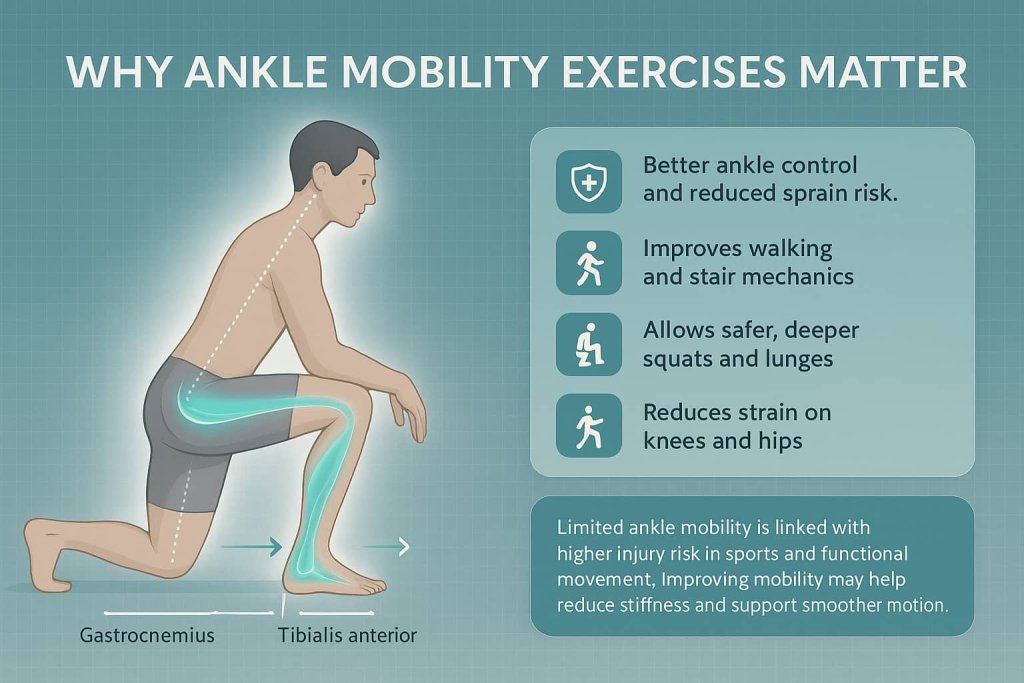
Good ankle mobility supports:
- Better stability and reduced risk of ankle sprains
- Improved walking and stair climbing mechanics
- Safer, deeper squats and lunges
- Less strain on the knees and hips
- More efficient balance and posture control
Research also shows a link between limited ankle mobility and higher injury risk during sports and functional movements. Improving mobility may help reduce stiffness, increase comfort, and support smoother, controlled movement throughout the lower body.
Warm-Up Before Ankle Mobility Work
Before starting the exercises, warm up for 1–2 minutes:
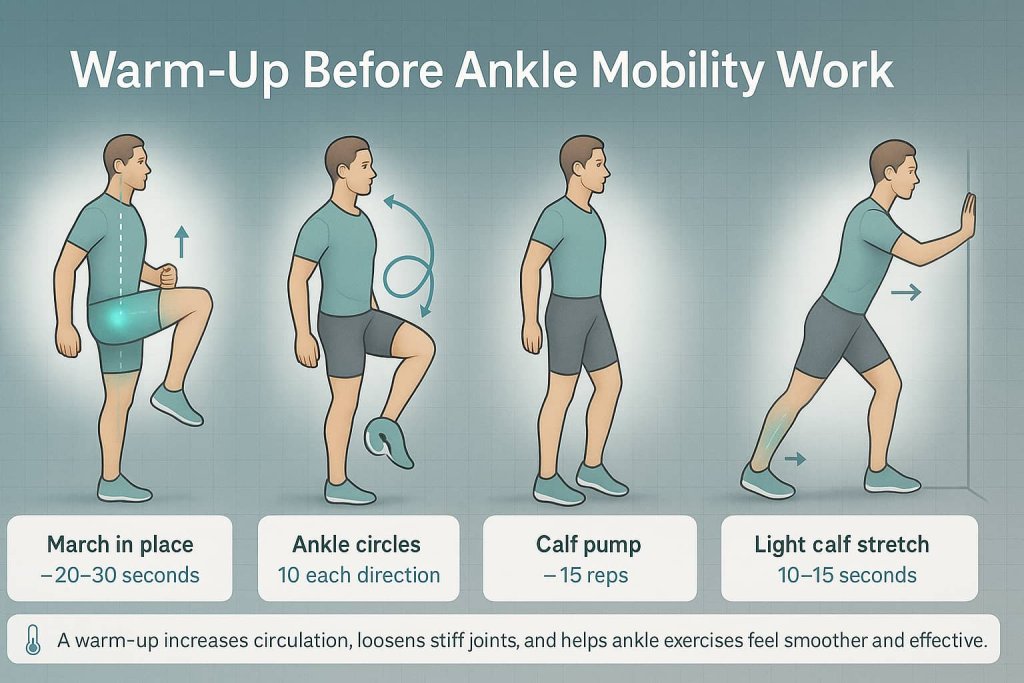
- March in place — 20–30 seconds
- Ankle circles — 10 each direction
- Calf pump (heel up/down) — 15 reps
- Light calf stretch — 10–15 seconds
A warm-up increases circulation, loosens stiff joints, and helps the exercises feel smoother and more effective.
15 Ankle Mobility Exercises
These exercises target ankle flexibility, strength, and stability to help you move with better balance and less stiffness. Perform them consistently to improve dorsiflexion, reduce discomfort, and support safer walking, squatting, and daily movement.
Category 1 — Range-of-Motion (ROM) Exercises
1. Ankle Circles
Why it works:
Improves joint lubrication, reduces stiffness, and increases smooth, multi-directional ankle mobility needed for daily movement.
Muscles worked:
Tibialis anterior, gastrocnemius, soleus, peroneals, intrinsic ankle stabilizers.
How to do it:
- Sit or stand and lift one foot slightly off the floor.
- Draw a slow, controlled circle with your toes.
- Reverse direction and repeat.
- Keep movement smooth, not jerky.
Trainer Tip:
Imagine making the biggest circle you can without moving your knee or hip — this ensures true ankle mobility work.
2. Ankle Pumps (Point & Flex)
Why it works:
Improves dorsiflexion and plantarflexion range, essential for walking, stairs, lunges, and squats.
Muscles worked:
Tibialis anterior, gastrocnemius, soleus.
How to do it:
- Sit or lie with legs extended.
- Point your toes downward.
- Pull your toes up toward your shins.
- Move slowly through full range.
Trainer Tip:
Add a light pause at the top and bottom to increase muscle control.
3. Ankle Alphabet
Why it works:
Promotes ankle mobility in all planes and helps restore neuromuscular control after stiffness or long periods of sitting.
Muscles worked:
Full ankle complex—tibialis anterior, posterior tibialis, peroneals, calf muscles.
How to do it:
- Sit with one leg lifted.
- “Write” the alphabet in the air with your toes.
- Keep the movement large and controlled.
Trainer Tip:
If your ankle fatigues quickly, take a short break halfway through — this is normal.
4. Knee-to-Wall Dorsiflexion Mobilization
Why it works:
Targets dorsiflexion — the most commonly restricted ankle motion — improving squat depth and walking efficiency.
Muscles worked:
Soleus, gastrocnemius, tibialis anterior.
How to do it:
- Stand facing a wall with one foot a few inches away.
- Drive your knee forward to gently touch the wall without your heel lifting.
- Adjust distance for challenge.
Trainer Tip:
Track your knee over your second toe to avoid inward collapse and encourage proper mechanics.
Category 2 — Stretching Exercises to Increase Flexibility
5. Standing Calf Stretch (Gastrocnemius)
Why it works:
Stretches the upper calf muscle, improving dorsiflexion needed for walking, running, and squatting.
Muscles worked:
Gastrocnemius.
How to do it:
- Stand facing a wall.
- Step one leg back with heel flat and knee straight.
- Lean forward until you feel a stretch.
Trainer Tip:
Keep your back foot pointing straight ahead — turning the foot outward reduces the effectiveness.
6. Bent-Knee Calf/Soleus Stretch
Why it works:
Targets the soleus, a deep calf muscle essential for ankle mobility and upright movement.
Muscles worked:
Soleus.
How to do it:
- Stand facing a wall.
- Bend your back knee slightly.
- Press your heel gently into the floor.
- Lean forward until you feel a lower-calf stretch.
Trainer Tip:
If the stretch feels too sharp, reduce pressure — this stretch should feel mild and steady.
7. Seated Towel Stretch
Why it works:
Gently improves calf and Achilles flexibility without loading the joint.
Muscles worked:
Gastrocnemius, soleus.
How to do it:
- Sit with legs straight.
- Loop a towel around the ball of your foot.
- Pull back until you feel a stretch along the calf.
Trainer Tip:
Keep your knee straight to stretch the gastrocnemius; bend it slightly for more soleus focus.
8. Downward Ankle Stretch (Deep Dorsiflexion)
Why it works:
Improves deep dorsiflexion — needed for squats, lunges, and descending stairs comfortably.
Muscles worked:
Soleus, gastrocnemius, tibialis anterior.
How to do it:
- Kneel with one foot forward.
- Lean forward into the front ankle, keeping the heel down.
- Press gently toward your end range.
Trainer Tip:
Place your hand lightly on the knee to guide it forward without collapsing inward.
Category 3 — Strengthening Exercises for Stability
9. Calf Raises (Double or Single-Leg)
Why it works:
Builds strength in the calves, which support balance, propulsion, and shock absorption.
Muscles worked:
Gastrocnemius, soleus, foot stabilizers.
How to do it:
- Stand tall with feet hip-width apart.
- Lift your heels slowly.
- Lower with control.
- Progress to single-leg when ready.
Trainer Tip:
Avoid bouncing — slow tempo builds true functional strength.
10. Tibialis Raises (Front-Shin Strengthening)
Why it works:
Strengthens dorsiflexor muscles, improving foot lift during walking and helping reduce shin stiffness.
Muscles worked:
Tibialis anterior.
How to do it:
- Stand with back against a wall.
- Lift your toes toward your shins while keeping heels down.
- Lower slowly.
Trainer Tip:
Pull your toes up as high as possible without leaning forward — this ensures proper activation.
11. Resistance Band Dorsiflexion
Why it works:
Strengthens foot-lifting muscles, aiding balance, walking mechanics, and ankle control.
Muscles worked:
Tibialis anterior.
How to do it:
- Sit with legs straight.
- Loop a band around your foot and anchor the opposite end.
- Pull toes back toward your shins.
- Return slowly.
Trainer Tip:
Keep tension constant — avoid letting the band snap back.
12. Resistance Band Inversion & Eversion
Why it works:
Strengthens both inner and outer ankle stabilizers, important for reducing sprain risk and improving balance.
Muscles worked:
Inversion: tibialis posterior.
Eversion: peroneals.
How to do it:
- Anchor band to a stable object.
- Pull foot inward for inversion or outward for eversion.
- Keep the movement small and controlled.
Trainer Tip:
Move only the ankle — don’t rotate your whole leg.
13. Towel Scrunches
Why it works:
Builds strength in small foot muscles that support arch control and ankle stability.
Muscles worked:
Intrinsic foot muscles.
How to do it:
- Sit with feet on a towel.
- Curl your toes to pull the towel toward you.
- Repeat until the towel bunches.
Trainer Tip:
Add a small weight (like a water bottle) on the towel for more challenge.
Category 4 — Balance & Proprioception Exercises
14. Single-Leg Balance
Why it works:
Trains stability, ankle coordination, and neuromuscular control — especially helpful after ankle sprains.
Muscles worked:
Peroneals, tibialis posterior, calf muscles, foot stabilizers.
How to do it:
- Stand on one foot for 20–30 seconds.
- Switch sides.
- Progress by adding eyes-closed, head turns, or gentle reaches.
Trainer Tip:
Keep your standing knee soft, not locked — this activates stabilizing muscles.
15. Balance Pad or Cushion Training
Why it works:
Challenges ankle stabilizers through controlled instability, improving proprioception and balance accuracy.
Muscles worked:
Peroneals, tibialis posterior, intrinsic foot muscles, calf complex.
How to do it:
- Stand on a foam pad or cushion.
- Maintain balance for 20–30 seconds.
- Progress to single-leg stance when ready.
Trainer Tip:
Focus your gaze on a still object — this improves body alignment and balance response.
How Often Should You Do Ankle Mobility Exercises?
A good general routine:
- ROM exercises: daily
- Calf stretches: 4–7 days per week
- Strength drills: 2–3 days per week
- Balance training: 2–3 days per week
Consistency is more important than intensity. Keep movements slow and pain-free.
Common Mistakes to Avoid
- Forcing stretches into sharp pain
- Letting the heel lift during dorsiflexion work
- Rushing through reps
- Skipping warm-ups
- Ignoring strengthening and balance (mobility alone is not enough)
Safety Guidelines Before Starting Ankle Mobility Exercises
Before beginning any ankle mobility routine, it is important to follow basic safety guidelines to protect the joint and surrounding tissues.
Key safety recommendations include:
- Move only within a pain-free range. Mild stretching discomfort is normal, but sharp pain is not.
- Warm up for 1–2 minutes to increase blood flow to the ankle and calf muscles.
- Keep movements slow and controlled to avoid unnecessary strain.
- Avoid forcing your heel down or pushing the ankle beyond its natural limit.
- Use support (wall, chair, or rail) if you have trouble balancing.
- Stop immediately if you feel sudden pain, swelling, numbness, or instability.
- Progress gradually—start with basic exercises and increase difficulty only as your mobility improves.
These guidelines help reduce injury risk and ensure that your mobility routine supports, rather than stresses, your joints.
Who Should Avoid or Modify Ankle Mobility Exercises
While ankle mobility exercises are generally safe for most people, certain individuals should avoid or modify these movements to prevent further irritation or injury.
You should avoid or modify ankle mobility exercises if you have:
- A recent fracture, sprain, or ankle injury that has not been cleared by a healthcare provider
- Post-surgical restrictions following ankle, foot, or lower-leg procedures
- Significant swelling, bruising, or warmth around the joint
- Inability to bear weight on the affected foot
- Severe arthritis, joint deformity, or chronic instability
- Sharp pain, locking, or catching sensations during movement
Consult a qualified healthcare professional—such as a physiotherapist, orthopedic specialist, or physician—before starting or progressing ankle mobility exercises if you fall into any of these categories. They can determine the safest exercises for your condition and guide modifications.
When to See a Professional
Consult a healthcare professional if you notice:
- Persistent or worsening pain
- Swelling, bruising, or instability
- Inability to bear weight
- Post-surgical or post-fracture limitations
- Locking or catching sensations
A physiotherapist can assess mobility restrictions, provide personalized exercises, and guide safe progression.
FAQs About Ankle Mobility
1. How long does it take to improve ankle mobility?
Most people notice improvement within 2–4 weeks of consistent training.
2. Can ankle mobility help with squatting?
Yes. Better dorsiflexion often improves squat depth, alignment, and knee tracking.
3. Should ankle mobility exercises hurt?
No. Mild stretching discomfort is normal, but sharp pain is not.
4. How do I know if my ankles are stiff?
If your knee cannot move past your toes without your heel lifting, mobility is usually limited.
5. Can these exercises help prevent sprains?
Strengthening + balance work may reduce ankle instability and re-sprain risk.
Conclusion
Improving ankle mobility is one of the most effective ways to enhance balance, walking mechanics, squatting form, and lower-body comfort. These 15 exercises offer a complete approach — stretching, strength, mobility, and stability — to help your ankles move and feel better over time.
Start with 2–3 exercises per category and progress gradually.
If pain, instability, or swelling persists, seek professional guidance for personalized care.
This content is for informational purposes only and is not medical advice.
References
- AAOS – Foot and Ankle Conditioning Program
- AAOS – Foot and Ankle Conditioning PDF (Exercise Details, Sets, and Frequency)
- Lima et al. – Association of Ankle Dorsiflexion and Dynamic Knee Valgus (Systematic Review & Meta-analysis)
- Almansoof et al. – Role of Ankle Dorsiflexion in Sports Performance and Injury Risk (Narrative Review)
- Taylor et al. – The Effect of Ankle Dorsiflexion on Hip and Knee Biomechanics During Landing
- Guo et al. – Balance Training for Chronic Ankle Instability (Systematic Review & Meta-analysis)
- Seever et al. – Chronic and Residual Effects of a Two-Week Foam Rolling Training on Ankle Dorsiflexion and Dynamic Balance
- Mass General – Physical Therapy Guidelines for Lateral Ankle Sprain