
Plyometric exercises for speed are designed to improve how quickly your muscles produce force, helping you run faster, accelerate harder, and move more explosively. They train your body to absorb force and re-apply it rapidly, which is a key factor in sprint speed, agility, and athletic performance.

Understanding how plyometric exercises for speed work is important because speed is not just about strength—it’s about how fast you can use that strength. When programmed correctly, plyometric training can complement sprinting and strength work while supporting safer, more efficient movement.
What Are Plyometric Exercises for Speed?
Plyometric exercises for speed are explosive movements that use the stretch-shortening cycle (SSC). This cycle involves a rapid muscle stretch immediately followed by a powerful contraction.
Examples include jumps, bounds, and hops that emphasize:
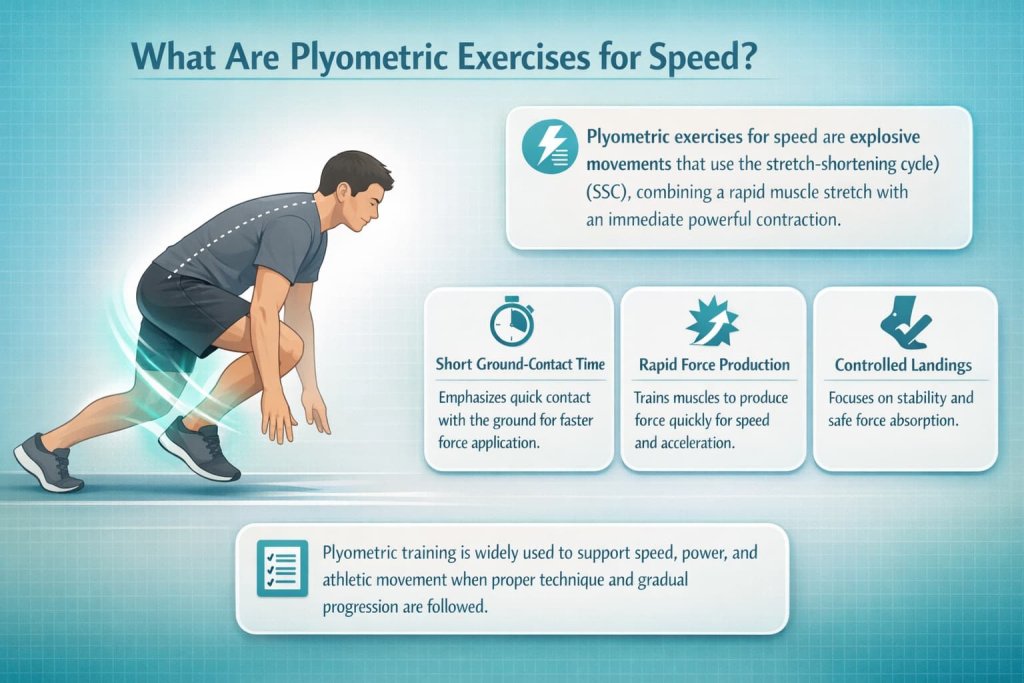
- Short ground-contact time
- Rapid force production
- Controlled landings
According to guidance commonly referenced by the National Strength and Conditioning Association, plyometric training is widely used to improve speed, power, and athletic movement when proper technique and progression are followed.
8 Best Plyometric Exercises for Speed and Explosive Power
These plyometric exercises are designed to improve explosive force production, quick ground contact, and acceleration. When performed with proper technique and recovery, they may help support faster sprint speed and overall athletic performance.
1. Squat Jumps
Why it works:
Squat jumps train explosive triple extension at the hips, knees, and ankles—the same joint action used during sprint takeoff. By minimizing ground contact time and emphasizing maximal force output, this movement helps improve acceleration and early sprint power.
Muscles worked:
Quadriceps, glutes, hamstrings, calves, core
How to do it:
- Stand with feet shoulder-width apart
- Brace your core and lower into a controlled squat
- Drive through your feet and explode upward as high as possible
- Land softly with knees slightly bent
- Reset your stance before the next repetition
Trainer tip:
Prioritize jump height and soft landings over speed. If your landing gets loud or unstable, stop the set.
2. Broad Jumps
Why it works:
Broad jumps emphasize horizontal force production, which closely mirrors sprint mechanics. This helps improve how effectively you push backward into the ground to move forward faster.
Muscles worked:
Glutes, hamstrings, quadriceps, calves
How to do it:
- Begin in an athletic stance with hips hinged slightly back
- Swing your arms forcefully as you jump forward
- Land on both feet with hips and knees bent
- Stabilize before resetting for the next jump
Trainer tip:
Track jump distance rather than reps to monitor power progress over time.
3. Bounding
Why it works:
Bounding develops elastic leg stiffness and reinforces strong sprint stride mechanics. It trains the body to apply force quickly while maintaining rhythm and coordination.
Muscles worked:
Glutes, hamstrings, calves, hip flexors
How to do it:
- Run forward using long, exaggerated strides
- Push forcefully off the ground with each step
- Keep your torso tall and arms driving rhythmically
- Maintain smooth, springy contacts
Trainer tip:
Avoid overstriding. Each bound should feel powerful but controlled.
4. Box Jumps
Why it works:
Box jumps allow you to express maximal power while reducing landing impact, making them useful for speed development with lower joint stress when performed correctly.
Muscles worked:
Quadriceps, glutes, hamstrings, calves
How to do it:
- Stand facing a sturdy box or platform
- Perform a quick dip at the hips and knees
- Jump onto the box, landing with full foot contact
- Stand tall, then step down carefully
Trainer tip:
Box height should allow a soft, stable landing—higher is not always better.
5. Split Squat Jumps
Why it works:
Split squat jumps train unilateral power and help correct side-to-side strength imbalances, which can improve sprint symmetry and efficiency.
Muscles worked:
Glutes, quadriceps, hamstrings, calves
How to do it:
- Start in a split stance with one foot forward
- Lower into a controlled lunge
- Jump vertically and switch legs mid-air
- Land smoothly and reset before repeating
Trainer tip:
Maintain an upright torso to reduce stress on the lower back and hips.
6. Lateral Bounds
Why it works:
Lateral bounds improve side-to-side power and stability, which supports better force control during sprinting and change-of-direction movements.
Muscles worked:
Glute medius, quadriceps, hamstrings, calves
How to do it:
- Start standing on one leg
- Jump laterally to the opposite side
- Absorb the landing with control
- Stabilize before the next repetition
Trainer tip:
Pause briefly after each landing to reinforce balance and joint control.
7. Tuck Jumps
Why it works:
Tuck jumps develop reactive strength and coordination by demanding rapid force production and quick ground contact times.
Muscles worked:
Quadriceps, glutes, calves, core
How to do it:
- Jump straight up explosively
- Pull knees toward your chest at the top
- Land softly and immediately prepare for the next jump
Trainer tip:
End the set when jump height decreases or landing mechanics deteriorate.
8. Sprint-Assisted Plyo Jumps
Why it works:
Pairing plyometric jumps with short sprints improves speed transfer by teaching the body to apply explosive force directly into sprint acceleration.
Muscles worked:
Full lower body, core
How to do it:
- Perform 1–2 explosive jumps
- Immediately sprint 10–20 meters
- Walk back and fully recover before repeating
Trainer tip:
Full recovery is essential—fatigue reduces speed quality and effectivenes
How Often Should You Do Plyometric Exercises for Speed?
Most athletes benefit from:
- 2–3 sessions per week
- 3–6 sets of 2–5 reps per exercise
- Full recovery between sets
The American College of Sports Medicine recommends adequate rest and gradual progression for high-intensity power training.
Why Plyometric Exercises for Speed Matter
Well-designed plyometric exercises for speed may help support:
- Faster acceleration over short distances (5–30 meters)
- Improved stride power and stiffness
- Better neuromuscular coordination
- More efficient force transfer from the ground
Research summarized in journals such as PLOS ONE and Sports shows that plyometric training can produce measurable improvements in sprint performance, especially when paired with sprint drills and strength training.
Who Should and Should Not Do Plyometric Exercises for Speed
Plyometric exercises for speed are high-impact and require good movement control. They are most effective when performed by individuals who already have a basic foundation of strength and coordination.
Plyometric speed training may be appropriate for:
- Athletes involved in sprinting, field sports, or court sports
- Individuals with prior resistance-training experience
- People who can perform basic squats, lunges, and jumps with good control
- Recreationally active adults seeking to improve speed and power
Plyometric exercises may not be suitable for:
- Individuals with unresolved joint pain or recent lower-body injuries
- Those with poor balance or difficulty controlling landings
- Beginners who lack a basic strength foundation
- Anyone experiencing discomfort during jumping or landing tasks
If you are unsure whether plyometric speed training is appropriate for you, consulting a qualified fitness or sports professional is recommended.
How to Prepare for Plyometric Speed Training
Proper preparation helps reduce injury risk and improves training effectiveness. Because plyometric exercises involve rapid force production, warming up thoroughly is essential.
Key preparation steps include:
- Light cardiovascular activity to increase body temperature
- Dynamic mobility for hips, knees, ankles, and shoulders
- Activation exercises for the glutes and core
- Low-intensity hops or skips to rehearse landing mechanics
Focus on controlled landings, soft foot contact, and maintaining proper posture before progressing to higher-intensity jumps. Plyometric exercises should be performed when you are fresh, not fatigued.
Plyometric Exercises for Speed vs Sprint Training
Plyometric exercises for speed and sprint training serve different but complementary roles in performance development.
Plyometric training focuses on:
- Explosive force production
- Reducing ground contact time
- Improving elastic energy use in muscles and tendons
Sprint training focuses on:
- Running mechanics and technique
- Acceleration and top-speed development
- Sport-specific movement patterns
Plyometric exercises do not replace sprint training. Instead, they support speed development by improving how efficiently force is produced and transferred during sprinting. For best results, many training programs combine plyometric drills with sprint work in the same or alternating sessions.
Common Plyometric Training Mistakes to Avoid
- Too much volume too soon
- Poor landing mechanics
- Training when fatigued
- Skipping warm-ups
- Treating plyometrics as cardio
Frequently Asked Questions (FAQs)
Are plyometric exercises good for sprint speed?
Yes. When properly programmed, plyometric exercises may help improve acceleration and sprint efficiency.
Can beginners do plyometric exercises for speed?
Beginners should start with low-impact plyometrics and progress gradually.
How long before speed improvements show?
Many programs report measurable improvements within 4–8 weeks.
Do plyometrics replace sprint training?
No. They complement sprinting but should not replace it.
Are plyometrics safe for joints?
They can be when performed with proper technique and progression.
Should plyometrics be done before or after strength training?
They are usually performed early in a workout when fatigue is low.
Conclusion
Plyometric exercises for speed are a powerful tool for developing explosive strength, faster acceleration, and better athletic performance. When used strategically alongside sprinting and strength training, they can help you move faster with more efficiency and control.
If your goal is to run faster and move more explosively, start with a few high-quality plyometric exercises and progress gradually.
References
- Effects of plyometric training on jump, sprint, and change of direction performance in adolescent soccer players: A systematic review with meta-analysis (PLOS ONE, 2025)
- Effects of Combined Plyometric and Sprint Training on Sprint Performance in Youth Soccer Players (MDPI Physiologia, 2025)
- Meta-analysis of the effect of plyometric training on the athletic performance of youth basketball players (Frontiers in Physiology, 2024)
- CURRENT CONCEPTS OF PLYOMETRIC EXERCISE (Clinical commentary, PubMed Central, 2015)
- Effects of Strength and Plyometric Training on Vertical Jump, Linear Sprint, and Change-of-Direction Speed in Female Adolescent Team Sport Athletes (Journal of Sports Science & Medicine PDF, 2025)
- Systematic review and meta-analysis on the effect of plyometric training vs resistance training on explosive power and short-distance sprinting in athletes (PubMed, 2024)
- Basics of Strength and Conditioning Manual (foundational programming and progression context) (NSCA PDF)