
Inner thigh exercises for seniors are safe, low-impact movements that strengthen the hip adductor muscles, which play a key role in balance, walking stability, and everyday movement. Strengthening these muscles may help older adults feel steadier on their feet, move more confidently, and better control side-to-side motion during daily activities.
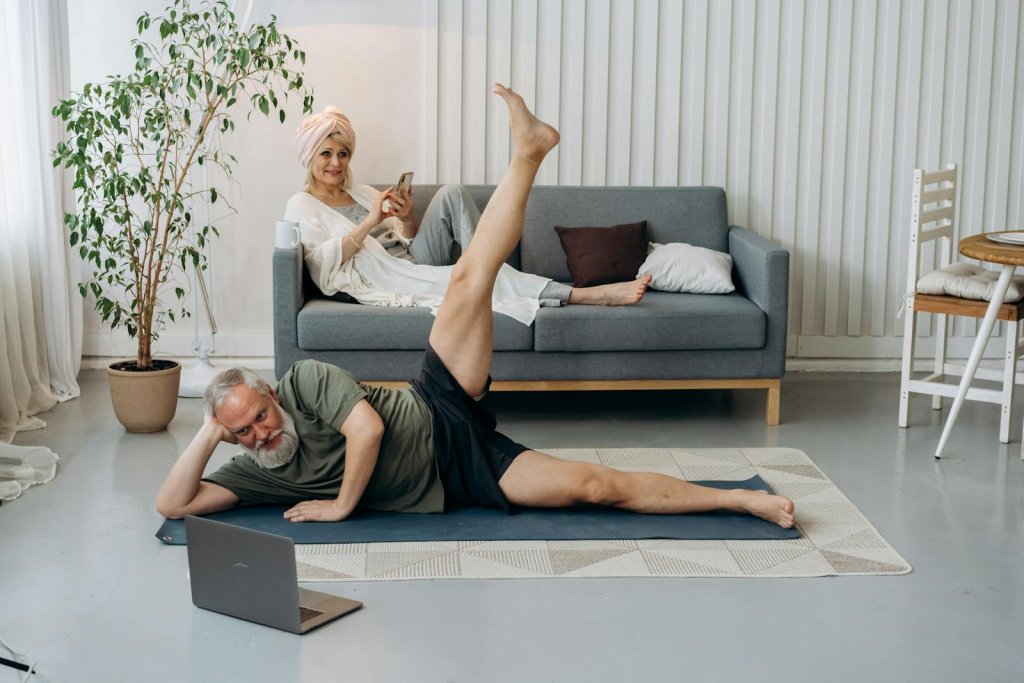
Understanding how to train the inner thighs safely matters because age-related muscle loss, reduced balance, and fear of falling can limit independence over time. This guide explains why inner thigh exercises are important for seniors, how to perform them safely, and how to include them in a balanced routine—using evidence-based, senior-friendly principles.
What Are Inner Thigh Exercises for Seniors?
Inner thigh exercises for seniors are low-impact strength movements that target the hip adductor muscle group, located along the inside of the thighs. These muscles help:
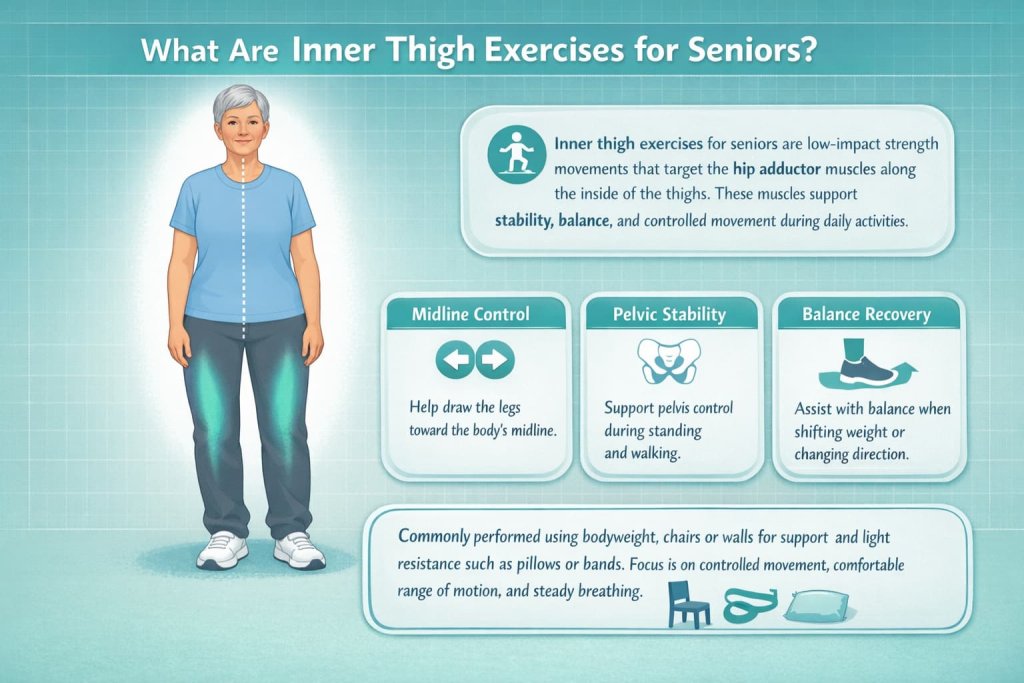
- Draw the legs toward the body’s midline
- Stabilize the pelvis during standing and walking
- Assist with balance recovery when shifting weight
For older adults, inner thigh exercises are typically performed using:
- Bodyweight
- Chairs or walls for support
- Light resistance bands or pillows
The focus is on controlled movement, comfortable range of motion, and steady breathing, rather than heavy loads or fast repetitions.
7 Safe Inner Thigh Exercises for Seniors
Each exercise below emphasizes safety, stability, and simplicity. A chair or wall should always be nearby for support.
1. Seated Inner Thigh Squeeze
How to do it:
- Sit upright in a sturdy chair with your back tall and feet flat on the floor
- Place a pillow, folded towel, or soft ball between your knees
- Gently squeeze your knees together without tensing your upper body
- Hold the squeeze for 3–5 seconds while breathing normally
- Slowly relax and repeat for controlled repetitions
Why it works:
This exercise activates the inner thigh muscles without placing stress on the knees, hips, or lower back. Because it is performed seated, it is especially suitable for seniors who need a stable, joint-friendly starting position.
Muscles worked:
Hip adductors (inner thigh muscles)
Trainer Tip:
Think about “hugging” the pillow rather than squeezing hard—gentle, steady pressure is more effective and comfortable.
2. Side-Lying Inner Thigh Lift
How to do it:
- Lie on your side with your bottom leg straight and your body aligned
- Bend your top leg and place that foot on the floor in front of the bottom leg
- Slowly lift the bottom leg upward a few inches
- Lower the leg back down with control
- Repeat before switching sides
Why it works:
This movement isolates the inner thigh while minimizing spinal and joint load. It allows focused strengthening without requiring balance or standing tolerance.
Muscles worked:
Hip adductors
Trainer Tip:
Lift only as high as feels comfortable—small, controlled lifts are sufficient and safer.
3. Standing Supported Leg Adduction
How to do it:
- Stand behind a chair or next to a countertop and hold for support
- Shift weight onto one leg
- Slowly move the opposite leg across the body toward the midline
- Return the leg to the starting position with control
- Repeat on both sides
Why it works:
This exercise trains the inner thighs in a standing position, helping translate strength into real-world activities like walking and side-stepping.
Muscles worked:
Hip adductors
Trainer Tip:
Keep your torso upright and hips facing forward—avoid twisting or leaning.
4. Chair-Supported Side Step-In
How to do it:
- Stand next to a chair or counter for balance support
- Step one foot out to the side
- Slowly bring the other foot back in to meet it
- Pause briefly before repeating
- Alternate sides
Why it works:
The inward stepping motion emphasizes inner thigh activation while maintaining balance support, making it ideal for seniors working on lateral control.
Muscles worked:
Hip adductors, gluteal muscles
Trainer Tip:
Move slowly on the return step—the inner thighs work hardest as the feet come together.
5. Supine Inner Thigh Press
How to do it:
- Lie on your back with knees bent and feet flat on the floor
- Place a pillow or folded towel between your knees
- Gently press knees inward against the pillow
- Hold for several seconds, then release slowly
- Repeat with steady breathing
Why it works:
This position removes balance demands and allows controlled inner thigh engagement, making it suitable for seniors who prefer floor-based exercises.
Muscles worked:
Hip adductors
Trainer Tip:
Keep shoulders and neck relaxed—focus only on the thighs doing the work.
6. Standing Ball or Pillow Squeeze
How to do it:
- Stand holding a chair or wall for stability
- Place a pillow or soft ball between your knees
- Gently squeeze the object while standing tall
- Hold the squeeze for a few seconds
- Relax and repeat
Why it works:
This exercise challenges inner thigh strength while lightly engaging balance and posture, helping connect lower-body strength to standing stability.
Muscles worked:
Hip adductors, core stabilizers
Trainer Tip:
Lightly engage your abdominal muscles to help maintain upright posture.
7. Seated March with Inner Thigh Control
How to do it:
- Sit tall in a chair with feet flat on the floor
- Slowly lift one knee while keeping it aligned forward
- Lower the foot back to the floor with control
- Alternate legs in a slow, steady rhythm
Why it works:
This movement improves coordination between the inner thighs and hip flexors while reinforcing controlled leg movement in a safe seated position.
Muscles worked:
Hip adductors, hip flexors
Trainer Tip:
Avoid letting the knee drift outward—imagine lifting straight up and down.
How to Program Inner Thigh Exercises for Better Balance
Inner thigh exercises are most effective when they are part of a well-rounded lower-body and balance routine, rather than done in isolation.
General programming guidelines for seniors include:
- Perform inner thigh exercises 2–3 days per week
- Start with 1–2 sets per exercise and gradually progress to 3 sets
- Aim for 8–12 slow, controlled repetitions or 10–30 second holds
- Rest at least 48 hours between sessions targeting the same muscles
For balance benefits, inner thigh exercises can be paired with:
- Walking or gentle cardio
- Balance exercises such as heel-to-toe standing
- Other lower-body strengthening movements
Consistency matters more than intensity. Gradual progression supports strength, confidence, and long-term adherence.
Why Inner Thigh Strength Matters for Seniors
Strong inner thigh muscles support functional stability, especially during activities that involve standing on one leg, stepping sideways, or changing direction.
Regular inner thigh strengthening may help seniors:
- Improve balance and side-to-side control
- Support safer walking and stair use
- Enhance hip and knee joint stability
- Reduce compensatory stress on the lower back
Public health guidance from the National Institute on Aging emphasizes that lower-body strength training supports mobility and independence in older adults.
Thigh Muscles Worked (Inner Thigh Focus)
Inner thigh exercises primarily target the hip adductors, including:
- Adductor longus
- Adductor brevis
- Adductor magnus
- Gracilis
- Pectineus
These muscles work together with the gluteals and core to maintain upright posture and controlled movement.
Safety Guidelines for Inner Thigh Exercises for Seniors
Safety should always come first when performing inner thigh exercises, especially for older adults. These exercises are intended to be low-impact and controlled, not strenuous or painful.
Key safety guidelines include:
- Use a stable support such as a chair, wall, or countertop when standing
- Perform all movements within a comfortable, pain-free range of motion
- Move slowly and with control, avoiding jerky or fast motions
- Breathe normally and avoid holding your breath during effort
- Stop the exercise if you feel sharp pain, dizziness, or loss of balance
Inner thigh exercises should feel gentle but purposeful. Mild muscle effort is expected, but joint pain or discomfort is not. Wearing supportive footwear and exercising on a non-slip surface can also improve safety.
Common Mistakes to Avoid
- Holding your breath during effort
- Leaning the torso instead of moving the leg
- Using momentum instead of muscle control
- Progressing resistance too quickly
Slow, consistent practice leads to better long-term results.
Who Should Be Careful With Inner Thigh Exercises?
While inner thigh exercises are generally safe for many seniors, some individuals should take extra care or seek professional guidance before starting.
Extra caution is advised for seniors who:
- Have had recent hip, knee, or pelvic surgery
- Experience significant balance difficulties or frequent falls
- Have unexplained hip, groin, or inner thigh pain
- Have been advised to limit certain movements by a healthcare provider
In these cases, exercises may still be appropriate but should be modified, supervised, or temporarily avoided depending on individual circumstances. Starting with seated or bed-based options can be a safer entry point.
Frequently Asked Questions
Are inner thigh exercises safe for seniors?
Yes, when performed with support, controlled movement, and proper technique.
Can inner thigh exercises help with balance?
They may help support balance by improving hip and pelvic stability.
Do I need equipment?
No. Most exercises can be done using a chair, pillow, or bodyweight.
Can seniors do inner thigh exercises at home?
Yes. All exercises in this guide are home-friendly.
How long before noticing benefits?
Many seniors notice improved control and confidence within a few weeks of consistent practice.
Should inner thigh exercises be combined with other training?
Yes. Combining them with balance, walking, and general strength exercises provides better overall support.
Conclusion
Inner thigh exercises for seniors are a simple, effective way to support strength, balance, and everyday movement. When practiced regularly and safely, these exercises can help older adults feel more stable, confident, and capable during daily activities.
If you are building a home routine, start slowly, stay consistent, and prioritize control over intensity.
This content is for informational purposes only and not medical advice.
References
- CDC — Physical Activity Guidelines for Older Adults
- CDC — Older Adult Falls: Data and Statistics
- World Health Organization — WHO Guidelines on Physical Activity and Sedentary Behaviour (PDF)
- U.S. Department of Health and Human Services — Physical Activity Guidelines for Americans, 2nd Edition (PDF)
- National Institute on Aging (NIH) — Exercise and Physical Activity for Older Adults
- Piercy KL, et al. — The Physical Activity Guidelines for Americans (JAMA, 2018)
- Systematic Review — Hip Muscle Strength, Activation, and Power for Balance and Mobility (PMC)
- Study — Aging Effects on Hip Abductor–Adductor Function and Lateral Balance Recovery (PMC)