
If you want to strengthen your inner thighs and improve hip stability, the best hip adductor exercises are the most effective way to do it. Hip adductor exercises help support balance, lateral movement, and overall lower-body control by strengthening the muscles that bring your legs toward the midline.
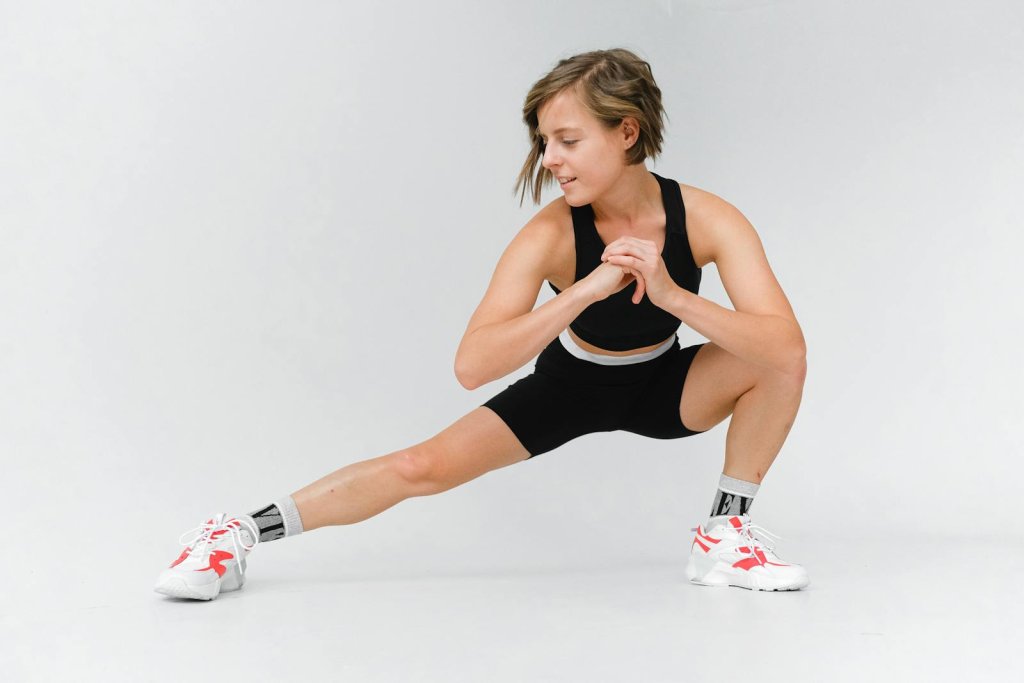
These muscles play a major role in walking, running, squatting, and side-to-side movements—yet many people overlook them. Strong adductors may help support pelvic alignment, improve sports performance, and reduce the risk of groin discomfort, especially during quick directional changes.
This guide breaks down 14 of the best hip adductor exercises, including beginner-friendly options, intermediate strength drills, and advanced athletic variations supported by research.
What Are Hip Adductor Muscles?
The hip adductors include the adductor longus, brevis, magnus, gracilis, and pectineus. These muscles run along the inner thigh and help with:
- Pulling the leg inward (adduction)
- Supporting hip flexion, extension, and rotation
- Stabilizing the pelvis during walking, running, and single-leg balance
Understanding their role makes it easier to choose exercises that strengthen them safely and effectively.
Why Hip Adductor Strength Matters
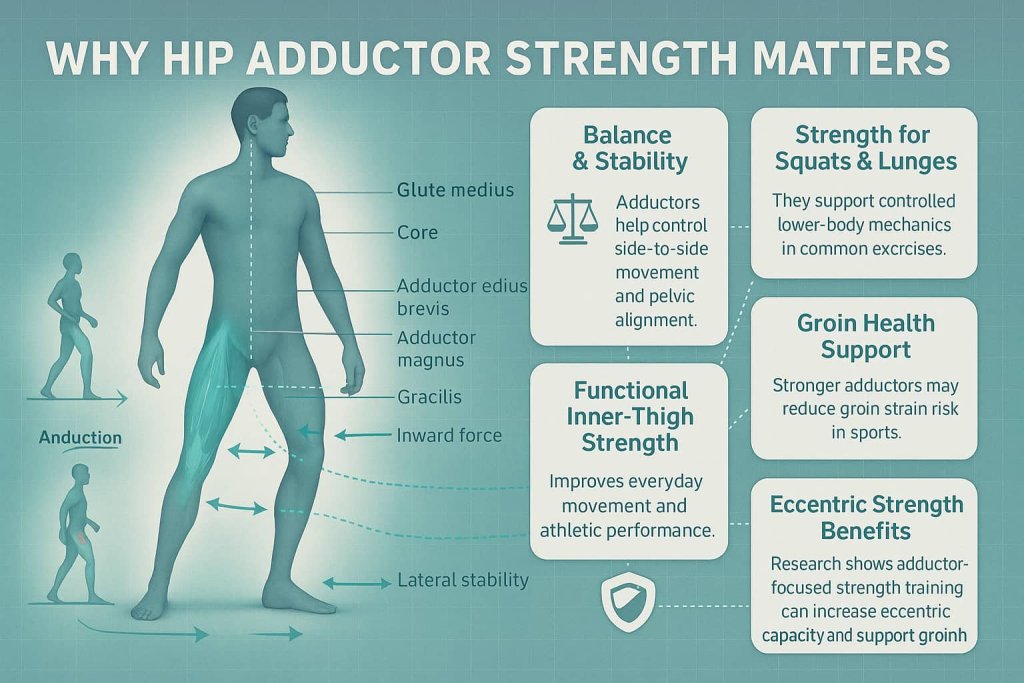
Strong hip adductors may help support:
- Better balance and side-to-side stability
- Improved control during squats, lunges, and athletic movement
- Reduced risk of groin strains (common in sports like soccer and hockey)
- Stronger, more functional inner thighs
- Stability during single-leg stance and directional changes
Research shows that adductor-focused strength training may increase eccentric strength and support groin health in athletes (Copenhagen exercise studies, Serner et al., 2013–2020).
14 Best Hip Adductor Exercises
These hip adductor exercises strengthen your inner thighs, improve hip stability, and support better movement in daily life and sports. Each exercise targets the muscles that help control balance, lateral motion, and pelvic alignment.
Beginner Hip Adductor Exercises
1. Supine Ball or Pillow Squeeze
Why it works:
This gentle, low-impact exercise activates the hip adductors without stressing the hip joint. It improves neuromuscular control and prepares the inner thighs for more advanced strengthening.
Muscles worked:
Adductor longus, adductor brevis, adductor magnus, gracilis, pectineus, and deep pelvic stabilizers.
How to do it:
- Lie on your back with knees bent and feet flat.
- Place a pillow or soft ball between your knees.
- Gently squeeze inward and hold for 5–10 seconds.
- Release slowly and repeat 10–15 times.
Trainer Tip:
Keep the squeeze at a mild-to-moderate intensity—enough to feel activation but not strain. Focus on even pressure from both knees.
2. Side-Lying Hip Adduction
Why it works:
This isolates the bottom-leg adductors and strengthens them through a controlled range of motion. It’s ideal for improving single-leg stability.
Muscles worked:
Primarily adductor longus and adductor magnus; secondary activation in obliques and hip stabilizers.
How to do it:
- Lie on your side with the bottom leg straight.
- Cross the top leg over or rest it in front.
- Lift the bottom leg upward a few inches.
- Lower slowly with control for 10–15 reps per side.
Trainer Tip:
Lead with your heel to avoid turning the leg outward. This isolates the adductors more effectively.
3. Standing Band Adduction
Why it works:
This introduces resistance while training balance and frontal-plane stability. It strengthens the adductors in a functional standing position.
Muscles worked:
Adductor group, gluteus medius (stabilizing), core muscles.
How to do it:
- Loop a light resistance band around your ankle.
- Stand tall and hold onto support if needed.
- Pull your working leg inward across your body.
- Return slowly.
- Perform 10–15 reps per leg.
Trainer Tip:
Move only your leg—the hips and torso should stay square and still for best muscle isolation.
4. Seated Hip Adduction Squeeze
Why it works:
Perfect for beginners or those with limited mobility, this version provides controlled activation without weight-bearing.
Muscles worked:
Adductor longus, brevis, magnus, and gracilis.
How to do it:
- Sit upright with feet flat on the floor.
- Place a cushion or ball between your knees.
- Squeeze gently for 5–8 seconds.
- Repeat 12–15 times.
Trainer Tip:
Sit tall and avoid leaning forward—keeping neutral posture improves activation.
5. Inner-Thigh Leg Raise (Top-Leg Version)
Why it works:
This variation targets the top leg adductors while also improving hip control and stability.
Muscles worked:
Adductor magnus, adductor longus, pectineus, and supporting core muscles.
How to do it:
- Lie on your side with the top leg extended forward.
- Lift the top leg slightly upward.
- Lower slowly with control.
- Repeat 10–15 reps.
Trainer Tip:
Keep your toes pointed forward, not upward—this prevents shifting work into the hip flexors.
Intermediate Hip Adductor Exercises
6. Cable Hip Adduction
Why it works:
Provides consistent resistance through the full range of motion, allowing for progressive strength development.
Muscles worked:
All hip adductors, especially adductor longus and magnus.
How to do it:
- Attach a low cable to your ankle.
- Stand tall with core braced.
- Pull the leg inward toward the midline.
- Return slowly to starting position.
- Perform 10–15 reps each side.
Trainer Tip:
Keep your foot flexed and move slowly—speed reduces adductor activation.
7. Cossack Squat
Why it works:
A deep side-to-side squat that improves inner-thigh strength, hip mobility, and lower-body stability.
Muscles worked:
Adductors, glutes, hamstrings, quadriceps, core.
How to do it:
- Step into a wide stance.
- Shift weight to one side and lower into a deep squat.
- Keep the opposite leg straight.
- Push back to center.
- Do 6–10 reps each side.
Trainer Tip:
Keep the heel of the straight leg grounded and your chest lifted to maintain good form.
8. Lateral Lunge
Why it works:
Strengthens the adductors while training functional side-to-side movement, useful for sports and stability.
Muscles worked:
Adductors, gluteus maximus, quadriceps, hamstrings.
How to do it:
- Step to the side and bend one knee.
- Keep the other leg straight.
- Push through the bent leg to return to standing.
- Perform 10–12 reps each side.
Trainer Tip:
Sit back into your hips—don’t let your knee collapse inward.
9. Sliding Lateral Lunge
Why it works:
The sliding motion increases eccentric load on the adductors, helping develop strength and control.
Muscles worked:
Adductors (eccentric emphasis), glutes, hamstrings, core.
How to do it:
- Stand with one foot on a slider or towel.
- Slide the foot outward as you bend the opposite knee.
- Pull the sliding foot back inward using the inner thigh.
- Do 8–12 reps each side.
Trainer Tip:
Move slowly—eccentric work is most effective with controlled tempo.
10. Stability Ball Wall Squeeze
Why it works:
Enhances isometric inner-thigh strength while engaging balance and pelvic stability.
Muscles worked:
Adductor group, core, glute medius (stabilization).
How to do it:
- Place a stability ball between your thigh and a wall.
- Stand tall and press inward.
- Hold 5–10 seconds.
- Repeat 10–12 times.
Trainer Tip:
Ensure your hips stay level—don’t let your body lean heavily into the wall.
Advanced Hip Adductor Exercises
11. Copenhagen Adduction (Short-Lever)
Why it works:
A research-supported exercise known for significantly increasing eccentric adductor strength and supporting groin health.
Muscles worked:
Adductors (especially longus and magnus), obliques, hip stabilizers.
How to do it:
- Place your top knee on a bench.
- Support your upper body with your forearm.
- Lift your hips and bottom leg off the floor.
- Lower with control.
- Perform 6–10 reps per side.
Trainer Tip:
Start with very small ranges to avoid overstressing the adductors if you’re new to this exercise.
12. Copenhagen Adduction (Long-Lever)
Why it works:
This variation dramatically increases load by extending the lever arm, ideal for advanced athletes.
Muscles worked:
Adductor longus, magnus, core, obliques, glute stabilizers.
How to do it:
- Place your top foot on the bench.
- Support yourself on your forearm.
- Lift hips and bottom leg.
- Lower slowly for eccentric strength.
- Aim for 5–8 reps each side.
Trainer Tip:
Use a slower lowering phase (2–3 seconds) to maximize strength benefits safely.
13. Lateral Shuffle with Resistance
Why it works:
Challenges the adductors dynamically during continuous side-to-side motion, improving athletic ability.
Muscles worked:
Adductors, glute medius, quadriceps, calves, core.
How to do it:
- Place a band around your ankles or knees.
- Lower slightly into an athletic stance.
- Shuffle sideways 10–20 steps per direction.
- Maintain tension throughout.
Trainer Tip:
Avoid clicking your feet together—keep constant outward pressure on the band.
14. Single-Leg Romanian Deadlift (Adductor-Biased)
Why it works:
Shifting the free leg inward increases adductor loading while improving balance and posterior chain strength.
Muscles worked:
Adductors, hamstrings, glutes, core stabilizers.
How to do it:
- Stand tall on one leg.
- Slightly angle the opposite leg inward.
- Hinge forward while maintaining a straight spine.
- Return to standing.
- Perform 8–12 reps each side.
Trainer Tip:
Push your hips back rather than lowering your chest—this protects your lower back and increases inner-thigh engagement.
How Often Should You Train Hip Adductors?
General guidelines based on ACSM strength-training recommendations:
- 2–3 days per week of lower-body or full-body strength work
- 1–3 sets per exercise
- 8–15 controlled reps depending on your level
- Allow 48 hours rest between hard sessions
- Begin with low-load isometrics if you have tightness or discomfort
Progress gradually to avoid overstressing the inner thigh muscles.
Common Mistakes to Avoid
- Using too much weight too soon: Start light to avoid inner-thigh strain.
- Letting hips rotate outward: Keep toes forward to target the adductors.
- Moving too quickly: Slow, controlled reps activate the muscles better.
- Leaning the torso or using momentum: Stay upright to prevent compensation.
- Skipping warm-up: Cold muscles are more prone to discomfort.
- Ignoring warning signs: Stop if you feel sharp pain or pulling.
Safety Tips Before You Start
To keep your training safe and effective:
- Warm up for 3–5 minutes (light marching, hip mobility, lateral steps).
- Start with slow, small-range movements.
- Avoid sharp pain or discomfort during adductor loading.
- Use isometrics (squeezes) if returning from groin tightness.
- Talk to a healthcare professional if you have a history of groin strain, hip pain, or arthritis.
Who Should Avoid or Modify Hip Adductor Exercises
- Recent groin strain: Begin only with gentle isometrics under guidance.
- Active hip or groin pain: Modify or stop until symptoms ease.
- Hip labral issues or impingement: Use smaller ranges and avoid deep side positions.
- Arthritis flare-ups: Choose low-impact, mild-intensity options.
- Beginners: Avoid advanced exercises like Copenhagen variations.
- Post-surgery individuals: Seek medical clearance first.
Frequently Asked Questions (FAQ)
1. Do hip adductor exercises reduce inner thigh fat?
No exercise can target fat in one body area. These exercises strengthen the muscles; overall fat change requires calorie balance and activity.
2. Are hip adductor exercises good for knee stability?
Yes, stronger adductors may help support knee alignment during lateral and single-leg movements.
3. Should beginners avoid Copenhagen exercises?
Beginners should start with isometrics or side-lying adduction first. Copenhagen variations are advanced and require preparation.
4. How long does it take to see results?
Many people notice strength changes in 3–6 weeks with consistent training.
5. Can these exercises help with mobility?
Yes—many movements improve both strength and inner thigh flexibility through controlled range of motion.
6. Are machines or free-weight adduction better?
Both can work. Free-weight and band versions challenge balance more, while machines offer targeted isolation.
7. Should I stretch before or after adductor exercises?
Do gentle mobility before, and save deeper stretching for after your workout or at the end of the day.
Conclusion
Hip adductor exercises are essential for stronger inner thighs, better balance, and more stable hips. Whether you’re an athlete or a beginner, adding 2–3 of these movements to your weekly routine may help support hip control and lower-body strength. Start with beginner squeezes and side-lying drills, then progress to intermediate and advanced variations like the Copenhagen adduction as your stability improves.
This content is for informational purposes only and not medical advice.
References
- Serner A, et al. EMG evaluation of hip adduction exercises for soccer players: implications for exercise selection in prevention and treatment of groin injuries. British Journal of Sports Medicine. 2014.
- Ishøi L, et al. Large eccentric strength increase using the Copenhagen Adduction exercise in-season: a randomized controlled trial. Scandinavian Journal of Medicine & Science in Sports. 2016.
- Pérez-Gómez J, et al. Copenhagen Adduction Exercise to Increase Eccentric Strength: A Systematic Review and Meta-Analysis. Applied Sciences. 2020.
- Harøy J, et al. The adductor strengthening programme prevents groin problems among male football players: a cluster-randomised controlled trial. British Journal of Sports Medicine. 2019.
- Thorborg K, et al. Eccentric and isometric hip adduction strength in male soccer players with and without adductor-related groin pain: an assessor-blinded comparison. Orthopaedic Journal of Sports Medicine. 2014.
- Quintana-Cepedal M, et al. The Copenhagen Adduction Exercise Effect on Sport Performance and Injury Prevention Outcomes in Athletes: A Systematic Review. 2025.
- American College of Sports Medicine. Progression models in resistance training for healthy adults. Medicine & Science in Sports & Exercise. 2009.
- Centers for Disease Control and Prevention (CDC). Adult Activity: An Overview – Physical Activity Basics. Updated 2023.