
The lunge exercise is a foundational lower-body movement that strengthens your legs, glutes, and core while also improving balance and coordination. Because it trains one leg at a time, it closely mimics real-world activities like walking, climbing stairs, and getting up from the floor, which makes it valuable for beginners, athletes, and older adults alike.
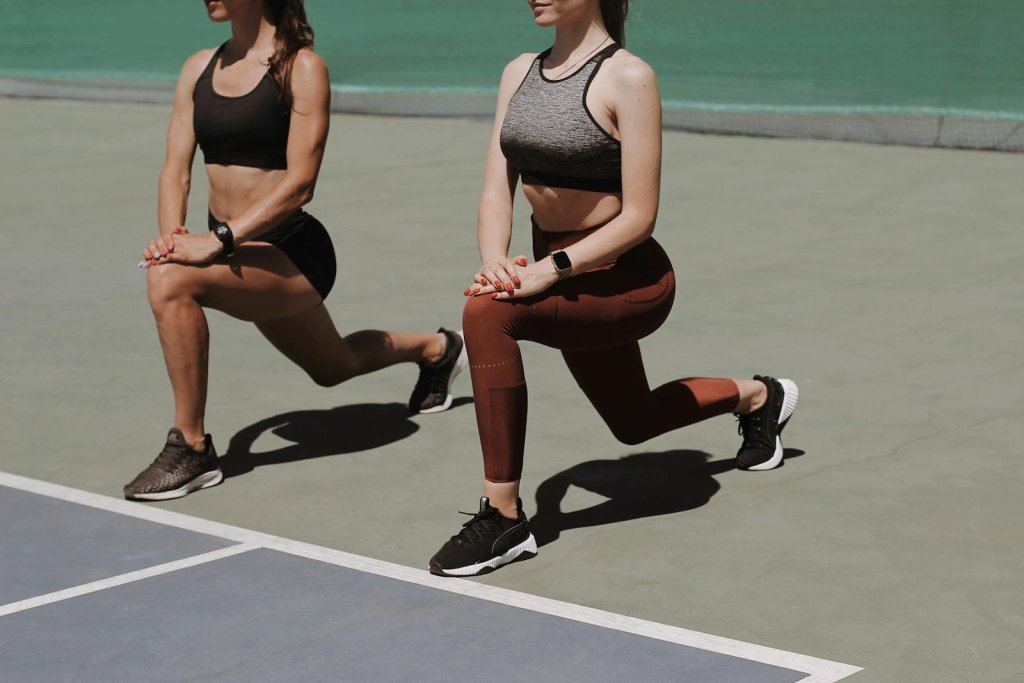
Understanding proper lunge form is important because small technique errors—especially at the knee and hips—can reduce effectiveness and increase unnecessary joint stress. This guide breaks down how the lunge exercise works, the muscles involved, its key benefits, safe execution, and common mistakes, using evidence-based fitness guidelines.
What Is the Lunge Exercise?
The lunge exercise is a unilateral lower-body movement where one leg steps forward, backward, or laterally while the body lowers under control and then returns to standing. Unlike squats, lunges challenge balance and stability because each leg works independently.
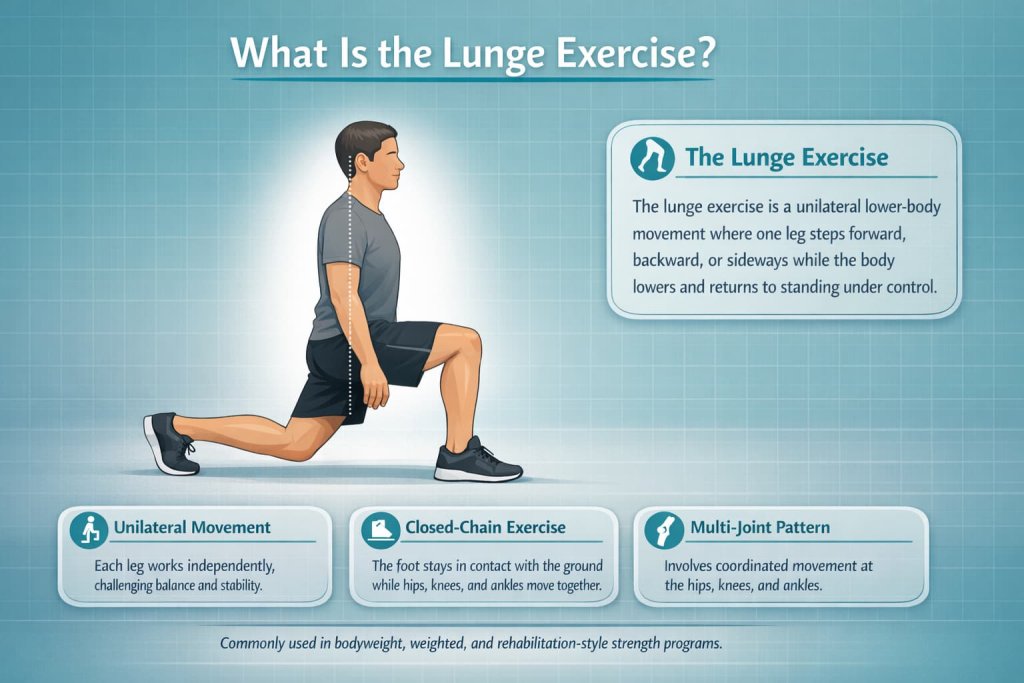
In resistance-training terminology, lunges are classified as a closed-chain, multi-joint exercise, meaning the foot stays in contact with the ground while multiple joints (hips, knees, ankles) move together.
Organizations such as the American College of Sports Medicine recognize lunges as a standard lower-body strengthening movement suitable for bodyweight, dumbbell, barbell, and rehabilitation-style programs.
How to Do the Lunge Exercise Correctly
How to do it
- Stand tall with feet hip-width apart
- Step one leg forward far enough to allow both knees to bend
- Lower your body until the back knee moves toward the floor under control
- Keep your torso upright and core braced
- Push through the front heel to return to standing
- Repeat on the other side
Controlled tempo is key. Avoid rushing the lowering phase, as this is where stability and muscle engagement are highest.
Lunge Exercise Variations
Different lunge variations can emphasize comfort, balance, muscle activation, or movement control. Below is an elaborated, research-aligned breakdown of the most common lunge exercise variations using your requested format.
1. Forward Lunge
Why it works:
The forward lunge challenges strength and control as you decelerate your bodyweight onto the lead leg. It closely resembles forward stepping tasks used in daily life and sport, making it highly functional.
How to do it:
- Stand tall with feet hip-width apart
- Step forward with one leg
- Lower until both knees bend under control
- Keep torso upright and knee tracking over toes
- Push through the front heel to return to standing
Trainer Tip:
Control the lowering phase to improve knee stability and reduce excessive joint stress.
2. Reverse Lunge
Why it works:
Stepping backward reduces forward momentum and knee shear forces, which may make this variation more comfortable for beginners or individuals with knee sensitivity.
How to do it:
- Stand tall with feet hip-width apart
- Step one leg backward
- Lower the body under control
- Keep weight centered over the front leg
- Push through the front heel to stand
Trainer Tip:
Think “sit straight down” rather than shifting forward to maintain balance and control.
3. Walking Lunge
Why it works:
Walking lunges increase time under tension and require continuous balance and coordination, which raises overall muscular and cardiovascular demand.
How to do it:
- Step forward into a lunge
- Push through the front foot to bring the back leg forward
- Step directly into the next lunge
- Maintain upright posture throughout
Trainer Tip:
Use slow, deliberate steps to avoid losing alignment as fatigue increases.
4. Lateral Lunge
Why it works:
The lateral lunge trains frontal-plane movement, which is often undertrained. It improves hip mobility and strengthens muscles involved in side-to-side stability.
How to do it:
- Stand with feet wider than hip-width
- Shift weight to one side while bending that knee
- Keep the opposite leg straight
- Push through the bent leg to return to center
Trainer Tip:
Sit the hips back rather than letting the knee drift excessively forward.
5. Split Squat
Why it works:
Because the feet stay planted, the split squat reduces balance demands while still delivering strong unilateral leg loading. This makes it ideal for beginners and strength progressions.
How to do it:
- Take a staggered stance and stay in place
- Lower straight down under control
- Keep torso upright
- Push through the front heel to rise
Trainer Tip:
Focus on vertical movement instead of forward motion to maximize muscle control.
Muscles Worked in the Lunge Exercise
The lunge exercise engages multiple muscle groups simultaneously, which is why it is often included in full-body or lower-body workouts.
Primary muscles
- Quadriceps (front thigh) – knee extension and control during lowering
- Gluteus maximus – hip extension and power during standing up
Secondary and stabilizing muscles
- Hamstrings – assist hip extension and knee control
- Gluteus medius and minimus – stabilize the pelvis and prevent hip drop
- Calves – ankle stability and push-off
- Core muscles – torso stability and balance
Electromyography (EMG) research consistently shows high activation of the quadriceps and meaningful glute engagement during forward and reverse lunges, especially when depth and control are maintained.
Key Benefits of the Lunge Exercise
Regularly performing lunges may help support:
- Lower-body strength development using functional movement patterns
- Improved balance and coordination due to unilateral loading
- Hip and knee control during deceleration and direction changes
- Muscle symmetry, helping reduce side-to-side strength differences
- Bone loading, which supports bone health when progressed appropriately
Public-health guidance from the Centers for Disease Control and Prevention and the World Health Organization recommends muscle-strengthening activities involving major muscle groups at least two days per week. Lunges easily fit within these guidelines.
Common Mistakes to Avoid With Lunges
- Letting the front knee collapse inward or drift excessively forward
- Leaning the torso too far forward or arching the lower back
- Taking a step that is too short, limiting proper depth
- Rushing repetitions instead of maintaining controlled movement
Proper alignment and controlled speed are consistently emphasized by professional coaching standards and strength-training research.
How Often Should You Do Lunge Exercises?
According to resistance-training guidelines from the American College of Sports Medicine, lunges can be programmed:
- 2–3 days per week for general strength
- 2–4 sets per side
- 8–12 controlled repetitions per set
Progressions can include added load, increased depth, slower tempo, or advanced variations.
Who Should Be Cautious or Modify Lunges?
The lunge exercise is generally safe when performed correctly, but modifications may be helpful if you:
- Are new to strength training
- Have balance limitations
- Are returning from a lower-body injury
- Experience knee or hip discomfort
Using reverse lunges, reducing depth, holding onto support, or starting with split squats can help maintain benefits while reducing difficulty.
If pain persists, consulting a qualified fitness or healthcare professional is recommended.
Frequently Asked Questions About the Lunge Exercise
Are lunges bad for your knees?
Lunges are not inherently bad for the knees. Poor form, excessive depth, or rushing movements are more common causes of discomfort.
Which lunge is best for beginners?
Reverse lunges or split squats are often better starting points because they reduce balance and knee stress.
Do lunges build glutes or quads more?
Lunges train both. Longer step lengths tend to increase glute involvement, while shorter steps emphasize the quadriceps.
Can I do lunges every day?
Light, bodyweight lunges may be performed frequently, but strength-focused sessions should allow recovery days.
Are lunges better than squats?
Neither is better universally. Lunges emphasize unilateral strength and balance, while squats allow heavier bilateral loading.
Conclusion
The lunge exercise is one of the most effective movements for building lower-body strength, balance, and functional control. When performed with proper technique and appropriate progression, it supports strong legs, stable hips, and confident movement in daily life.
If you are building a balanced workout routine, lunges deserve a consistent place alongside squats, hinges, and pushes. Start with controlled form, choose the variation that suits your ability level, and progress gradually for long-term results.