
If you’re looking to build bigger biceps and stronger triceps using dumbbells, you’ll find a proven set of moves that deliver. This article shows exactly how to select and perform 16 dumbbell exercises to target your arm muscles effectively while reducing risk of injury. Understanding proper form, exercise variety, and smart progression matters because your arms aren’t just for looks—they’re involved in daily pushing and pulling, and a good program ensures strength, balance and long-term health. In this guide you’ll find top biceps and triceps exercises, how to program them, safety tips, plus how to tune reps, sets and frequency for real results.
Why Dumbbell Exercises for Biceps and Triceps Matter
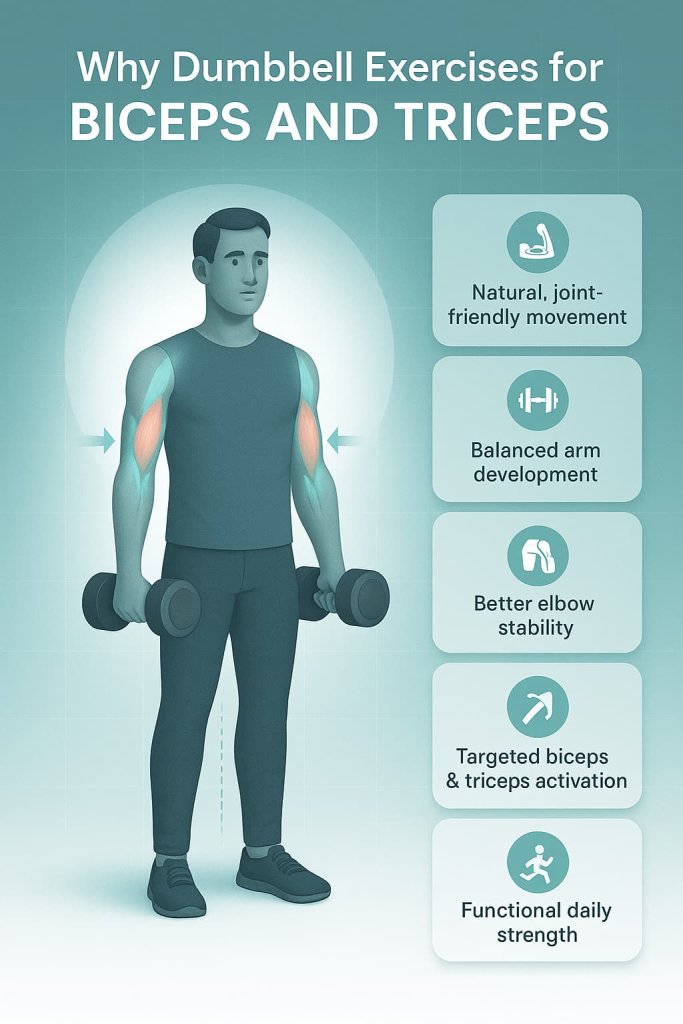
Dumbbell exercises play an important role in developing strong, well-balanced arms. Because dumbbells allow each arm to move independently, they help correct imbalances, improve joint stability, and build functional strength for everyday tasks. Training both biceps and triceps together also supports better pushing and pulling performance, making upper-body movements smoother and more controlled.
Key reasons they matter:
- Provide a natural, joint-friendly range of motion
- Strengthen both sides of the arm for balanced development
- Improve elbow stability and long-term joint support
- Allow targeted training for both flexion (biceps) and extension (triceps)
- Make progression simple—easy to increase weight gradually
- Enhance functional strength for daily activities
- Require minimal equipment, making them accessible at home or in the gym
16 Best Dumbbell Exercises for Bigger Biceps & Stronger Triceps
Section 1: Best Dumbbell Biceps Exercises
Here are 8 dumbbell exercises that target the biceps with different angles and grips.
1. Standing Dumbbell Curl
Why it works:
The standing dumbbell curl trains the biceps through a natural, full range of motion. Because you’re standing, your core and posture muscles stay engaged, allowing you to control momentum more effectively. Using a supinated (palms-up) grip emphasizes the short head of the biceps and helps build both strength and visible arm shape.
How to do it:
- Stand tall with feet shoulder-width apart, holding dumbbells at your sides with palms facing forward.
- Keep elbows pinned to your torso.
- Curl both dumbbells upward until your forearms are nearly vertical.
- Pause briefly at the top and contract the biceps.
- Lower slowly for 2–3 seconds back to the starting position.
- Perform 2–4 sets of 8–12 controlled reps.
Trainer Tip:
If your upper body rocks backward, the weight is too heavy. Reduce the load and slow down the eccentric (lowering) phase to increase tension safely.
2. Seated Dumbbell Curl
Why it works:
Sitting removes lower-body assistance and prevents excessive swinging, forcing your biceps to handle the full load. This creates strict tension on the short and long heads of the biceps and allows better focus and symmetry.
How to do it:
- Sit upright on a bench holding dumbbells at your sides, palms facing forward.
- Keep elbows fixed as you curl the weights up simultaneously or alternately.
- Pause briefly, then lower slowly under control without bouncing.
Trainer Tip:
Let your arms hang slightly behind your body at the start for an increased long-head stretch and better tension through the entire movement.
3. Alternating Dumbbell Curl
Why it works:
By curling one arm at a time, you minimize compensation and develop better left-right balance. This exercise enhances mind-muscle connection and allows you to concentrate fully on each rep.
How to do it:
- Stand (or sit) with dumbbells in both hands.
- Curl the right dumbbell while the left arm stays still.
- Lower the right dumbbell slowly, then repeat with the left.
- Continue alternating with strict form.
Trainer Tip:
At the top of each curl, pause for ½–1 second to increase peak contraction and improve biceps engagement.
4. Incline Dumbbell Curl
Why it works:
Setting the bench to a 30–45° incline places the biceps in a stretched position, especially the long head. This extended stretch increases mechanical tension, which may help improve size and peak shape over time.
How to do it:
- Sit back on an incline bench with arms fully extended down.
- Rotate palms forward and curl the dumbbells in a smooth arc.
- Lower slowly until you feel a full stretch in the biceps.
Trainer Tip:
Relax your shoulders and avoid arching your back—focus on keeping the motion isolated to the arms.
5. Hammer Curl
Why it works:
The neutral-grip hammer curl shifts more stress to the brachialis and brachioradialis, muscles that add thickness and width to the upper arm. It also strengthens grip and forearm stability.
How to do it:
- Stand tall holding dumbbells at your sides with palms facing inward.
- Curl the weights upward while maintaining the neutral grip.
- Lower slowly and repeat.
Trainer Tip:
Keep wrists straight and elbows pinned to prevent swinging and ensure the brachialis stays engaged.
6. Cross-Body Hammer Curl
Why it works:
Curling diagonally across your body increases brachialis recruitment and changes the angle of tension. This movement helps build upper-arm width and creates a unique stimulus compared to standard curls.
How to do it:
- Hold dumbbells at your sides with palms facing inward.
- Raise the right dumbbell across your body toward the left shoulder.
- Lower slowly, then repeat with the left arm.
Trainer Tip:
Use a smooth, controlled motion—any swinging reduces brachialis activation and increases injury risk.
7. Concentration Curl
Why it works:
With elbow braced against your thigh, the concentration curl eliminates body momentum and isolates the biceps completely. This creates high tension on the muscle and allows strong peak contraction.
How to do it:
- Sit on a bench with legs spread.
- Lean forward and rest your working arm’s elbow on the inside of your thigh.
- Curl the dumbbell upward until your biceps are fully contracted, then lower slowly.
Trainer Tip:
Take 3–4 seconds to lower the weight each rep to maximize tension and muscle control.
8. Zottman Curl
Why it works:
This combination curl uses a supinated grip on the way up (biceps focus) and a pronated grip on the way down (forearm emphasis). It builds stronger biceps and forearms while improving wrist rotation strength.
How to do it:
- Stand holding dumbbells, palms facing up.
- Curl the weights up.
- At the top, rotate palms down and lower the dumbbells slowly.
- Rotate back to palms-up at the bottom.
Trainer Tip:
The rotation at the top is what makes the Zottman curl effective—perform it deliberately, not quickly.
Section 2: Best Dumbbell Triceps Exercises
Here are 8 top dumbbell exercises for triceps development covering all three heads and varied pressing and isolation angles.
9. Dumbbell Overhead Triceps Extension
Why it works:
Raising the arms overhead lengthens the long head of the triceps, allowing a deep stretch and strong contraction. This move is highly effective for overall triceps size and strength.
How to do it:
- Sit or stand holding one dumbbell (or two) overhead.
- Keep upper arms beside ears as you lower the weight behind your head.
- Extend upward while maintaining control.
Trainer Tip:
Avoid flaring your elbows outward—forward-facing elbows keep tension on the triceps.
10. Dumbbell Skullcrusher (Lying Triceps Extension)
Why it works:
This variation provides a stable base and allows you to lower the dumbbells deeply, stretching the long and lateral heads of the triceps. It’s one of the best isolation moves for building mass.
How to do it:
- Lie on a bench with dumbbells held above your chest.
- Bend elbows to lower the weights toward your ears.
- Extend the elbows to return to the top.
Trainer Tip:
Only your forearms should move—fix the upper arms to prevent shoulder strain.
11. Dumbbell Close-Grip Floor Press
Why it works:
Pressing from the floor limits range of motion and protects the shoulders while placing more demand on the triceps. Perfect for building pressing strength and triceps thickness.
How to do it:
- Lie on the floor with dumbbells extended above your torso.
- Lower until elbows touch the floor.
- Press upward while keeping elbows tucked.
Trainer Tip:
Maintain a 45° elbow angle—tucked, not flared—to maximize triceps activation.
12. Dumbbell Triceps Kickback
Why it works:
The kickback isolates the triceps at full elbow extension, which is where the lateral head works hardest. Great for shaping and strengthening the lockout phase.
How to do it:
- Support your non-working hand on a bench.
- Keep upper arm parallel to the floor.
- Extend the dumbbell fully behind you, then lower slowly.
Trainer Tip:
If your upper arm drops during reps, you’ll lose tension. Keep it fixed and parallel at all times.
13. Dumbbell Tate Press
Why it works:
This unique pressing movement targets the medial and lateral heads of the triceps through an unusual angle. It’s excellent for overall thickness and lockout strength.
How to do it:
- Lie on a bench holding dumbbells above your chest, palms facing your face.
- Lower the dumbbells diagonally toward your shoulders.
- Press back to the starting position.
Trainer Tip:
Use light to moderate weights—this move relies on precision, not heavy loading.
14. Dumbbell JM Press
Why it works:
A hybrid between a skullcrusher and a close-grip press, this exercise targets all three heads of the triceps while improving pressing power.
How to do it:
- Lie on a bench with palms facing each other.
- Lower dumbbells toward your upper chest/neck area by bending elbows.
- Press back up in a smooth arc.
Trainer Tip:
Keep the movement small and controlled—this is not a full press or full extension.
15. Dumbbell Neutral-Grip Press (Elbows Tucked)
Why it works:
Using a neutral grip shifts emphasis from chest to triceps while keeping the movement joint-friendly. Excellent for strength and finishing triceps after isolation work.
How to do it:
- Lie on a bench with dumbbells held at chest level, palms facing each other.
- Press upward while keeping elbows close to your body.
- Lower slowly and repeat.
Trainer Tip:
Keep your core tight and avoid overarching your lower back.
16. Dumbbell Decline Triceps Extension
Why it works:
Changing the bench angle alters the line of pull on the long head of the triceps, providing a unique stretch that helps break plateaus and adds variety to your routine.
How to do it:
- Set bench to a 15–30° decline.
- Hold dumbbells overhead and lower them behind you.
- Extend back up with full control.
Trainer Tip:
A great alternative if traditional overhead extensions feel uncomfortable—keep the movement slow and your elbows close.
Why Focus on Both Biceps and Triceps
To sculpt well-rounded arms, you must train both the front (biceps) and the back (triceps). The biceps (two heads) contribute to elbow flexion and forearm supination. The triceps (three heads) drive elbow extension and stabilise pressing movements. Working both ensures functional strength and visual balance—ignoring the triceps often leads to under-developed arms and pressing weakness.
How to Train with Dumbbells for Arm Growth
- Choose a weight where the final 2-3 reps of a set are challenging but can still be done with good form.
- Use a rep range of about 8-12 reps for most sets for hypertrophy.
- Perform 2-4 sets per exercise depending on your overall volume.
- Rest about 60-90 seconds between sets.
- Aim for 2-3 arm-specific sessions a week or incorporate arms twice.
- Progress by adding 2–10% load or more reps when current sets become manageable.
- Vary the angle, grip and type of contraction (stretch vs lock-out) to hit the muscle fully.
Training Guidelines for Arm Growth (Sets, Reps, Frequency)
- Train arms 2–3 days per week
- Perform 2–4 sets per exercise
- Use 8–12 reps for muscle growth
- Rest 60–90 seconds between sets
- Increase weight gradually when reps feel easier
- Use controlled lowering phases for better muscle tension
Sample Weekly Program
Here’s how you might schedule these 16 exercises across a week for hypertrophy:
| Day | Focus | Exercise Count |
|---|---|---|
| Day 1 | Biceps (4 exercises) | 4 exercises × 3 sets |
| Day 2 | Triceps (4 exercises) | 4 exercises × 3 sets |
| Day 3 | Rest or Lower-body/Back | — |
| Day 4 | Biceps (4 new exercises) | 4 × 3 sets |
| Day 5 | Triceps (4 new exercises) | 4 × 3 sets |
| Day 6-7 | Rest/active recovery | — |
Notes:
- Use a weight that allows 8-12 reps with good form; on 3rd set aim for near-failure.
- Switch up exercises every 4–6 weeks to keep stimulus fresh.
- Ensure full recovery (≥48 hours) between arm-specific sessions to avoid overtraining.
Trainer Tips & Common Mistakes
- Trainer Tip: Prioritise form over heavy weight; strict reps build more muscle than sloppy high reps.
- Common Mistake: Using swinging motion or too much momentum (especially with standing curls) — this reduces muscle tension and increases injury risk.
- Trainer Tip: Always include a warm-up set (light weight, ~15 reps) before jumping into your work sets to prepare joints and muscles.
- Common Mistake: Ignoring the eccentric (lowering) phase — slowing the lowering brings more mechanical tension and growth stimulus.
- Trainer Tip: For safety and longevity: ensure good posture, avoid locking joints when tired, and listen to shoulder or elbow discomfort (modify or stop if pain persists).
How to Use Dumbbells Safely for Arm Workouts
- Warm up 3–5 minutes before lifting
- Choose weights you can control with proper form
- Keep shoulders down, core tight, and wrists straight
- Avoid swinging or using momentum
- Move through a pain-free range of motion
- Stop immediately if you feel sharp or unusual pain
Frequently Asked Questions
Q1: How often should I train my biceps and triceps?
You can train each muscle group about 2 times per week with sufficient recovery in between (≥48 hours) and using 6–10 hard sets per session.
Q2: Can I train biceps and triceps on the same day?
Yes. Combining biceps and triceps into one arm-session (e.g., 4 biceps + 4 triceps exercises) is efficient and allows you to free other days for back, chest, legs.
Q3: Do I need heavy weights to build arm muscle?
Not necessarily heavy — load should be enough that the final 2–3 reps are challenging while maintaining form. Progressive overload (small increases over time) matters more than maximal weight.
Q4: What if one arm is significantly weaker or smaller?
Use unilateral dumbbell exercises (alternating curls, single-arm extensions) and start with the weaker arm so it sets the load. Focus on equal reps and avoid letting the stronger side dominate.
Q5: Should I prioritize compound pressing moves or isolation for triceps?
Both. Compound moves (neutral-grip presses, floor press) build strength and engage triceps plus other muscles; isolation moves (kickbacks, skullcrushers) allow focus on triceps heads. A mix produces best results.
Q6: How long until I see results?
With consistent training (2 arm sessions/week), proper nutrition and recovery, noticeable changes can appear in 8–12 weeks. However, individual responses vary.
Q7: Can I do these exercises at home with limited equipment?
Absolutely. Most exercises only require dumbbells and a bench or stable chair. Adjust weight/sets accordingly and make sure your space allows safe movement.
Conclusion
With the 16 dumbbell exercises listed above, you have a powerful, well‐rounded plan to build bigger biceps and stronger triceps. Combine the right sets, reps, progression and smart exercise selection, and you’ll be on track for defined, functional arms. Start with good form, maintain focus, and be consistent—and your arms will respond. Now grab your dumbbells, pick the option that fits your gear and schedule, and get started with confidence.