
If you want to strengthen the back of your legs without heavy equipment, resistance band hamstring exercises are one of the most effective and joint-friendly options available. These band-based movements help you train hip extension and knee flexion—the two primary actions of the hamstrings—using portable, low-impact resistance.
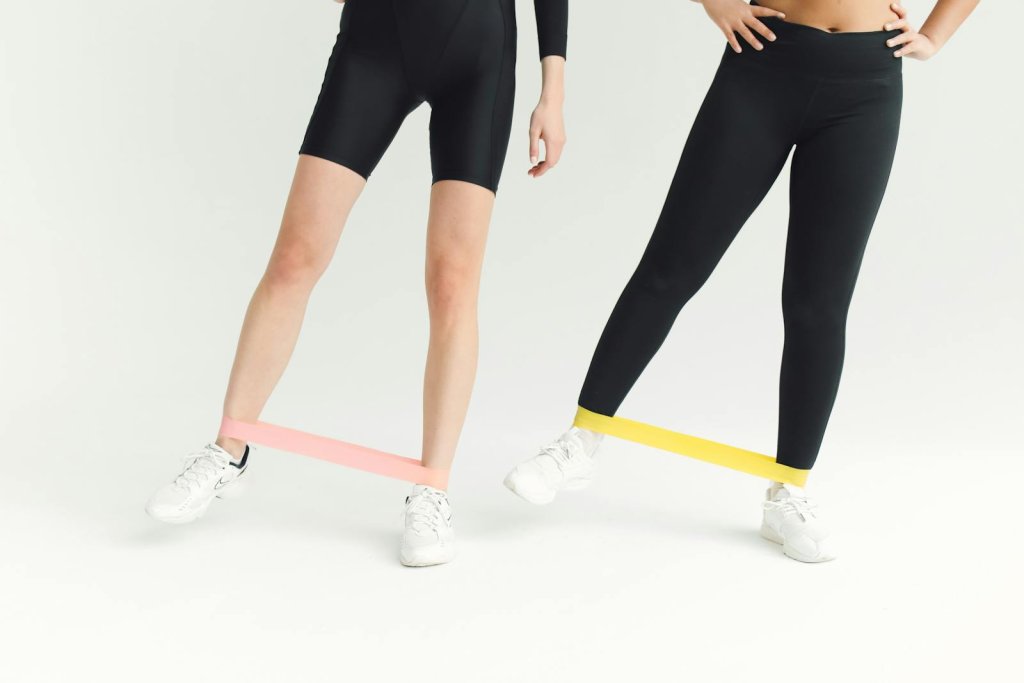
Training your hamstrings is essential because weak or tight hamstrings increase the risk of strains, poor movement patterns, knee instability, and lower-back stress. Resistance bands offer a simple way to build strength, improve flexibility, and activate the entire posterior chain at home or in the gym.
The 10 Best Resistance Band Hamstring Exercises
These exercises target your hamstrings through both hip-extension and knee-flexion patterns, giving you a complete posterior-chain workout using only a resistance band. Choose 3–4 movements and perform them consistently to build strength, stability, and flexibility.
1. Banded Romanian Deadlift (RDL)
Why it works:
Trains the hamstrings through a long-length hip hinge, building strength, flexibility, and posterior-chain stability. This movement also reinforces proper hip-hinge mechanics, which are essential for safe lifting.
Muscles worked:
Hamstrings, glutes, lower-back stabilizers (erector spinae), core.
How to do it:
- Stand on the resistance band with your feet hip-width apart.
- Hold the band ends or handles with straight arms at thigh level.
- Keep a soft bend in your knees and hinge at your hips, pushing your butt backward.
- Lower your torso until you feel a deep stretch in your hamstrings.
- Pause briefly, then drive your hips forward to return to standing.
- Repeat with slow, controlled reps.
Trainer Tip:
Keep your spine neutral—avoid rounding your upper or lower back during the hinge.
2. Banded Lying Leg Curl (Double or Single Leg)
Why it works:
Mimics a leg-curl machine by isolating knee flexion, helping strengthen the hamstrings without loading the lower back.
Muscles worked:
Hamstrings (all heads), calf stabilizers.
How to do it:
- Anchor a band behind you at floor level.
- Loop the band around one or both ankles.
- Lie face-down with legs extended.
- Curl your heels toward your glutes, squeezing your hamstrings.
- Lower your legs slowly with full control.
- Alternate legs if doing single-leg curls.
Trainer Tip:
Keep your hips pressed into the floor—lifting them reduces hamstring activation.
3. Standing Banded Hamstring Curl
Why it works:
Offers functional knee-flexion training while standing, improving balance, hamstring activation, and leg control.
Muscles worked:
Hamstrings, glutes, core stabilizers.
How to do it:
- Anchor the band behind you at ankle height.
- Loop it around one ankle.
- Stand upright and bend your working knee, pulling your heel toward your glute.
- Control the return to the starting position.
- Switch legs after completing reps.
Trainer Tip:
Use a wall or chair for stability to keep the movement smooth and isolated.
4. Banded Good Morning
Why it works:
Reinforces the hip hinge with consistent resistance, ideal for building hamstring and glute strength while strengthening the lower back.
Muscles worked:
Hamstrings, glutes, erector spinae, core.
How to do it:
- Stand on the band with both feet.
- Place the other end behind your neck like a barbell.
- Keep knees slightly bent.
- Hinge forward from the hips while maintaining a straight spine.
- Return to standing by driving your hips forward.
Trainer Tip:
Think “hips back first” to maintain proper hinge mechanics and protect your spine.
5. Banded Glute Bridge (Hamstring-Focused)
Why it works:
Primarily hits the glutes, but when you drive through your heels, the hamstrings take on a major role during hip extension.
Muscles worked:
Hamstrings, glutes, core.
How to do it:
- Lie on your back with the band around your thighs.
- Bend knees, placing feet hip-width apart.
- Press through your heels to lift your hips upward.
- Squeeze your glutes and hamstrings at the top.
- Lower slowly to the floor.
Trainer Tip:
Dig your heels into the ground—this shifts more tension into the hamstrings.
6. Banded Pull-Through
Why it works:
Strengthens the hamstrings and glutes using a long range of motion and constant backward tension, similar to a cable pull-through.
Muscles worked:
Hamstrings, glutes, lower-back stabilizers.
How to do it:
- Anchor a heavy band behind you.
- Step forward and grip the band between your legs.
- Hinge at the hips, letting the band pull your hips backward.
- Drive hips forward to stand tall.
- Keep your chest lifted throughout.
Trainer Tip:
Keep your ribs down—do not arch your lower back as you stand.
7. Single-Leg Banded RDL
Why it works:
Strengthens hamstrings while improving balance, stability, and correcting side-to-side muscle imbalances.
Muscles worked:
Hamstrings (standing leg), glutes, core, ankle stabilizers.
How to do it:
- Stand on the band with one foot.
- Hold the ends of the band in your hands.
- Lift your opposite leg behind you as you hinge forward.
- Keep hips square and spine neutral.
- Return to standing and repeat; switch legs after reps.
Trainer Tip:
Move very slowly—this exercise emphasizes control, not speed.
8. Banded Nordic Hamstring Curl (Assisted)
Why it works:
Trains the hamstrings eccentrically—the proven method for reducing hamstring strain risk and improving overall strength.
Muscles worked:
Hamstrings (eccentric focus), glutes, core.
How to do it:
- Kneel and secure your feet under a stable surface.
- Hold an anchored band for support.
- Lean forward slowly while keeping your body straight.
- Use the band to help you return to the starting position.
- Perform smooth, controlled reps.
Trainer Tip:
Use just enough band assistance to complete the movement—avoid letting it do all the work.
9. Seated Banded Hamstring Curl
Why it works:
Allows safe hamstring isolation without lying on the floor, making it beginner-friendly and ideal for seniors or limited mobility.
Muscles worked:
Hamstrings, hip stabilizers.
How to do it:
- Sit tall on a chair.
- Anchor the band in front of you and loop it around your ankles.
- Curl your heels underneath you toward the chair.
- Control the return to the starting position.
Trainer Tip:
Keep your torso upright—leaning back reduces hamstring tension.
10. Banded Backward Hamstring Walks
Why it works:
Activates the hamstrings dynamically while also training glutes and aiding knee stability through controlled backward stepping.
Muscles worked:
Hamstrings, glutes, hip stabilizers.
How to do it:
- Place a mini band around your ankles.
- Slightly hinge at your hips with soft knees.
- Step backward slowly while keeping constant band tension.
- Keep hips, knees, and toes aligned.
Trainer Tip:
Point toes straight forward to maintain proper alignment and avoid compensations.
How Often Should You Train Your Hamstrings?
Most people benefit from:
- 2–3 hamstring sessions per week
- 8–15 reps per set, depending on exercise difficulty
- 2–4 sets per exercise
- Mix of hip-hinge (RDL, good morning) and knee-flexion (curl) movements
- At least 48 hours rest between sessions
Why Resistance Band Hamstring Exercises Important
Strengthening your hamstrings with bands is valuable because it:
- Supports hip extension and knee flexion—key for walking, running, lifting, and sports
- Reduces strain on the lower back by improving posterior-chain strength
- Helps correct imbalances between quads and hamstrings, lowering injury risk
- Uses variable resistance, meaning tension increases as the band stretches, matching natural strength curves
- Allows safe training for beginners, older adults, or people recovering from injury
- Requires no machines or heavy weights
- Helps improve flexibility when performed through full range of motion
How to Do Resistance Band Hamstring Workouts Safely
- Prioritize slow, controlled movement—especially on the lowering phase.
- Stop if you feel sharp or sudden pain.
- Use a stable anchor point for curls or pull-throughs.
- Start with a lighter band and progress gradually.
- Avoid rounding your back during hinge exercises.
Common Mistakes to Avoid
- Rounding your back during hinge exercises
- Using a band that’s too heavy to control
- Letting your hips lift during curls
- Rushing the movement instead of lowering slowly
- Allowing knees to collapse inward or outward
- Neglecting single-leg work
- Anchoring the band to unstable objects
These corrections help you train safely and get better hamstring activation.
FAQ
1. Are resistance band hamstring exercises effective?
Yes. Research shows elastic resistance can increase hamstring strength and performance similar to traditional weights.
2. Do I need a heavy band for hamstring training?
Not always. Medium to heavy bands work well for hinges; lighter bands are better for curls.
3. Can these exercises help with lower-back pain?
They may help by strengthening the posterior chain, but always consult a healthcare professional if you have active back pain.
4. Should I train both legs separately?
Yes—unilateral exercises help correct imbalances.
5. What if the band feels too easy?
Increase tension by:
- Using a thicker band
- Moving farther from the anchor
- Slowing the tempo
- Adding pauses at the top or bottom
6. Are these exercises beginner-friendly?
Yes. Start with lying curls, seated curls, and glute bridges.
7. Can bands replace machines?
For many people, yes. Bands replicate both hinge and curl patterns effectively.
Conclusion
Resistance band hamstring exercises offer a simple, joint-friendly, and highly effective way to build strong, flexible legs. By combining hinge movements and curl variations, training 2–3 times per week, and increasing resistance gradually, you can strengthen your posterior chain without any heavy equipment.
Start with 2–3 of the exercises above and build from there—consistency is what creates real results.
References
- Janusevičius D, et al. (2017). Effects of High Velocity Elastic Band versus Heavy Resistance Training on Hamstring Strength, Activation, and Sprint Running Performance.
- Tsaklis P, et al. (2015). Muscle and intensity based hamstring exercise classification in elite female track and field athletes: implications for exercise selection during rehabilitation.
- Hu C, et al. (2023). Effects of Different Hamstring Eccentric Exercise Programs on Lower Extremity Injuries: A Systematic Review and Meta-Analysis.
- Nunes H, et al. (2024). The Effects of Nordic Hamstring Exercise on Performance and Injury Prevention.
- Edouard P, et al. (2022). Hamstring Muscle Injuries and Hamstring Specific Training in Elite Athletics (Track and Field) Athletes.
- Fragala MS, et al. (2019). Resistance Training for Older Adults: Position Statement from the National Strength and Conditioning Association.