
The fastest way to support rotator cuff strength and shoulder stability is by practicing a small set of low-load, controlled exercises that target rotation and shoulder-blade control. These movements are commonly recommended in orthopedic and rehabilitation programs because they are simple, scalable, and joint-friendly.
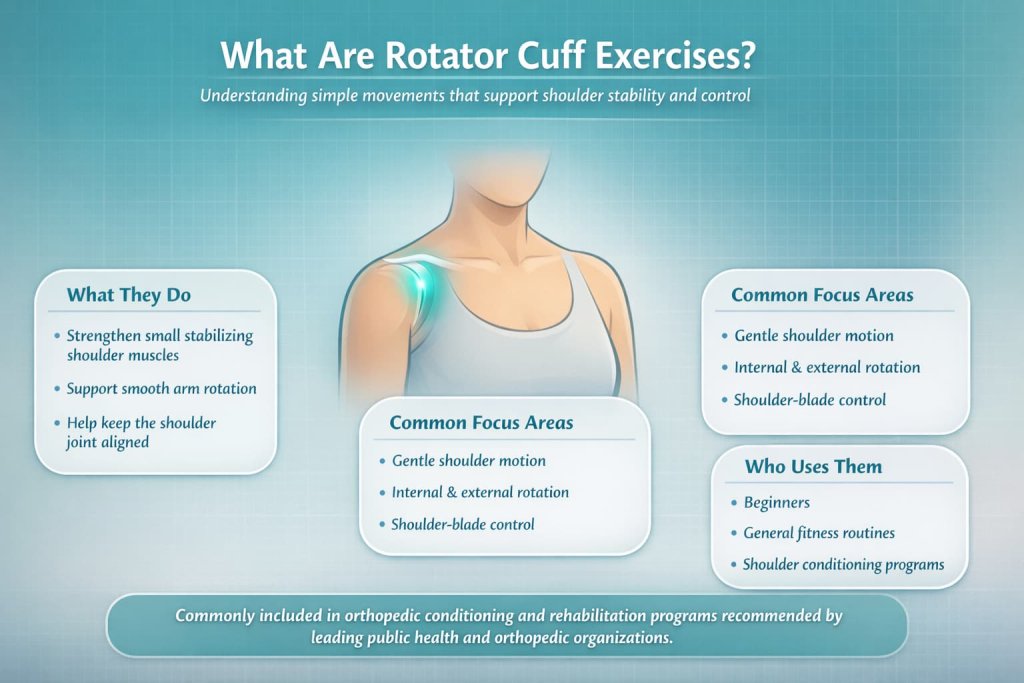
Understanding how to train the rotator cuff matters because these small muscles help keep the shoulder joint centered during daily activities and exercise. When they are weak or poorly coordinated, shoulder discomfort and movement limitations are more likely. This guide walks you through five easy rotator cuff exercises, explains why they work, and shows how to perform them safely at home using minimal or no equipment.
5 Easy Rotator Cuff Exercises
Build shoulder strength and stability with these 5 easy rotator cuff exercises designed for beginners.
Each movement focuses on controlled motion and joint-friendly strengthening to support healthy shoulder function.
1. Pendulum Arm Swing
How to do it
- Stand next to a chair, table, or countertop for support
- Place one hand on the surface and hinge slightly forward at the hips
- Let the opposite arm hang freely toward the floor
- Gently swing the arm forward and back, side to side, or in small circles
- Keep movements slow, relaxed, and controlled
- Breathe normally and avoid tightening the shoulder
Why it works
The pendulum arm swing introduces gentle shoulder motion without loading the joint. Because the arm moves passively with gravity, it allows circulation, joint lubrication, and early mobility while minimizing stress on irritated tissues. This is why it is commonly used in early shoulder conditioning and recovery programs.
Trainer Tip
Let gravity do the work. If you feel muscle tension, reduce the range of motion and slow the swing even more.
2. Band External Rotation (Elbow at Side)
How to do it
- Attach a light resistance band at waist height
- Stand sideways to the anchor point
- Hold the band with the arm farthest from the anchor
- Bend your elbow to 90 degrees and keep it gently tucked against your side
- Rotate your forearm outward away from your body
- Pause briefly, then return slowly to the starting position
Why it works
External rotation targets key rotator cuff muscles responsible for stabilizing the shoulder during arm elevation and reaching. Strengthening this movement helps support shoulder control and alignment, especially during overhead or repetitive activities.
Trainer Tip
Imagine your elbow is glued to your side. If it drifts away, the resistance is likely too heavy.
3. Band Internal Rotation (Elbow at Side)
How to do it
- Set up the band at waist height
- Stand so the band pulls your forearm away from your body
- Bend your elbow to 90 degrees and keep it close to your side
- Rotate your forearm inward toward your abdomen
- Control the return to the starting position
Why it works
Internal rotation balances external rotation by strengthening the muscles that guide inward arm motion. This balance supports shoulder stability during pushing, pulling, and daily functional movements.
Trainer Tip
Keep your chest tall and shoulders relaxed. If your shoulder rolls forward, decrease resistance and slow the movement.
4. Shoulder Blade Squeeze (Scapular Retraction)
How to do it
- Stand or sit tall with arms relaxed at your sides
- Gently pull your shoulder blades back and slightly down
- Hold the squeeze for 2–3 seconds
- Slowly release back to neutral posture
- Repeat with smooth, controlled effort
Why it works
Strong and well-coordinated shoulder blades provide a stable base for rotator cuff function. Improving scapular control helps the shoulder joint move more efficiently and reduces unnecessary strain on smaller stabilizing muscles.
Trainer Tip
Avoid shrugging or arching the lower back. The movement should feel calm and controlled across the upper back.
5. Scaption Raise (Thumbs Up)
How to do it
- Stand holding very light dumbbells or no weight
- Position your arms slightly forward and out to the sides (about 30–45°)
- Turn your thumbs upward
- Slowly raise your arms to shoulder height
- Lower with control, maintaining steady posture
Why it works
Scaption places the shoulder in a joint-friendly position that aligns well with natural shoulder mechanics. This movement is commonly used in rehabilitation settings to strengthen the rotator cuff while minimizing joint irritation.
Trainer Tip
Lift only as high as you can without discomfort. Smaller, controlled ranges are often more effective than forcing height.
How Often Should You Do Rotator Cuff Exercises?
Most orthopedic conditioning programs suggest:
- Strength exercises: 2–3 sets of 8–12 reps
- Frequency: 2–3 non-consecutive days per week
- Mobility-focused movements (like pendulums): can be done more frequently
The American Academy of Orthopaedic Surgeons emphasizes gradual progression and stopping if sharp pain occurs.
Common Beginner Mistakes to Avoid
- Using heavy resistance too soon
- Letting the elbow drift away from the body during rotation
- Rushing through repetitions
- Ignoring shoulder blade posture
- Training through pain instead of discomfort
Who Should Be Careful With These Exercises?
These exercises are generally considered low risk, but individuals with:
- Recent shoulder surgery
- Known rotator cuff tears
- Persistent or worsening shoulder pain
should follow guidance from a qualified healthcare or rehabilitation professional, as advised by the National Health Service.
When to Seek Professional Guidance
While easy rotator cuff exercises are commonly used for general shoulder conditioning, there are situations where professional assessment is recommended.
You should consider seeking guidance from a qualified healthcare or rehabilitation professional if you experience:
- Persistent or worsening shoulder pain despite exercise modification
- Sudden loss of shoulder strength or range of motion
- Pain that interferes with sleep or daily activities
- A history of shoulder surgery, dislocation, or diagnosed rotator cuff tear
- Numbness, tingling, or symptoms extending down the arm
Frequently Asked Questions
Are rotator cuff exercises good for beginners?
Yes. When performed with light resistance and proper control, they are commonly recommended for beginners.
Do I need equipment?
Most exercises can be done with a light resistance band or no equipment at all.
How long before I notice improvement?
Many people notice better shoulder control within a few weeks when practicing consistently.
Can I do these exercises daily?
Mobility-based movements can be done more often, but strengthening exercises usually benefit from rest days.
Should I stop if I feel pain?
Sharp or worsening pain is a signal to stop and seek professional guidance.
Are these exercises only for injuries?
No. They are often used for prevention and shoulder health, not just rehabilitation.
Conclusion
Easy rotator cuff exercises can play a key role in supporting shoulder strength, stability, and movement control when performed correctly and consistently. By focusing on slow, controlled motion and light resistance, you can train these important muscles safely at home. Start gradually, prioritize form, and build a routine that supports long-term shoulder health.
References
- AAOS: Rotator Cuff and Shoulder Conditioning Program
- AAOS: Shoulder Conditioning Program (PDF)
- APTA: Management of Rotator Cuff Injuries (Clinical Practice Guideline hub)
- JOSPT: Rotator Cuff Tendinopathy Clinical Practice Guideline (DOI page)
- Kingston & Richmond NHS: Shoulder exercises for rotator cuff tear
- Vanderbilt / MOON Shoulder Group: Nonoperative Rotator Cuff Tear Home Protocol (PDF)
- Mass General Brigham: Shoulder Home Exercise Program (includes rotator cuff/scapular work) (PDF)
- PMC: Systematic review on scapular stability and muscle balance exercises