
Hip impingement exercises are structured movements designed to improve hip strength, control, and movement quality while avoiding positions that aggravate symptoms. Hip impingement exercises may help reduce discomfort and improve daily mobility by strengthening supportive muscles and improving movement control.

Understanding how and why these exercises work is important because hip impingement—often referred to clinically as femoroacetabular impingement (FAI)—can affect walking, sitting, exercise, and long-term joint health if not managed properly.
What Are Hip Impingement Exercises?
Hip impingement exercises focus on strengthening and coordinating the muscles that support the hip joint—particularly the glutes, core, and deep hip stabilizers—while improving how the hip moves during everyday activities.
These exercises typically emphasize:
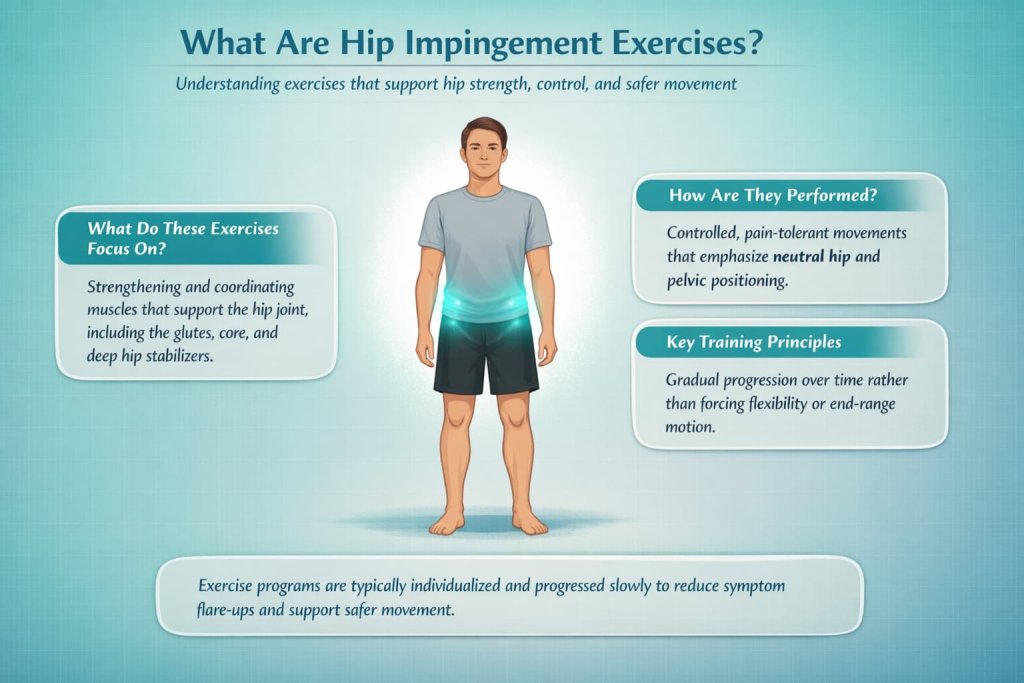
- Controlled, pain-tolerant ranges of motion
- Neutral hip and pelvic positioning
- Gradual progression rather than forcing flexibility
Clinical guidance consistently notes that exercise programs should be individualized and progressed slowly to avoid symptom flare-ups.
10 Best Hip Impingement Exercises
These hip impingement exercises focus on improving hip strength, control, and stability while avoiding positions that may increase joint irritation. Each movement is selected to support safer daily motion and gradual mobility improvement.
1. Glute Bridge
How to do it:
- Lie on your back with knees bent and feet flat on the floor, hip-width apart
- Gently brace your core by tightening your abdominal muscles
- Squeeze your glutes and lift your hips until your shoulders, hips, and knees form a straight line
- Hold briefly, then lower your hips slowly with control
Why it works:
The glute bridge strengthens the gluteus maximus, which helps control hip extension during walking, standing, and stair use. Stronger glutes reduce reliance on excessive hip flexion and may decrease front-of-hip irritation commonly associated with hip impingement.
Trainer Tip:
Avoid arching your lower back at the top. Think “ribs down, glutes on” to keep the movement hip-driven, not spine-driven.
2. Side-Lying Hip Abduction
How to do it:
- Lie on your side with hips stacked and legs straight
- Keep your bottom knee slightly bent for balance
- Lift the top leg slightly backward and upward
- Lower slowly without letting the leg swing
Why it works:
This exercise targets the outer hip muscles that help stabilize the pelvis. Improved pelvic control can reduce excessive hip motion during walking and standing, which may help manage symptoms related to hip impingement.
Trainer Tip:
Lift only as high as you can while keeping your hips stacked. Higher is not better if form is lost.
3. Quadruped Hip Extension
How to do it:
- Start on hands and knees with a neutral spine
- Gently brace your core
- Extend one leg straight back without arching your lower back
- Lower slowly and switch sides
Why it works:
Quadruped hip extension trains hip extension while minimizing joint compression. It reinforces coordinated movement between the hips and core, which supports healthier movement patterns during daily activities.
Trainer Tip:
Imagine balancing a glass of water on your lower back to prevent unwanted movement.
4. Standing Hip Extension (Band or Bodyweight)
How to do it:
- Stand tall and hold a chair or wall for balance
- Shift weight slightly onto one leg
- Move the opposite leg straight backward without leaning forward
- Return slowly with control
Why it works:
Performing hip extension in standing helps transfer strength gains to real-world activities such as walking and stair climbing, while avoiding deep hip flexion that may aggravate symptoms.
Trainer Tip:
Keep your torso upright and pelvis level—movement should come from the hip, not the lower back.
5. Seated Marching (Controlled)
How to do it:
- Sit upright in a chair with feet flat on the floor
- Gently brace your core
- Lift one knee slightly, then lower with control
- Alternate sides slowly
Why it works:
Seated marching encourages controlled hip flexor activation without forcing end-range hip flexion. This makes it a joint-friendly option for improving hip control during everyday movements.
Trainer Tip:
Lift only to a comfortable height. Smooth, controlled motion is more important than range.
6. Clamshell
How to do it:
- Lie on your side with hips stacked and knees bent
- Keep feet together and core gently engaged
- Open the top knee without rolling the hips backward
- Lower slowly
Why it works:
Clamshells activate deep hip stabilizers that help guide hip movement and maintain joint alignment. Improved stability may reduce compensatory movement patterns linked with hip discomfort.
Trainer Tip:
Place a hand on your top hip to monitor and prevent rotation.
7. Hip Hinge Drill
How to do it:
- Stand with feet hip-width apart
- Keep your spine neutral and chest tall
- Push hips backward as if sitting into a chair
- Return to standing by driving hips forward
Why it works:
The hip hinge teaches safer bending mechanics by shifting load to the hips instead of forcing excessive hip flexion. This can reduce strain during lifting and daily tasks.
Trainer Tip:
Practice in front of a mirror or with a dowel along your spine to reinforce neutral alignment.
8. Mini Squat (Pain-Free Range)
How to do it:
- Stand with feet shoulder-width apart
- Lower into a shallow squat within a comfortable range
- Keep knees aligned over toes
- Rise slowly to standing
Why it works:
Mini squats strengthen the lower body while avoiding deep hip angles that may aggravate impingement. They help prepare the hips and legs for functional activities like sitting and standing.
Trainer Tip:
Stop before symptoms appear—depth should always stay pain-free.
9. Standing Weight Shift
How to do it:
- Stand tall with feet hip-width apart
- Slowly shift weight onto one leg
- Keep pelvis level and posture upright
- Shift back to center and repeat
Why it works:
Weight-shifting improves load tolerance and hip control during transitions such as walking and changing direction, which are often challenging with hip impingement.
Trainer Tip:
Move slowly and deliberately to reinforce balance and control.
10. Single-Leg Balance
How to do it:
- Stand on one leg with upright posture
- Keep hips level and core engaged
- Hold for 20–30 seconds
- Switch sides
Why it works:
Single-leg balance enhances neuromuscular control and joint awareness, which supports safer movement and reduces unnecessary hip stress during daily activities.
Trainer Tip:
Progress by lightly moving the free leg or closing your eyes—only if balance is well controlled.
Why Hip Impingement Exercises Matter
Limited hip control can increase joint stress and contribute to repeated irritation at the front or side of the hip. Well-designed hip impingement exercises may help by:
- Improving hip and pelvic stability during walking and sitting
- Reducing compensatory movement patterns
- Supporting safer return to daily activity and exercise
- Enhancing confidence in hip movement
According to guidance summarized by the National Institute of Arthritis and Musculoskeletal and Skin Diseases, structured exercise plays an important role in maintaining joint function when matched to individual ability.
How Often Should You Do Hip Impingement Exercises?
Most public-health and orthopedic guidance suggests performing strengthening exercises 2–3 days per week, allowing rest days between sessions. Programs often start with 1–2 sets of controlled repetitions and progress gradually as tolerated.
Common Mistakes to Avoid With Hip Impingement Exercises
Hip impingement exercises are most effective when performed with proper technique and realistic expectations. Common mistakes can increase irritation rather than support recovery.
Key mistakes to avoid include:
- Forcing deep hip ranges such as deep squats or aggressive stretching that provoke symptoms
- Moving too fast or using momentum, which reduces muscular control around the hip
- Ignoring pelvic and core alignment, leading to compensation through the lower back
- Progressing too quickly by increasing repetitions, resistance, or difficulty before symptoms are well controlled
- Pushing through sharp or worsening pain, rather than staying within a pain-tolerant range
Clinical guidance from organizations such as the American Academy of Orthopaedic Surgeons emphasizes that symptom-guided, controlled exercise is safer and more effective than aggressive training for joint-related conditions.
When to Modify or Pause Hip Impingement Exercises
It is normal to experience mild muscle fatigue with strengthening exercises, but certain signs indicate the need to modify or temporarily pause your program.
Consider modifying or stopping exercises if you notice:
- Sharp or catching pain in the front, side, or groin area of the hip
- Symptoms that worsen during exercise and do not settle within 24 hours
- Increasing stiffness or loss of movement after sessions
- Pain that interferes with walking, sitting, or sleeping
In these situations, reducing range of motion, slowing the movement, or temporarily returning to easier variations is often recommended. Persistent or worsening symptoms should be discussed with a qualified healthcare professional before resuming progression.
Who Should Be Cautious With Hip Impingement Exercises?
While hip impingement exercises are commonly used in conservative care, some individuals should take extra precautions or seek professional guidance before starting.
Extra caution is advised for:
- People with severe or rapidly worsening hip pain
- Individuals with a recent hip injury, fracture, or surgery
- Those with persistent groin pain accompanied by clicking, locking, or giving way
- Anyone with known hip structural abnormalities already under medical care
- People whose symptoms significantly limit daily activities despite exercise
In these cases, a personalized assessment can help determine appropriate exercise selection, range limits, and progression strategies.
Frequently Asked Questions
Can hip impingement exercises fix hip impingement?
Exercises do not change bone shape, but they may help manage symptoms and improve function by improving strength and movement control.
Are stretches good for hip impingement?
Gentle stretching may help some people, but aggressive or deep stretches can worsen symptoms. Strength and control are often prioritized first.
How long does it take to see results?
Many rehabilitation programs note improvements over 8–12 weeks, depending on consistency and symptom severity.
Should I avoid squats with hip impingement?
Deep squats may aggravate symptoms. Modified or shallow squats are often used instead.
Can I exercise at home?
Yes. Many hip impingement exercises are designed for home programs with minimal equipment.
When should I see a professional?
If pain persists or worsens despite exercise, consult a qualified healthcare professional for assessment.
Conclusion
Hip impingement exercises focus on building strength, control, and confidence in hip movement—without forcing painful ranges. When performed consistently and progressed gradually, they may help support daily function and comfort. If symptoms persist, working with a qualified professional can help tailor an exercise plan to your specific needs.
References
- Femoroacetabular Impingement (FAI) – OrthoInfo (American Academy of Orthopaedic Surgeons)
- A Patient’s Guide to Femoroacetabular Impingement Syndrome (RNOH NHS)
- Conservative Treatment for FAI Syndrome (British Hip Society UK Hip Physiotherapy Network) (PDF)
- FAIS Patient Leaflet (Oxford University Hospitals NHS) (PDF)
- Femoral Acetabular Impingement Advice and Exercises (Dynamic Health NHS)
- Hip Arthroscopy vs Physiotherapy and Activity Modification for Symptomatic FAI (BMJ, 2019)
- Hip Arthroscopy vs Best Conservative Care for FAI (The Lancet, 2018)
- UK FASHIoN Trial: Hip Arthroscopy vs Personalised Hip Therapy (NIHR Health Technology Assessment)