
Closed chain shoulder exercises are weight-bearing movements where your hands stay fixed on a surface, helping build shoulder strength while improving joint stability and control. These exercises are widely used in rehabilitation, athletic training, and general fitness because they encourage coordinated muscle activation around the shoulder, scapula, and core rather than isolating a single muscle.
Understanding how closed chain shoulder exercises work is important if you want to train your shoulders safely, improve stability, or return to activity after injury. These movements are commonly recommended by physical therapy and sports medicine guidelines as part of balanced upper-body training programs.
6 Best Closed Chain Shoulder Exercises
Below are six of the most effective closed chain shoulder exercises, commonly used in both clinical and fitness settings.
1. Wall Push-Up Plus
How to do it
- Stand facing a wall with feet hip-width apart
- Place hands on the wall at shoulder height and shoulder-width
- Bend elbows to bring your chest toward the wall
- Press back to straight arms
- At the top, gently push the wall away to move your shoulder blades forward (the “plus” phase)
- Return to the start with control
Why it works
The wall push-up plus trains shoulder stability by encouraging coordinated movement between the shoulder joint and the scapula. The added “plus” phase promotes controlled scapular protraction, which is essential for healthy shoulder mechanics and arm elevation. The wall position keeps load low, making it ideal for beginners or early-stage rehab.
Muscles worked
Serratus anterior, anterior deltoid, rotator cuff muscles, upper and mid-back stabilizers.
Trainer Tip
Move slowly during the plus phase and keep your neck relaxed—avoid shrugging your shoulders toward your ears.
2. Incline Push-Up (Bench or Counter Height)
How to do it
- Place hands on a stable bench, box, or counter
- Walk feet back so your body forms a straight line
- Lower your chest toward your hands while keeping elbows controlled
- Push back up to full arm extension
- Maintain steady breathing throughout
Why it works
Incline push-ups gradually increase load on the shoulders while maintaining a closed chain position. This allows you to build strength and stability without the high demands of floor push-ups. The incline angle also helps reinforce proper scapular positioning and trunk control.
Muscles worked
Chest, anterior shoulder muscles, triceps, scapular stabilizers, core.
Trainer Tip
Select a height that allows smooth, pain-free movement—higher surfaces reduce shoulder stress.
3. Quadruped Shoulder Weight Shifts
How to do it
- Start on hands and knees with wrists under shoulders
- Keep your spine neutral and core lightly engaged
- Slowly shift your body weight forward, then backward
- Shift side to side while keeping arms straight
- Return to center between each shift
Why it works
This exercise builds shoulder stability and joint awareness by exposing the shoulders to controlled weight shifts. Because movement is slow and deliberate, the nervous system learns to stabilize the shoulder joint without relying on momentum or large ranges of motion.
Muscles worked
Rotator cuff, serratus anterior, deltoids, deep core stabilizers.
Trainer Tip
Keep ribs down and move slowly—speed reduces the stability benefit.
4. Quadruped Scapular Push-Ups
How to do it
- Begin on hands and knees with arms straight
- Allow your chest to sink slightly between your shoulders
- Push the floor away to spread the shoulder blades
- Keep elbows locked and neck neutral
- Repeat with controlled tempo
Why it works
This movement isolates scapular motion while keeping the shoulder joint in a closed chain position. It strengthens the muscles responsible for controlling scapular glide, which supports smoother and safer shoulder movement during pressing or overhead activities.
Muscles worked
Serratus anterior, upper trapezius, lower trapezius.
Trainer Tip
Think “shoulder blades move, arms stay still” to avoid turning it into a regular push-up.
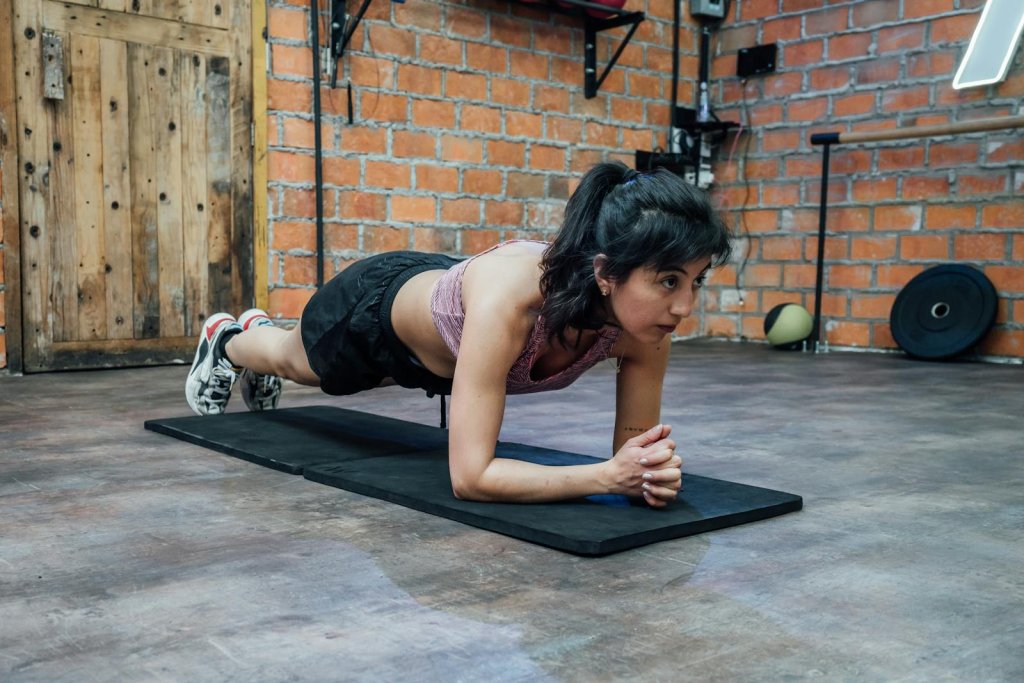
5. Forearm Plank Hold
How to do it
- Place forearms on the floor under shoulders
- Extend legs back into a straight plank position
- Engage core and glutes
- Hold while keeping shoulders steady and breathing controlled
Why it works
The forearm plank challenges shoulder stability under sustained load. Because the arms remain fixed, the shoulder muscles must continuously stabilize the joint while the core maintains alignment, reinforcing total-body control.
Muscles worked
Deltoids, rotator cuff, scapular stabilizers, abdominals, glutes.
Trainer Tip
If shoulders fatigue quickly, drop knees to the floor while maintaining good posture.
6. Bear Plank (Modified or Full)
How to do it
- Start on hands and knees with shoulders over wrists
- Lift knees slightly off the floor
- Keep spine neutral and head aligned
- Hold briefly while breathing steadily
Why it works
The bear plank increases closed chain shoulder demand while adding a strong core and hip stabilization component. This exercise reinforces kinetic-chain coordination, teaching the shoulders to stay stable while the body supports load dynamically.
Muscles worked
Shoulders, rotator cuff, scapular stabilizers, core, hip muscles.
Trainer Tip
Stop immediately if shoulder control is lost or discomfort appears—quality always comes first.
How to Program Closed Chain Shoulder Exercises
Closed chain shoulder exercises are typically used:
- 2–3 times per week
- Early in a workout as activation or stability work
- In rehabilitation or warm-up phases
A common approach is to start with wall or quadruped variations and progress gradually to floor-based or plank-based exercises as strength and control improve.
Why Closed Chain Shoulder Exercises Matter
Closed chain shoulder exercises may help support:
- Shoulder joint stability and control
- Scapular coordination during arm movement
- Safer loading for beginners or those returning from injury
- Whole-body integration rather than isolated shoulder work
Clinical guidance from sports rehabilitation literature emphasizes combining closed and open chain exercises rather than relying on only one approach. Public health and exercise organizations such as the American College of Sports Medicine recommend progressive, well-rounded strength training that includes stability-focused movements.
Who Should Use Closed Chain Shoulder Exercises
Closed chain shoulder exercises are appropriate for a wide range of individuals when performed with proper technique and progression. These exercises are commonly used in both fitness and rehabilitation settings because they emphasize joint stability and controlled movement.
They may be especially suitable for:
- Beginners learning proper shoulder and scapular control
- Individuals seeking to improve shoulder stability and coordination
- Athletes who need stronger shoulder support for pushing or overhead activities
- People training at home with limited equipment
- Individuals returning to activity after mild shoulder issues, with professional guidance
Who Should Avoid or Modify Closed Chain Shoulder Exercises
While closed chain shoulder exercises are generally well tolerated, some individuals may need to avoid or modify them to reduce risk.
Extra caution or professional supervision is recommended for:
- People with acute shoulder pain or inflammation
- Individuals recovering from recent shoulder or upper-limb surgery
- Those with significant shoulder instability or frequent joint giving-way
- Anyone experiencing pain, numbness, or sharp discomfort during weight-bearing positions
- Individuals with wrist conditions that limit tolerance to floor-based exercises
If symptoms worsen or discomfort persists, stop the exercise and consult a qualified healthcare or rehabilitation professional.
Safety Guidelines for Closed Chain Shoulder Training
Following basic safety principles helps ensure that closed chain shoulder exercises remain effective and low risk.
Key safety guidelines include:
- Perform all movements in a pain-free range of motion
- Maintain neutral neck and spine alignment throughout
- Avoid shrugging shoulders toward the ears during exercises
- Use slow, controlled movement rather than momentum
- Progress gradually by changing surface height, hold time, or exercise complexity
- Prioritize quality and control over exercise intensity
Proper technique and gradual progression are essential for long-term shoulder health and performance.
Common Mistakes to Avoid
- Locking the elbows aggressively
- Shrugging the shoulders toward the ears
- Rushing through movements
- Ignoring pain or discomfort signals
Quality and control matter more than intensity with closed chain shoulder exercises.
Frequently Asked Questions
Are closed chain shoulder exercises good for beginners?
Yes, especially wall and quadruped variations, which allow gradual loading.
Can these exercises replace dumbbell shoulder exercises?
They should complement, not replace, open chain movements in most programs.
Do closed chain shoulder exercises help with shoulder stability?
They may support joint control by encouraging coordinated muscle activation.
How often should I do closed chain shoulder exercises?
Most programs include them 2–3 times per week.
Are these exercises safe for shoulder rehab?
They are commonly used in rehab but should be guided by a professional when injury is present.
Can I do them at home?
Yes, most closed chain shoulder exercises require minimal equipment.
Conclusion
Closed chain shoulder exercises offer a practical, effective way to build shoulder strength, stability, and control using weight-bearing movement. When programmed correctly and progressed gradually, they can support healthier shoulder function and safer upper-body training.
If you are building a balanced shoulder routine or returning to activity, consider adding these six closed chain shoulder exercises to your program.
References
- A Kinetic Chain Approach for Shoulder Rehabilitation (McMullen & Uhl, 2000)
- Role of the Kinetic Chain in Shoulder Rehabilitation: Systematic Review (Richardson et al., 2020)
- 2022 Bern Consensus Statement on Shoulder Injury Prevention, Rehabilitation and Return to Sport (Schwank et al., 2022)
- A Comparison of Serratus Anterior Muscle Activation During a Wall Slide Exercise and Other Traditional Exercises (Hardwick et al., 2006)
- Shoulder Electromyography Activity During Push-Up Variations: A Scoping Review (Kowalski et al., 2022)
- The Effect of Hand Position Changes on EMG Activity of Shoulder Stabilizers During Push-Up Plus (Lee et al., 2013)
- Serratus Anterior and Upper Trapezius EMG During Push-Up Plus Variants: Systematic Review (Kang et al., 2019)
- Shoulder Muscle EMG Activity During Push-Up Variations on Stable vs Labile Surfaces (Lehman et al., 2006)