
Closed chain exercises are movements where your hands or feet stay fixed against a surface while your body moves, making them one of the most effective ways to build functional strength, joint stability, and coordinated movement. Understanding and using closed chain exercises matters because these movements closely match how your body works in daily life, sports, and many rehabilitation settings.

In this guide, you’ll learn exactly what closed chain exercises are, why they matter, and the 10 best closed chain exercises you can use to improve strength, stability, and joint control—safely and effectively.
What Are Closed Chain Exercises?
Closed chain exercises (also called closed kinetic chain exercises) are movements where the distal end of the limb stays fixed against an immovable surface, such as the floor, wall, bar, or platform. Instead of one joint working in isolation, multiple joints and muscle groups work together.
Common closed chain characteristics include:
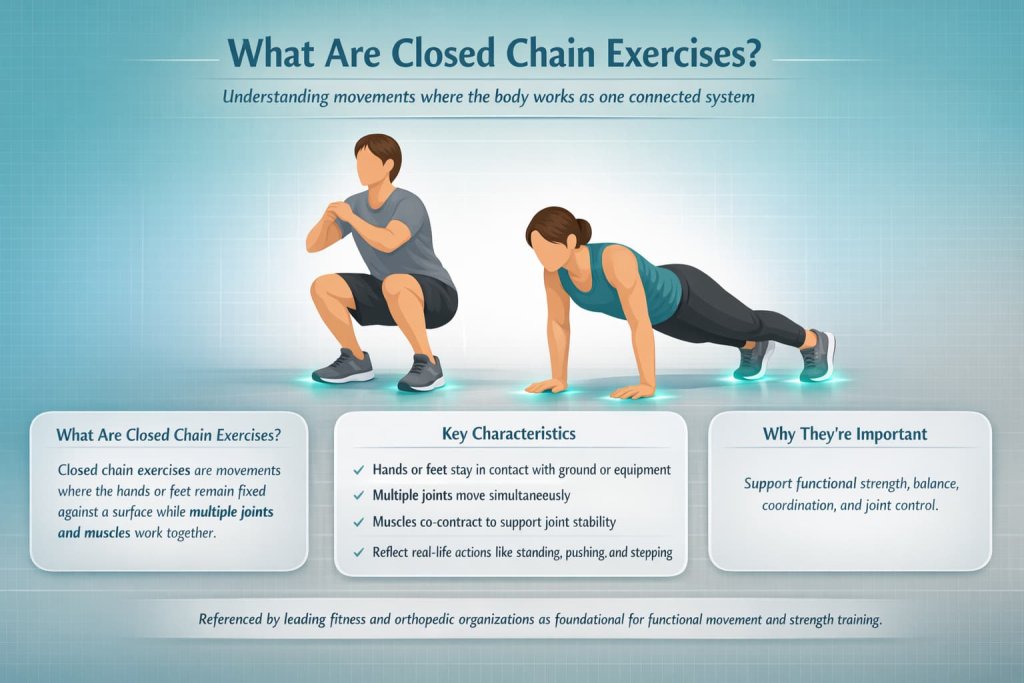
- Feet or hands remain in contact with the ground or equipment
- Multiple joints move at the same time
- Muscles co-contract to stabilize the joints
- Movement patterns resemble real-life activities like standing, pushing, pulling, and stepping
Organizations such as the American Council on Exercise and American Academy of Orthopaedic Surgeons frequently describe closed chain exercises as foundational for functional strength and joint control.
10 Best Closed Chain Exercises
These closed chain exercises keep your hands or feet fixed against a surface, helping build functional strength, stability, and coordinated joint control. They are widely used in fitness and rehabilitation programs to support safer, more effective movement.
1. Squats
How to do it
- Stand with feet shoulder-width apart and toes slightly turned out
- Brace your core and keep your chest upright
- Push hips back and bend knees to lower into a squat
- Keep heels flat and knees tracking over toes
- Press through heels to return to standing
Why it works
Squats train multiple joints at once, encouraging coordinated movement between the hips, knees, and ankles. This closed chain pattern closely matches everyday activities like sitting and standing, supporting functional strength and joint control.
Muscles worked
Quadriceps, glutes, hamstrings, core stabilizers
Trainer Tip
Focus on depth you can control without losing posture—quality matters more than how low you go.
2. Push-Ups
How to do it
- Place hands under shoulders with body in a straight line
- Brace your core and squeeze glutes
- Lower chest toward the floor with elbows slightly tucked
- Push the floor away to return to the start position
Why it works
Push-ups require the arms, shoulders, and core to work together while the hands remain fixed. This promotes upper-body strength and shoulder stability in a functional, joint-friendly pattern.
Muscles worked
Chest, shoulders, triceps, core
Trainer Tip
If full push-ups are too challenging, elevate your hands on a bench or wall to maintain proper form.
3. Lunges
How to do it
- Step one foot forward into a split stance
- Lower hips until both knees bend comfortably
- Keep torso upright and front knee aligned
- Push through the front heel to return to standing
Why it works
Lunges challenge single-leg strength and balance while reinforcing hip and knee control. The closed chain position helps distribute load across multiple joints.
Muscles worked
Glutes, quadriceps, hamstrings, calves
Trainer Tip
Start with shorter steps to improve control before increasing stride length.
4. Step-Ups
How to do it
- Stand facing a stable step or platform
- Place one foot fully on the step
- Press through the heel to lift your body up
- Step down under control and repeat
Why it works
Step-ups replicate stair climbing and emphasize unilateral leg strength. They encourage proper hip and knee alignment while improving balance.
Muscles worked
Glutes, quadriceps, hamstrings
Trainer Tip
Choose a step height that allows smooth movement without pushing off the back leg.
5. Pull-Ups or Chin-Ups
How to do it
- Hang from a bar with arms fully extended
- Brace your core and engage shoulder blades
- Pull chest toward the bar using controlled motion
- Lower slowly back to the starting position
Why it works
With hands fixed on the bar, pull-ups train the upper body as a connected system, promoting shoulder stability and trunk control.
Muscles worked
Lats, upper back, biceps, core
Trainer Tip
Use resistance bands or assisted machines if full bodyweight reps are not yet manageable.
6. Planks
How to do it
- Place forearms or hands on the floor
- Extend legs behind you with toes on the ground
- Keep body in a straight line from head to heels
- Hold while breathing steadily
Why it works
Planks develop core stability without joint movement, teaching the body to resist unwanted motion—an essential part of joint protection.
Muscles worked
Deep core muscles, shoulders, glutes
Trainer Tip
Stop the set as soon as your hips drop or shoulders collapse.
7. Wall Sits
How to do it
- Stand with your back against a wall
- Slide down until knees bend comfortably
- Keep feet flat and core engaged
- Hold the position for time
Why it works
Wall sits are an isometric closed chain exercise that builds endurance and reinforces knee alignment under controlled load.
Muscles worked
Quadriceps, glutes, core
Trainer Tip
Adjust knee bend to a pain-free range, especially if knee sensitivity is present.
8. Hip Bridges (Feet on Floor)
How to do it
- Lie on your back with knees bent and feet flat
- Press feet into the floor and squeeze glutes
- Lift hips until body forms a straight line
- Lower slowly with control
Why it works
Keeping the feet grounded encourages posterior chain activation while supporting pelvic and spinal control.
Muscles worked
Glutes, hamstrings, lower back stabilizers
Trainer Tip
Avoid arching your lower back—movement should come from the hips.
9. Bear Crawls
How to do it
- Start on hands and knees
- Lift knees slightly off the floor
- Crawl forward with opposite hand and foot
- Keep spine neutral and movements controlled
Why it works
Bear crawls challenge coordination, shoulder stability, and core control simultaneously, making them a highly functional closed chain exercise.
Muscles worked
Shoulders, core, hips, arms
Trainer Tip
Move slowly at first to maintain balance and alignment.
10. Split Squats
How to do it
- Stand in a split stance with feet planted
- Lower straight down by bending both knees
- Keep torso upright and hips stable
- Push through the front heel to rise
Why it works
Split squats strengthen one leg at a time while maintaining a stable base, improving joint control and muscular balance.
Muscles worked
Glutes, quadriceps, hamstrings
Trainer Tip
Think “straight down,” not forward, to reduce knee stress.
How to Program Closed Chain Exercises
For general fitness:
- 2–3 sessions per week
- 2–4 sets per exercise
- 8–15 controlled repetitions (or time-based holds)
Closed chain exercises can be placed early in workouts because they require coordination and control.
Why Closed Chain Exercises Matter for Strength and Stability
Closed chain exercises are widely used in both fitness and rehabilitation because they emphasize control, alignment, and coordinated movement. Compared with many single-joint exercises, they may help:
- Improve joint stability through muscle co-activation
- Support better balance and body awareness
- Strengthen muscles in patterns used during daily activities
- Distribute forces across multiple joints rather than one area
Who Can Benefit Most From Closed Chain Exercises?
Closed chain exercises are suitable for a wide range of people, including:
- Beginners learning proper movement mechanics
- Older adults focusing on balance and joint health
- Athletes building functional strength and coordination
- Individuals in structured rehabilitation programs (when approved by a professional)
Organizations like the Centers for Disease Control and Prevention highlight strength and balance training as key components of long-term physical function.
Safety Guidelines Before Starting Closed Chain Exercises
To train safely and effectively:
- Warm up with light movement before loading joints
- Maintain proper alignment of hips, knees, and shoulders
- Start with bodyweight before adding resistance
- Stop exercises that cause sharp or worsening pain
- Progress gradually rather than increasing volume too quickly
If you have a joint condition or recent injury, guidance from a qualified professional is strongly recommended.
Who Should Avoid or Modify Closed Chain Exercises
Closed chain exercises may need adjustment for certain individuals, especially when joint safety is a concern.
You should avoid or modify these exercises if you:
- Have acute joint pain, swelling, or inflammation
- Are recovering from recent joint or spinal surgery
- Experience joint instability or balance limitations
- Have a flare-up of an existing musculoskeletal condition
- Feel pain that worsens during or after exercise
Professional guidance is recommended to ensure exercises match your current ability and condition.
Closed Chain vs Open Chain Exercises
Closed chain and open chain exercises are not opposites that compete—they serve different purposes.
Closed chain exercises
- Fixed hands or feet
- Multiple joints involved
- Emphasize stability and coordination
- Examples: squats, push-ups, lunges
Open chain exercises
- Hands or feet move freely
- Often isolate one joint
- Emphasize targeted muscle strengthening
- Examples: leg extensions, biceps curls
Clinical and training guidelines often recommend using both, depending on goals, training phase, and individual ability.
Common Mistakes to Avoid With Closed Chain Exercises
Avoiding these common errors helps reduce joint stress and improve results.
- Rushing movements instead of using controlled tempo
- Poor joint alignment, such as knees collapsing inward
- Adding load too quickly before mastering bodyweight form
- Neglecting core engagement, leading to poor stability
- Pushing through sharp or increasing pain
Proper technique, gradual progression, and listening to your body are essential for safe, effective training.
Frequently Asked Questions
Are closed chain exercises better than open chain exercises?
Not necessarily. Closed chain exercises emphasize coordination and stability, while open chain exercises target specific muscles. Most balanced programs use both.
Are squats considered closed chain exercises?
Yes. Because your feet remain fixed on the ground, squats are a classic closed chain exercise.
Can closed chain exercises help joint health?
They may support joint control and muscular coordination, which can contribute to better movement quality when performed correctly.
Are closed chain exercises good for beginners?
Yes. Many beginners start with closed chain movements because they resemble everyday activities and promote full-body engagement.
Can I do closed chain exercises at home?
Absolutely. Many closed chain exercises require little to no equipment and can be done safely at home.
Are closed chain exercises used in physical therapy?
Yes. They are commonly used in rehabilitation settings to emphasize controlled, multi-joint movement patterns.
Conclusion
Closed chain exercises are a powerful tool for building strength, improving stability, and enhancing joint control through real-world movement patterns. By including the 10 best closed chain exercises in your routine, you can develop more coordinated, functional strength that supports both fitness and everyday life.
If you’re unsure where to start, begin with bodyweight variations and progress gradually—or consult a qualified professional for personalized guidance.
References
- Closed Kinetic Chain Exercises in Knee Osteoarthritis (PLOS ONE, 2025) — Systematic review and meta-analysis focused on CKC outcomes.
- Electromyographic Analysis of Single-Leg Closed Chain Exercises (full text) — Muscle activation data for exercises like step-ups/single-leg squats.
- WHO Guidelines on Physical Activity and Sedentary Behaviour (recommendations) — World Health Organization guidelines (strength + activity recommendations).