
Knee extension exercises are targeted movements that strengthen the quadriceps and improve your ability to fully straighten the knee. This matters because strong, well-coordinated quadriceps help stabilize the knee joint, support walking and stair use, and reduce unnecessary joint stress.
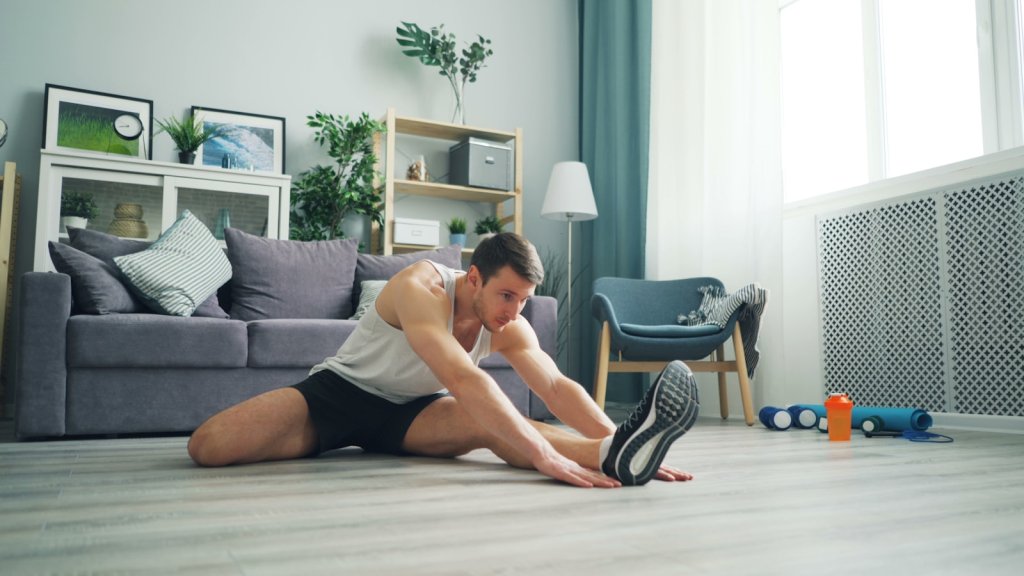
Understanding which knee extension exercises to use—and how to perform them correctly—can make your workouts safer and more effective, whether your goal is general fitness, rehab support, or joint health.
What Are Knee Extension Exercises?
Knee extension exercises are movements where the knee straightens against gravity or resistance. They primarily train the quadriceps, the large muscles on the front of your thigh that control knee straightening and help stabilize the joint during daily activities.
These exercises are commonly used in:
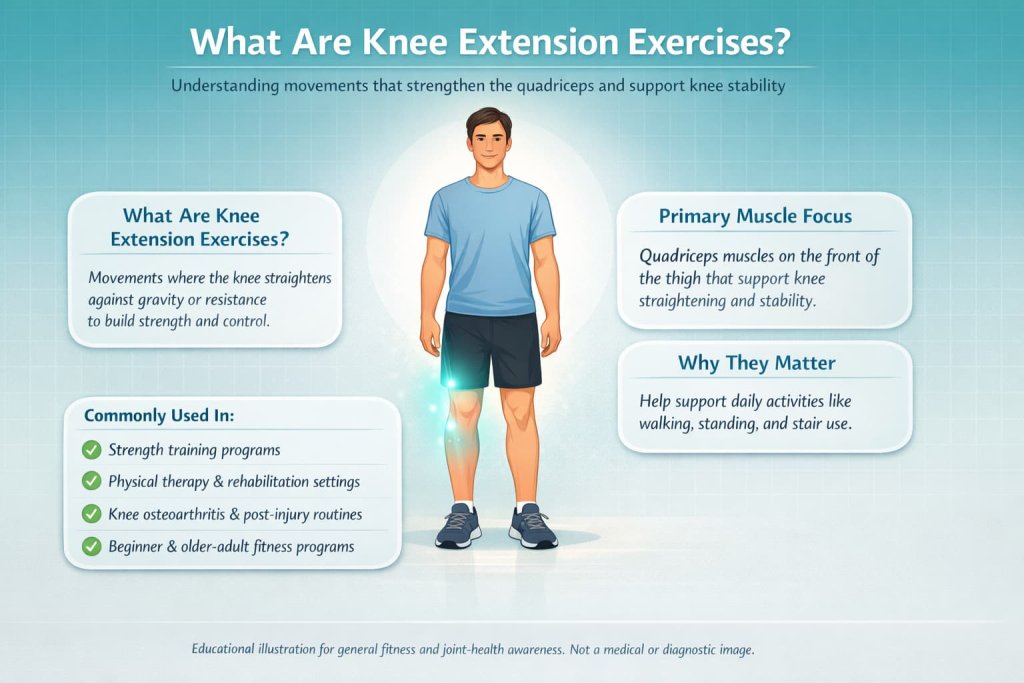
- Strength training programs
- Physical therapy and rehabilitation settings
- Knee osteoarthritis and post-injury exercise routines
- Beginner and older-adult fitness programs
6 Best Knee Extension Exercises
These knee extension exercises focus on strengthening the quadriceps to support knee stability and control. When performed with proper form, they help improve daily movement such as walking, standing, and climbing stairs.
1. Quad Sets (Static Quads)
How to do it
- Sit or lie on your back with one leg fully straight
- Place a small towel under the knee if helpful for comfort
- Tighten the thigh muscle by gently pressing the knee downward
- Hold the contraction for 5–10 seconds while breathing normally
- Relax fully, then repeat for controlled repetitions
Why it works
Quad sets activate the quadriceps without moving the knee joint. This makes them especially useful when knee motion is limited, painful, or recently reintroduced. They help restore neuromuscular control and improve the ability to fully straighten the knee during daily activities.
Muscles worked
Quadriceps (with emphasis on the vastus medialis)
Trainer Tip
Think about “lifting the kneecap upward” using the thigh muscle rather than pushing hard into the surface.
2. Short Arc Quads (SAQ)
How to do it
- Lie on your back with a rolled towel or foam roll under your knee
- Start with the knee slightly bent over the support
- Straighten the knee until the foot lifts and the leg becomes straight
- Hold for 2–3 seconds, then lower slowly with control
- Repeat without rushing the movement
Why it works
Short arc quads load the quadriceps through a limited, joint-friendly range. This helps build strength near full knee extension, which is often where weakness or control deficits occur.
Muscles worked
Quadriceps
Trainer Tip
Move slowly on the way down—controlled lowering is just as important as lifting.
3. Seated Knee Extensions (Chair)
How to do it
- Sit upright in a chair with feet flat on the floor
- Slowly straighten one knee until the leg is fully extended
- Pause briefly at the top without locking forcefully
- Lower the leg back down under control
- Alternate sides or complete all reps on one leg
Why it works
This exercise strengthens the quadriceps through a functional range that closely matches everyday movements like standing up, walking, and climbing stairs.
Muscles worked
Quadriceps
Hip flexors (secondary)
Trainer Tip
If adding resistance, start with very light ankle weights and stop immediately if pain increases.
4. Straight Leg Raises
How to do it
- Lie on your back with one knee bent and the other leg straight
- Tighten the thigh of the straight leg before lifting
- Raise the leg to the height of the opposite knee
- Lower slowly while keeping the knee fully straight
- Repeat with steady, controlled motion
Why it works
Straight leg raises strengthen the quadriceps without requiring knee bending, making them useful when knee flexion is uncomfortable but muscle activation is still needed.
Muscles worked
Quadriceps
Hip flexors
Trainer Tip
If the knee bends during the lift, lower the height or pause and reset your muscle tension.
5. Terminal Knee Extensions (Band TKE)
How to do it
- Anchor a resistance band behind knee height
- Loop the band behind the knee and step back to create tension
- Start with the knee slightly bent
- Straighten the knee fully against the band
- Return slowly to the starting position
Why it works
Band TKEs train knee extension in a standing position, reinforcing strength and control during weight-bearing tasks like walking and standing.
Muscles worked
Quadriceps
Glute stabilizers (secondary)
Trainer Tip
Keep the heel planted and avoid leaning backward to “cheat” the movement.
6. Heel Prop Knee Extension Stretch
How to do it
- Sit or lie down with the heel supported on a pillow or rolled towel
- Allow the knee to gently straighten under gravity
- Keep the leg relaxed—do not force the position
- Hold for 30–60 seconds, breathing comfortably
Why it works
This stretch supports knee extension range of motion, which can be limited by stiffness in the back of the knee or hamstrings. Maintaining extension is important for efficient walking and standing posture.
Muscles worked
Passive stretch of the hamstrings and posterior knee tissues
Trainer Tip
A mild stretch sensation is normal, but sharp pain or pressure is a signal to stop.
How Often Should You Do Knee Extension Exercises?
Most public-health and orthopedic guidance recommends muscle-strengthening activities 2–3 days per week, allowing rest between sessions. Start with low repetitions and progress gradually as strength and comfort improve.
The National Institute on Aging notes that consistent, moderate strengthening supports joint function across the lifespan when exercises are adapted to individual ability.
Why Knee Extension Exercises Matter for Knee Stability
Strong quadriceps act like shock absorbers for the knee. When these muscles are weak, more load is transferred directly to passive structures such as cartilage and ligaments.
Regular knee extension exercises may help:
- Improve knee control during walking and stairs
- Support joint alignment under load
- Reduce feelings of instability or “giving way”
- Improve confidence in daily movement
According to guidance summarized by the American College of Sports Medicine, consistent lower-body strengthening supports joint function when exercises are matched to ability and performed with proper form.
How to Perform Knee Extension Exercises Safely
Performing knee extension exercises with proper technique is essential for supporting knee strength without placing unnecessary stress on the joint. These exercises are most effective when they are controlled, pain-free, and matched to your current ability level.
Key safety guidelines include:
- Move through a slow, controlled range rather than using momentum
- Keep the motion smooth and deliberate, especially when lowering the leg
- Avoid forcefully locking the knee at full extension
- Maintain normal breathing—do not hold your breath
- Stop the exercise if you feel sharp pain, joint catching, or swelling
Public-health and orthopedic guidance from organizations such as the American Academy of Orthopaedic Surgeons and the American College of Sports Medicine emphasizes gradual progression, proper form, and symptom monitoring when performing knee-focused strengthening exercises.
Who Should Be Cautious With Knee Extension Exercises
While knee extension exercises are widely used in fitness and rehabilitation settings, some individuals should take extra care or seek professional guidance before starting or progressing these movements.
You should be cautious if you have:
- Recent knee surgery or a post-operative rehabilitation plan
- Acute knee swelling, locking, or instability
- Sharp or worsening pain during knee straightening
- A recent knee injury that has not been medically assessed
Older adults, beginners, and individuals with long-standing knee conditions may benefit from starting with low-load variations such as quad sets or short arc quads before progressing to resistance-based exercises.
According to the National Institute on Aging, adapting exercise intensity to individual capacity and monitoring symptoms helps support safe, long-term joint health.
Common Mistakes to Avoid
- Using momentum instead of controlled movement
- Adding resistance too quickly
- Locking the knee forcefully at full extension
- Ignoring pain or swelling signals
Frequently Asked Questions (FAQs)
Are knee extension exercises safe for knee pain?
When performed correctly and pain-free, they are commonly used to support knee strength. Always start gently.
Do knee extensions help with knee osteoarthritis?
Quadriceps strengthening is commonly included in non-surgical management plans to support knee function.
Can beginners do knee extension exercises?
Yes. Exercises like quad sets and seated extensions are beginner-friendly.
How many reps should I do?
A common starting point is 8–15 controlled reps for 2–3 sets, depending on comfort.
Should I use weights for knee extensions?
Only after mastering form and if exercises remain pain-free.
Can knee extensions improve walking and stairs?
Stronger quadriceps support knee control during daily movements like walking and stair climbing.
Conclusion
Knee extension exercises play a key role in building quadriceps strength, supporting knee stability, and improving daily movement. By choosing controlled, appropriate exercises and progressing gradually, you can support knee health safely and effectively. Start with the basics, stay consistent, and focus on quality movement.
References
- AAOS: Knee Conditioning Program (PDF)
- AAOS: Knee Conditioning Program (OrthoInfo Page)
- AAOS Clinical Practice Guideline: Management of Osteoarthritis of the Knee (Non-Arthroplasty) (PDF)
- NICE NG226: Visual Summary on Osteoarthritis Management (PDF)
- CDC: Adult Physical Activity Guidelines Overview (Strength Training Frequency)
- Physical Activity Guidelines for Americans, 2nd Edition (PDF)
- Aspetar Guideline: Rehabilitation After ACL Reconstruction (Open-Chain Knee Extension Guidance)
- Forelli et al. (2025): Open Kinetic Chain Knee Extension After ACLR (Scoping Review, PMC)