
Hand exercises for arthritis can help reduce stiffness, improve mobility, and support daily hand function — but they do not cure arthritis. They work by gently moving the joints, supporting circulation, and strengthening the small muscles that control grip and motion.
Understanding how these exercises help is important because hand arthritis often causes pain, reduced range of motion, and difficulty performing everyday tasks like opening jars, typing, and gripping objects. Safe, daily mobility drills combined with light strengthening may support joint function and comfort.
10 Best Hand Exercises for Arthritis (Step-by-Step)
Hand exercises for arthritis are simple, gentle movements designed to support joint mobility, reduce stiffness, and improve daily hand function. Perform each exercise slowly, stay within a comfortable range, and stop if any movement causes sharp pain.
1. Fist Stretch
Why it works
This gentle movement helps lubricate the finger joints and supports smoother motion by taking each joint through a comfortable range. It may help reduce morning stiffness, promote circulation, and maintain mobility in arthritic fingers without adding pressure or strain.
Muscles worked
Finger flexors, finger extensors, lumbricals, and intrinsic hand muscles.
How to do it
- Start with your hand open, fingers straight and relaxed.
- Slowly close your hand into a loose, gentle fist — avoid squeezing hard.
- Open your hand again, spreading your fingers slightly.
- Repeat 10–12 times.
Trainer Tip
Imagine softly wrapping your fingers around a sponge. The goal is movement, not force.
2. Finger Spreads
Why it works
This exercise improves joint spacing and mobility between the knuckles, which may feel stiff in arthritis. It encourages the small stabilizing muscles to activate, supporting better control during daily tasks.
Muscles worked
Interossei, lumbricals, and lateral finger-spreading muscles.
How to do it
- Hold your hand flat with fingers relaxed.
- Spread your fingers apart as comfortably as possible.
- Bring them back together slowly.
- Repeat 8–10 times.
Trainer Tip
Use smooth, controlled movement. Avoid pushing your fingers wider than feels comfortable.
3. Tendon Glide Sequence
Why it works
This sequence targets the tendons that bend your fingers, helping them glide more smoothly inside their sheaths. It’s especially beneficial for stiffness caused by arthritis, overuse, or long typing sessions.
Muscles worked
Flexor tendons, lumbricals, interossei, and deep intrinsic hand stabilizers.
How to do it
Move through these positions in order:
- Straight hand
- Hook fist (bend middle and end joints)
- Tabletop (knuckles bent, fingers straight)
- Full fist
- Straight hand again
Perform 3–5 cycles.
Trainer Tip
Move slowly through each shape. Avoid forcing the curled positions if joints feel tight.
4. Thumb-to-Fingertip Touch (Thumb Opposition)
Why it works
Opposition is the key movement that allows the thumb to meet each fingertip. This exercise may help maintain coordinated thumb movement and support gripping and pinching tasks.
Muscles worked
Thumb flexors, opponens pollicis, intrinsic hand muscles.
How to do it
- Touch your thumb to each fingertip, forming a soft “O.”
- Hold for 1–2 seconds.
- Repeat the sequence 2–3 rounds.
Trainer Tip
If full contact is uncomfortable, aim for light-touch mobility without forcing the thumb inward.
5. Thumb Stretch to Base of Little Finger
Why it works
The CMC joint is commonly affected in thumb arthritis. This stretch gently mobilizes the joint, supporting better thumb movement for gripping and rotating tasks.
Muscles worked
Thumb stabilizers, thenar muscles, adductor pollicis.
How to do it
- Move your thumb across your palm.
- Aim toward the base of your little finger.
- Hold for 2–3 seconds.
- Repeat 8–10 times.
Trainer Tip
Stop immediately if you feel sharp pain at the base of your thumb — use only gentle range.
6. Finger Lifts
Why it works
Lifting each finger individually helps improve joint mobility, reduce stiffness, and support dexterity. It also activates the smaller extension muscles that are often underused.
Muscles worked
Finger extensors, lumbricals, interossei, and dorsal hand stabilizers.
How to do it
- Place your hand flat on a table, palm down.
- Lift one finger at a time as high as comfortable.
- Lower gently and move to the next finger.
- Repeat twice on each finger.
Trainer Tip
If lifting is too difficult, lift just a few millimeters — even small motion helps.
7. Wrist Flex and Extend
Why it works
The wrist affects hand mechanics. Improving wrist mobility may help reduce tension in the fingers and support smoother hand movement during gripping and daily activities.
Muscles worked
Wrist flexors, wrist extensors, forearm stabilizers.
How to do it
- Rest your forearm on a table with your hand hanging off the edge.
- Bend your wrist upward, then downward.
- Move slowly and avoid forcing the stretch.
- Repeat 10–12 times.
Trainer Tip
Stay within a pain-free range — smooth motion is more important than how far you move.
8. Rubber Band Finger Extensions
Why it works
Strengthening the extensors helps balance the strong finger flexors, supporting better overall hand mechanics. It may also help reduce stiffness from prolonged gripping.
Muscles worked
Finger extensors, lateral stabilizers, intrinsic extensor muscles.
How to do it
- Place a light rubber band around your fingers and thumb.
- Slowly open your hand against the band’s resistance.
- Return to the starting position.
- Perform 8–10 reps.
Trainer Tip
Use a very thin band. Thick or tight bands can irritate arthritic joints.
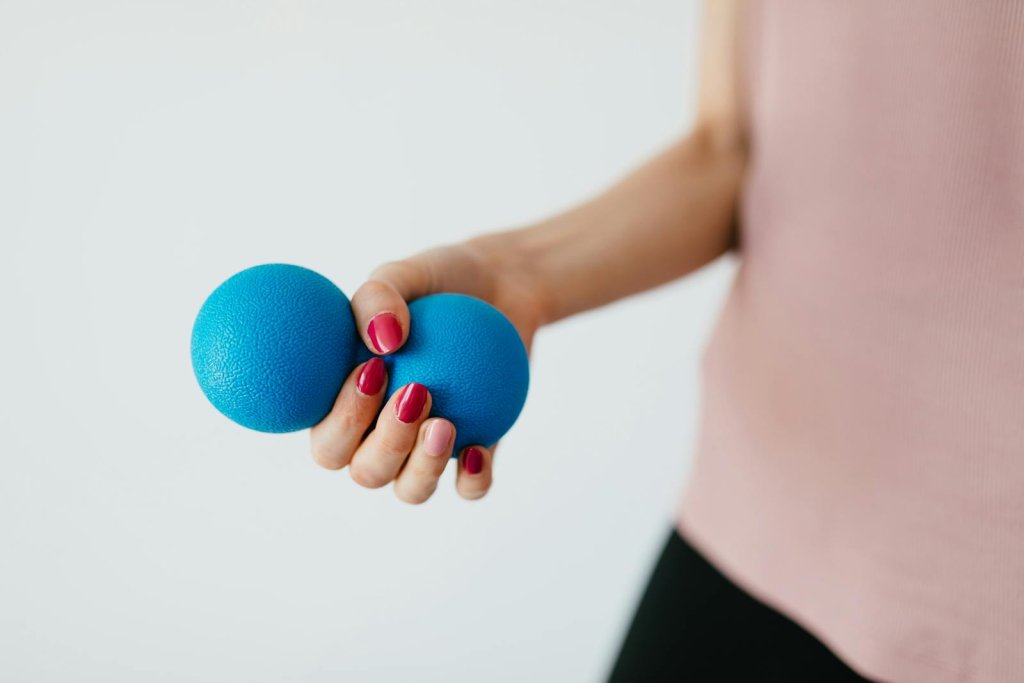
9. Soft Ball or Putty Squeeze
Why it works
This gentle strengthening drill supports grip without overloading inflamed joints. It encourages blood flow and mild activation of the finger muscles.
Muscles worked
Finger flexors, palm muscles, thenar and hypothenar muscles, forearm flexors.
How to do it
- Hold a soft therapy ball or soft putty in your hand.
- Gently squeeze for 2–3 seconds.
- Release slowly.
- Repeat 8–10 times.
Trainer Tip
The goal is a light squeeze — avoid gripping hard, which may increase joint stress.
10. Pinch Strengthening (Ball or Putty Pinch)
Why it works
Pinching exercises support fine motor control and coordination between the thumb and each finger, which is often reduced in arthritis.
Muscles worked
Thumb flexors, adductor pollicis, fingertip stabilizers, intrinsic thumb muscles.
How to do it
- Pinch a soft ball or putty between your thumb and one finger.
- Hold for 2 seconds.
- Repeat 3–5 times per finger.
Trainer Tip
Choose soft putty or a very squishy ball — firmer tools can overload sensitive joints.
How Often Should You Do Hand Exercises for Arthritis?
- Mobility exercises: 1–2 times per day
- Light strengthening: 2–3 days per week
- Warm-up: before every session
Consistency is key. Start slow and increase gradually as comfort improves.
Why Hand Exercises for Arthritis Matter
Hand exercises for arthritis matter because they help keep your joints moving, support circulation, and may reduce the stiffness that often makes daily tasks difficult. Gentle mobility and strengthening work can improve grip, flexibility, and overall hand function. While these exercises do not cure arthritis, performing them regularly may help you use your hands more comfortably and confidently throughout the day.
Key benefits include:
- Supporting joint mobility
- Helping reduce stiffness
- Improving grip strength
- Enhancing finger and thumb flexibility
- Supporting better control during daily tasks
Safety Tips Before You Start Hand Exercises for Arthritis
- Warm up with warm water, a warm towel, or gentle finger movements.
- Move slowly and avoid forcing stiff joints.
- Mild discomfort is normal — sharp pain is not.
- During flare-ups, focus on gentle mobility only.
- Stop if swelling increases or joints feel unstable.
- Consult a physician or hand therapist if you have recent surgery, severe joint damage, or new symptoms.
Who Should Avoid or Modify Hand Exercises
Avoid or modify exercises if you have:
- A severe flare-up with acute inflammation
- Sudden swelling or heat in the joints
- Recent hand/wrist surgery (follow surgeon guidelines)
- Significant joint instability
- Sharp or worsening pain during movement
Seek personalized guidance from a rheumatologist or certified hand therapist.
When to See a Doctor or Hand Therapist
- Increased swelling, redness, or warmth
- Difficulty gripping objects
- Symptoms spreading to new joints
- Numbness or tingling
- A decline in hand function despite exercises
A medical professional can recommend targeted therapy, splints, or medication adjustments.
FAQ
1. Do hand exercises help arthritis pain?
They may help reduce stiffness and improve mobility, supporting better daily function. They do not cure arthritis.
2. Should I exercise my hands during an arthritis flare?
Focus only on gentle mobility; avoid strengthening during active flares.
3. Are these exercises safe for rheumatoid arthritis?
Generally yes, if movements are gentle and done within comfort. Always consult your rheumatologist for personalized advice.
4. How long until I see improvement?
Some people feel less stiffness within 1–2 weeks. Strength and mobility improvements may take several weeks.
5. Can hand exercises prevent arthritis?
Exercises cannot prevent arthritis, but they may help maintain joint function and support everyday tasks.
6. Should I use therapy putty or a ball?
Yes — soft putty or a soft ball can provide safe strengthening options.
7. What if exercises increase pain?
Stop immediately and switch to gentle range-of-motion only. If pain persists, consult a healthcare provider.
Conclusion
Hand exercises for arthritis may help reduce stiffness, improve mobility, and support daily hand function, especially when combined with warm-ups and performed consistently. Start gently, move within a comfortable range, and progress slowly. If symptoms worsen or new issues appear, seek professional guidance.
This content is for informational purposes only and not medical advice.
References
- Lamb SE, et al. (2015). SARAH Trial – Exercises to improve function of the rheumatoid hand.
Strong RCT showing that a structured hand-exercise program improved function in rheumatoid arthritis of the hand. - Williams E, et al. (2017). Extended follow-up of SARAH hand exercise trial.
Shows that benefits of hand exercises can be maintained over the longer term. - Hennig T, et al. (2015). Home-based hand exercises in women with hand osteoarthritis.
RCT demonstrating improved grip strength and function from home hand-exercise programs. - Srikesavan C, et al. (2024). Exercise-based rehabilitation for hand osteoarthritis – systematic review & meta-analysis.
Summarizes overall evidence that exercise may reduce stiffness and support function in hand OA. - Kloppenburg M, et al. (2019). 2018 EULAR recommendations for the management of hand osteoarthritis.
International guideline recommending education and hand exercises as core management.