
Exercises for scoliosis in seniors can help support mobility, posture, and daily comfort when performed safely and consistently. While exercise cannot straighten a scoliosis curve, research and clinical guidance show that gentle strengthening, mobility, and posture-focused movements may help older adults stay active, confident, and functional.
Understanding how to move safely with scoliosis is especially important for seniors, as age-related changes such as joint stiffness, balance challenges, and bone-density loss can affect exercise tolerance. This guide explains the 5 best senior-friendly exercises, safety guidelines, and common questions.
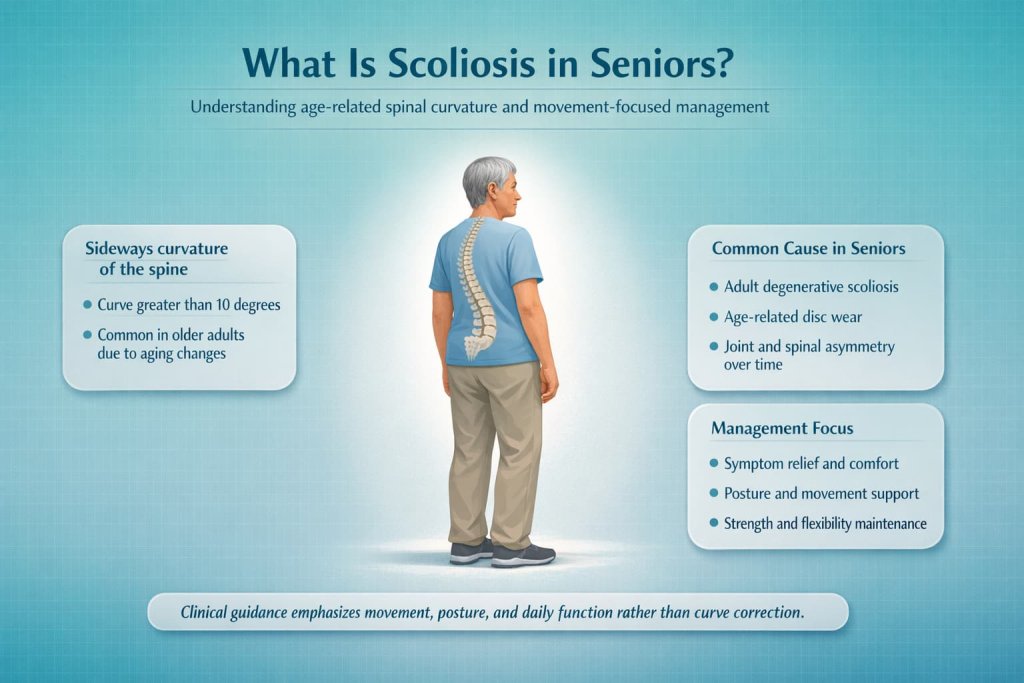
What Is Scoliosis in Seniors?
Scoliosis is a sideways curvature of the spine measuring more than 10 degrees. In seniors, it is most commonly adult degenerative scoliosis, which develops due to age-related disc wear, joint changes, and spinal asymmetry.
According to the Mayo Clinic, adult scoliosis management often focuses on symptom relief, posture, and maintaining movement rather than structural correction. Exercise and physical therapy are commonly recommended to support strength, flexibility, and daily function.
Can Exercise Help Seniors With Scoliosis?
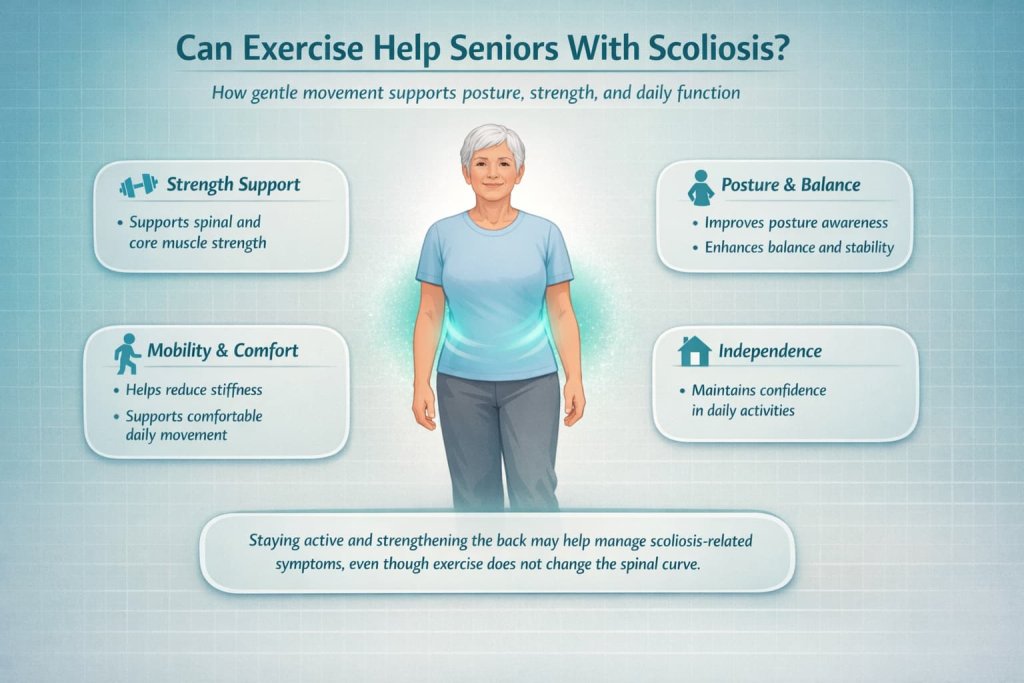
Exercise may help seniors with scoliosis by:
- Supporting spinal and core muscle strength
- Improving posture awareness and balance
- Reducing stiffness and movement-related discomfort
- Maintaining independence with daily activities
Guidance from the National Health Service notes that staying active and strengthening the back can help adults manage scoliosis-related symptoms, even though exercise does not change the spinal curve itself.
5 Best Exercises for Scoliosis in Seniors
These exercises are selected for being low-impact, posture-focused, and adaptable for older adults. Always stay within a pain-free range of motion.
1. Seated Pelvic Tilt
How to do it
- Sit upright on a sturdy chair with your feet flat on the floor, hip-width apart
- Place your hands on your thighs to help stay relaxed
- Gently tilt your pelvis backward to slightly flatten your lower back
- Hold for 2–3 seconds while breathing normally
- Slowly return to a neutral sitting position
- Repeat with slow, controlled movement
Why it works
This exercise improves awareness of neutral spine alignment and encourages gentle movement through the lower spine. It helps seniors reconnect with core control without placing stress on the spine or joints, making it ideal for scoliosis management.
Muscles worked
- Deep abdominal muscles
- Lower back stabilizers
- Pelvic stabilizing muscles
Trainer Tip
Move slowly and stay pain-free. The goal is control and awareness—not forcing range of motion.
2. Chair-Supported Side Bend Stretch
How to do it
- Sit tall on a chair with both feet firmly planted on the floor
- Place one hand on the seat or side of the chair for support
- Slowly bend your torso slightly away from the supporting hand
- Keep your chest facing forward and shoulders relaxed
- Hold the stretch briefly, then return to center
- Repeat on the opposite side
Why it works
Scoliosis often leads to uneven muscle tension along the spine. This gentle side bend improves side-to-side mobility and flexibility while minimizing spinal loading, making it suitable for seniors.
Muscles worked
- Side trunk muscles
- Upper and mid-back muscles
- Supporting spinal stabilizers
Trainer Tip
Think “lengthen,” not “collapse.” Keep the movement small and controlled.
3. Standing Wall Posture Hold
How to do it
- Stand with your back facing a wall and feet a few inches forward
- Gently touch the wall with your hips, upper back, and head (as comfortable)
- Keep your chest lifted and shoulders relaxed
- Hold this upright posture while breathing normally
- Step away from the wall and try to maintain the same alignment
Why it works
This exercise builds postural endurance and body awareness, helping seniors practice upright alignment during everyday activities like standing and walking.
Muscles worked
- Upper back muscles
- Glutes
- Core stabilizers
Trainer Tip
Avoid pressing forcefully into the wall. Think “tall and relaxed,” not stiff.
4. Bird Dog (Modified)
How to do it
- Start on hands and knees, or place hands on a bench or chair for support
- Keep your spine neutral and head aligned with your body
- Slowly extend one arm or one leg at a time
- Hold briefly while maintaining balance
- Return to the starting position with control
- Switch sides and repeat
Why it works
This modified version trains core stability and coordination while minimizing strain on the spine. It helps seniors improve balance and spinal control in a safe, controlled manner.
Muscles worked
- Core stabilizers
- Glutes
- Upper back muscles
Trainer Tip
If balance feels uncertain, reduce range or perform only arm movements.
5. Heel-to-Toe Balance Walk
How to do it
- Stand tall near a wall, railing, or countertop for support
- Step forward slowly, placing the heel of one foot directly in front of the toes of the other
- Keep your posture upright and core gently engaged
- Take slow, controlled steps forward
- Use support as needed for balance
Why it works
Balance training is essential for seniors with scoliosis, as it supports posture, gait control, and fall prevention. This exercise also reinforces upright alignment during movement.
Muscles worked
- Lower leg muscles
- Hip stabilizers
- Core stabilizers
Trainer Tip
Look straight ahead instead of down to encourage better posture and balance
How Often Should Seniors Do These Exercises?
General public-health guidance recommends:
- Strength and posture exercises: 2–3 days per week
- Light mobility or balance work: most days
- Low-impact aerobic activity (walking, cycling): as tolerated
Always allow rest days and adjust volume based on comfort.
Safety Guidelines for Seniors With Scoliosis
- Stay within a pain-free range of motion
- Avoid fast twisting or high-impact movements
- Use support (chair, wall, rail) when balance is limited
- Progress slowly over weeks, not days
- Consult a healthcare professional if pain, numbness, or weakness occurs
The American College of Sports Medicine emphasizes gradual progression and individualized modification for older adults with musculoskeletal conditions.
When to Avoid Exercise or Seek Medical Advice
Seniors with scoliosis should avoid exercise and seek professional guidance if they experience:
- Persistent or worsening back pain that does not improve with rest
- Sharp, sudden, or radiating pain in the back or legs
- Numbness, tingling, or weakness in the legs or feet
- Noticeable loss of balance or frequent falls
- Pain during basic daily movements such as standing, walking, or sitting
- A recent fall, fracture, or spinal injury
- Diagnosed osteoporosis with a high fracture risk
- Rapid changes in posture or spinal appearance
In these cases, consulting a qualified healthcare provider or physical therapist is recommended before continuing any exercise program. Guidance from organizations such as the Mayo Clinic and the National Institute on Aging emphasizes that individualized assessment is especially important for older adults with spinal conditions.
Frequently Asked Questions
Are scoliosis exercises safe for seniors?
Yes, when they are low-impact, well-controlled, and performed within a comfortable range.
Can exercise fix scoliosis in older adults?
No. Exercise does not correct spinal curvature, but it may help support movement, posture, and comfort.
Should seniors avoid twisting exercises?
Deep or fast twisting is usually discouraged. Gentle, controlled rotation may be appropriate under professional guidance.
Is physical therapy better than home exercise?
Physical therapy can be helpful for personalized assessment, especially for pain or balance issues.
Can scoliosis exercises help with balance?
Yes. Many posture and core exercises also support balance and walking confidence.
Should seniors with osteoporosis modify these exercises?
Yes. Extra caution and professional input are recommended if osteoporosis is present.
Conclusion
Exercises for scoliosis in seniors are about moving safely, maintaining posture, and supporting independence, not forcing correction. With gentle strengthening, mobility, and balance work, many older adults can stay active and confident in daily life.
If you’re unsure where to start, consider consulting a qualified professional to tailor these exercises to your needs—and begin with consistency, not intensity.
References
- Scoliosis: Diagnosis and Treatment (Mayo Clinic)
- Treatment in Adults: Scoliosis (NHS)
- Scoliosis: Symptoms, Causes, and Treatment (NIAMS – NIH)
- 2016 SOSORT Guidelines for Conservative Treatment of Idiopathic Scoliosis (SpringerOpen)
- Schroth Method for Scoliosis (Johns Hopkins Medicine)
- Older Adult Physical Activity Recommendations (CDC)
- Falls and Falls Prevention (National Institute on Aging)
- Exercising With Osteoporosis: Safety Guidance (Mayo Clinic)