
Achilles tendonitis exercises are controlled movements designed to gradually load the Achilles tendon to reduce pain, improve strength, and support long-term recovery.
Understanding how and when to load the tendon matters because complete rest can weaken the tissue, while the right exercises help the tendon adapt safely over time.
This guide explains the best evidence-based Achilles tendonitis exercises, how they work, and how to use them safely—whether your goal is walking comfortably, returning to running, or preventing re-injury.
What Are Achilles Tendonitis Exercises?
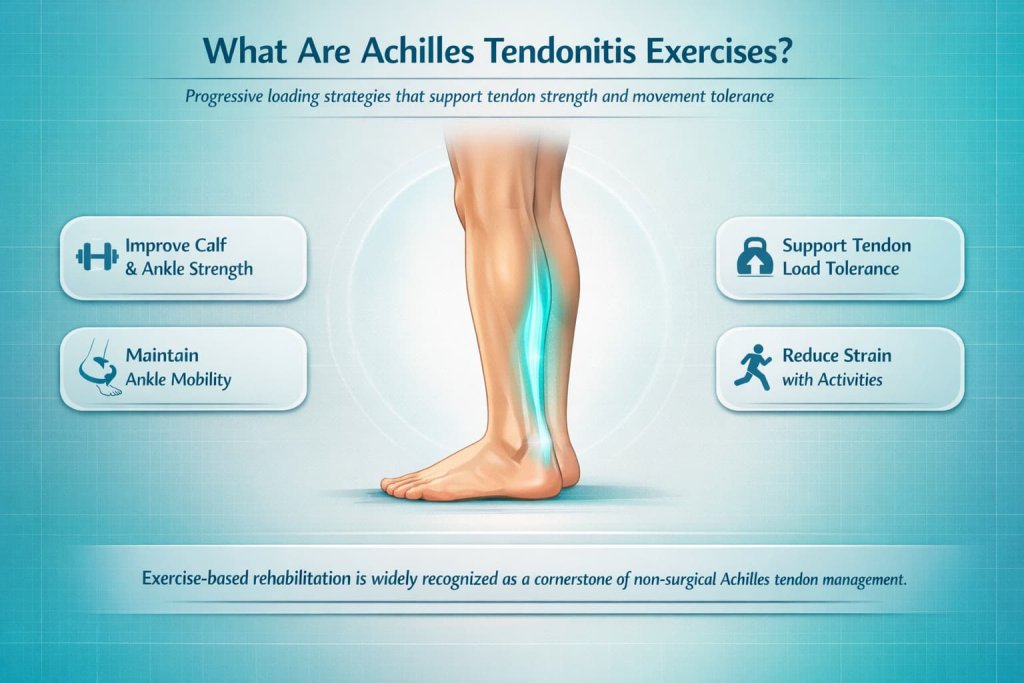
Achilles tendonitis exercises focus on progressive tendon loading—gradually applying force to the tendon so it can rebuild tolerance to daily and athletic demands.
These exercises typically aim to:
- Improve calf and ankle strength
- Support tendon load tolerance
- Maintain or restore ankle mobility
- Reduce strain during walking, running, and jumping
Clinical guidance from groups such as the International Federation of Sports Physical Therapy emphasizes exercise as a cornerstone of non-surgical management.
Why Exercise Matters for Achilles Tendonitis
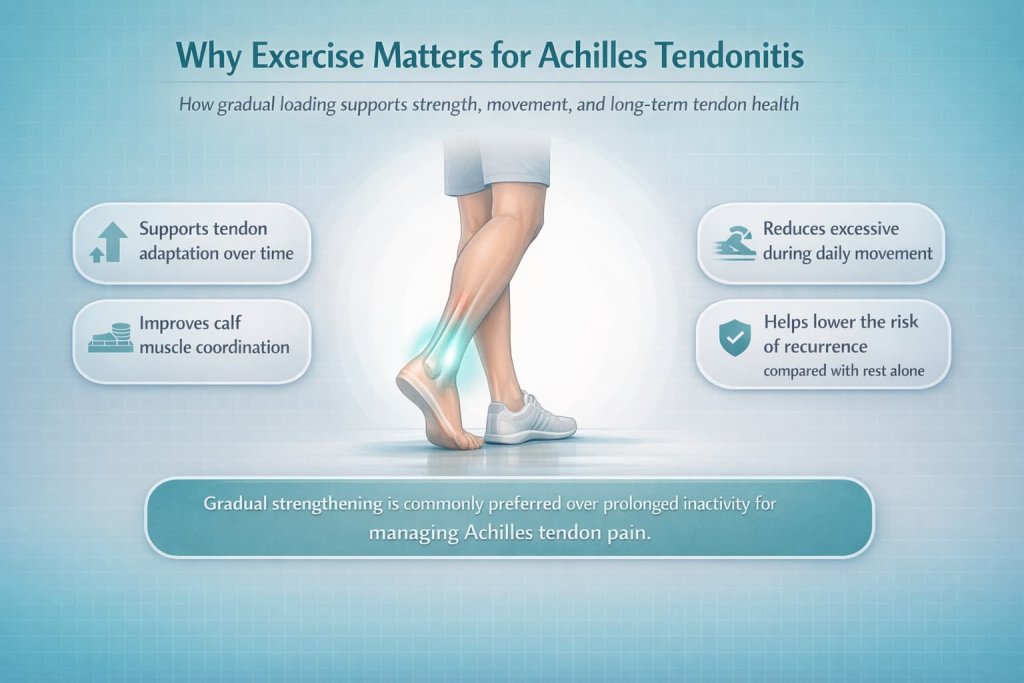
Exercise does not “fix” the tendon overnight, but consistent, well-selected loading may help by:
- Supporting tendon adaptation over time
- Improving calf muscle coordination
- Reducing excessive stress during daily movement
- Lowering the risk of recurrence compared with rest alone
According to guidance summarized by Mayo Clinic, gradual strengthening is preferred over prolonged inactivity for most people with Achilles tendon pain.
8 Best Achilles Tendonitis Exercises
These 8 Achilles tendonitis exercises focus on gradual tendon loading to help reduce pain and improve ankle strength. When performed consistently and progressed carefully, they support safer movement and long-term tendon health.
1. Isometric Calf Raise Hold
How to do it
- Stand upright while holding a wall, rail, or chair for balance
- Slowly rise onto both toes, lifting your heels off the floor
- Hold the top position without bouncing or shifting weight
- Maintain the hold for 30–45 seconds
- Rest briefly and repeat 3–5 times
Why it works
Isometric loading places tension on the Achilles tendon without joint movement. This type of loading may be better tolerated during early or pain-sensitive stages because it limits excessive tendon strain while still encouraging the tendon to handle force
Trainer Tip
Focus on even weight through both feet. If symptoms remain stable for several sessions, you can gradually progress to single-leg holds.
2. Double-Leg Standing Calf Raises
How to do it
- Stand with feet hip-width apart and hands lightly supported
- Press through the balls of your feet to lift your heels
- Pause briefly at the top
- Lower your heels back down with control
- Perform 10–15 repetitions
Why it works
This exercise builds foundational calf strength and introduces controlled tendon loading. It prepares the Achilles for more demanding exercises by improving force tolerance during everyday movements like walking and standing.
Trainer Tip
Use a slow, steady tempo—about 2 seconds up and 3 seconds down—to avoid relying on momentum.
3. Eccentric Heel Drops (Straight Knee)
How to do it
- Stand on a step with heels hanging off the edge
- Rise onto your toes using both feet
- Shift your weight onto the affected side
- Slowly lower the heel below step level
- Repeat for 8–12 controlled repetitions
Why it works
Eccentric loading emphasizes the muscle-lengthening phase, which has been widely studied for Achilles tendinopathy. It may help improve tendon load tolerance and functional strength over time.
Trainer Tip
Lower the heel slowly for 3–4 seconds. Stop the movement if pain increases sharply or lingers significantly afterward.
4. Bent-Knee Heel Drops
How to do it
- Stand on a step with the knee slightly bent
- Lift both heels, then shift weight to the affected side
- Slowly lower the heel while keeping the knee bent
- Complete 8–12 repetitions
Why it works
Bending the knee shifts more load to the soleus muscle, which plays a major role in walking, standing endurance, and supporting the Achilles during daily activities.
Trainer Tip
Keep the bend consistent throughout the movement—straightening the knee changes the muscle emphasis.
5. Seated Calf Raises
How to do it
- Sit upright with feet flat on the floor
- Press through the balls of your feet to lift your heels
- Pause briefly at the top
- Lower heels back down slowly
- Perform 12–15 repetitions
Why it works
Seated calf raises reduce body-weight loading while still activating the calf-Achilles complex. This makes them useful during flare-ups or as an early strengthening option.
Trainer Tip
Move through a comfortable range and avoid rushing the repetitions. Light resistance can be added gradually if tolerated.
6. Ankle Dorsiflexion and Plantarflexion
How to do it
- Sit or lie in a comfortable position
- Gently point your toes away from you
- Slowly pull your toes back toward your shin
- Move only within a pain-free range
- Perform 10–15 repetitions
Why it works
This movement helps maintain ankle mobility and circulation without placing high load on the Achilles tendon. Preserving motion supports smoother walking mechanics.
Trainer Tip
Think “controlled movement,” not stretching. Avoid pushing into discomfort at the end range.
7. Single-Leg Balance Holds
How to do it
- Stand on the affected leg
- Keep your posture upright and core gently engaged
- Hold your balance for 20–30 seconds
- Repeat 2–3 times
Why it works
Balance exercises improve ankle stability and neuromuscular control, which helps the tendon manage load during uneven surfaces, turns, and daily activities.
Trainer Tip
Progress gradually by reducing hand support or standing on a softer surface once balance feels steady.
8. Slow Step-Ups
How to do it
- Place the affected foot on a low step or platform
- Push through the foot to stand up fully
- Slowly lower back down under control
- Perform 8–12 repetitions
Why it works
Step-ups build functional lower-body strength while training the Achilles to handle load during real-world tasks such as stairs and inclines.
Trainer Tip
Choose a step height that allows smooth, controlled movement without pain or compensation.
Exercise Progression Strategy for Achilles Tendonitis
A common progression approach includes:
- Starting with isometric and double-leg exercises
- Progressing to eccentric and single-leg loading
- Gradually reintroducing faster or spring-like movements
Clinical concepts discussed in the British Journal of Sports Medicine emphasize matching exercise load to current tolerance rather than pain elimination alone.
Safety Guidelines Before Starting Achilles Tendonitis Exercises
Before beginning, keep these principles in mind:
- Mild discomfort during exercise is common; sharp or worsening pain is not
- Progress load slowly—avoid sudden jumps in volume or intensity
- Warm up with light walking or ankle movement
- Modify or pause exercises during pain flare-ups
- Consult a qualified professional if pain persists or worsens
Understanding Achilles Tendon Load and Pain Tolerance
Achilles tendonitis is best managed by gradually improving how the tendon tolerates load, not by avoiding movement completely. Tendons adapt slowly, and appropriate stress is what encourages positive change.
Key points to understand:
- Some discomfort during exercise can be normal, especially early on
- Pain should stay mild to moderate and settle within 24 hours
- Sharp pain, limping, or worsening morning stiffness suggests overload
- Tendon pain does not always mean damage—it often reflects sensitivity to load
Learning to balance load and recovery helps reduce fear, supports consistency, and improves long-term outcomes.
How to Progress Achilles Tendonitis Exercises Safely
Progression should be gradual, planned, and based on tolerance, not speed of recovery.
Safe progression guidelines:
- Start with double-leg or supported exercises before single-leg work
- Increase one variable at a time (reps, hold time, or resistance)
- Maintain good control and technique as difficulty increases
- Allow at least 48 hours between heavier loading sessions
The goal is steady improvement in strength and confidence, not pushing through pain.
How to Know If an Exercise Is Too Much
Exercises may be too demanding if you notice:
- Pain that increases during the set and does not settle afterward
- Morning stiffness that is worse the day after exercise
- Swelling, warmth, or reduced ankle movement
- Difficulty walking or climbing stairs later in the day
A helpful rule: if symptoms are worse for more than 24 hours, reduce intensity, volume, or exercise difficulty.
How Often to Perform Achilles Tendonitis Exercises
Most people respond well to 2–3 structured exercise sessions per week, with rest or lighter days between loading.
General frequency guidance:
- Isometric or light exercises: up to most days if well tolerated
- Strength-focused exercises: 2–3 times per week
- Balance and mobility work: can be done more frequently
Consistency matters more than daily intensity. Allowing recovery time helps the tendon adapt safely and reduces flare-ups.
Common Mistakes During Achilles Tendonitis Rehab
- Resting completely for long periods
- Increasing intensity too quickly
- Ignoring pain signals during or after exercise
- Stretching aggressively into sharp pain
When to Seek Medical or Physical Therapy Guidance
Consider professional evaluation if:
- Pain persists beyond several weeks
- Swelling or stiffness worsens
- Daily walking becomes difficult
- Symptoms interfere with sleep or work
A licensed physical therapist or healthcare provider can tailor loading strategies to your condition.
Frequently Asked Questions
How often should I do Achilles tendonitis exercises?
Most programs recommend 2–3 sessions per week, allowing rest days between loading.
Should exercises hurt?
Mild discomfort may be acceptable, but sharp or escalating pain is not recommended.
Are stretches enough for Achilles tendonitis?
Stretching alone is usually insufficient; strengthening and loading are key components.
Can runners do these exercises?
Yes, but running volume may need temporary adjustment during rehab.
How long does recovery take?
Improvement often occurs over weeks to months, depending on severity and consistency.
Are these exercises safe for insertional Achilles pain?
Some exercises may need modification to limit deep ankle dorsiflexion.
Conclusion
Achilles tendonitis exercises focus on gradual, controlled loading to support pain reduction, strength, and ankle function. When performed consistently and progressed wisely, these movements can help you return to daily activities and sport with greater confidence.
If symptoms persist, seek individualized guidance to ensure safe and effective recovery.
This content is for informational purposes only and not medical advice.
References
- Midportion Achilles Tendinopathy Revision – 2024 Clinical Practice Guideline (JOSPT)
- Midportion Achilles Tendinopathy Revision – 2024 Guideline PDF (IFSPT)
- Eccentric exercise vs other exercises for mid-portion Achilles tendinopathy: Systematic review and meta-analysis (PubMed, 2023)
- Full Text: Eccentric exercise for mid-portion Achilles tendinopathy (PMC, 2023)
- Reducing tendon compression for insertional Achilles tendinopathy: Randomised clinical trial (BJSM, 2025)
- Achilles Tendinitis: Symptoms and Treatment (Cleveland Clinic, Updated March 6, 2024)
- Achilles Tendinitis (OrthoInfo) – American Academy of Orthopaedic Surgeons (AAOS)
- Achilles tendinitis: Symptoms and causes (Mayo Clinic)