
Posterior tibial tendonitis exercises focus on strengthening the posterior tibial tendon, supporting the foot arch, and improving ankle control to help you walk and move more comfortably. Understanding and performing the right exercises matters because this condition—often referred to clinically as posterior tibial tendon dysfunction (PTTD)—can progress over time if the tendon continues to be overloaded.
When done correctly and consistently, targeted exercises may help support arch stability, improve balance, and reduce strain on the ankle during daily activities.
What Is Posterior Tibial Tendonitis?
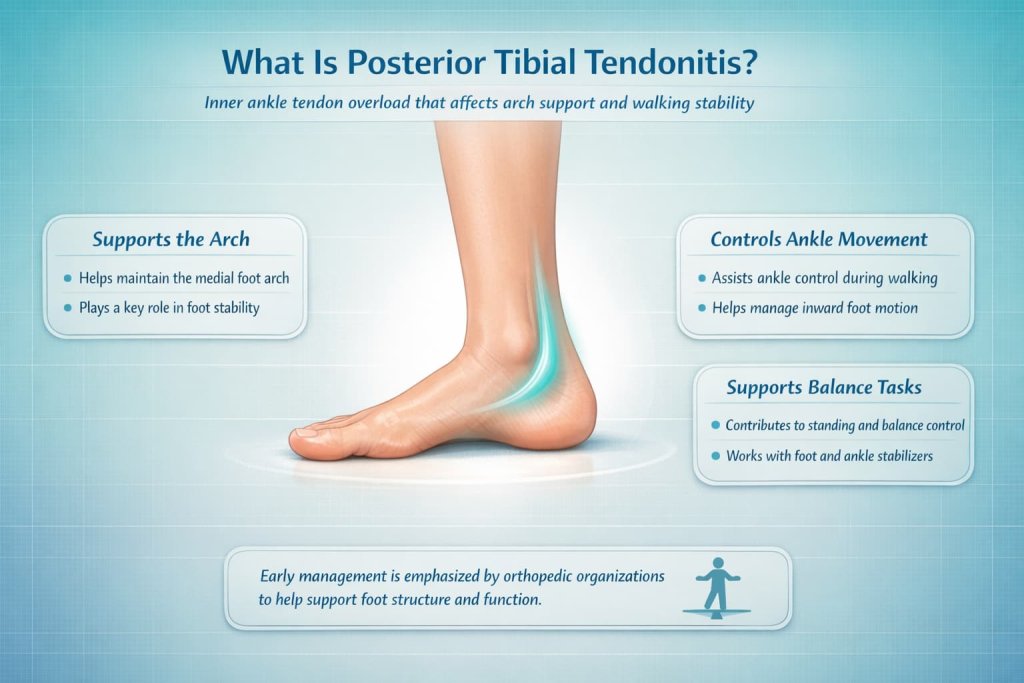
Posterior tibial tendonitis occurs when the posterior tibial tendon—running along the inside of the ankle and foot—becomes irritated or overloaded. This tendon plays a major role in:
- Supporting the medial foot arch
- Controlling ankle movement during walking
- Stabilizing the foot during standing and balance tasks
According to the American Academy of Orthopaedic Surgeons, ongoing dysfunction of this tendon may contribute to progressive arch flattening, which is why early, appropriate management is emphasized.
5 Best Posterior Tibial Tendonitis Exercises
These posterior tibial tendonitis exercises focus on improving arch support, ankle strength, and balance control. They are commonly used in conservative rehab to help support walking and daily movement tolerance.
1. Resisted Ankle Inversion
How to do it:
- Sit on the floor or a firm surface with one leg extended straight
- Loop a resistance band around the forefoot of the working leg
- Anchor the band to the outside (lateral side) of the foot so it pulls outward
- Keep the knee relaxed and the heel lightly resting on the floor
- Slowly turn the foot inward against the band’s resistance
- Pause briefly at the end range, then return to the start with control
- Perform all reps smoothly before switching sides
Why it works:
This exercise directly loads the posterior tibial tendon in its primary functional role—controlling inward foot movement and supporting the arch. Controlled resistance helps improve tendon load tolerance and reinforces proper foot mechanics during walking and standing.
Trainer Tip:
Use a light to moderate band and focus on slow, precise movement. If the ankle or foot twists suddenly, the resistance is too strong.
2. Heel Raises With Arch Focus
How to do it:
- Stand upright while holding a wall, counter, or chair for balance
- Position your feet hip-width apart with weight evenly distributed
- Gently lift both heels off the floor while keeping pressure through the big toe
- Maintain the natural arch of the foot as you rise
- Pause briefly at the top of the movement
- Lower your heels slowly back to the floor with control
- Complete all repetitions before resting
Why it works:
Heel raises load the posterior tibial tendon while the foot is bearing weight, which closely matches how the tendon functions during daily activities. Emphasizing arch control helps prevent excessive inward collapse during the movement.
Trainer Tip:
If arch control is difficult, reduce the range of motion or slow the lowering phase before progressing.
3. Short Foot (Arch Activation) Exercise
How to do it:
- Sit or stand barefoot on a flat surface
- Keep your toes relaxed and spread naturally
- Gently draw the ball of the foot toward the heel
- Avoid curling or gripping with the toes
- Hold the arch contraction for 5–10 seconds
- Relax fully and repeat for the desired number of repetitions
Why it works:
The short foot exercise strengthens the small intrinsic muscles of the foot that help maintain arch integrity. These muscles work alongside the posterior tibial tendon to support the foot during standing and walking.
Trainer Tip:
Think “lift the arch” rather than “scrunch the toes.” The movement should feel controlled and subtle.
4. Single-Leg Balance Hold
How to do it:
- Stand barefoot or in supportive shoes on one leg
- Lift the opposite foot slightly off the floor
- Keep your hips level and torso upright
- Maintain gentle arch engagement on the standing foot
- Hold the position for the set time
- Step down, rest briefly, and switch sides
Why it works:
Single-leg balance challenges the foot and ankle to stabilize the body during load, improving neuromuscular coordination. This helps prepare the posterior tibial tendon for real-world demands like walking, turning, and uneven surfaces.
Trainer Tip:
If balance is difficult, lightly touch a wall with one finger for support instead of rushing progressions.
5. Calf Stretch (Heel Cord Stretch)
How to do it:
- Stand facing a wall with hands placed at chest height
- Step one foot back while keeping the heel flat on the floor
- Bend the front knee and lean forward slightly
- Keep the back leg straight and the foot pointing forward
- Hold the stretch for the prescribed time
- Switch sides and repeat
Why it works:
Tight calf muscles can limit ankle movement and increase strain on the posterior tibial tendon during walking. Improving calf flexibility helps distribute load more evenly through the foot and ankle.
Trainer Tip:
Stretch to a comfortable tension, not pain. Gentle, consistent stretching is more effective than forcing range.
Why Exercises Matter for Posterior Tibial Tendonitis
Exercises do not “fix” the tendon overnight, but they are widely used to support function and movement tolerance.
Research and clinical guidance suggest that well-chosen exercises may help by:
- Supporting the muscles that help maintain the foot arch
- Improving ankle strength and control during walking
- Reducing excessive strain placed on the tendon during daily activities
- Enhancing balance and single-leg stability
Guidance from physical therapy organizations and orthopedic sources consistently highlights strengthening—not just stretching—as a key component of conservative care.
How Often Should You Do Posterior Tibial Tendonitis Exercises?
Most conservative programs recommend:
- Strength exercises: 2–4 times per week
- Balance work: daily or near-daily
- Stretching: daily, especially if stiffness is present
Progress gradually and reassess how your foot responds over time.
Safety Guidelines Before Starting Posterior Tibial Tendonitis Exercises
Before beginning, keep these points in mind:
- Exercises should be pain-guided, not pain-provoking
- Mild effort or muscle fatigue is acceptable; sharp or worsening pain is not
- Supportive footwear or orthotics are often recommended alongside exercises
- Sudden increases in training volume or impact activity should be avoided
If symptoms continue to worsen, or if you notice increasing arch flattening, medical evaluation is recommended.
Common Mistakes to Avoid With Posterior Tibial Tendonitis Exercises
Avoiding common errors is just as important as choosing the right exercises.
Frequent mistakes include:
- Performing exercises through pain rather than within a controlled range
- Using resistance that is too heavy too soon
- Ignoring footwear support outside of exercise sessions
- Advancing to running or jumping before adequate strength and control return
- Rushing balance progressions without mastering basic stability
These mistakes may increase tendon stress rather than supporting recovery.
When to Seek Medical or Physical Therapy Guidance
While exercises are commonly part of conservative care, professional guidance is important in certain situations.
Consider consulting a healthcare or physical therapy professional if:
- Pain continues to worsen despite consistent exercise
- Walking or standing tolerance decreases
- You notice increasing flattening of the foot arch
- Swelling or tenderness along the inside of the ankle persists
- Symptoms interfere with daily activities or work demands
Early assessment can help determine the stage of the condition and guide appropriate support strategies.
Frequently Asked Questions
Can exercises cure posterior tibial tendonitis?
Exercises do not cure the condition, but they may help support function and reduce strain when combined with appropriate footwear and activity management.
Should I wear orthotics while doing these exercises?
Many clinicians recommend supportive footwear or orthotics during daily activities, but some exercises are intentionally done barefoot to train foot control.
How long does it take to see improvement?
Many people notice functional improvements within several weeks, though timelines vary depending on severity and consistency.
Are these exercises safe for flat feet?
Yes, but progression should be gradual, and arch support outside of exercise is often recommended.
When should I stop exercising and see a doctor?
If pain worsens, walking becomes more difficult, or visible arch collapse progresses, professional evaluation is advised.
Can runners do posterior tibial tendonitis exercises?
Yes, but running volume often needs temporary reduction while strength and control are rebuilt.
Conclusion
Posterior tibial tendonitis exercises play an important role in conservative management by supporting arch strength, ankle control, and balance. When paired with supportive footwear and sensible activity modification, these exercises may help you move with greater confidence and comfort over time.
If symptoms persist or worsen, consulting a qualified healthcare or physical therapy professional is strongly recommended.
This content is for informational purposes only and not medical advice.
References
- AAOS OrthoInfo: Progressive Collapsing Foot Deformity (Posterior Tibial Tendon Dysfunction)
- AAOS OrthoInfo: Foot and Ankle Conditioning Program (Exercise Instructions)
- ChoosePT (APTA): Physical Therapy Guide to Posterior Tibial Tendon Dysfunction (Adult-Acquired Flatfoot)
- NCBI Bookshelf (StatPearls): Posterior Tibial Tendon Dysfunction
- BMJ Open Sport & Exercise Medicine: Exercise for Posterior Tibial Tendon Dysfunction (2018 Systematic Review)
- PubMed: Stage I and II Posterior Tibial Tendon Dysfunction Treated by an Orthosis and Exercise Program (Alvarez et al., 2006)
- Cleveland Clinic: Posterior Tibial Tendonitis and Posterior Tibial Tendon Dysfunction