
Resistance band ab exercises are one of the most effective ways to strengthen your core at home without heavy equipment. They add external tension, challenge your stability, and activate deep core muscles more effectively than many traditional bodyweight movements.
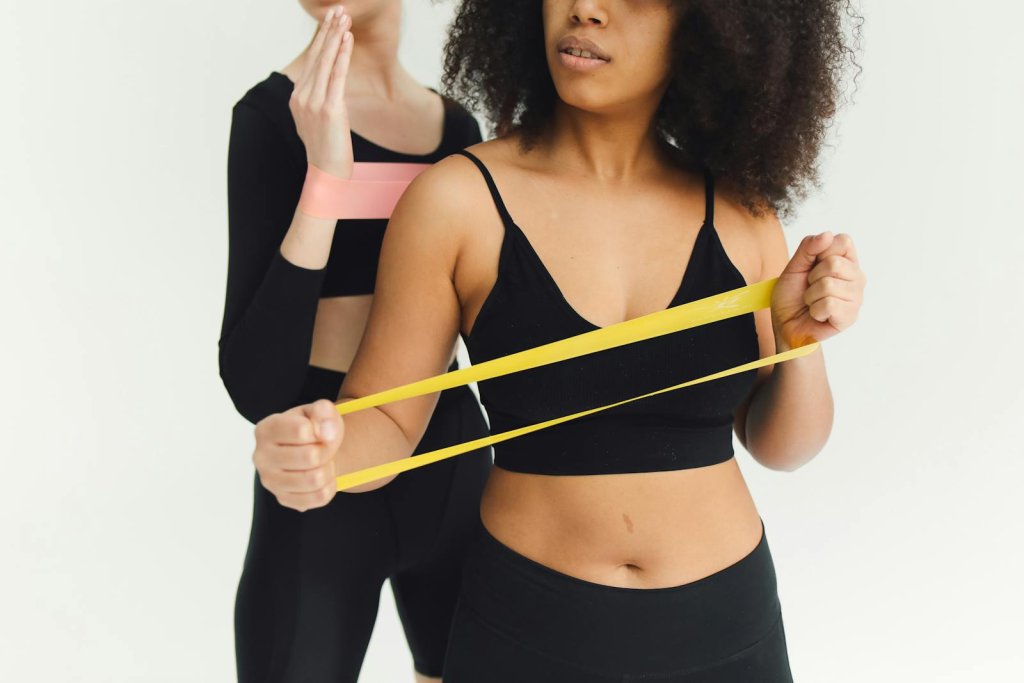
Understanding how to train your abs with bands is important because it helps improve posture, protects your lower back, enhances daily movement, and builds a stronger, more balanced midsection. This guide walks you through the best ab exercises, correct form, safety tips, training frequency, and research-backed benefits.
The 15 Best Resistance Band Ab Exercises
These resistance band ab exercises strengthen your entire core with controlled tension, deeper muscle activation, and joint-friendly resistance. Each move targets stability, rotation control, and lower-ab engagement to help you build a stronger, more functional midsection at home.
1. Pallof Press
Why it works:
This anti-rotation movement forces your deep core to stabilize against sideways pulling. It trains real-life core strength and improves spinal stability.
How to do it:
- Anchor the band at chest height.
- Stand sideways to the anchor and hold the band with both hands.
- Step out until you feel tension.
- Press the band straight forward without letting your torso rotate.
- Hold briefly, then return slowly.
Trainer Tip:
Keep ribs down and squeeze your glutes to prevent twisting.
2. Standing Anti-Rotation Hold
Why it works:
Teaches your core to resist movement, improving posture and rotational control.
How to do it:
- Stand sideways to the anchor point.
- Hold the band at your chest with elbows slightly bent.
- Step away to create tension.
- Hold the position for 10–20 seconds.
Trainer Tip:
Imagine “zipping up” your core—brace gently like someone is tapping your stomach.
3. Banded Dead Bug
Why it works:
Strengthens the lower abs and enhances spinal stability through controlled limb movement.
How to do it:
- Lie on your back and loop the band around both feet.
- Lift knees to 90 degrees and raise arms straight up.
- Extend one leg forward while keeping your back flat.
- Return and switch sides.
Trainer Tip:
Press your lower back gently into the floor to prevent arching.
4. Banded Reverse Crunch
Why it works:
The band increases resistance during the lift, boosting lower-ab activation.
How to do it:
- Anchor the band overhead and loop it around your feet.
- Lie on your back and bend your knees.
- Curl hips up toward your chest.
- Lower slowly with control.
Trainer Tip:
Avoid swinging—use your abs, not momentum.
5. Banded Bicycle Crunch
Why it works:
Combines rotation and tension, maximizing oblique engagement.
How to do it:
- Place a light band around your feet.
- Perform bicycle crunches by alternating elbow-to-knee contact.
- Keep movement slow and controlled.
Trainer Tip:
Focus on twisting from the torso, not pulling your neck.
6. Banded Russian Twist
Why it works:
The band adds constant tension, strengthening rotational control.
How to do it:
- Sit with knees bent and hold the band anchored to one side.
- Lean back slightly.
- Rotate your torso side to side while maintaining tension.
Trainer Tip:
Keep your chest lifted to avoid rounding your back.
7. Standing Diagonal Wood Chop
Why it works:
Explosive diagonal movement builds rotational strength used in sports and daily tasks.
How to do it:
- Anchor the band high.
- Stand sideways and grasp the handle with both hands.
- Pull diagonally down across your body.
- Return with control.
Trainer Tip:
Rotate your torso—not just your arms.
8. Standing Lift (Low-to-High)
Why it works:
Opposite of the wood chop, it challenges anti-rotation as you pull upward.
How to do it:
- Anchor the band low.
- Pull diagonally upward across your torso.
- Keep hips square the entire time.
Trainer Tip:
Avoid leaning—stay tall as you lift.
9. Banded Plank Pull-Through
Why it works:
Adds dynamic resistance to a plank, increasing deep core engagement.
How to do it:
- Start in plank with the band beside you.
- Reach under your body and pull the band to the other side.
- Alternate hands while keeping hips level.
Trainer Tip:
Don’t let your hips rock—slow is better.
10. Banded Plank with Row
Why it works:
Strengthens the core while challenging upper-back stability.
How to do it:
- Anchor the band in front of you.
- Hold a plank and row the band toward your ribs.
- Switch sides.
Trainer Tip:
Imagine your body as a “solid plank”—no swaying.
11. Banded Side Bend
Why it works:
Isolates and strengthens obliques with controlled lateral flexion.
How to do it:
- Stand on one end of the band.
- Hold the other end with the opposite hand.
- Lean sideways away from the band.
- Return slowly.
Trainer Tip:
Keep your chest facing forward—avoid twisting.
12. Seated Band Knee Tuck
Why it works:
Beginner-friendly ab exercise that activates lower abs with assistance from the band.
How to do it:
- Sit and loop the band around your feet.
- Lean back slightly with support from your hands.
- Pull knees toward your chest.
- Extend legs out with control.
Trainer Tip:
Keep your core tight so the lower back doesn’t round.
13. Banded Good Morning
Why it works:
Strengthens the lower back and deep spinal stabilizers—crucial for core health.
How to do it:
- Stand on the band and loop it around your upper back.
- Hinge at the hips, keeping a neutral spine.
- Return to standing.
Trainer Tip:
Think “hips back, not down”—avoid rounding your back.
14. Lying Banded Leg Raise
Why it works:
Targets lower abs with added resistance that prevents momentum.
How to do it:
- Anchor the band low and loop it around your ankles.
- Lie on your back.
- Lift legs upward while keeping them straight.
- Lower slowly.
Trainer Tip:
Engage your core before lifting to protect your back.
15. Banded Hip Pull-In (Mountain Climber Variation)
Why it works:
Adds resistance to a familiar movement, boosting lower-core activation and stability.
How to do it:
- Loop the band behind your feet.
- Get into plank position.
- Drive one knee toward your chest against the band.
- Switch sides rhythmically.
Trainer Tip:
Keep your hips level—avoid bouncing or sagging.
How Often Should You Do Resistance Band Ab Workouts
For best results:
- 2–3 core sessions per week
- 3–6 exercises per session
- 2–3 sets per exercise
- 8–15 slow, controlled reps (or 20–30 seconds for holds)
How to Do Resistance Band Ab Exercises Safely
- Keep your spine neutral unless the exercise involves controlled flexion.
- Move slowly and avoid snapping the band.
- Anchor the band securely to a heavy object.
- Use a lighter band if you lose control or feel back strain.
- Breathe continuously—avoid holding your breath.
Who Should Avoid or Modify These Exercises
Consult a healthcare provider before starting if you have:
- Acute lower-back pain
- Herniated discs
- Recent abdominal, pelvic, or spinal surgery
- Pregnancy complications
- Cardiovascular or blood pressure concerns
Common Mistakes to Avoid With Resistance Band Ab Exercises
- Using a band that’s too heavy – Excess tension causes twisting, arching, and loss of control.
- Letting your lower back arch – Reduces core activation and increases lower-back strain.
- Rushing through reps – Fast movements remove tension and raise injury risk; slow is better.
- Not securing the band properly – A weak anchor point can cause the band to snap back.
- Using momentum instead of muscle – Swinging your legs or torso takes work away from your abs.
- Holding your breath – Maintain steady breathing for better stability and safety.
- Rounding your shoulders or neck – Keep your posture tall and neutral to avoid strain.
FAQ
1. Are resistance bands effective for building abs?
Yes. Research shows resistance bands can increase strength and muscle activation similarly to weights when intensity is sufficient.
2. Can I get visible abs from band workouts?
Band exercises build strong abdominal muscles, but visible abs also depend on overall body fat and nutrition.
3. How long does it take to strengthen the core?
With consistent training (2–3 times per week), most people notice improvements in 4–6 weeks.
4. Are these exercises safe for beginners?
Yes. Start with light resistance, slow movements, and simple anti-rotation drills like Pallof presses.
5. Can bands replace weighted ab exercises?
For home workouts, bands offer comparable tension and activation when used properly.
6. Do band ab exercises help with lower-back pain?
They may help by improving stability, but avoid painful movements and consult a professional first.
7. What band resistance should I choose?
Beginners should use a light band for control; intermediate users can progress to medium tension.
Conclusion
Resistance band ab exercises are a powerful, joint-friendly way to build a stronger, more functional core at home. With consistent practice—just 2–3 sessions per week—you can develop better posture, stability, and abdominal strength using only a simple, affordable piece of equipment.
Start with a few movements from the list above, progress steadily, and stay consistent.