
The boat exercise is one of the most effective moves for strengthening your entire core, including the deep stabilizers that support posture, balance, and spinal alignment. It’s a staple in yoga, Pilates, and functional fitness because it challenges the abs, hip flexors, and back muscles while improving stability and control.
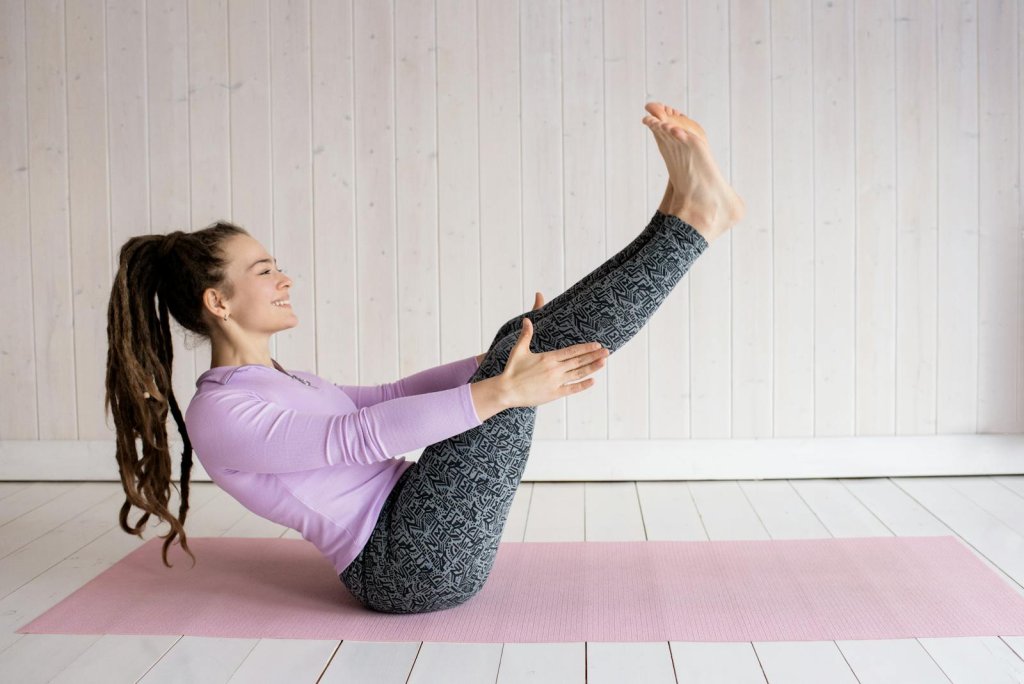
Understanding how to perform the boat exercise correctly is important because poor form can strain your lower back, while proper technique helps you gain strength safely. In this guide, you’ll learn how to do the exercise, its benefits, variations, mistakes to avoid, safety guidelines, and more—based on the latest expert recommendations and evidence from yoga and physiotherapy resources.
What Is the Boat Exercise?
The boat exercise (also called Boat Pose or Navasana) is a core-strengthening movement where you balance on your sitting bones while lifting your legs and keeping your torso tall. It creates a “V” shape with the body and requires isometric core engagement, stability, and balance.
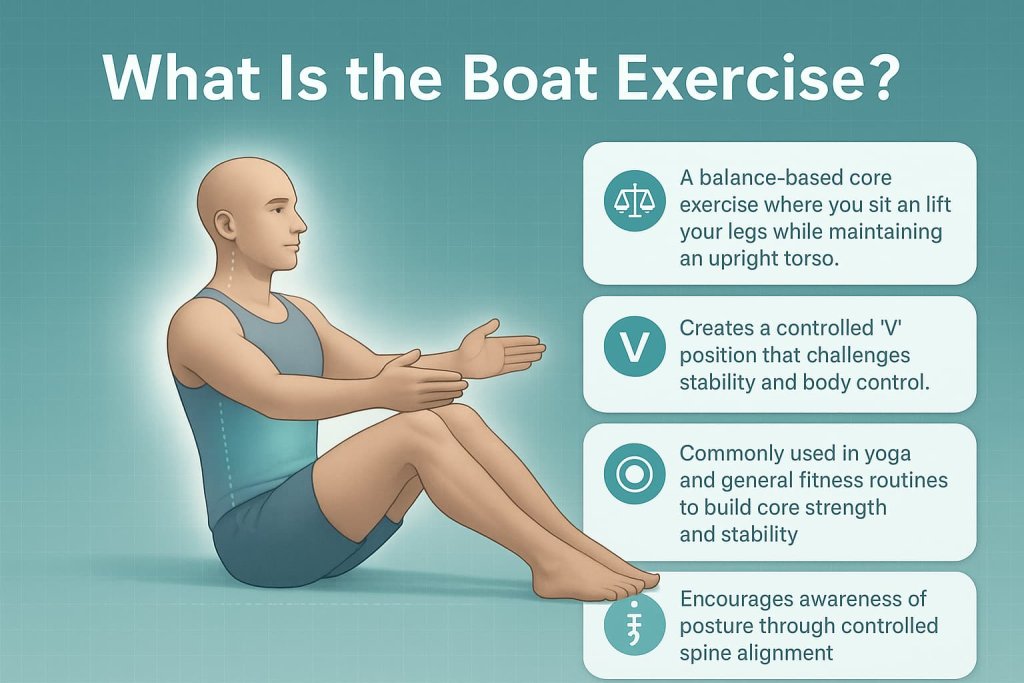
Boat exercise is widely used in yoga and core workouts to strengthen the abdominal wall, hips, and posture muscles.
How to Do the Boat Exercise (Step-by-Step)
Step 1: Start Seated
- Sit on the floor with knees bent and feet flat.
- Keep your spine tall and chest open.
Step 2: Lean Back Slightly
- Tilt your torso back while maintaining a straight spine.
- Avoid rounding the lower back.
Step 3: Lift Your Legs
- Raise your shins so they are parallel to the floor.
- For beginners, keep knees bent.
- For advanced variations, straighten your legs into a V-shape.
Step 4: Extend Arms Forward
- Reach your arms forward at shoulder height.
- Keep shoulders relaxed and neck neutral.
Step 5: Hold and Breathe
- Engage your core and hold for 10–20 seconds.
- Breathe evenly, keeping your spine long.
- Repeat for 2–3 sets.
Variations of the Boat Exercise
1. Half Boat (Beginner)
Why it works:
This variation reduces the load on the hip flexors and spine, allowing beginners to build foundational core strength safely while learning proper alignment.
Muscles worked:
Rectus abdominis, transverse abdominis, obliques, hip flexors (light), erector spinae.
How to do it:
- Sit with knees bent and feet flat.
- Lean back slightly while keeping your spine tall.
- Lift your shins so they are parallel to the floor.
- Hold behind your thighs for support.
- Keep your chest open and core braced.
Trainer Tip:
If your back rounds, place a folded towel under your hips to help maintain a neutral spine.
2. Supported Boat
Why it works:
Using a strap or holding behind the thighs reduces tension on the hip flexors and lower back, helping you maintain proper posture and core activation without strain.
Muscles worked:
Deep core stabilizers, rectus abdominis, obliques, hip flexors (reduced load).
How to do it:
- Sit with knees bent and loop a yoga strap around your feet, or hold the backs of your thighs.
- Lean back with a straight spine.
- Lift your feet off the floor while keeping your chest lifted.
- Use the strap or your hands to support the position.
Trainer Tip:
Think of lifting your sternum upward rather than pulling your legs higher—this keeps the spine long and prevents rounding.
3. Full Boat (Navasana)
Why it works:
The straight-leg position creates a longer lever, increasing core activation and requiring strong hip flexor and posture control for full-body stability.
Muscles worked:
Rectus abdominis, transverse abdominis, obliques, hip flexors, quadriceps, spinal extensors.
How to do it:
- Start in half boat.
- Slowly straighten your legs to form a “V” shape.
- Extend your arms forward at shoulder height.
- Keep your chest lifted and back long.
- Hold while breathing steadily.
Trainer Tip:
If your spine collapses, bend your knees slightly until you can maintain proper alignment.
4. Low Boat (Ardha Navasana)
Why it works:
Lowering the torso and legs increases the challenge to deep core stabilizers, improving strength, endurance, and spinal control.
Muscles worked:
Transverse abdominis, rectus abdominis, obliques, hip flexors, pelvic stabilizers.
How to do it:
- From full or half boat, slowly lower your back and legs toward the floor.
- Stop just before touching the ground.
- Keep your lower back gently pressed into the mat.
- Hold the position with tight core engagement.
Trainer Tip:
If you feel your lower back lifting off the floor, shorten your range and pull your ribs down to regain control.
5. Dynamic Boat
Why it works:
Moving between high and low boat builds core endurance, improves motor control, and trains the body to stabilize under motion—similar to athletic movement demands.
Muscles worked:
Entire core complex, including rectus abdominis, transverse abdominis, obliques, hip flexors, and spinal stabilizers.
How to do it:
- Start in high boat with legs lifted and chest tall.
- Slowly lower into low boat with control.
- Return to high boat without using momentum.
- Repeat for 6–10 controlled repetitions.
Trainer Tip:
Move on a slow count (e.g., 3 seconds down, 3 seconds up) to maximize muscle engagement and prevent jerking.
Benefits of the Boat Exercise
The boat exercise offers several science-backed and expert-supported benefits:
Strengthens the Entire Core
Engages rectus abdominis, obliques, transverse abdominis, and deep stabilizers essential for posture and functional movement.
Improves Balance and Stability
Holding the V-shape trains your body to maintain control, improving neuromuscular coordination.
Supports Better Posture
Maintaining an upright spine strengthens postural muscles that help prevent slouching.
Enhances Hip and Lower-Body Control
Activates hip flexors and quads, improving control needed for daily movements like walking, climbing stairs, and bending.
Helps Build Mental Focus
Boat exercise requires concentration and breath control, supporting stress reduction and mindfulness often emphasized in yoga practices.
How Often Should You Do the Boat Exercise?
Most fitness and physiotherapy guidelines recommend:
- 2–3 core sessions per week
- 10–20 second holds, 2–3 sets per session
- Combine with other core exercises for balanced development
- Include warm-up movements such as seated spinal alignment and gentle hip mobility
Common Mistakes to Avoid
- Rounding the lower back (leads to lumbar strain).
- Lifting the legs too high, which tilts the pelvis backward.
- Overusing hip flexors instead of the deep core muscles.
- Holding your breath, causing tension and poor stability.
- Tight shoulders or neck strain due to poor alignment.
Focusing on posture and breath helps prevent these mistakes.
Safety Guidelines for the Boat Exercise
- Start with beginner variations if you experience lower back discomfort.
- Keep movements pain-free and avoid pushing through sharp pain.
- Maintain a neutral spine throughout the exercise.
- If you have low back pain, sciatica, disc issues, or hip flexor tightness, use modifications or consult a qualified professional.
- Pregnant individuals and people with blood pressure or heart-related concerns should avoid or modify according to their healthcare provider’s advice.
For many beginners and older adults, starting with alternative core stabilizers like bird dog, dead bug, or pelvic tilts may be more appropriate.
Who Should Avoid or Modify the Boat Exercise
The following groups may need modifications or professional guidance:
- Individuals with lower back pain, spinal disorders, herniated discs, or SI joint issues
- People with hip flexor overuse or tightness
- Those experiencing migraines or vertigo
- Pregnant individuals (especially in later trimesters)
- Anyone who cannot maintain a neutral spine during core movements
Always choose a variation that allows you to move safely and comfortably.
FAQ
1. Is the boat exercise good for beginners?
Yes, especially when using supported or half-boat variations.
2. Why does my back hurt during the boat exercise?
This usually happens due to rounding the spine or weak deep core muscles. Try regressions or alternate exercises.
3. Can boat exercise reduce belly fat?
No single exercise reduces fat in a specific area. Boat exercise strengthens your core but fat loss requires overall activity and nutrition.
4. How long should I hold the boat exercise?
Start with 10–15 seconds and increase gradually as strength improves.
5. Is boat exercise safe for seniors?
Yes, with modifications such as bent knees or holding onto a support strap. Seniors with back issues should consult a professional.
6. Can I do boat exercise every day?
Daily practice is okay if intensity is low, but rest days are recommended for deeper core strengthening work.
7. What can I do instead of boat exercise?
Try dead bug, bird dog, bridges, or Pilates toe taps if boat pose feels too intense.
Conclusion
The boat exercise is a powerful, accessible move that strengthens your entire core, improves balance, and enhances posture when done correctly. By starting with proper form, using supportive variations, and progressing gradually, you can safely build core strength and stability.
If you’re ready to add a highly effective core movement into your routine, the boat exercise is one of the best places to start.
References
- Abs, Abs, Abs: Core Strength Training Guide – ACE Fitness ProSource
- Want a Stronger Core – Skip the Sit-ups – Harvard Health Publishing
- Exercises to Improve Your Core Strength – Mayo Clinic
- How to Strengthen Your Core – Mayo Clinic Health System
- Core Stability Training for Injury Prevention – Sports Health (Bliven & Anderson)