
The Bird Dog Exercise strengthens your core, improves balance, and protects your spine — all without equipment.
This simple yet powerful move targets your deep stabilizing muscles, helping you build strength safely and efficiently.
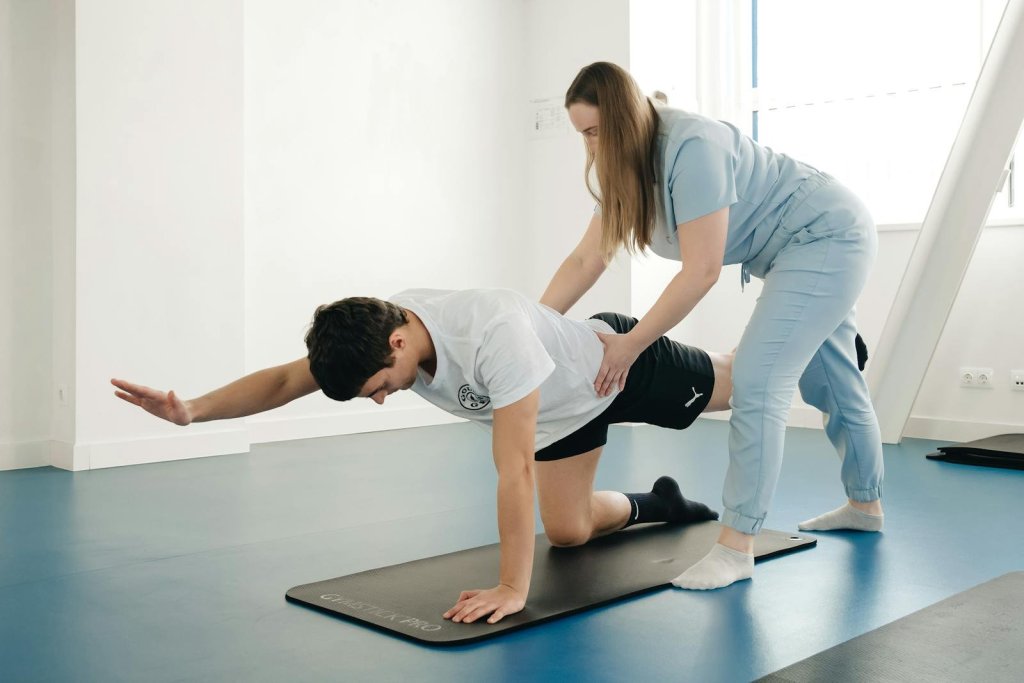
Understanding how to perform the Bird Dog properly is key for reducing back pain, enhancing posture, and preventing injury. In this guide, you’ll learn how to do it correctly, what muscles it works, its benefits, and common mistakes to avoid.
What Is the Bird Dog Exercise?
The Bird Dog is a bodyweight core exercise performed on all fours (hands and knees).
You extend one arm and the opposite leg simultaneously, keeping your spine neutral and abs engaged.
It’s widely used in physical therapy and functional training because it builds core stability without stressing the lower back — making it ideal for beginners, seniors, and anyone recovering from back discomfort.
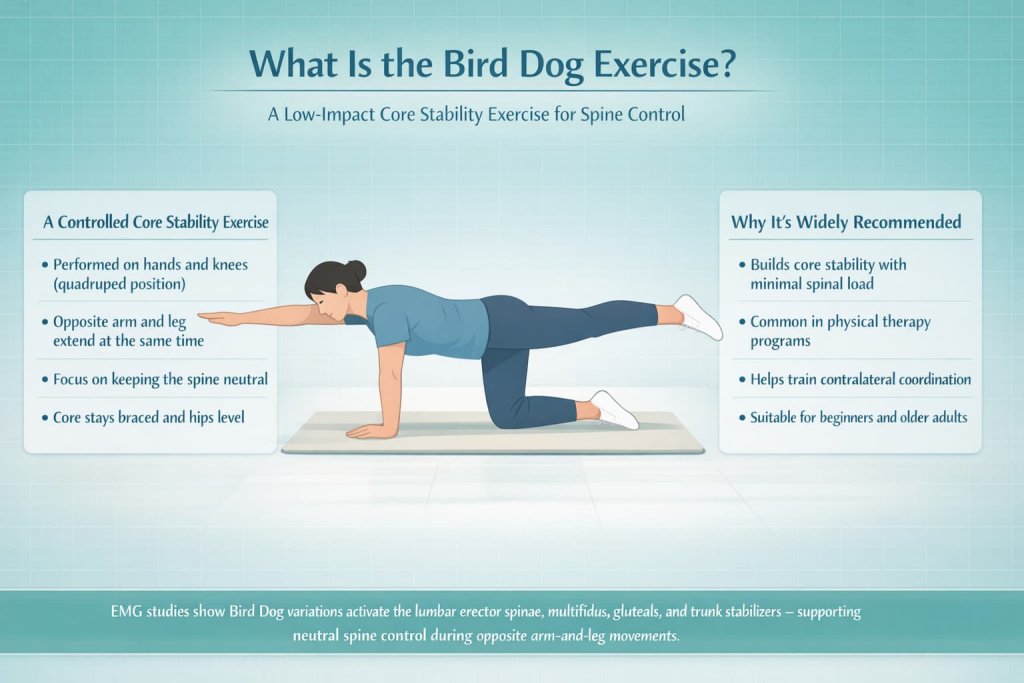
According to peer-reviewed EMG studies, Bird Dog variations activate the lumbar erector spinae and multifidus while also recruiting the gluteals and trunk/shoulder stabilizers—helping you maintain a neutral spine during contralateral arm-and-leg movements.
How to Do the Bird Dog Exercise Correctly
Follow these steps for proper form and maximum results:
- Start Position
- Begin on all fours, with hands under shoulders and knees under hips.
- Keep your neck neutral, gaze slightly ahead of you.
- Engage Your Core
- Tighten your abs as if bracing for a gentle punch.
- Keep your spine flat and avoid arching your back.
- Extend Opposite Arm and Leg
- Raise your right arm and left leg simultaneously.
- Hold for 3–5 seconds, maintaining balance and control.
- Return and Switch Sides
- Lower your limbs slowly, keeping your core engaged.
- Repeat with your left arm and right leg.
Trainer Tip:
Start with 8–10 reps per side for 2–3 sets.
Focus on slow, controlled movement rather than speed.
Variations and Progressions
Once you master the basic Bird Dog, try these progressions:
1. Leg-Only or Arm-Only Bird Dog
Why it works:
This foundational variation builds core stability and body control by isolating one limb at a time. It teaches proper alignment and balance while strengthening the deep spinal stabilizers — ideal for beginners or anyone improving coordination after injury.
How to do it:
- Begin on all fours with hands under shoulders and knees under hips.
- Engage your core by pulling your belly button gently toward your spine.
- Extend one leg straight back, keeping hips level and spine neutral.
- Hold for 3–5 seconds, then return to start.
- Switch sides and repeat.
- For the arm-only version, extend one arm forward instead of the leg.
Trainer Tip:
Move slowly — your torso should stay perfectly still. Focus on length and control, not how high you lift. Once you can hold steady, you’re ready for the full Bird Dog.
2. Elbow-to-Knee Bird Dog
Why it works:
Adding the elbow-to-knee connection increases core activation and spinal mobility. This variation challenges both stability and flexion, improving abdominal strength and movement coordination.
How to do it:
- Start in a tabletop position with a neutral spine.
- Extend your right arm forward and left leg back until both align with your torso.
- Engage your core and bring your right elbow and left knee together under your body.
- Pause briefly, then extend back out to full length.
- Complete 8–12 reps per side for 2–3 sets.
Trainer Tip:
Control every phase — especially when drawing the elbow and knee together. Keep your spine flat and avoid rounding your back. Exhale as you bring them in; inhale as you extend.
3. Bird Dog Hold
Why it works:
Holding the Bird Dog position for an extended time improves isometric endurance and postural control. It trains your stabilizers to maintain tension, supporting spinal alignment under sustained load.
How to do it:
- Begin on all fours with a neutral spine.
- Extend right arm and left leg simultaneously, forming a straight line from hand to heel.
- Engage your abs and glutes to keep your body steady.
- Hold for 15–20 seconds, breathing slowly and evenly.
- Lower back down and switch sides.
Trainer Tip:
Don’t hold your breath — steady breathing keeps your core stable. Focus on a soft gaze forward and minimal movement in your torso. The goal is stillness, not strain.
4. Resistance Band Bird Dog
Why it works:
Adding resistance builds strength, stability, and muscle endurance. The band increases tension on both the arm and leg, forcing your core to work harder to control rotation and maintain alignment.
How to do it:
- Anchor a light resistance band to a stable object or loop it between your hand and opposite foot.
- Begin on all fours with the band slightly taut.
- Extend your right arm forward and left leg back against resistance.
- Hold for 3–5 seconds, then return slowly to start.
- Perform 8–10 reps per side for 2–3 sets.
Trainer Tip:
Choose a light band that challenges stability without pulling you off balance. Move with control and keep hips square. This version is excellent for intermediate to advanced users looking to progress core strength.
Muscles Worked
The Bird Dog is a compound stability exercise that targets multiple muscle groups:
- Core stabilizers: Transverse abdominis, rectus abdominis, obliques
- Back muscles: Erector spinae, multifidus
- Glutes and hips: Gluteus maximus, gluteus medius, hip extensors
- Shoulders: Deltoids and scapular stabilizers
This makes it one of the most efficient exercises for building spinal stability and coordination.
Benefits of the Bird Dog Exercise
1. Strengthens Core and Back Muscles
A 2023 Journal of Back and Musculoskeletal Rehabilitation study found that Bird Dog variations effectively activate the lumbar stabilizers while minimizing spinal compression — making it safer than many traditional ab exercises.
2. Improves Posture and Balance
By teaching your body to stabilize across diagonal limbs, Bird Dogs enhance coordination and postural control.
3. Reduces Risk of Back Pain
According to Cleveland Clinic (2024), this exercise can reduce lower back pain by improving the endurance of deep spinal muscles.
4. Enhances Athletic Performance
It improves movement efficiency for athletes in sports that demand trunk stability — such as running, swimming, or golf.
5. Accessible for All Levels
No equipment, no strain — just progressive control and body awareness.
Common Mistakes to Avoid
Avoid these errors to get the most from your Bird Dog training:
- Arching or rounding the back: Keep your spine flat and neutral.
- Lifting limbs too high: Aim for alignment, not height.
- Holding your breath: Always breathe steadily.
- Letting hips rotate: Keep them parallel to the ground.
- Rushing the motion: Focus on slow, controlled movements.
Safety Tips and Precautions
- Warm up before training (e.g., cat-cow or pelvic tilt)
- Avoid if you have acute back pain, spinal injury, or hernia
- Consult a healthcare provider or physical therapist before starting if unsure
- Emphasize slow, pain-free range of motion
FAQs
1. What muscles does the Bird Dog target most?
It primarily strengthens your core, glutes, and back stabilizers like the erector spinae.
2. Is the Bird Dog exercise good for back pain?
Yes — when done correctly, it supports spinal health and reduces pain risk.
3. How many Bird Dogs should I do per day?
Start with 2–3 sets of 8–10 reps per side, 3–4 times weekly.
4. Should beginners try Bird Dog exercises?
Absolutely. It’s beginner-friendly and easily adjustable to all fitness levels.
5. Can I do Bird Dogs every day?
Yes, if performed gently and with good form. Avoid over-fatigue.
6. What’s the best breathing technique?
Exhale as you extend limbs, inhale as you return to start.
7. How long until I see results?
Consistent practice for 4–6 weeks improves balance, posture, and stability.
Conclusion
The Bird Dog Exercise is one of the safest and most effective ways to build a stronger, more stable core.
It supports your spine, enhances balance, and strengthens key muscles — all without equipment or strain.
Start slow, stay consistent, and focus on form.
Your core — and your back — will thank you.
References
- NSCA Strength & Conditioning Journal (2009) — Exercise: Bird Dog — Professional standards for setup, coaching, and safety.
- Ghorbanpour A, et al. (2018) — McGill Stabilization vs Conventional Physiotherapy in Low Back Pain (Open Access) — Clinical outcomes supporting low-load stabilization (Bird Dog is part of the McGill “Big Three”).
- Tsartsapakis I, et al. (2024) — Comparison of Core Stability Exercises via Ultrasound (Open Access) — Muscle thickness changes in abdominals/multifidus across stability drills; programming context.
- Prat-Luri A, et al. (2025) — Short-term Bridging & Bird-Dog Programs (PLOS ONE, Open Access) — Evidence on transfer to balance/endurance; helps calibrate claims.