
Pilates bar exercises are a low-impact, full-body strength workout that uses a lightweight bar and resistance bands to build muscle control, stability, and flexibility. They allow you to train your arms, legs, glutes, and core together—similar to reformer-style movements—without bulky equipment or heavy weights.
Understanding how Pilates bar exercises work is important because controlled resistance training supports strength, posture, and daily movement ability. With the right exercises and tempo, a Pilates bar routine can fit beginner programs, home workouts, and joint-friendly strength plans recommended by major health organizations.
What Are Pilates Bar Exercises?
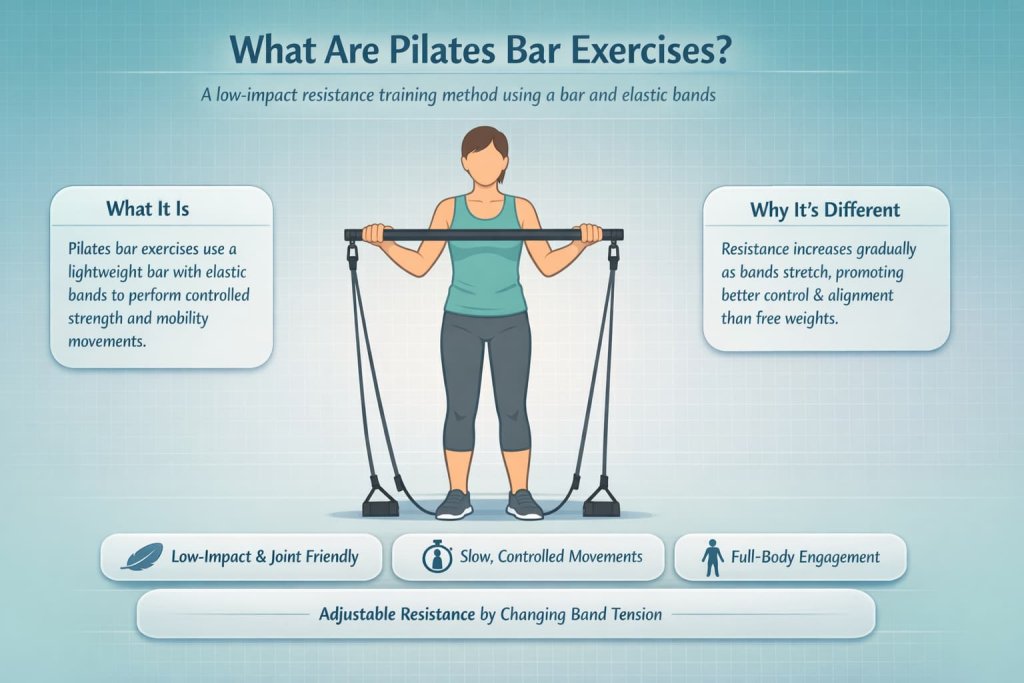
Pilates bar exercises are strength and mobility movements performed using a short bar attached to elastic resistance bands, often with foot straps. The bar acts as a stable handle, while the bands create progressive resistance as they stretch.
Key characteristics of Pilates bar training include:
- Low-impact, joint-friendly resistance
- Emphasis on slow, controlled movement
- Full-body muscle engagement
- Easy resistance adjustment by changing band tension
Unlike free weights, the resistance increases gradually, which encourages better control and alignment—core principles of Pilates-based training.
Why Pilates Bar Exercises Are Effective
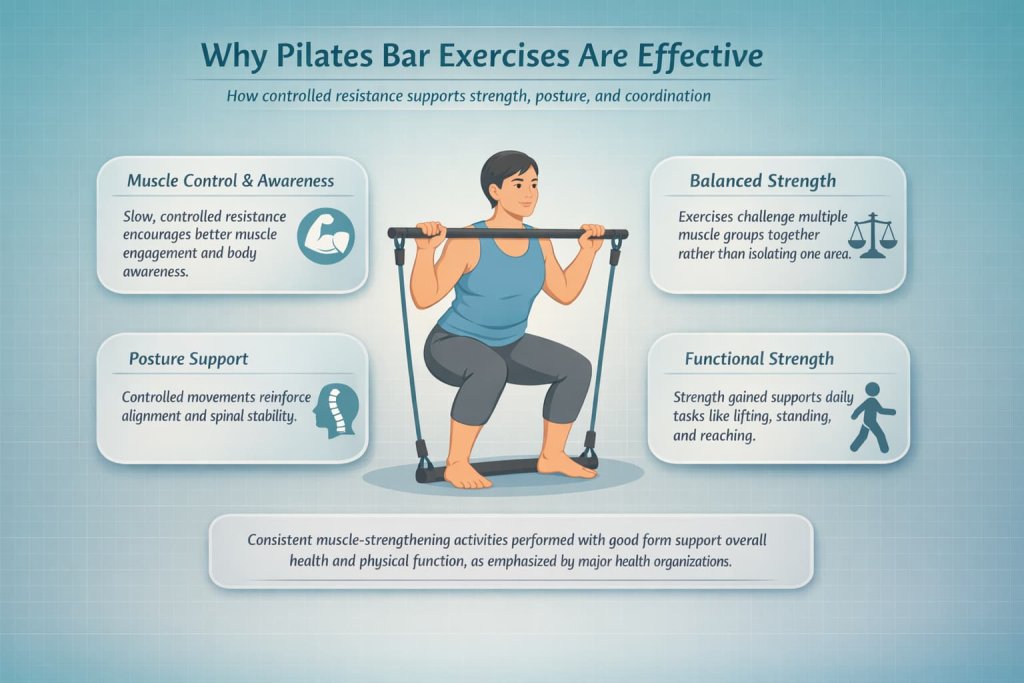
Pilates bar exercises work because they challenge muscles while reinforcing posture and coordination rather than relying on momentum.
Benefits commonly associated with Pilates-style resistance training include:
- Improved muscle control and body awareness
- Balanced strength across major muscle groups
- Support for posture and spinal alignment
- Functional strength for daily activities
Guidance from organizations such as the American College of Sports Medicine and the World Health Organization emphasizes that muscle-strengthening activities performed consistently and with good form support overall health and function.
9 Best Pilates Bar Exercises for a Strong, Toned Full Body
Pilates bar exercises combine controlled resistance and full-body movement to help strengthen the arms, legs, glutes, and core together. The following exercises focus on balance, muscle control, and low-impact strength, making them suitable for home workouts and a wide range of fitness levels.
1. Pilates Bar Squat
How to do it:
- Stand with feet shoulder-width apart and step on the resistance bands evenly
- Hold the Pilates bar at shoulder height or down by your thighs
- Brace your core and keep your chest tall
- Sit your hips back and bend your knees to lower into a squat
- Press through your heels to return to standing with control
Why it works:
The Pilates bar squat strengthens the lower body while reinforcing proper alignment through the hips, knees, and spine. The band resistance encourages controlled movement and continuous muscle engagement, which supports functional strength used in daily activities like sitting and standing.
Muscles worked:
Quadriceps, glutes, hamstrings, core stabilizers
Trainer Tip:
Think “heels heavy and chest tall.” If the bar drifts forward, reduce resistance and slow the tempo.
2. Pilates Bar Deadlift
How to do it:
- Stand on the bands with feet hip-width apart
- Hold the bar in front of your thighs with arms straight
- Brace your core and hinge at the hips
- Lower the bar toward mid-shin while keeping your spine neutral
- Drive hips forward to stand back up under control
Why it works:
This movement trains the posterior chain while reinforcing proper hip-hinge mechanics. The elastic resistance increases tension as you stand, encouraging glute activation and controlled spinal positioning.
Muscles worked:
Glutes, hamstrings, lower-back stabilizers
Trainer Tip:
Keep the bar close to your legs throughout the movement to reduce strain on the lower back.
3. Pilates Bar Overhead Press
How to do it:
- Stand on the bands with the bar at shoulder height
- Engage your core and keep ribs stacked over hips
- Press the bar overhead in a smooth motion
- Lower slowly back to shoulder level
Why it works:
This exercise develops shoulder strength while challenging trunk stability. The need to control the bar overhead encourages proper alignment and core engagement.
Muscles worked:
Shoulders, triceps, core
Trainer Tip:
If you feel your lower back arching, reduce resistance or perform the movement seated.
4. Pilates Bar Biceps Curl
How to do it:
- Stand on the bands with arms extended and palms facing forward
- Hold the bar close to your thighs
- Curl the bar toward your shoulders with control
- Lower slowly to the starting position
Why it works:
The elastic bands keep constant tension on the biceps, improving muscle activation throughout the entire curl rather than only at the top.
Muscles worked:
Biceps, forearms
Trainer Tip:
Keep elbows close to your sides and avoid leaning back.
5. Pilates Bar Triceps Extension
How to do it:
- Hold the bar overhead with elbows bent
- Anchor bands behind you or under your feet
- Extend elbows to straighten arms
- Lower slowly back to the bent-elbow position
Why it works:
This movement isolates the triceps while promoting controlled elbow motion and shoulder stability, key for pushing strength.
Muscles worked:
Triceps, shoulder stabilizers
Trainer Tip:
Move slowly and keep upper arms still to avoid turning it into a shoulder exercise.
6. Pilates Bar Glute Bridge
How to do it:
- Lie on your back with knees bent and feet hip-width apart
- Place the bar across your hips and anchor bands under your feet
- Press through your heels to lift hips upward
- Lower slowly while maintaining core control
Why it works:
The glute bridge strengthens the hips while reinforcing pelvic stability and neutral spine positioning, supporting daily movements like walking and standing.
Muscles worked:
Glutes, hamstrings, core
Trainer Tip:
Avoid arching your lower back—lift by squeezing the glutes, not the spine.
7. Pilates Bar Chest Press
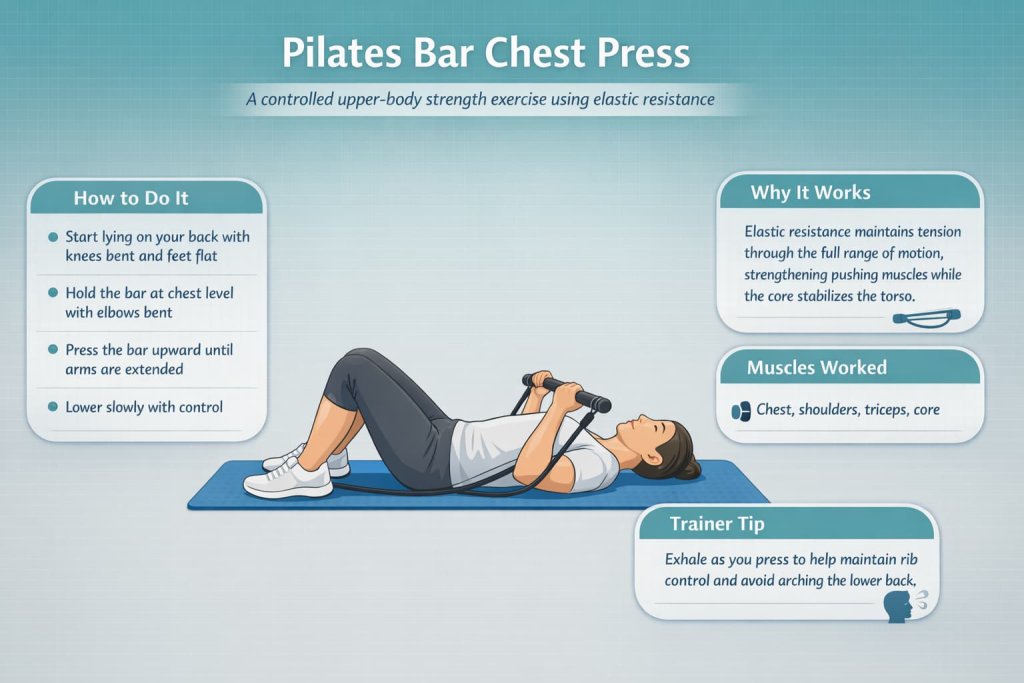
How to do it:
- Lie on your back with knees bent and feet flat on the floor
- Loop bands under your upper back or anchor behind you
- Hold the bar at chest level with elbows bent
- Press the bar upward until arms are extended
- Lower slowly with control
Why it works:
The chest press builds upper-body pushing strength while requiring core engagement to stabilize the torso. The band resistance maintains tension through the full range of motion.
Muscles worked:
Chest, shoulders, triceps, core
Trainer Tip:
Exhale as you press to help maintain rib control and avoid arching the lower back.
8. Pilates Bar Row
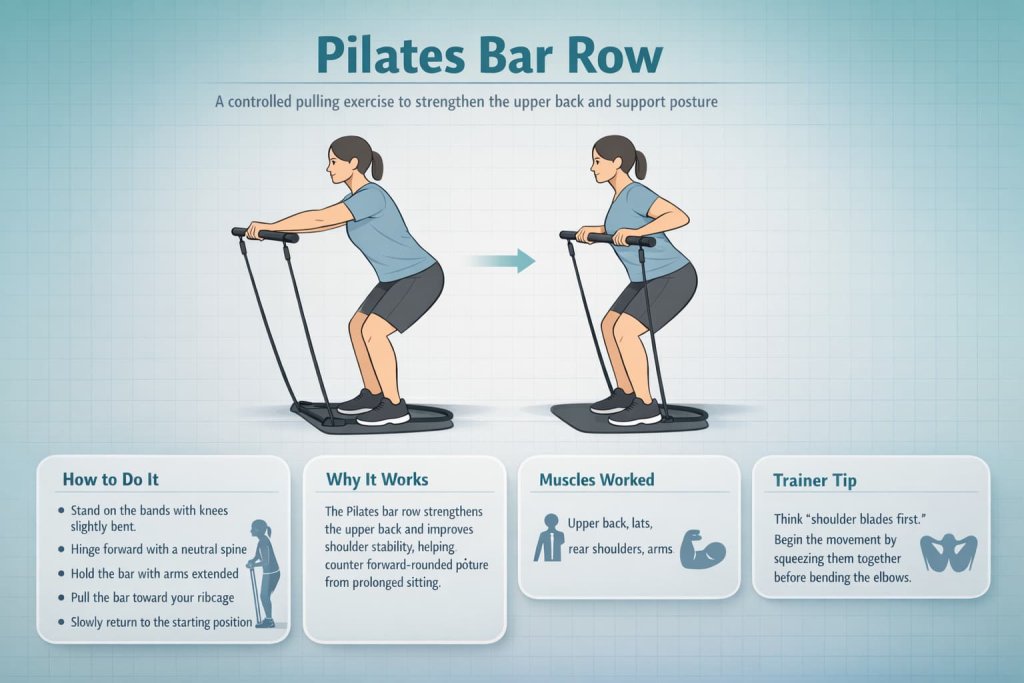
How to do it:
- Stand on the bands with knees slightly bent
- Hinge forward slightly while keeping your spine neutral
- Hold the bar with arms extended
- Pull the bar toward your ribcage
- Slowly extend arms back to the start
Why it works:
Rows strengthen the upper back and support better posture by counteracting prolonged sitting and forward-shoulder positions. Controlled resistance improves scapular stability.
Muscles worked:
Upper back, lats, rear shoulders, arms
Trainer Tip:
Focus on squeezing the shoulder blades together before bending the elbows.
9. Pilates Bar Standing Core Rotation
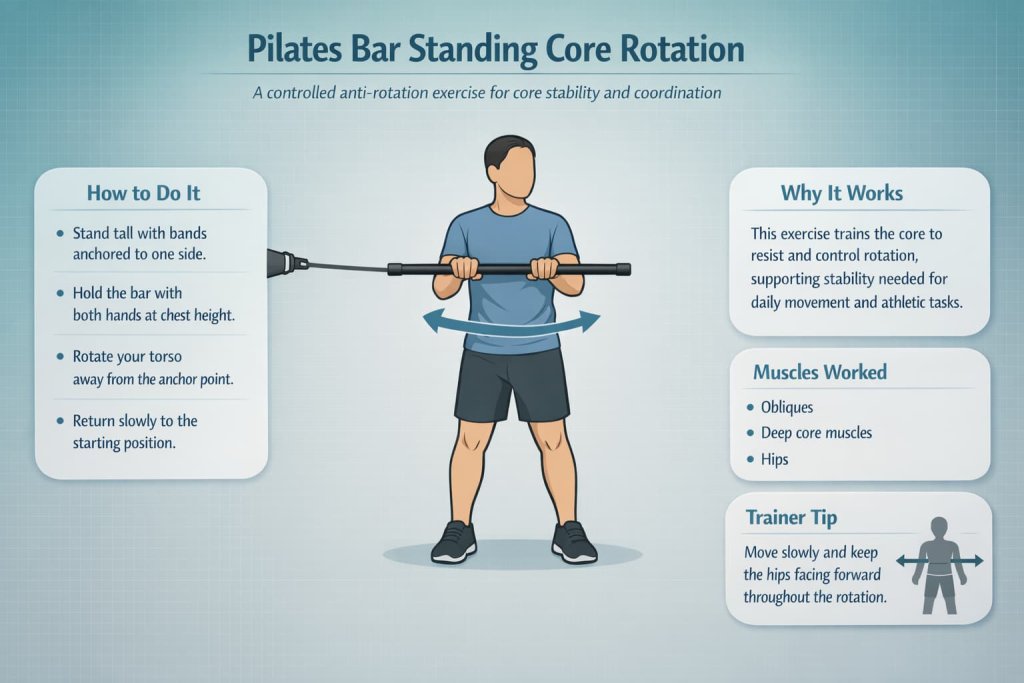
How to do it:
- Stand tall with bands anchored to one side
- Hold the bar with both hands at chest height
- Rotate your torso away from the anchor point
- Return slowly to the starting position
Why it works:
This exercise trains the core to resist and control rotation, improving stability needed for everyday movements and athletic tasks.
Muscles worked:
Obliques, deep core muscles, hips
Trainer Tip:
Move slowly and keep hips facing forward throughout the rotation.
How Often Should You Do Pilates Bar Exercises?
For most adults:
- 2–3 sessions per week
- 1–3 sets per exercise
- 8–15 controlled repetitions
Public-health guidance summarized by the Centers for Disease Control and Prevention recommends muscle-strengthening activities at least two days per week, which aligns well with Pilates bar training.
How Pilates Bar Exercises Support Full-Body Strength
Pilates bar exercises support full-body strength by combining controlled resistance with coordinated movement patterns.
Key ways they help include:
- Progressive band resistance that keeps muscles engaged through the full range
- Core activation during both upper- and lower-body movements
- Balanced training for arms, legs, glutes, and trunk
- Slow, controlled tempo that emphasizes muscle control over momentum
This approach supports functional strength used in daily activities like standing, lifting, and reaching.
Safety Guidelines for Pilates Bar Workouts
To keep Pilates bar exercises safe and effective:
- Start with light resistance
- Focus on slow, controlled movement
- Maintain neutral spine alignment
- Stop if sharp pain or joint discomfort occurs
If you have existing injuries or medical conditions, consulting a qualified professional before starting a new exercise program is advised.
Common Mistakes to Avoid
Avoiding these common mistakes helps keep Pilates bar workouts safe and effective:
- Using resistance that is too heavy
- Moving too quickly or relying on momentum
- Poor posture or loss of neutral spine alignment
- Forgetting to engage the core
- Standing unevenly on the bands
Focusing on control, alignment, and appropriate resistance improves results and reduces strain.
Who Should Be Cautious
Pilates bar exercises may need modification if you have:
- Recent surgery
- Uncontrolled joint pain
- Balance limitations
In these cases, seated or reduced-range variations are often more appropriate.
Frequently Asked Questions
Are Pilates bar exercises good for beginners?
Yes. The adjustable resistance and slow tempo make them suitable for beginners when performed with proper form.
Can Pilates bar exercises replace weights?
They can support strength training, especially for home and low-impact workouts, but heavy weight training may still be useful for advanced strength goals.
Do Pilates bar exercises help tone muscles?
They may support muscle toning by improving strength and control when done consistently.
How long should a Pilates bar workout be?
Most routines last 20–40 minutes, depending on exercise selection and rest.
Are Pilates bar exercises safe for older adults?
They can be appropriate with lighter resistance and controlled movements, following safety guidance.
Can Pilates bar exercises help posture?
They may help support posture by strengthening core and upper-back muscles.
Conclusion
Pilates bar exercises offer a practical, low-impact way to build full-body strength, improve control, and support everyday movement—right at home. With consistent practice and proper technique, they fit well into balanced fitness routines for beginners and experienced exercisers alike.
If you’re ready to start, choose a few exercises from this list, keep the resistance light, and focus on slow, controlled movement for the best results.