
Full body Pilates exercises help strengthen your entire body, improve mobility, and build core stability through controlled, low-impact movements. The short answer: yes, Pilates works as a full-body workout because it trains your core, hips, back, shoulders, and legs at the same time.
Understanding how full body Pilates works is important because it improves posture, enhances functional strength, and supports long-term mobility—without heavy weights or joint strain. Most movements combine core activation with coordinated upper and lower body engagement, helping you build strength, balance, and flexibility in one routine.
This guide explains the best full body Pilates exercises, how to do them safely, key benefits, common mistakes, and FAQs—using evidence-based information from leading medical and fitness sources.
What Are Full Body Pilates Exercises?
Full body Pilates exercises are movements that train multiple muscle groups at once using deliberate, coordinated patterns. Unlike isolated strength training, Pilates integrates the core, spine, hips, shoulders, and legs into each exercise.
Key characteristics:
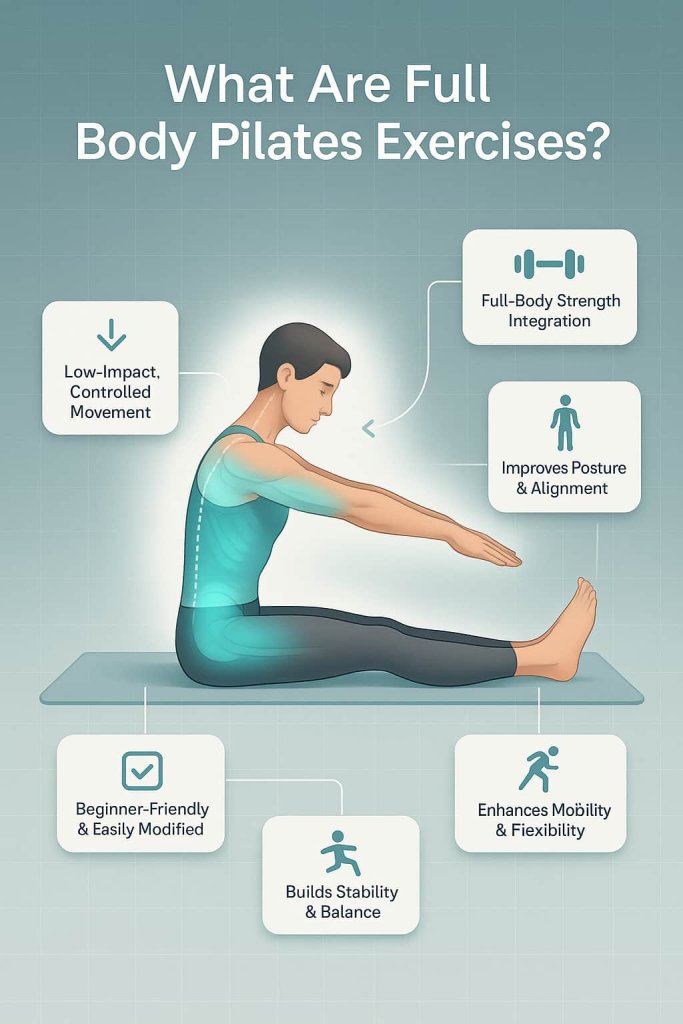
- Uses slow, precise, low-impact movement
- Strengthens the core while challenging the whole body
- Improves posture and spinal alignment
- Enhances mobility through controlled stretching
- Builds stability, balance, and muscular endurance
- Easy to modify for beginners, older adults, or people with stiffness
These exercises can be done using only a mat, making them ideal for home or studio routines.
10 Best Full Body Pilates Exercises
These full body Pilates exercises strengthen your core, improve mobility, and engage multiple muscle groups in every movement. Each one is low-impact, beginner-friendly, and designed to help you build balanced, functional strength from head to toe.
1. Pilates Hundred
Why it works:
A full-body warm-up that activates the core, stimulates circulation, and builds endurance.
Muscles worked:
Core, hip flexors, shoulders, arms.
How to do it:
- Lie on your back, knees bent in tabletop.
- Lift head and shoulders, extend arms long.
- Pump arms up and down while inhaling for 5 counts, exhaling for 5 counts.
- Continue for 50–100 counts.
Trainer Tip:
If your neck feels strained, lower your head or keep legs bent.
2. Roll-Up
Why it works:
Improves spinal mobility while strengthening the core and stretching the hamstrings.
Muscles worked:
Core, hip flexors, back.
How to do it:
- Lie on your back with legs straight.
- Reach arms overhead, inhale.
- Exhale as you roll up slowly, reaching toward your toes.
- Roll back down with control.
Trainer Tip:
Move one vertebra at a time—avoid using momentum.
3. Plank to Pike
Why it works:
Combines core stability, shoulder strength, and hamstring mobility.
Muscles worked:
Core, shoulders, upper back, glutes, hamstrings.
How to do it:
- Start in a strong plank.
- Lift hips upward into a pike, keeping legs straight.
- Lower back to plank with control.
Trainer Tip:
Keep shoulders stacked over wrists in plank.
4. Swimming
Why it works:
Strengthens the entire posterior chain while improving mobility and spinal stability.
Muscles worked:
Lower back, glutes, hamstrings, shoulders.
How to do it:
- Lie face down, arms extended overhead.
- Lift opposite arm and leg gently.
- Switch sides in a controlled flutter pattern.
Trainer Tip:
Keep core lightly engaged to avoid overarching your back.
5. Bridge (Shoulder Bridge / Pelvic Curl)
Why it works:
Strengthens glutes, hamstrings, and core; improves spinal articulation.
Muscles worked:
Glutes, hamstrings, lower back, core.
How to do it:
- Lie on your back, knees bent.
- Lift hips slowly, rolling up through the spine.
- Lower one vertebra at a time.
Trainer Tip:
Press through heels to avoid lower-back strain.
6. Side Plank with Leg Lift
Why it works:
A full-body lateral exercise that builds oblique strength and hip stability.
Muscles worked:
Obliques, shoulders, glutes, abductors.
How to do it:
- Start in a side plank.
- Lift the top leg slowly up and down.
- Keep hips lifted and core tight.
Trainer Tip:
If full plank is too hard, drop to your bottom knee.
7. Single Leg Stretch
Why it works:
A Pilates staple that strengthens the core while coordinating upper and lower body movement.
Muscles worked:
Core, hip flexors, thighs.
How to do it:
- Lie on your back, head lifted.
- Pull one knee in as the other leg extends.
- Switch legs with control.
Trainer Tip:
Keep lower back gently pressed into the mat.
8. Double Leg Stretch
Why it works:
Expands on the Single Leg Stretch by challenging stability and coordination.
Muscles worked:
Core, hip flexors, shoulders.
How to do it:
- Start in tabletop, head lifted.
- Extend legs forward and arms overhead.
- Circle arms to pull knees back in.
Trainer Tip:
Only extend legs as far as you can maintain core control.
9. Teaser Prep
Why it works:
Builds foundational strength for the advanced Teaser movement.
Muscles worked:
Core, hip flexors, spine stabilizers.
How to do it:
- Sit with knees bent, hands behind thighs.
- Lean back, lifting one or both legs.
- Maintain a steady V-shape.
Trainer Tip:
Focus on balance and slow control, not height.
10. Standing Pilates Arm Reach with Leg Extension
Why it works:
A full-body standing move that trains balance, mobility, and coordinated strength.
Muscles worked:
Shoulders, core, glutes, hamstrings.
How to do it:
- Stand tall.
- Reach arms overhead while extending one leg behind you.
- Return and switch sides.
Trainer Tip:
Keep spine long and avoid arching your lower back.
How Often Should You Do Full Body Pilates?
- For general fitness, perform Pilates 2–3 times per week.
- Beginners can start with 10–20 minutes, gradually increasing duration.
- Consistency is more important than intensity—small, frequent sessions build results
Common Mistakes to Avoid
Avoid these mistakes to improve performance and reduce strain:
- Holding your breath instead of using controlled breathing
- Using momentum rather than slow, precise movement
- Letting hips sag in planks
- Arching the lower back excessively
- Rushing through transitions
- Lifting legs too high without core control
Slow, aligned movement is the core of Pilates.
Benefits of Full Body Pilates
Full body Pilates offers evidence-backed improvements to strength, function, and mobility.
Benefits include:
- Strengthens core, back, glutes, shoulders, and legs
- Improves posture and alignment through spinal control
- Enhances flexibility and joint mobility
- Builds muscular endurance with low-impact tension
- Supports balance and stability (important for daily movement)
- Helps reduce stiffness from long sitting or sedentary routines
- Supports spine health and may help manage back discomfort
- Suitable for beginners, older adults, and people needing low-impact training
Safety Tips Before You Start Full Body Pilates
Full body Pilates is low-impact, but proper preparation helps protect your joints and spine. Follow these quick safety guidelines before you begin:
- Start slowly and prioritize proper form.
- Keep your spine neutral—avoid excessive arching or rounding.
- Use steady, controlled breathing throughout each movement.
- Stop immediately if you feel sharp pain or discomfort.
- Modify planks or weight-bearing exercises if you have wrist, shoulder, or back issues.
- Avoid forcing flexibility; move only through comfortable ranges.
- Support your neck or lower back with props if needed.
Who Should Avoid or Modify Full Body Pilates
Most people can safely do Pilates, but modifications are important for:
- Individuals with severe osteoporosis
- Anyone with acute back pain, disc injuries, or spinal instability
- People recovering from surgery
- Pregnant individuals (some moves require modification)
- Those with wrist or shoulder issues (plank-based movements may need adjustment)
Always consult a healthcare professional if you have medical conditions.
FAQs
1. Is Pilates enough for a full-body workout?
Yes. Pilates engages the core, back, shoulders, glutes, and legs in most movements.
2. Can beginners do full body Pilates?
Absolutely. Most exercises have simple modifications to start safely.
3. How long until I see results from Pilates?
Many people feel stronger within 2–4 weeks of consistent practice.
4. Is Pilates good for mobility?
Yes. Pilates strengthens muscles while moving joints through controlled ranges of motion.
5. Do I need equipment?
No. A mat is enough for most full-body Pilates workouts.
6. Can Pilates help with posture?
Pilates focuses heavily on alignment and core strength, which supports better posture.
7. Is Pilates safe for people with back issues?
It may help with mobility and stability, but always consult a healthcare provider first.
Conclusion
Full body Pilates is one of the most effective ways to build strength, stability, and mobility using controlled, low-impact movements. When practiced consistently, these exercises help improve posture, core control, and full-body coordination—benefits that support both daily movement and long-term wellness. Start with the beginner-friendly variations, focus on proper form, and progress gradually as your strength improves.
For best results, aim to practice Pilates 2–3 times per week, and listen to your body as you move. A consistent routine will help you feel stronger, more aligned, and more confident in how your body performs each day.
References
- Sampaio T et al. – The Effectiveness of Pilates Training on Older Adults’ Balance: Systematic Review and Meta-analysis (JSSM, 2023)
- Wells C et al. – The Effectiveness of Pilates Exercise in People with Chronic Low Back Pain: A Systematic Review (PLOS ONE)
- Ruiz-Ariza B et al. – 12-Week Pilates Program Improves Strength, Balance, Flexibility and Glycemic Control in Older Adults with Type 2 Diabetes (Healthcare, 2025)
- Harvard Health – Exercise Programs That Improve Balance (Includes Pilates)
- ACSM / CDC – Physical Activity Guidelines for Adults